Norway and Denmark will reopen the borders between the two countries from 15 June. Restrictions for Swedes will however be maintained. Several opposition parties in Denmark have also called for the border to be reopened to Germany. Due to the coronavirus situation in Scandinavia, Denmark and Norway are reluctant to include Sweden in tourism.
Unlike its Scandinavian neighbors, Sweden did not impose a lockdown and the country’s Covid-19 death toll is by far the highest in the region (4.542 per June 4). Sweden’s state epidemiologist Anders Tegnell claims that Sweden is further along in the infection curve and that could actually make citizens a safer bet. “When we get to summer, it might be the case that we have so many people in Sweden who are immune that it could be safer for Swedes to go abroad than others,” he told TT.
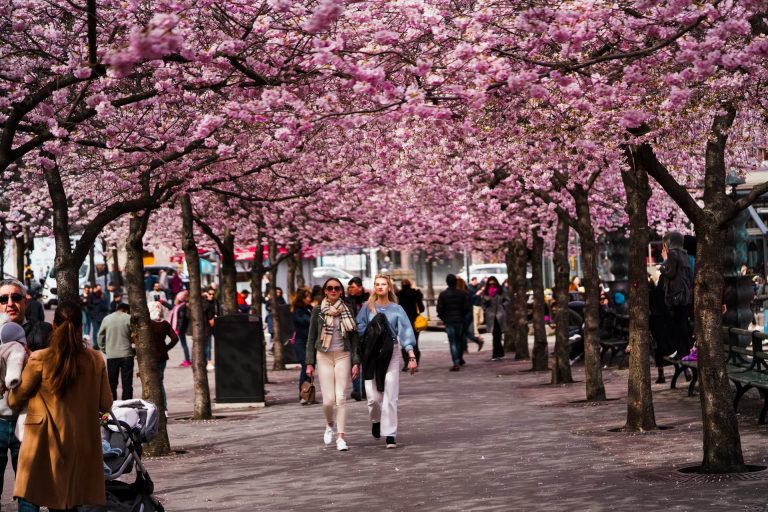
This year Scandinavians plan for domestic summer holidays
The statement is based on the assumption that exposure to the coronavirus grants immunity against re-infection, something the World Health Organization has warned is not a certainty. In addition to a higher level of infection in Sweden, the country also have a lower level of testing and tracing than its Scandinavian neighbors.
Danes and Norwegians are not yet advised to travel to Southern Europe for their holidays since a 10-day quarantine apply to all people returning from abroad and no-entry to most non-Scandinavians who do not have right to live and work in Denmark and Norway.
Swedish Foreign Minister Ann Linde said that excluding Sweden from moves to open borders across the Nordic region would be a political decision and not justifiable on health grounds. Photo: Kelly Sikkema/Unsplash
Cannot reopen borders too suddenly At a joint video news conference, Norwegian Prime Minister Erna Solberg said, ““We do not wish to maintain the restrictions longer than we have to, and at the same time we want to give people as well as the travel industry in this country as much predictability as we can. However, we can’t open too suddenly, that would jeopardize everything we’ve accomplished”.
While the governments are encouraging domestic tourism this summer, the exclusion of foreign tourists without offering substantial financial support to travel firms will most likely trigger a string of bankruptcies, warns the enterprise federations.
Excluding Sweden from moves to open borders across the Nordic region would be a political decision and not justifiable on health grounds. Photo: Engin Akuyrt/Unsplash
Coronavirus: Denmark and Norway Reluctant to include Sweden in Tourism Swedish Foreign Minister Ann Linde said that excluding Sweden from moves to open borders across the Nordic region would be a political decision and not justifiable on health grounds.
In comments reported by Swedish TV, she said Sweden had hoped for a common Nordic solution but it was impossible.
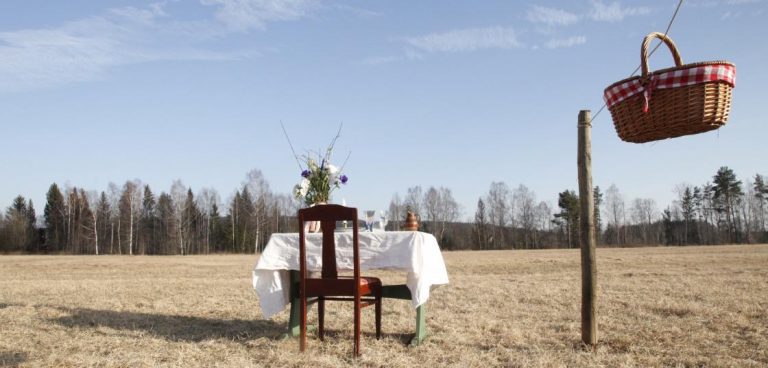
A pop-up restaurant in Ransäter, Värmland, Sweden, roughly 217 miles (350 kilometers) from Stockholm serves solo diners only. In the age of physical distancing social distancing is exceedingly easy. Read more about the restaurant Table for One in Sweden.
Though Sweden doesn’t have physical-distancing restrictions, a Swedish couple, Rasmus Persson and Linda Karlsson (both 36), decided to open a small restaurant in the middle of a field: Table for One (Bord för en). There are recommendations that the couple has been following, and the guests are guaranteed no interaction with others.
Social-distancing protocols
According to their official website, only one person, adhering to social-distancing protocols, can dine at the table next to the couple’s home in the remote village. The Bord för en restaurant will be open through August 1 and one person a day, which means the couple can give its full focus to one guest at a time, so this unusual setup is an ode to sole dining.
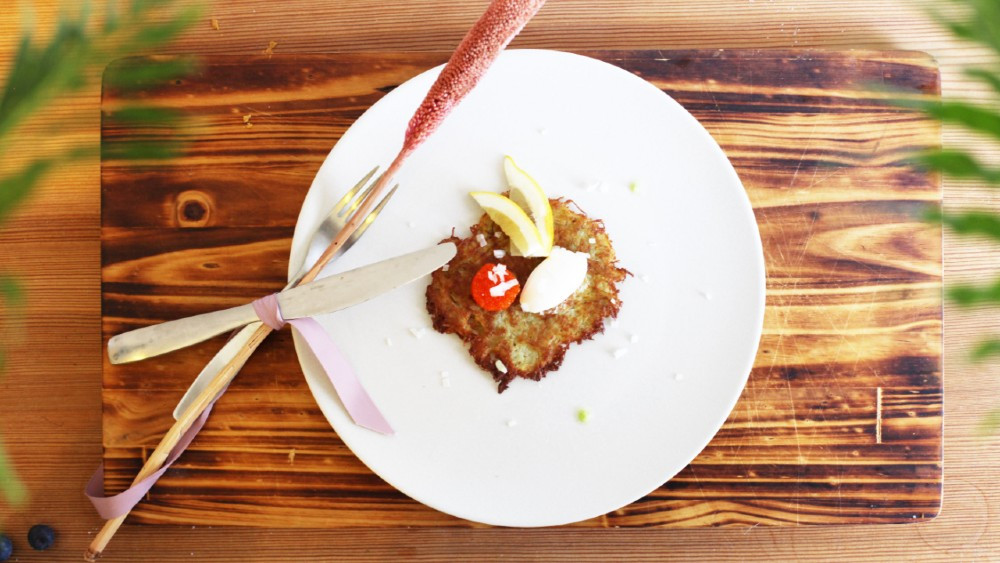
Each meal will consist of three courses made by Persson, along with drinks crafted by world-renowned mixologist Joel Söderbäck
During the corona-crisis, the former professional chef, Persson, has been cooking dishes for his wife’s parents and serving them through the window. This birthed the idea of the “table for one” concept, which is not realized to make money.
“If you want to go out and eat at a restaurant by yourself, it’s kind of frowned upon, right? People look at you like you’re a loser of some sort — like you’re on a date and have been stood up,” Persson said. “We all are facing difficult times and there are people who have lost their jobs, a loved one or even their mind,” he adds, so the couple wanted to avoid the feeling of guests being watched while they eat their food.
Rasmus Persson and Linda Karlsson (both 36), decided to open a small restaurant in the middle of a field
Pay what you wish “For us, the sole act of eating is … an amazing experience,” Persson says. The solo diner, sitting in the field, will receive their food from the kitchen in their home about 150 feet away by a basket attached to a rope. One guest per night will have the pleasure of dining with themselves.
Each meal will consist of three courses made by Persson, along with drinks crafted by world-renowned mixologist Joel Söderbäck. “We welcome all, no matter what financial situation you are in. The price of the menu is up to the guest,” says Karlsson. The couple has opted for a pay-what-you-wish system in order to accommodate people who may be struggling financially during the coronavirus outbreak.
Each course of the three-course meal is curated with a poem, chosen by friends of the couple
Table For One in Sweden
Persson hopes dining at Table For One is a peaceful, introspective experience for visitors. He says each course of the three-course meal is curated with a poem, chosen by friends of the couple.
“We want to do our best to make sure every guest we have this summer has a respite … a break from all the stress and drama in life that everyone is facing right now,” Persson says and adds that the couple might expand the Table For One concept when this is all over.
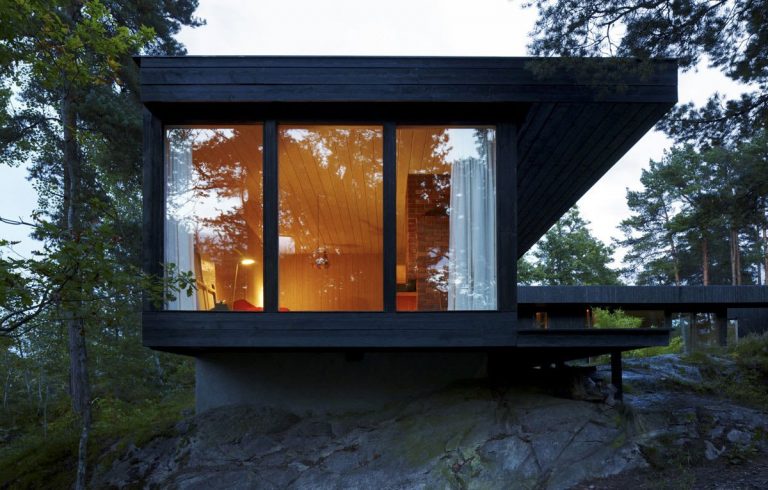
Cabins in Norway are traditionally built to gather the family. In this Japanese-inspired cabin designed by the Norwegian artist and architect Irene Sævik in Drøbak outside Oslo, Norway, the purpose has been to gain inner peace. Read more about theJapanese-inspired summer house in Oslo.
The zen-like summer house by Irene Sævik is situated just a stone’s throw away from the shores of the Oslo fjord amidst a plethoria of summer houses and cottages, only forty minutes outside the busy capital of Oslo.
“I can concentrate and let thoughts fly. here,” says Irene Sævik
Originally built in the 1960s
The summer house was originally built in the 1960s by the Norwegian modernist painter Salo Jæger and the 430-square-foot cabin sat unoccupied and in partial despair for years before Sævik purchased it and decided to expand. She has managed to do so in true Scandinavian form, following principles of simplicity and respect for nature.
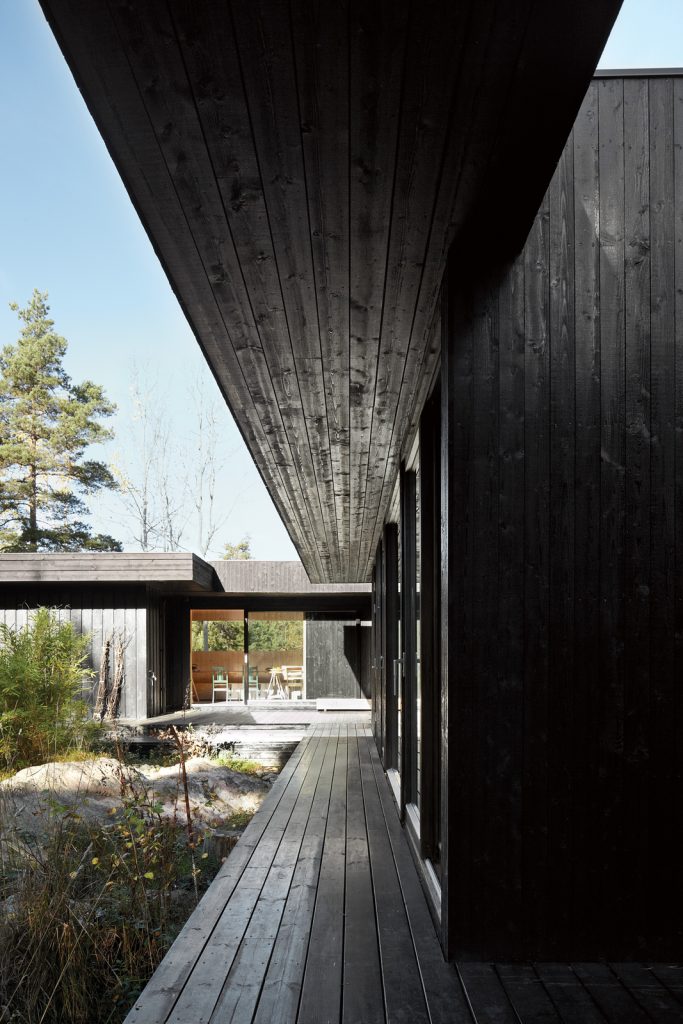
Inspired by Japanese architecture, the yard is surrounded by a slender gallery
“The cabin had an appealing expression that inspired me to develop it further – to transform the site and make a stronger connection between house and landscape,” Sævik says. Growing up in the northwest coast of Norway, surrounded by fjords and high mountains, it wasn’t destined that architecture and art were to become crucial parts of Irene Sævik’s life.
Japanese-inspired summer house in Oslo
Norwegian summer cabins are real houses. They are unique and situated where the view is at its best. In return, they must withstand wind, rain and snow. In the middle of the Norwegian summer cottage paradise – at the very end of a green hill between the Oslo fjord and Hallangspollen out towards the Drøbak sound – you find a different kind of cottage.
The living room, kitchen, dining room, bathroom, sauna, restroom, study and two bedrooms all follow one another
Inspired by Japanese architecture, the yard is surrounded by a slender gallery enabling one to freely circulate – and enter – between the adjacent rooms. The living room, kitchen, dining room, bathroom, sauna, restroom, study and two bedrooms all follow one another. The total area is just under 970 square feet. “I tried to make a place where one could stay alone, as well as a good place to be with friends,” she says. “This is not a house, it’s a place,” she adds.
A contemplative hideout
Due to the rooms being separate the retreat can harbor a larger number of people and yet allow for quiet activities such as writing, reading, painting, as well as listening to music, preparing foods in the spacious kitchen, and conversing.
When Sævik bought the site in 2003, she decided to expand. The house could not be extended naturally due to a rock crunch. She also did not want to add an extension on the rock crunch to capture the view – as many cabin owners would have done in pure reflex – as it would have spoiled the character of the existing house.
The total area is just under 970 square feet
Today, a large terrace is ideal for soaking in the sun and the view encompassing both treetops and the fjord arms surrounding the narrow peninsula. The house is divided into three sections connected by a series of outdoor galleries. “When I walk from one room to another, I have to go outdoors and feel the weather and nature – rain, cold, and sun,” says Irene Sævik.
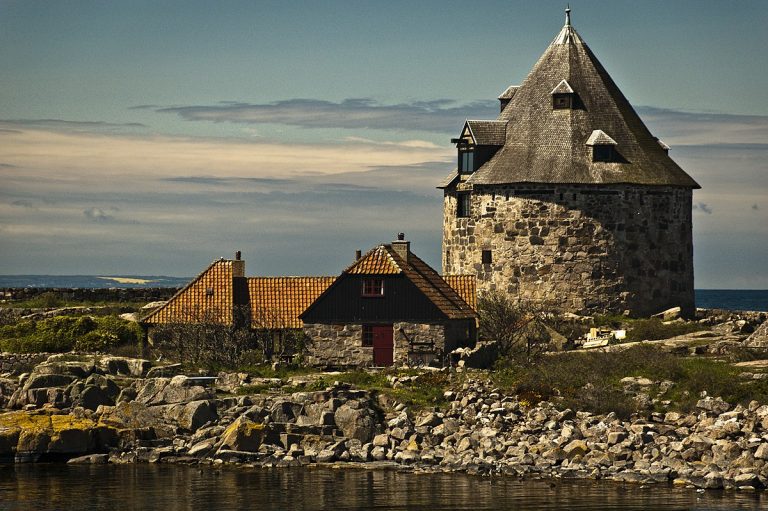
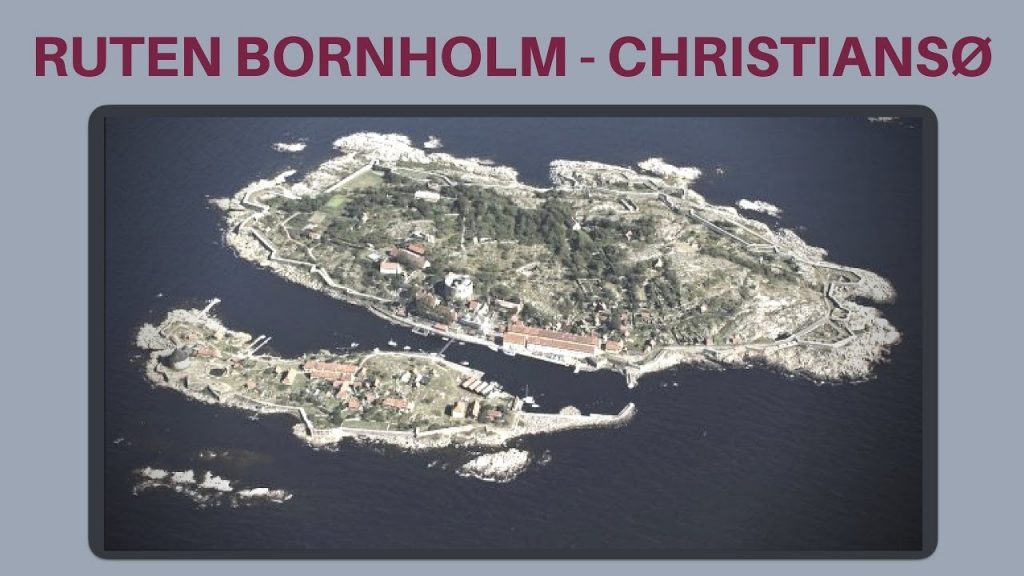
An hour’s sail from Danish Gudhjem (God’s home) harbor to the group of islands known as Ertholmene (Pea islands), we arrive at the largest ones which are Christiansø and Fresdriksø. A naval base was constructed here in about 1684, but today only fishermen and their families live in this “Danish fortress in the sea”.
It makes an interesting place to visit. The islands are quite rocky, with castle towers, batteries and cannon, all serving as reminders of the past. Their isolated setting and car-free environment make them attractive to birdlife, particularly cider-ducks, which breed all over the island.
In the late 17th century, Denmark needed a naval base in the central Baltic Sea. Photo: Visit Bornholm
Outpost for the Danish navy
This is Denmark’s easternmost point with a population of 84. The archipelago have a total of 39 hectares. Fishermen from Bornholm have used Ertholmene for temporary shelter since the Middle Ages. The first permanent settlement was the result of the Danish-Swedish conflicts in the late 17th century. As Denmark needed a naval base in the central Baltic Sea, a fort was built on Christiansø and Frederiksø in 1684 which served as an outpost for the Danish Navy until 1855. Christiansø Church originally served the garrison. The population peaked at the census in 1810 which showed 829 inhabitants. They were soldiers and were there because of the Gunboat War (Wikipedia).
Since 1725, the islands were used as a place of banishment for life time prisoners as for example Doctor Dampe, who was a prisoner here from 1826 to 1841 accused of “high treason and lese-majesty”. Ertholmene are owned by the Danish Ministry of Defence and the houses, which can only be hired, are domicile for the residents. Every year, about 40,000 guests visit the islands!
Danish fortress in the sea Christiansø is a unique place. You cannot find such a special group of islands anywhere else in Denmark. The old fortress of King Christian V has not changed and the islands have their own circadian rhythm and the rugged nature of the unique landscape offers an unrivalled experience. Here you’re given a sense of the special atmosphere and peace.
The Danish Fortress in the Sea, written by Tor Kjolberg
Scandinavia is the name of a sub-region in Northern Europe, comprised of the kingdoms of Denmark, Norway, and Sweden. Some geographers consider Finland, Iceland, and the Faroe Islands as part of Scandinavia. Read more about Scandinavia before the Vikings.
Made popular by TV shows and Movies, Vikings are the most notorious feature of this beautiful region. While the fearless, kohl-eyed, and ruthless warriors who nearly took over England are undoubtedly interesting, there is more to Scandinavia than them.
The scenic beauty of Scandinavia existed long before the Vikings made it their home
In this article, we shed-light on Pre-Viking Scandinavia, a topic which is often ignored but is equally fascinating.
Let’s begin!
The Ice Age: Landscape and the Fjords The scenic beauty of Scandinavia existed long before the Vikings made it their home. The Norwegian Fjords, formed during the Ice age, are a world-famous tourist destination. UNESCO has declared some of them as world heritage sites, including Geirangerfjord, a 9.3-mile fjord with many waterfalls and dramatic mountain scenery.
About 2.4 million years ago, the ice started to cover mountains, and the pressure caused mountain pieces to break away, letting seawater rush into the opening. When the ice age ended, and the snow melted away, the mountain pieces that broke away formed a U-shaped wall filled with seawater. These narrow pathways of water surrounded by beautiful sceneries are truly nature’s masterpiece.
Calmer than the sea, these fjords are natural harbors. In the pre-Viking era, small towns settled near the fjord and used the ports for trade, fishing, and other maritime activities. Even today, in modern Norway, many small-towns exist near the Fjords. These towns are the most popular tourist destinations as people from across the world come to visit these wondrous sites.
The first settlers arrived on the shores of Sweden and Denmark around 5000 – 9000 BC
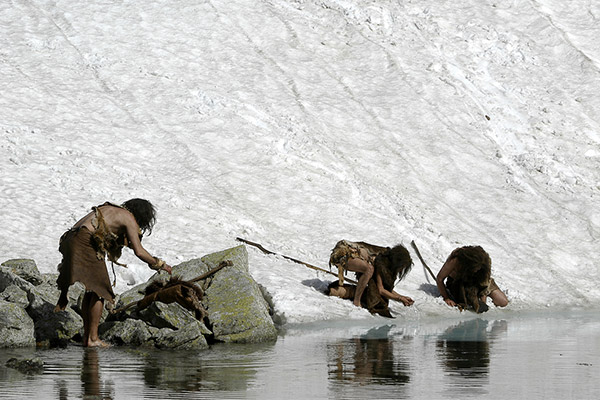
The Stone Age: The First Settlers The first settlers arrived on the shores of Sweden and Denmark around 5000 – 9000 BC. From there, these settlers moved to Norway in the Komsa, Finnmark, and Fosna regions of the country.
Archaeologists found definite evidence of this timeline when they unearthed the remains of a man in Koelbjerg, Denmark. Examination revealed that this man lived in Denmark during 8000 BC, confirming the existence of the population across the region.
Archaeologists report these settlers came to the region for agriculture, but the population included hunters and gatherers as well. Historians note that these early settlers had domesticated dogs and cattle, which hints at the earliest agriculture society. Discovery of coarse tools such as axes and picks suggest that these men and women hunted as well as farmed in their daily life.
Indigenous Scandanavians: The Sámi people The Sámi people are indigenous people of Finno-Ugric heritage that lived in Scandanavia before the settlers arrived. Traces of these populations are found side-by-side with the settler population; however, while the immigrants inhabited the coastal areas in the south, the Sámi lived inland. Interestingly, these two populations did not come into contact until much later.
The Sámi people lived a simple life; they lived in tent-like homes and adopted fishing, sheep herding, fur trapping, and reindeer herding as their primary source of livelihood. Just like the rest of the unfortunate aboriginal tribes of the world, the Sámi’s also faced forced assimilation by their settlers in the 9th and 10th centuries.
Today, there are only 80,000 to 100,000 Sámi people worldwide; most of them live in Norway, Sweden, Denmark, Finland, and Russia.
Bronze age in the Scandinavian countries is recorded between 1700 BC and 500 BC
Bronze Age: Farmers, Fishers, and Metal Workers Bronze age in the Scandinavian countries is recorded between 1700 BC and 500 BC. During the Bronze age, the settlers expanded their settlements along the shorelines. Although there were no proper villages or towns, the immigrants built wooden dwellings which housed large families and kinships.
The Bronze age Norsemen developed finer tools and became skilled in farming, fishing, hunting, and trade. As they learned to create superior tools, the Norsemen started farming millet, wheat, and barley, among other grains. Since they lived in coastal areas, fishing remained one of the main sources of livelihood. Some adventurous Scandinavians took expeditions inland to hunt for elk, deer, and other big game.
The most notable thing perhaps was the introduction of trade in the Norse society; the settlers began to trade amber for metal, and therefore they became skilled metalworkers. This society was more civilized than the stone age population, but still a long way away from modern-day civilizations.
Iron Age: Economic and Political Instability and Norse Resourcefulness The Scandanavian Iron age came to Scandinavia around 500 BC. It was a challenging time for the region climatically and politically. Climatic deterioration in the area severely affected farming, whereas the wars in central Europe and Celtic tribes put a stop to trade.
In these challenging times, the Danes learned to become self-sufficient. They survived on fish and meat from hunting, and they made iron deposits found in swamps into weapons. They also started looking for new trade routes, and that’s how they came into contact with the Roman empire, where the Iron age was well underway.
Through this connection, the Scandinavian countries came into contact with religion, the written word, and modern civilization. Historians note that traders brought back more than just goods, they brought modern ways of building houses, writing, metalworking skills, and even household skills like cleaning, pickling, and drying meat, etc.
During the Iron age, communities expanded, and chieftains became active. Each chief wanted to gain more power and, thus, economic opportunities for the survival of its own community. This battle for dominance led to scuffles and fighting among the tribes. The Norse were hard folk, often living in tough economic conditions due to challenging weather. This infighting made them warriors as well.
The political unrest, economic deterioration, and infighting gave way to the Viking Age, which has dominated the history of Scandanavia.
Scandinavia before the Vikings, written for Daily Scandinavian by Arslan Hassan. Arslan is an electrical engineer with a passion for writing, designing, and anything tech-related. His educational background in the technical field has given him the edge to write on many topics. He occasionally writes blog articles for Carpet Cleaning Epsom.
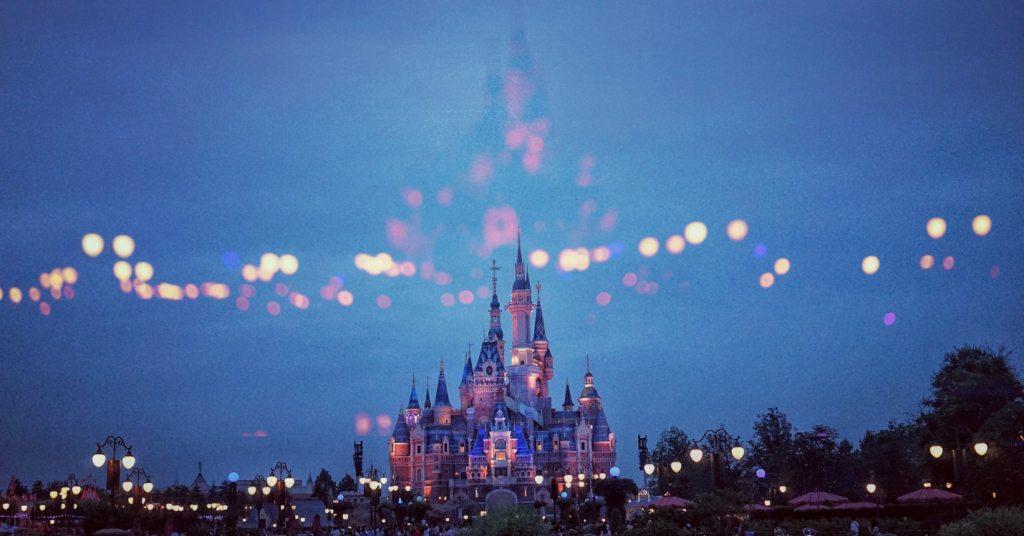
Like almost everywhere else in the world, Disney is big in Scandinavia. In Sweden, for instance, roughly 40 percent of residents tune into a Disney special on Christmas Eve. But Disney’s Scandinavian connection was not built in modern times — it goes back to fairy tales and folklore. In fact, several of the most famous Disney shorts, films, and characters are Scandinavian in origin. Read more about Disney characters with Scandinavian connections.
Ariel, The Little Mermaid The original Little Mermaid fairy tale was written by Danish author Hans Christian Andersen. It was published in 1837 and concerns a mermaid (unnamed) who sells her beautiful voice to a Sea Witch in exchange for legs. Disney had considered adapting this story since the 1930s. In 1989, a feature length Little Mermaid was finally released by the company, which gave the title character a proper name. While Ariel is not Scandinavian in the story, her creator, born in Odense, Denmark, is as Scandinavian as it gets.
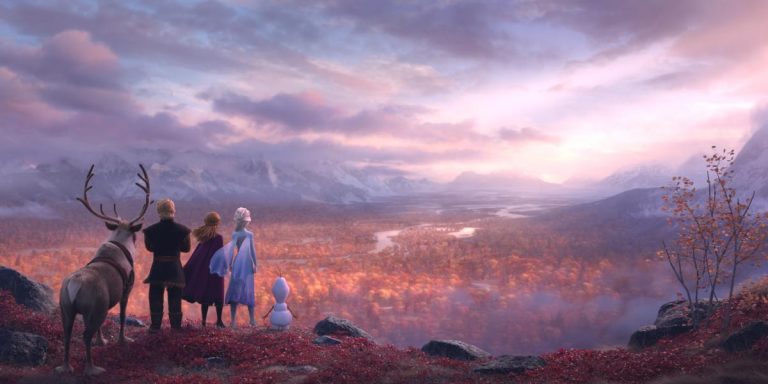
Elsa, Frozen and Frozen II Both of the Frozen films are based on a different Hans Christian Andersen tale, The Snow Queen. In the Disney adaptations, the “Snow Queen” is named Elsa and is much more benevolent than her literary counterpart. While Frozen was first conceived as a pretty faithful rendition of the 1844 tale (again, Disney had been trying to adapt this Hans Christian Andersen work since the 30s), the final product diverged sharply from its source material.
However, Frozen and Frozen II may surpass The Snow Queen in Scandinavian authenticity. According to Frozen’s writers, Norway was their biggest influence on the look of the films. Prominent Nordic landmarks, such as Akershus Fortress, were planted in Frozen. The characters’ clothing was even inspired by 19th century Nordic folk costumes.
The year after Frozen’s release, US tourism to Norway increased by 31 percent. By 2018, Frozen-attributed US tourism to Norway had risen to 170 percent. Today, a wide array of products featuring all kinds of Elsa and Frozen paraphernalia can be shipped throughout the world, many of which are available in popular subscription boxes for kids.
Both of the Frozen films are based on a different Hans Christian Andersen tale, The Snow Queen. Image: Pan Xiaozhen/Unsplash
Disney Characters with Scandinavian Connections – Bonus: Donald Duck While not Scandinavian in the way that Ariel and Elsa are, Donald Duck is actually more popular in Scandinavia than both. As mentioned before, nearly half of Sweden watches a televised Disney special on Christmas Eve. What wasn’t mentioned is that this special revolves around Donald Duck. The special is called Kalle Anka, or “Donald Duck and His Friends Wish You a Merry Christmas”. Watching it is a Swedish tradition dating back 60 years.
Donald Duck’s name is Donald Duck in Norway, Kalle Anka in Sweden and Anders And in Denmark. (Editor’s comments).
Donald Duck’s name is Donald Duck in Norway, Kalle Anka in Sweden and Anders And in Denmark.
Several Disney characters originated in Scandinavian fairy tales, of which Ariel and Elsa are most known. Donald Duck, though not Scandinavian in origin, deserves a mention for being the most popular Disney character in Sweden. While his appeal is likely obvious to Swedes, it leaves the rest of us in Scandinavia scratching our heads.
Karoline Gore
Disney Characters with Scandinavian Connections, written by Karoline Gore. Karoline is a freelance writer from Stoke on Trent in the UK who left the corporate grind when she started a family and has never looked back. She enjoys contributing to a range of online publications on the topics that are important to her.
Feature image (on top): From Disney Frozen 2 Copyright: Visit Norway
According to the World Happiness Report, Scandinavian countries have been ranked the happiest countries in the world for several years in a row. Despite there being very little sun, a lot of cold and long winter, Scandinavian people are still the most content in the world. The reason for this is the approach to life they practice. Here are some of the most popular Scandinavian life philosophies that can make you happier. Read more about the5 Scandinavian Life Philosophies that Can Make You Happier
Fika It is highly possible that you are already familiar with this term. Despite not being native to the English language, fika is something that has just happened to get successfully adopted into the active vocabulary of English speakers. It has a lot of different uses around the world, so there are various ways in which you might have heard about it. Perhaps, you came across it in popular culture, or maybe it is something your Swedish friends bring up in a conversation from time to time, or it could even be that you visited one of the cafés with this name since it is a popular name for Swedish-style coffee houses around the world. But do you know what fika really refers to?
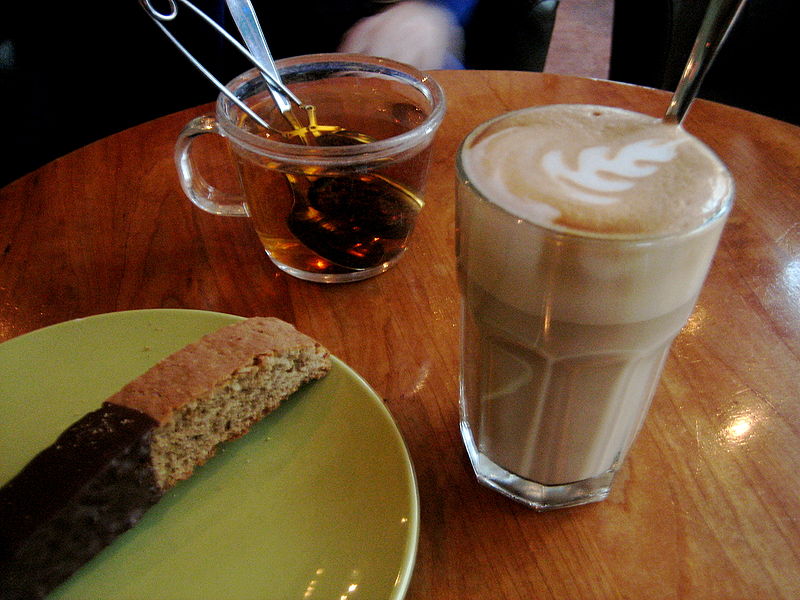
Literally, Fika is simply another name for ‘coffee break’. It was originally formed by changing the syllables in “kaffe,” the Swedish word for coffee. In its essence, however, fika is much more than just a coffee break. In fact, it is a rather specific Swedish philosophy that helps people find their inner peace and alter their attitude towards life in general once adopted.
Literally, Fika is simply another name for ‘coffee break’. Photo: Wikipedia commons
In order to understand this concept better, it is important to get down to the cultural specifics of having a coffee break in Scandinavian countries. Unlike the rest of the world where caffeinated products are consumed primarily to wake up and focus better on completion of different tasks, in Sweden coffee is a drink symbolic of slowing down and stepping away from all your problems at least for a little while. While Americans and a lot of Europeans treat coffee as a stimulant and something that will help them work faster and will fuel them up (overall, in the minds of a lot of people, a central attribute of a pretty stressful environment), Swedish people, on the contrary, turn to coffee breaks to breathe out and relax for a moment.
Fika culture in Sweden is very peculiar: coffee, or tea, as a matter of fact, is mostly an excuse to savor the moment. It is all about giving yourself a minute to enjoy your life and dissociate from your daily stress. There is no fixed policy on how fika should be done, you can either do it alone, focusing on your own thoughts and contemplating your life or gather with your friends to catch up! One way or another, it should always be something to look forward to, something that gives you peace and allows you to retreat from pressure.
The only thing you need to do is being consistent when incorporating fika in your life. After all, it is a necessity to be able to have a moment for yourself without feeling you are doing that at the expense of your productivity. If you do so, you will immediately become calmer and subsequently happier!
Friluftsliv Unlike the rest of Scandinavian philosophies outlined on this list, Friluftsliv is a concept that focuses on fostering not only your spiritual well-being but also your physical health.
The concept of Friluftsliv is decoded in the translation of this Norwegian word. It can be translated into English as ‘free air life’. And, in its essence, this is exactly what Friluftsliv is about – spending more time outside and feeling more connected with nature.
Outdoor life in Norway. Photo: Den norske turistforeningen
What constitutes a great part of this philosophy is understanding that no matter how urbanistic and busy your life is, what really matters is your inner balance and your harmony with yourself and the world around you. The best way to find it is by establishing a mindful connection between you and the outer world, nature in particular. For a lot of Scandinavian people, this means getting out there to camp and go to the forest. But in reality, Friluftsliv is a philosophy open to interpretation and amendments. You may replace a forest or mountain retreat with a simple half an hour stroll in the park next to your house and still get a lot of use out of it! After all, it is not about the place itself, but rather the experience you get to live through. Forgetting about the never stopping rhythm of a big city and going back to your roots will not only clear your mind and let you think straight but will also improve your health significantly. It is proven that being in the fresh air helps to lower your blood pressure, heart rate, and muscle tension as well as reduce your stress levels. And a healthy person is always a much happier person!
Hygge Hygge is often regarded as a defining characteristic of Danish culture, which makes complete sense granted that Danish people are among the happiest people in the world. Hygge refers to the practice of appreciating your life no matter what and preaching positivity in everything you do and say.
The term itself can be translated from Danish as “coziness of the soul”. And can best describe the feeling of being tucked in a blanket with your loved one and a hot drink warming up your hands. The moment is absolutely immaculate, care-free, and extremely cozy.
If anything, hygge is all about allowing yourself to indulge in things that make you feel good, and things that you enjoy without giving yourself second thoughts and doubting whether you deserve a special moment like that or not. Because the answer is always the same: you do!
Adapting hygge as a part of your lifestyle is an amazing way to heighten the feeling of the world being a happy place since you focus on multiplying the moments when you feel the most content and aligned with your wishes. Besides, by surrounding yourself with the people that you love and the ones that love you back, you create an atmosphere of trust and overall feel more secure, especially if things in the outside world are starting to feel a bit negative.
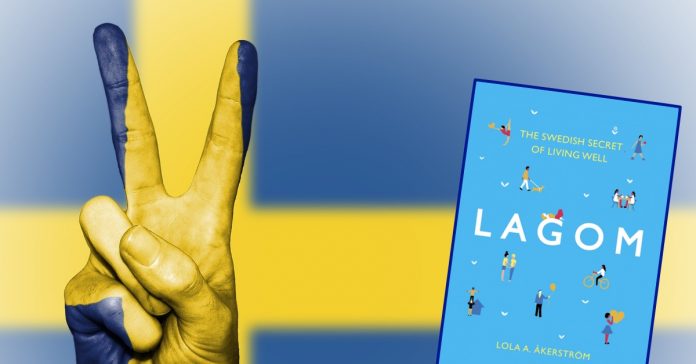
Lagom Lagom is a word that originates from the Swedish language and can be best translated into English as ‘optimal’ or ‘moderate’. The name of this philosophy is pretty self-explanatory. The concept teaches people that everything is good in moderation and you should be extreme in neither your beliefs nor your actions.
This concept is also great for understanding that you need to be flexible and tolerant when it comes to hearing out other people. While it is important to stand on your own grounds and protect what you believe in, you need to make sure that you are not going overboard and can compromise effectively. If you come to this, you will instantly see how easy it is to be more content with the people around you.
Lagom is all about finding the right balance that would lead to maximum enjoyment. Essentially, it means focusing on listening to your body and learning what your body and soul really need. After all, it is fulfilling those needs as opposed to being too centered on what you think is needed that will bring you true happiness!
Lykke At last but definitely not at least, Lykke is an important part of the complex of Scandinavian life philosophies that can make you happier.
Lykke is the Danish and Norwegian word for ‘happiness’, so, naturally, the concept of Lykke teaches people to focus on the things that are pivotal for alleviating the levels of joy within themselves.
According to Meik Wiking, the author of the book “The Little Book of Lykke”, happiness comprises several key factors: togetherness, money, health, freedom, trust, and kindness.
In order to be genuinely happy, you need to balance your life out in such a way that you pay close attention to all those parts of your life so that none of them is lacking. While it might sound like a lot of work (fair enough, it is not the easiest thing to complete), you will be surprised how tightly interlinked all these things are once you try to adapt this approach. If you work on your togetherness, you are simultaneously increasing your levels of trust and kindness, while improving your money directly affects your freedom etc.
Louis Robidoux
5 Scandinavian Life Philosophies that Can Make You Happier, written for Daily Scandinavian by Louis Robidoux. Louis is a blogger who enjoys writing articles that are of great interest to society. After having lots of posts published on different platforms, Louis decided to create his own site deeptop10.com where he’s covering topics about food, interesting hacks and lifestyle.
Scandinavian countries are countries with beautiful natural landscapes and cities that are at the top of the most expensive in the world. To find true friendship in Scandinavia among representatives of another culture requires effort and not everyone succeeds. But if you succeed, you will never regret it. Learn about 5 ways to meet true friendship in Scandinavia.
Gossip builds friendship In this matter, the difference between the northern and southern Norwegians is obvious. Gossip in Northern Norway is not shameful, and discussing people with friends at dinner is quite normal. Therefore, participating in such friendly gatherings is quite capable of strengthening your friendship with the Norwegians. Southerners are more polite and closed. Here you will never guess with whom you can discuss a third party, and with whom it is better not to do this. Therefore, be careful and observant, and keep your mouth shut for the time being.
Sport is our everything How do you make friends? If you want to make friends among the Scandinavians, then you simply can’t find a better idea than to start skiing. You will always find a lot of topics for conversation, start asking for advice, and conversations will begin to be tied up on their own. You can read more about similar specific “tricks” in the essays about friendship. These essay examples are full of advice and ideas. After that Scandinavian people won’t seem boring, and there will seem to be something to talk to them about.
If you want to make friends among the Scandinavians, then you simply can’t find a better idea than to start skiing. Photo: Maarten Duineveld/Unsplash
Usually, the Scandinavians are friends since kindergarten, then as school students, in college, and so on until the end of life. If you want to become their friend, you need to try hard. If it’s not the season for skiing or you just don’t feel like it, you can start cycling. For this, a climate without snow, as in Western Norway, or the spring-summer period, is suitable. Cyclists also come together in interest groups. Finding friends this way is also easy. And there is participation in various competitions, trips abroad, and a lot of common topics.
If you are basically an unsportsmanlike person, there is nothing wrong with starting to get involved in nature and photography. The Scandinavians are the most important fans of their countries and nature. You can easily find a common language for walks in the mountains, photo trips to the lakes.
If the weekend in nature is not on the list of your preferences, and you are a cheerful person who loves parties, then here you can find common hobbies. Locals are fond of dancing. You can choose one of the two most common dance styles: salsa or swing.
Avoid “wrong” topics It is not customary for the Scandinavians to talk with friends about politics, religion, health, the economic situation in the world, personal problems, income, and work. The list of “allowed” topics is approximately the following: weather, cooking, sports, vacation, free writing, cars, creative paper works, pets, and needlework.
Keep your distance. Photo: Wiktor Karkocha/Unsplash
Keep your distance You shouldn’t hug the Scandinavian tightly by the shoulders, gesticulate animatedly in front of their faces, and also look closely in their eyes. For residents of these countries, all these are signs of obsession, poor education, and gross violation of personal boundaries.
Scandinavians will be delighted if you praise their new phone or scarf. Photo: Mark Fuller/Unsplash
Do not forget about the compliments Surprisingly, the harsh and restrained Scandinavians are very fond of compliments. They will be delighted if you praise their new phone or scarf. But most of all they value compliments that emphasize the characteristics of a national culture or character. If you sincerely admire the local beer, sauna, Scandinavian nature, calmness and restraint of the townspeople of the country where you are, the friendship contact with people will be provided to you.
5 Ways To Meet True Friendship In Scandinavia – Conclusion: If the “friend” ribbon is hung on you, then you become the owner of a variety of privileges. Essay samples on this topic give some examples: you can be sure that you will be friends for the next fifty years, even if you do something terribly awkward. Now you will be fed with cinnamon rolls, which someone’s Swedish grandmother baked. Now there is someone to go for medicines with you and help you learn a new health system.
5 Ways To Meet True Friendship In Scandinavia is written for Daily Scandinavian by the editorial team at phdessay.com
There are plenty of things for you to see in Copenhagen beyond the beautifully colored Nyhavn and the Little Mermaid. There are many great places for you to visit which in most cases tend to be overlooked. You’ll be surprised to know that most of these spots are right next to famous tourist attraction sites that are usually in the spotlight. Here are some of the best suggestions for the best spots and hidden gems in Copenhagen Let’s get started!
University Gardens Back in the day, the citizens of Copenhagen would spend their weekends dressing up in the finest gowns and visiting the University Gardens. Thanks to this romantic gesture, you can take a step back and enjoy this historical walk down the beautiful pathways among flower beds, groves, rose gardens and woods and creeks.
According to college papers, this is an ideal location for people who want to relieve stress and tension. At the moment, locals and students are the ones who stroll through this serene area because it’s not very close to the inner city. The University Gardens are a must-see for anyone visiting Copenhagen. If you’re traveling with your children, you can also visit the Frederiksberg Gardens with them and round it up with a visit to the zoo in the afternoon.
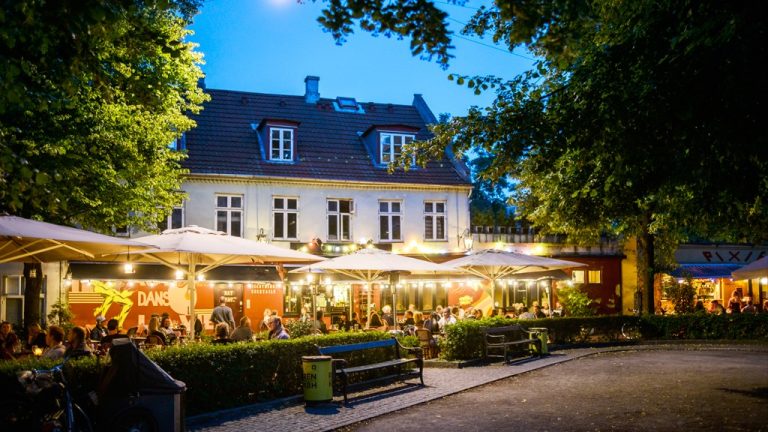
Bopa Plads Bopa Plads square is in many ways similar to a little Berlin hideaway thanks to the hidden pocket of café relaxation hideout in Ostebro, a quiet residential area. By taking your time to relax in this place, you’ll be in for a wide variety of treats.
You’ll have an opportunity to sit below the treetops and enjoy a glass of lemonade or a cold beer from the adjacent cafes. And this will enhance your peace of mind. The atmosphere is comfy with an edge that displaces it from the neighborhood.
If you are looking to eat in this colorful and inviting place, there are great cafes around the corner such as the Pixie café. You’ll also find antique shops, boutiques, and delis which will make your day.
Assistens Cementry Copenhagen’s Norrebro is one of the most vibrant and colorful areas thanks to the variety of cultures, bikes, warm greengrocers, ethnic eateries, and students. In the middle of this neighborhood, you’ll find the lovely and peaceful Assistens Cementry (Kirkegard) which hides behind a long yellow wall alongside Norrebrogade.
It is both a cemetery and a park. It’s one of the most charming spots in Copenhagen. Its tranquility sets it apart from the entire city. The majority of grand characters have been laid to rest here including the famous writer H.C. Andersen and philosopher Soren Kierkegaard.
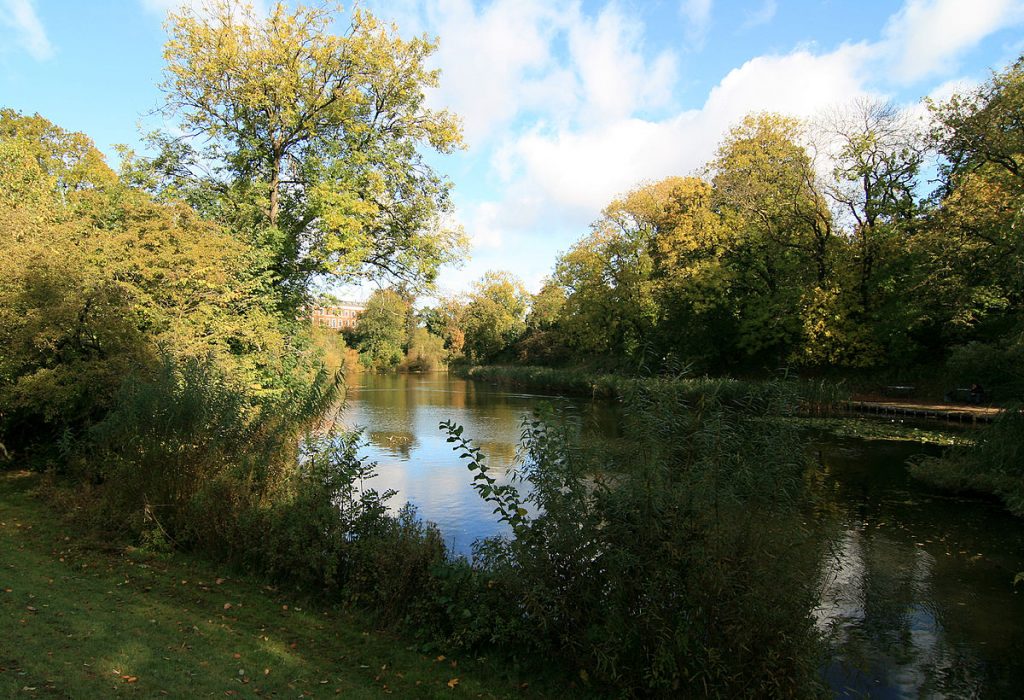
You’ll probably notice, Copenhagen is full of lush greenery. From Østre Anlæg. Photo: Wikipedia commons
Østre Anlæg As you’ll probably notice, Copenhagen is full of lush greenery, making it difficult to notice when you move away from the city center.
As paper writing service reports, Østre Anlæg is a great example and a perfect hideout located behind the Danish National Gallery. Once you are here, you’ll have the opportunity to peek inside the gallery and get a closer look at a wide of valuable and timeless art collections.
Taking a walk around Copenhagen’s old moat system and bringing your loved ones to the huge plays cape including a paddling pool, tennis court, swings, and fishing vessels will greatly enhance their experience in this area.
Kartoffelrækkerne This spot is probably what most tourists would imagine Copenhagen to look and feel like. It was built back in the 19th century to accommodate the working class of Copenhagen. The cramped and charming two-story houses are among the best places to live in Copenhagen.
This spot was named Kartoffelrækkerne because it was built on old market gardens and its layout looked like rows of potatoes. The houses are located in the eastern parts of Copenhagen which are quiet and serene. They are also right next to the lakes. This makes Kartoffelrækkerne the ideal spot for strolling and jogging.
Brumleby got its name from the cows that would move around the area and chew grass all day long.
Brumleby Brumleby is a small community and one of the earliest social housing examples in Denmark. Once you get here, you’ll see children playing on the streets, cats basking and laundry hanging out to dry in the sun. You’ll just feel calm and at ease, once you get to this place.
According to assignment help, this small village has developed thanks to the love and unity among its inhabitants. The Danish Medical Association created Brumleby for workers back in the 19th century. It got its name from the cows that would move around the area and chew grass all day long. Take a walk and let your children have fun in the twisted playhouses.
The lakes There are three consecutive lakes near Norreport Station named Peblinge Sø, Sankt Jørgens Sø and Sortedamssøen Sø. The locals simply refer to them as The Lakes. It’s one of the best parks in Copenhagen. The buildings along the lakes are vibrant and beautiful thus making it a great relaxing spot. There are a few benches along the lakes and grassy spots under treetops. The best thing about this spot is it’s located in the center of the town. You’ll find most locals jogging or having a picnic here.
Botanical Gardens Another park that you should visit in Copenhagen is the Botanical Gardens. It is located near Rosenberg and Norreport Station. It’s a very quiet and serene place despite being in the town’s center. The park has ponds, flower gardens, and trees. There are also greenhouses that you can visit at any time. The Botanical Gardens are quiet and serene thus making it ideal for people who want to relax and have a good time.
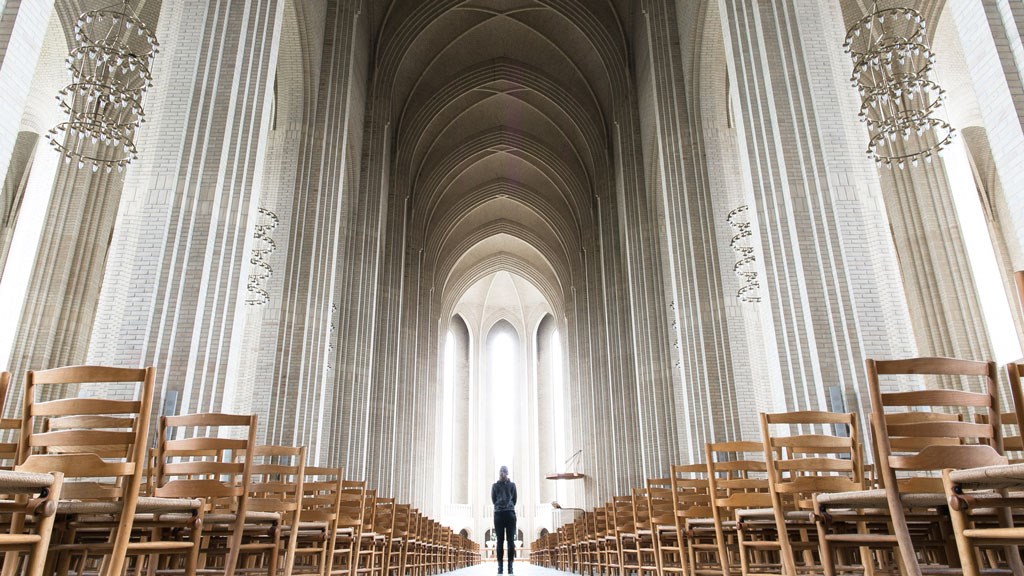
Grundtvig church was built in the 1920s. Photo Visit Copenhagen
Grundtvig’s church Copenhagen is filled with lots of beautiful churches. Grundtvig’s church tops the list thanks to the hidden gems of the famous Danish philosopher and composer Grundtvig. The church was built back in the 1920s. The architecture is a combination of Brick and Gothic Expressionism. The interior is minimalistic; however, it’s gorgeous.
Vesterbro According to edubirdie reviews, walking through the neighborhoods of Copenhagen when traveling will greatly improve your experience. Vesterbro is home to some of the famous sights in Copenhagen such as Carlsberg Brewery and Frederiksberg Palace. Most tourists don’t walk through the neighborhood. This means that you’ll have a lot of space to yourself.
Østerbrogade. Photo: Wikipedia commons
Østerbro Østerbro is another great neighborhood in Copenhagen with a unique mix of historic and modern architecture. It is home to the largest park in Copenhagen called Fælledparken. You’ll get the chance to see architecture inspired by Victorian. There are also several shops and restaurants in the area.
The best spots and Hidden Gems in Copenhagen – conclusion Copenhagen is an amazing place for both solo and group travelers. Most of the famous sights in the rea are usually overlooked. And this makes it easier for you to explore these areas and have a wonderful experience. As a local, you can escape the rush of the city by visiting these calm and serene spots.
Serena Dorf
The best spots and Hidden Gems in Copenhagen, written for Daily Scandinavian by Serena Dorf. Serena has been working as an editor and an essay writer at academic writing, dissertations services and paper writing services in London for 3 years. She is also a professional content writer and journalist in such topics as inspiration, productivity, education, and technologies.
Feature image (on top): Bopa Plads. Photo: Christian Lindgren/Visit Copenhagen
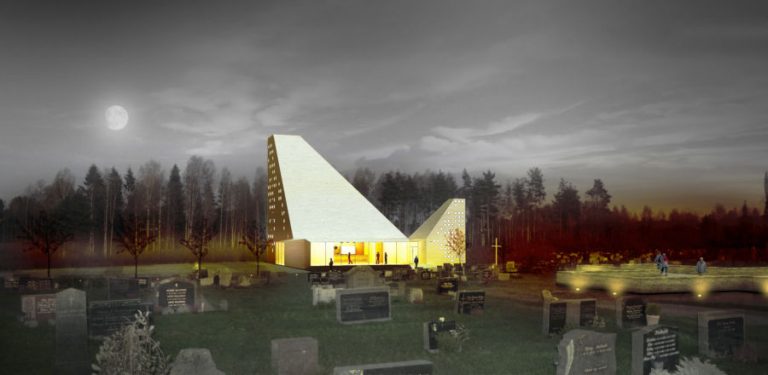
Night to Thursday, May 25, 2009, the 203-year-old Våler church in Norway was completely destroyed by fire. An international architectural competition was announced and resulted in 239 proposals from 23 countries. In 2012, architect Espen Surnevik won the competition with a solution that would give society back the wooden church, but in a form adapted to our time where the art of Espen Dietrichson was to be integrated as a major part of the architectonics. The tragic loss of the old Norwegian church gave birth to a new beginning.
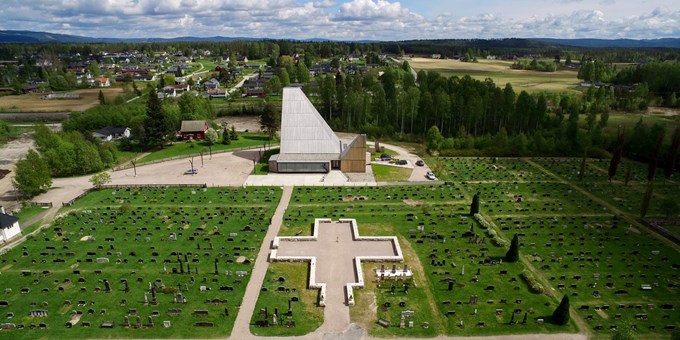
Våler is a small village on the Glomma River. The churchyard is one of the few planned areas of the town centre, and when the old church burned down in 2009, people felt the loss very keenly. The all but impossible task of the new church was to recreate the lost space as a frame for significant events in local people’s lives.
Together with the artist, Espen Dietrichson, the architects worked with different design elements to manifest the theme through the project
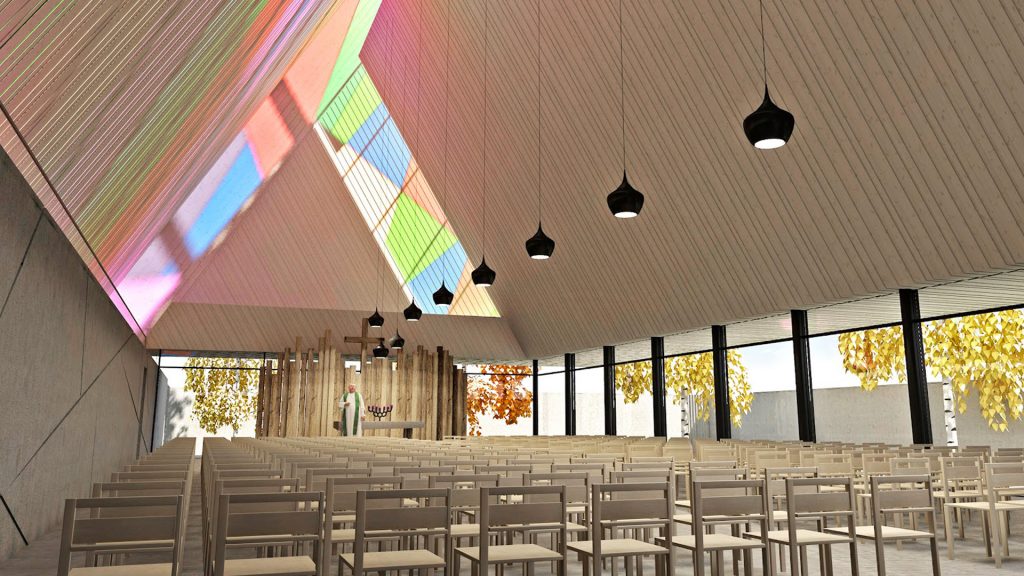
So, the theme of the new church became resurrection. Together with the artist, Espen Dietrichson, the architects worked with different design elements to manifest the theme through the project. The most important element was the work with daylight coming into the church from different daylight openings. This symbolizes hope, and that light defies darkness, after the tragic loss of the old church.
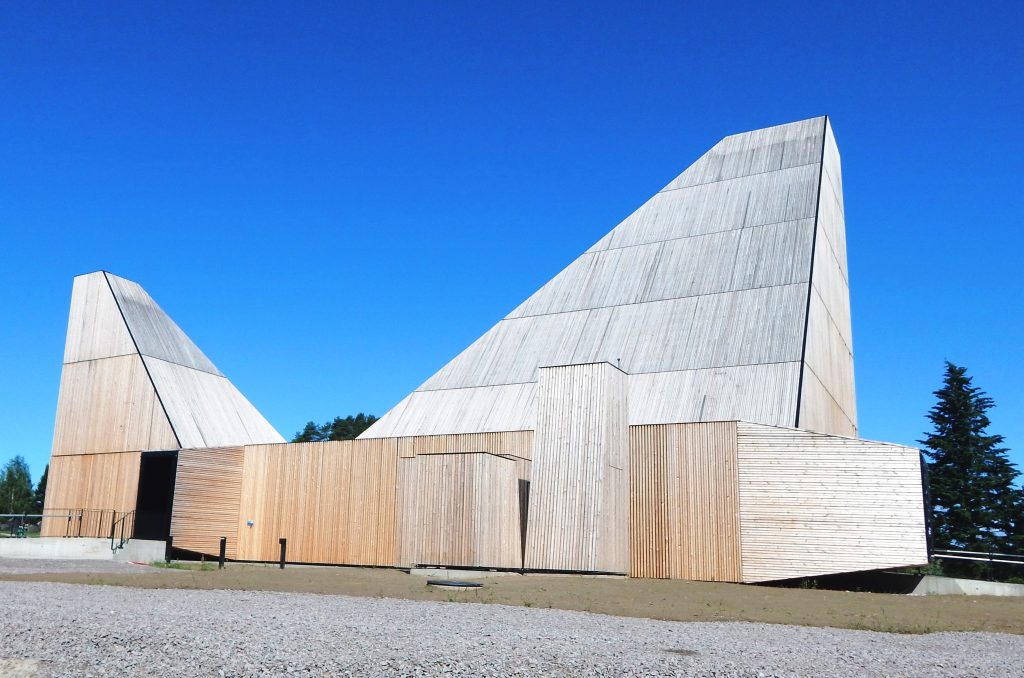
The new church is placed on the existing processional axis, and clad in straight board of heartwood pine, reflecting the local forest landscape. Photo: Wikipedia commons
A collaboration between architect and artists
The new church is placed on the existing processional axis, and clad in straight board of heartwood pine, reflecting the local forest landscape. The natural facades have a long local tradition. Due to climate they slowly get darker before ending up going back to nature. Every fifty years the façade-wood will be renewed, and the church will resurrect as new for every new-born generation.
Espen Dietrichson has painstakingly followed Espen Surnevik’s mathematical instructions, and decorated the entire end wall with a myriad of windows with associated mirror panels and purple-colored glass consoles. At the forefront stands understated liturgical furniture, co-designed by the artist and the architect.
The footprint of the old cross-church, were made into a memorial as a big grave in the middle of the old graveyard, Photo: Visit Hedmark
The forms of the building are designed by strict geometric rules. The plan is quadratic and divided by a diagonal procession-axis going from a small chappell, placed south, and over to the main church room placed north. Two towers are showing where the liturgics points are placed in the church. The highest tower is 24m high, and the small tower is 12m. The towers have daylight openings on the top, making a view from the audience towards the sky. At the same time, the daylight openings allow daylight to enter the rooms.
Religious aspects worked out in an abstract way The footprint of the old cross-church, were made into a memorial as a big grave in the middle of the old graveyard. Behind the memorial the new church rises up. The new church is built as a cultural arena, an open-minded gathering-place for the whole community of Våler.
The natural facades have a long local tradition
“The religious aspects are worked out in an abstract way. As you walk up the aisle, the lines meet a point above the ground that unconsciously lifts your gaze up to something bigger than yourself,” says Espen Dietrichson.
Architect: Espen Surnevik (1973) – professor at The Oslo School of Architecture
Collaborating structural engineer: Dr. Techn. Kristoffer Apeland AS
Collaborating artist: Espen Dietrichson (1976)
Contractor / Entrepreneur: Martin M. Bakken AS
Project type: Lutheran Norwegian Church.
Location: The eastern part of Norway, close to the Swedish border, two hours driving north of Oslo. Våler-center (place) – Våler (local district) – Hedmark (district) – Norway
Site: Old cemetery form the 17th century.
Project size: The Church is 950 square meters. The large tower is 24m high. Small towers are 12m high.
Awards: Våler Church is awarded with:
Building of the Year 2015 in Norway (Årets bygg 2015)