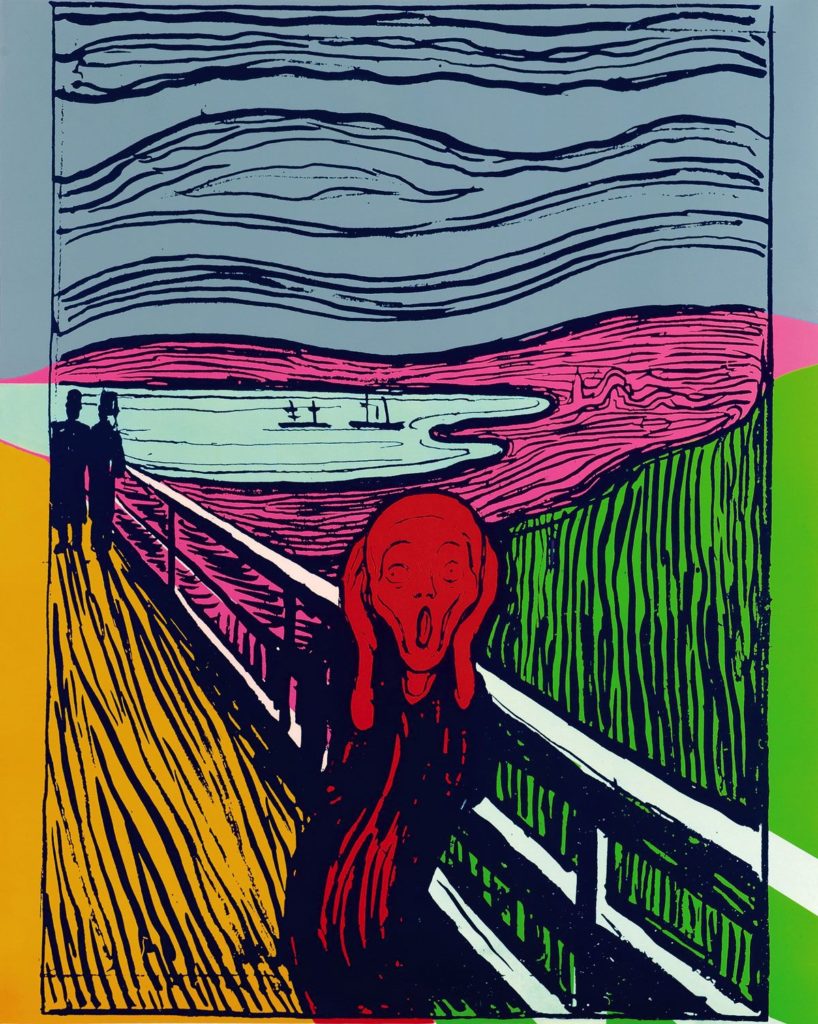
In 1983–84, Pop artist Andy Warhol (1928–87) produced a series of 15 prints with images taken directly from some of Edvard Munch’s most renowned motifs.But he enlarged them and colored them so boldly that Edvard Munch had turned in his grave if he had seen them!
Warhol had long regarded Munch, alongside Henri Matisse, as one of his favorite artists, and he had visited Oslo in 1973 to view Munch’s works at the National Gallery and the Munch Museum.
Edvard Munch by Andy Warhol
Like most of Warhol’s best-known works, these are copies which at the same time transform the sense and meaning of the originals. And he has made many of each subject – but in completely different colors and color combinations
The paintings describe a transaction in which the famously superficial Warhol becomes a profound and important figure in the history of art, while Munch, tortured and brooding, is best known for the mass-culture icon that The Scream has become.
The 15 prints become very different depending on the color scheme. How should we interpret the works of the two artists? How should we look at the expressionist Munch? And what did Warhol want when copying and transforming Munch?
We choose to place Edvard Munch into the age of modernity. The alienation that shines out of his images is not just his own. His self-portrait does not only express himself. It delves into the depths of today’s modern soul life. Unlike Andy Warhol, where the surface is essential. If you scratch it off “there is nothing underneath”, as Warhol expresses it. These contradictions are probably the main focus on the exhibition.
Munchmuseet on the Move – Kunsthall Oslo: Dronning Eufemias gate 34, Bjørvika. 26/05/18 — 26/08/18
Feature image (on top): From the ‘Andy Warhol after Munch’ exhibition at Louisiana Museum of Modern Art, Copenhagen.
The Edvard Munch Museum in Oslo on the Move, based on a press release
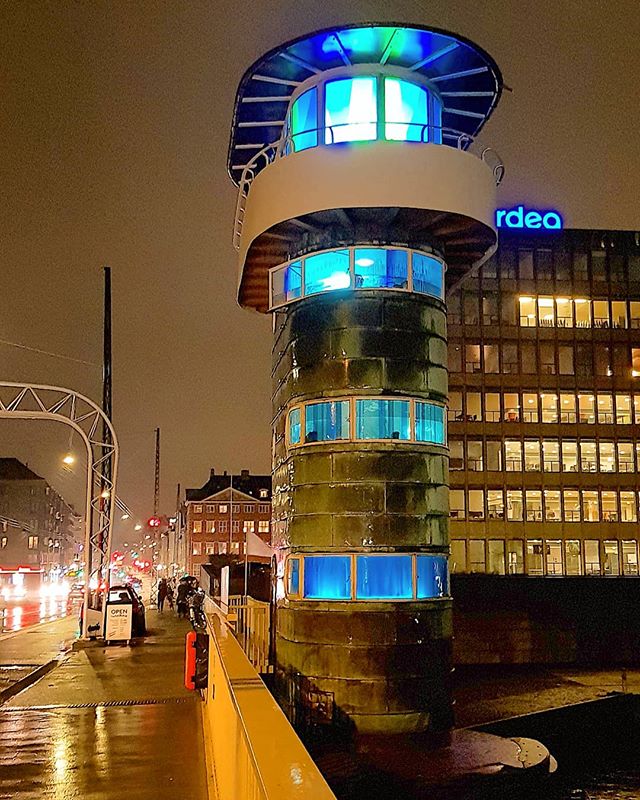
A little-known café, Kulturtårnet, in an old copper bridge tower with 360-degree views of the Copenhagen harbor and even many Danes don’t know of its existence. That in spite of the fact that the copper bridge tower at Knippelsbro, is one of Copenhagen’s most treasured landmarks.
Since 2010 the image of the tower has even featured on the front of the Danish 200 kroner bank note, pushing other celebrated gems aside. A few precious times a day the city’s bike-flow takes a breather as the bridge does what it was designed to do back in 1937, allowing ship traffic to continue its journey through Copenhagen’s harbor.
Kulturtårnet – the entrance
Opened to the public a few years ago
Knippelsbro is one of only two highway bridges across Copenhagen’s inner harbor. It is a bascule bridge designed by engineer Godfred Lorenz with Danish architect Kaj Gottlob, with an aesthetic that has lasted well.
Danish 200 kroner note displaying the bridge tower at Knippelsbro
Most people find this gem by accidently walking across the Christianshavn side of the bridge. Recently, the southern tower has been converted into a cultural event space, open to the public for the first time in over 80 years. Kulturtårnet (The Culture tower) is a new cultural institution in the harbor of Copenhagen.
Knippelsbro is one of only two highway bridges across Copenhagen’s inner harbor
The bright teal yet unassuming river tower turned cafe is almost submarine-like as it sits at the side of the harbor. Funded by Copenhagen City Council and Realdania, Kulturtårnet’s minimalistic space leans to its maritime heritage and offers its guests a unique cultural and gastronomic experience.
Copenhagen’s smallest and latest cultural institution
From inside the old copper tower you can now see Copenhagen from a totally unique view. The tower operates as a place for the community to come together for cultural events and good food. The team behind this unique project, Lars Erik Lyndgaard Schmidt and Malthe Merrild, are also utilizing Copenhagen’s smallest and latest cultural institution as an experimental space for radio producers.
Kulturtårnet consists of two dining rooms as well as outdoor tables and chairs. On the deck there’s a peaceful atmosphere; inside is cozy and fun. So, once you spot the tower with the big white flag, run over and grab a coffee while taking in the sights and sounds of Copenhagen.
A Hidden Gem in Copenhagen, written by Tor Kjolberg
The award-winning Loyds Paxter, the so-called Postman Pat vehicle, designed and produced in Norway, is Europe’s most efficient and environmentally friendly postal delivery vehicle.
Norway Post wanted a vehicle that could be registered as a moped, with a 100-200 kg weight capacity and a range of 40km, or up to six hours without recharging. In 2013 Loyds Paxter was launched with a 200 kg loading capacity making fewer deposit roundtrips compared to any other small delivery vehicle.
Norway Post wanted a vehicle that could be registered as a moped
In 2016 the New Zealand Post approached the Waitaki District Council for permission to trial the new electric vehicle on Oamaru footpaths, and several other countries are considering the vehicle for use in their postal delivery systems.
Nationally, NZ Post set aside a total of $15m over two years to buy the new electric vehicles from Norwegian manufacturers Paxster AS.
NZ Post service delivery chief operating officer Ashley Smout said the four-wheeled battery-powered vehicles would be used for the combined delivery of parcels and mail in residential areas in larger centres. “The vehicles will give us extra capacity to meet the growing demand created by online shopping and give us an edge in the competitive parcel delivery market,” Smout said.
For easy access, Paxster can carry 3 x 15 kg up front, and the rear cargo box with a volume up to 820 liters can be tailor-made to fit any postal trays for the distribution of post, newspapers and small packages. The vehicle is purpose built down to every single detail, from using the battery placement to optimize center of gravity, via designing the cockpit for time-saving on repetitive tasks, to the appreciated hill-hold feature.
In 2013 Loyds Paxter was launched with a 200 kg loading capacity
The so-called Postman Pat vehicle, Loyds Paxter, is a unique product that is 100% designed for the job it is required for, namely to deliver the post. It is an ergonomic, environmentally friendly, efficient and attractive working environment with tremendous international potential.
The Postman Pat Vehicle from Norway, written by Tor Kjolberg
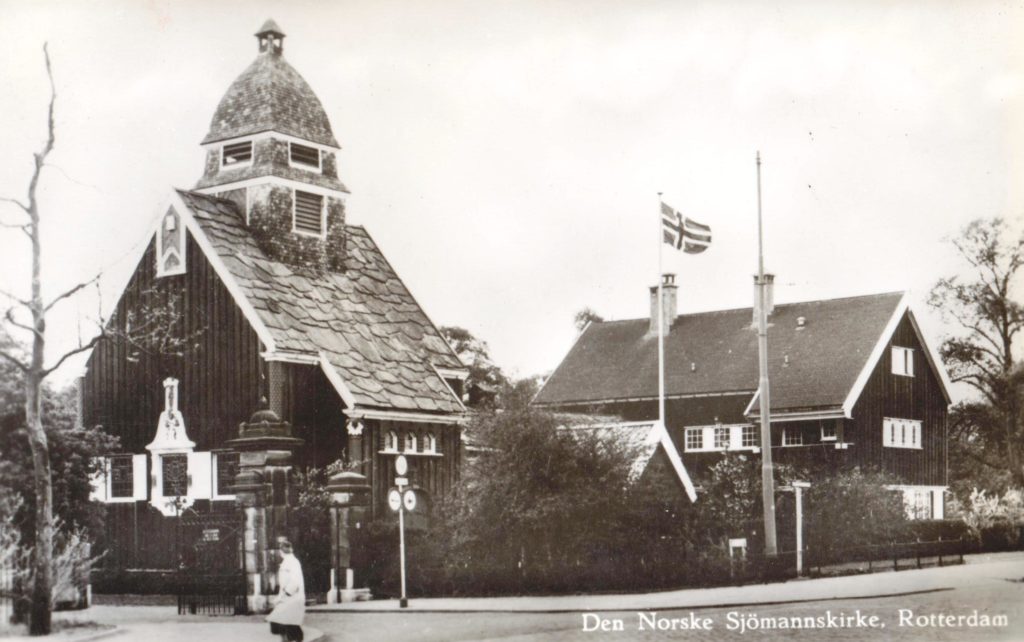
At the end of the 19th century a new architectural fashion arose in Scandinavia based on traditional wooden houses. This romantic movement came to be knowns by the name of Dragistil (Dragon Style), a reference to the dragon heads that used to adorn Viking ships.
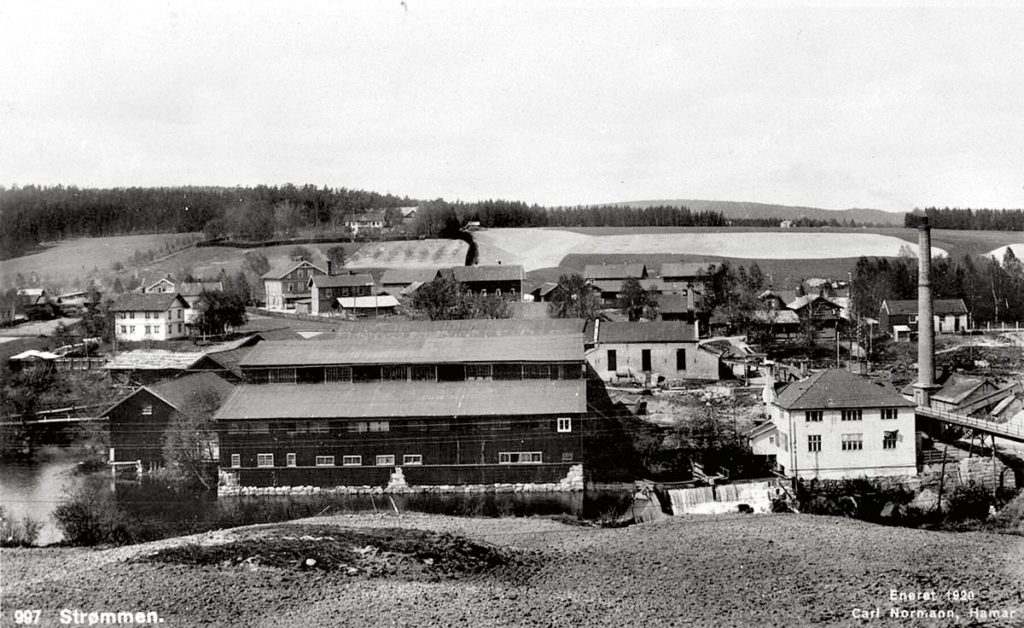
The STRØMMEN TRÆVAREFABRIK outside Oslo, established in the year 1884, was one of the first big steam-powered sawmills to manufacture and export ready-made wooden houses. The houses were built from sawn or milled logs, numbered and dismantled for transportation and reassembled on the buyer’s site. Some order standard models, others custom-made houses designed by architects. In a sense, we can say that Strømmen Trævarefabrik was a forerunner of today’s IKEA.
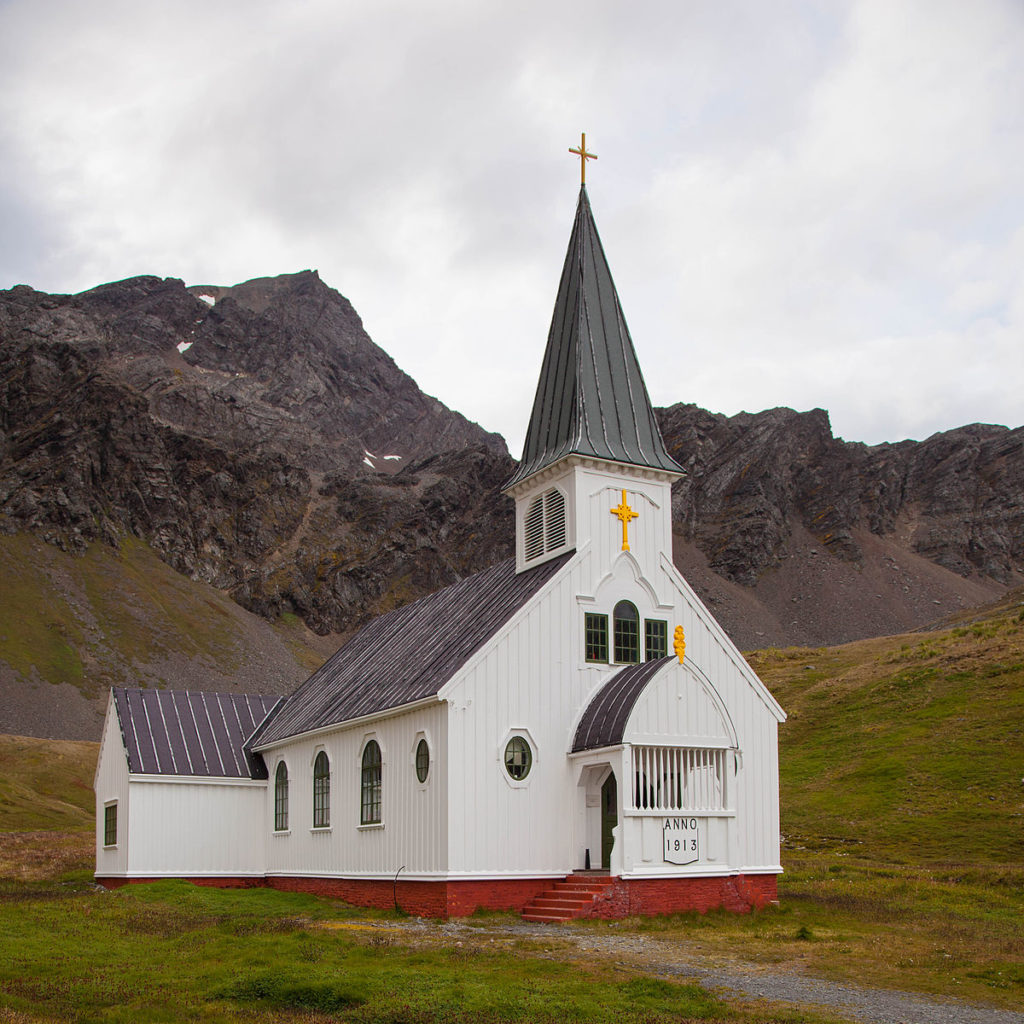
In a marketing catalogue from 1910, the factory says, “In the course of these years, we have built and shipped about 1300 wooden houses, some churches, several barracks, garden houses, and other buildings for different purposes, which are scattered all over the world – from the island Spitzbergen in the North, where we erected the buildings for the Norwegian Wireless Telegraph Station, to the South Pole, where we furnished “The Borchgrevink South Polar Expedition” with the necessary winter dwellings.”
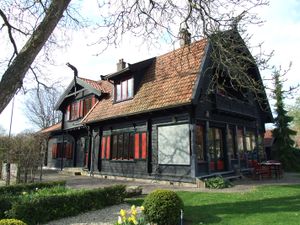
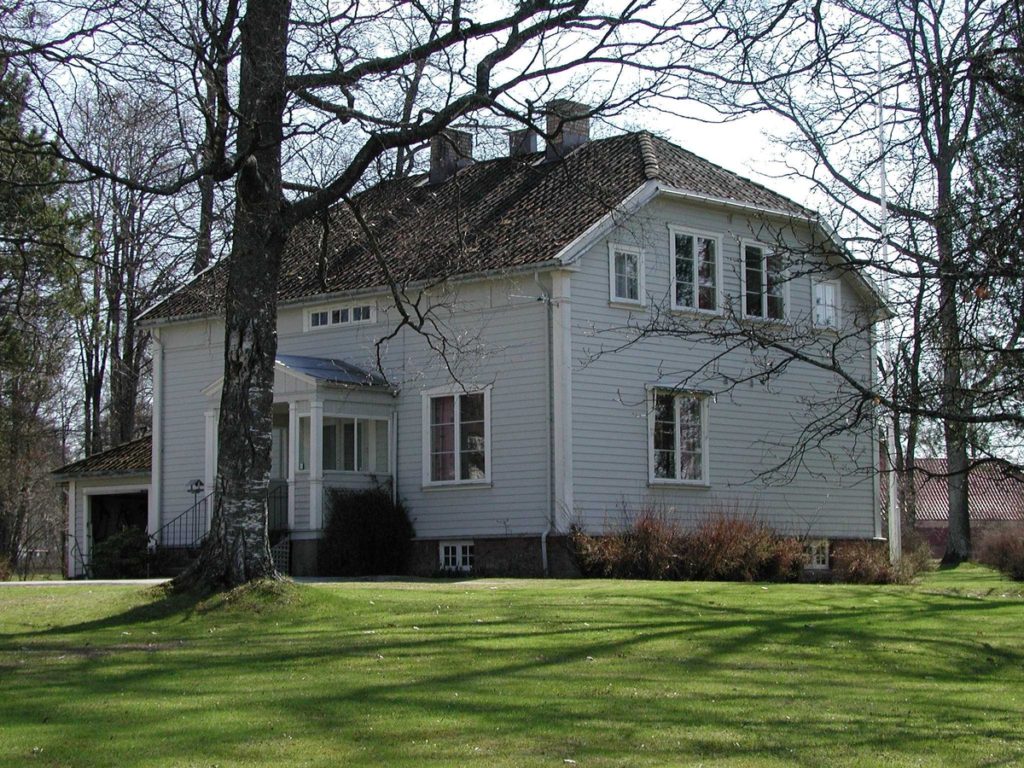
Molenweg 57 in Gorssel, Holland
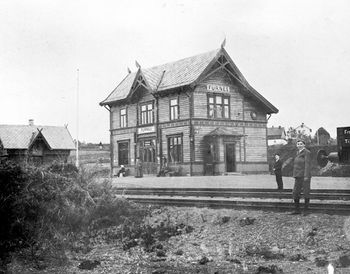
Customers could look through a catalogue and order a range of houses, as well as wooden churches, railway stations and even a sanatorium.
One of the most famous houses delivered by Strømmen Trævarefabrik is probably Høfdi, by architect Olav Olson, designed for the French consul in Reykjavik in 1908, and which the Icelandic government later bought as a representation residence. In 1986, Presidents Reagan and Gorbachev met there for a summit raising public international attention.
Grytviken church
A large number of the houses from the Norwegian factory were shipped to South Africa, Central Africa, South America, the West Indies and other transmarine places, and in like manner they will be found in most European countries. Thus were 90 houses and barracks sent down and erected at Messina and Reggio after the earthquake in 1908.
“Our houses have everywhere proved highly efficacious, so that they have attained an ever-growing reputation. In the regions frequently afflicted with earthquakes, a wooden house well-constructed is indubitably the most secure place of habitation,” states the catalogue.
Typical house from Strommen trævarefabrik AS
Also the residents of Gelderland, Holland, had an opportunity to learn about this building system at an industrial art exhibition in Arnhem. In 1903, and in 1913, a Norwegian house was exported to Gorssel and assembled on site. It had all the modern facilities of the time, including running water and electricity. The house was owned for a time by Vloogenboom and Van Hasselt and was then acquired by Maria Büchner, who left it to a foundation for disabled children after her death.
The railway station in Hamar, Norway
The art of building wooden houses is known to be very old in Norway, where this method of building has, with very few exceptions, been the only one in use from the commencement of history. The country still possesses wooden churches, whose age has been proved to be 800 years.
The factory burned in 1919 and went bankrupt ten years later.
The Exciting Story of a Norwegian House Manufacturer, written by Tor Kjolberg
Feature image (on top): Høfdi, by architect Olav Olson, designed for the French consul in Reykjavik in 1908.
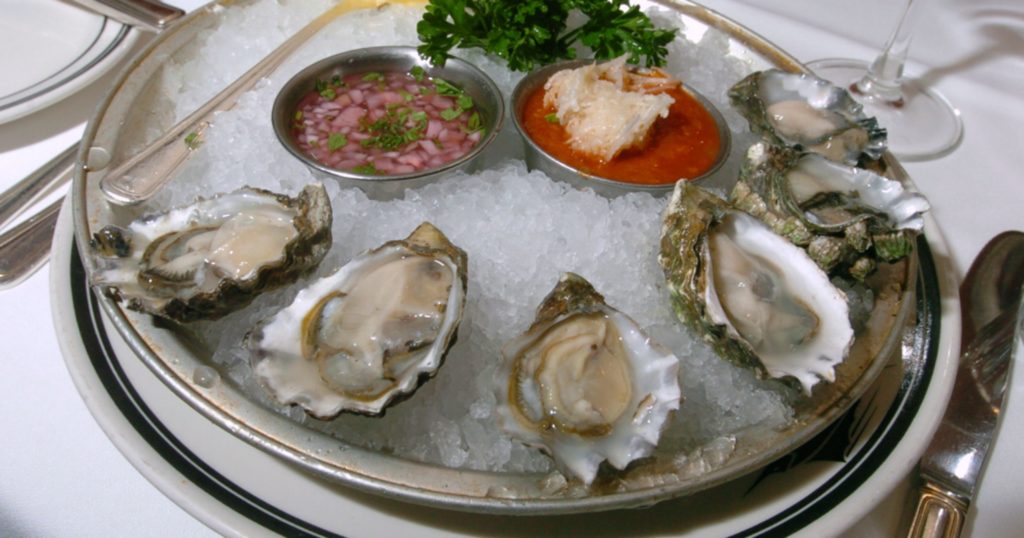
The Scandinavian oyster (Ostrea edulis) is the round-shelled belon, and this is what our oyster shell-middens consist of. Pollution, bad management and overfishing have reduced the native population, however, so most oysters are imported.
Nevertheless, the population of the native oyster is on the rise once again, and as it is much fleshier and in most people’s opinion superior to the imported Pacific oyster, it is good to have the choice. There are not many wild oysters to be had, but oysters have been farmed since Roman times.
A Scandinavian oyster plate
Appearance and taste A shucked oyster in its prime should have a visible beard ands a light brown or greyish color with a white muscle. It should have a good, clean flavor and be firm and juicy. Oysters contain water, which you either drink, while eating them, or put into any dish with them. The liquid gas a refined sea-breeze quality that you don’t want to miss.
The population of the native oyster is on the rise once again
Native oysters spawn in the summer and are usually not eaten during that time, but other, farmed species are available all year round. There is a great difference in the taste and consistency, depending on whether or not the oysters have spawned; before spawning they are fat and firm, while afterwards, in the autumn, they are thin and exhausted – both have their dedicated fans.
Buying and storing With oysters, you must trust your fishmonger as there is no way of telling how fresh they are, or how long they have been kept out of water. Make sure that they smell fresh and are tightly closed.
Oysters can be stored alive in the fridge for a couple of days, in the container they are bought in, though they lose taste and precious water with prolonged waiting.
Culinary uses If eating raw, live creature seems too much for you, try them in a delicious fish soup or grill them for 3 minutes with a blob of hollandaise and a dusting of breadcrumbs. Warm oysters are lovely, and the gentle way to set your mind at ease while getting addicted to them.
To eat raw, serve with butter, good toasted bread and lemon. Six oysters per person for a first course.
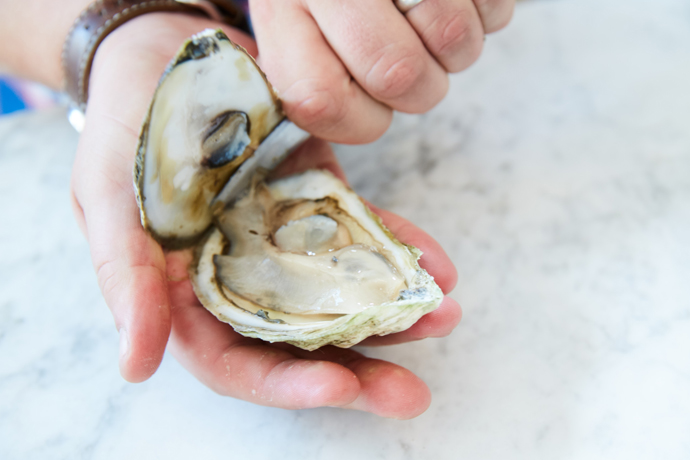
How to suck an oyster Oysters have a flat and a rounded side. Rest the rounded side in the palm of your glove-clad hand and using a short, thick-bladed knife, either cut the valve or tweeze the blade between the two shells at the other end and, in order to cut the stool (the muscle that keeps the shells together).
Remove the flat shell. This operation admittedly takes the nerve, patience, practice, and possibly, the odd plaster. Put your nose to every oyster; it should smell like a swim in cold salt water. If it doesn’t discard it.
Rest your shucked oyster in the deep shell on a bed of crushed ice, or seaweed, so the juices stay in the shell. And continue with the other oysters. Any that are not well inside should be rejected. Once shucked, the oysters should be eaten as quickly as possible.
It’s anyone’s guess what the Swedish sculptor John Tobias Sergel (1740-1814) might have thought of the huge illuminated obelisk, fountain and square that bears his name, and of the modern city around it.
The heart of this business and commercial area is not large, but it sits somewhat uneasily with the rest. From Sergels Torg it is hard to miss the five towering office blocks on Sveavägen, which cast their shadow over the other buildings.
Spring in King’s Garden
In the 1960s. Stockholm City Council, like so many others, succumbed to the temptation to knock things down and build concrete and glass high-rise buildings.
The destruction of many fine old buildings continued until it threatened the King’s Garden with the statue of the warrior king Karl XII on its southern side. At this point the Stockholmers had had enough. Normally placid and biddable, they mustered at the King’s Garden, climbed the threes that were in danger of the axe, and swore that if the trees went so did the people.
The City Fathers retreated, and Kungsträdgården survives to soften the edges of the new buildings and harmonize with the older buildings that are left. This the place to take a leisurely stroll or sit beside the fountains on a summer day and enjoy a coffee at its outdoor café.
In summer it is the venue of many outdoor festivals and rock concerts. In winter, part og Kungsträsdgården is flooded with water and becomes a popular ice rink, and the restaurant moves indoors.
The Hallwyl Collection
A short stroll east is the early 20th-century private palace housing one of Stockholm’s most unusual museums, the Hallwyl Collection. It’s the magpie collection of one person, Countess von Hallwyl, from her ornate piano to china, beautiful furniture and personal knick-knacks.
The Café at King’s Garden
Just north of the museum on Östermalmtorg, stop to snack at Östermalmshallen, a classy deli-style market.
King’s Garden in Stockholm, written by Tor Kjolberg
Sweet Protection, the Norwegian maker of the most advanced helmets, protective gear and apparel for ski, snowboard, bike and paddle sport, set out for the small village of Valldal on the West Coast of Norway to test and shoot the bike gear for this season.
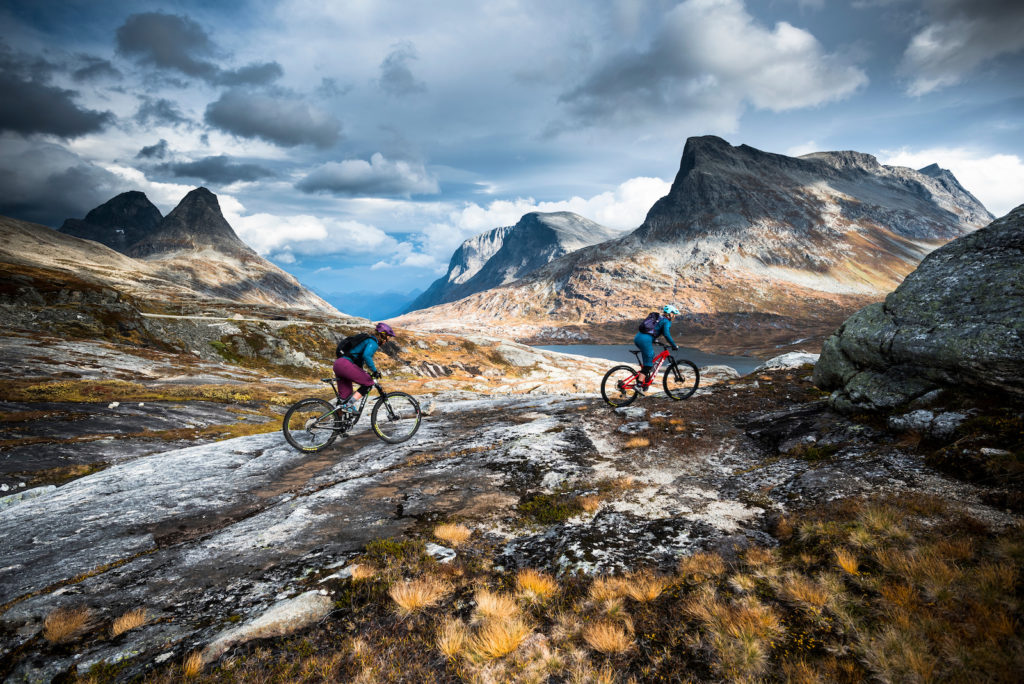
Valldal, a small village on the West Coast of Norway known for its amazingly juicy strawberries is also a world-class mountain biking destination. It was a natural choice for both testing and shooting this season’s new bike gear.
Valldal was a natural choice for both testing and shooting the season’s new bike gear
The Sweet Protection photo shoot Last summer you might have seen Sweet Protection ambassador Mads “Makken” Haugen biking on what looks like the edge of the world in Norway’s west coast town of Geirangerfjorden. Playing host to some of the most dramatic landscapes anywhere, Geirangerfjorden is a popular tourist attraction with its unique fjords, abundant waterfalls and towering mountains.
You can escape the throngs of cruise ship tourists for a quieter place with world-class mountain biking
Paradise for mountain biking
However, less than an hour away you can escape the throngs of cruise ship tourists for a quieter place with world-class mountain biking and the juiciest strawberries you will ever taste. Some would say it’s mountain bike paradise on Earth, others just call it Valldal.
Valldal was for a long time a hidden gem mostly enjoyed by the locals
Placed between the two main tourist attractions of Trollstigen and Geirangerfjorden, Valldal was for a long time a hidden gem mostly enjoyed by the locals. Due to its location in a small valley away from the coast, Valldal is often a couple of degrees warmer than its neighbors (hence the extraordinary strawberry situation), making it the perfect summer outdoor adventure location. And indeed, it is. At least if you enjoy mountain biking.
Riding on the West Coast is spectacular and well worth the effort
Spectacular biking
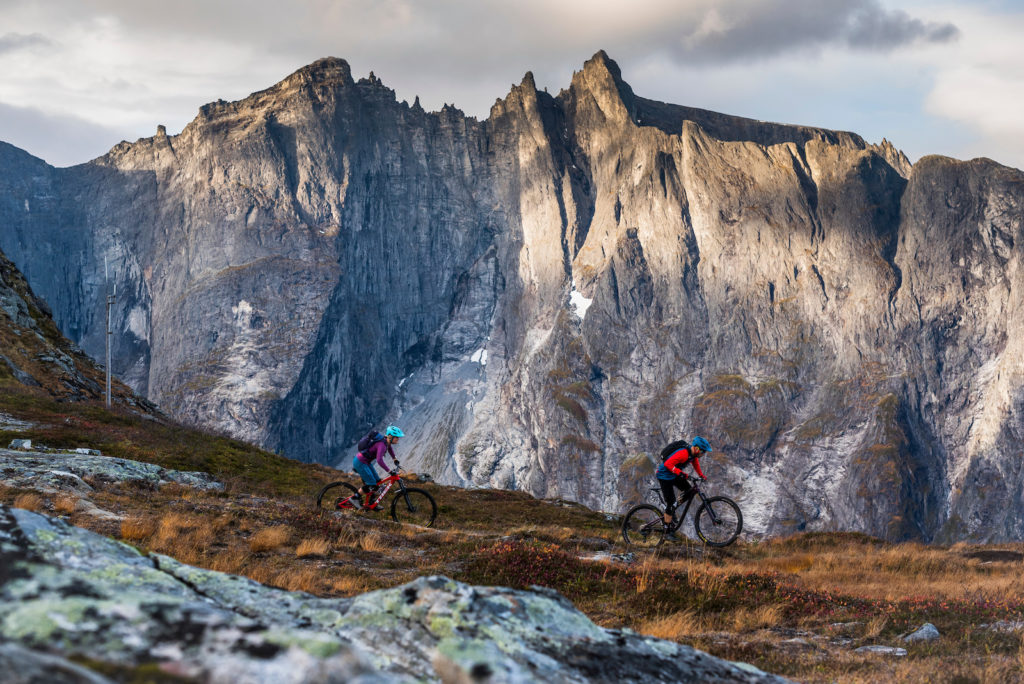
Mountain biking on the West Coast is tough. There are no lifts to take you to the top. And with some climbs rising so quickly, this is definitely hike-a-bike territory, meaning you’ll have to earn your turns in the summertime, too. However, riding on the West Coast is spectacular and well worth the effort. If you aren´t convinced by the views at the top, the ride down is guaranteed to win you over.
ValldaL is placed between the two main tourist attractions of Trollstigen and Geirangerfjorden at the Norwegian western coast
Whether you prefer smooth, flowy trail or a more technical ride, Valldal offers it all. The quality ride, small-town coffee shop, strawberry fields, fjords and unique mountain views make it sound like a cliché, but it´s not. It´s Valldal.
Whether you prefer smooth, flowy trail or a more technical ride, Valldal offers it all
Perfect for bikers as well as photographers
There’s no such thing as bad weather. Every day is a single-track kind of day! Don’t let a little rain stop you. Try the Hunter series from Sweet Protection if you´re in need of an upgrade.
Valldal was the perfect location for the Sweet Protection photo shoot
This was the perfect location for our Sweet Protection photo shoot. The views, the unique terrain and the best trails were searched for, like for instance the Romsdal´s Horn.
Sweet Protection searched for unique terrain and the best trails
Another upside of the choice of location, is the fact that you will never run out of water. Waterfalls are not a rare sight, and the water quality is first class.
Biking at Roimsdal’s Horn
The History of Sweet Protection
The Sweet Protection story started in Trysil, a mountain village in Østerdalen, Norway close to Swedish border in 1988. The Sweet mantra, stronger – lighter – better, can be traced back to a school paper from 1988, made by one of the founders and design manager, Ståle N. Møller. A pioneering and visionary industrial designer on a relentless mission to let action sport enthusiasts benefit from the properties of high tech materials and manufacturing methods.
Ståle N. Møller, the creator of Sweet Protection, Photo: Wikipedia
Some years down the road, and the scribbles on a paper have become the core of a unique brand identity, and in the process the mantra has evolved into a purified sentence: We create superior protection inspiring people to push their boundaries.
From the Sweet Protection photo shoot
How an illegal skate ramp was the start of a successful protection company Skateboarding was prohibited in Norway until 1989, as the only country in the world. Judged to be dangerous by the government. Growing up in a small town in the deep forests of eastern Norway, Ståle and his friends were clueless of how the banned sport of skateboarding was developing in other parts of Norway. Together they built a 7 meter high vert ramp hidden in the woods, and this was where it all went down until the prohibition law was repealed and a better ramp was built in the center of town.
Local shredders were supplied with handmade boards made of fine Norwegian wood out of the garage of Ståle´s parents. Ståle was also always busy improving and creating clothing and equipment for the boys, even making his own snowboard. In the mid 90’s, they made the clothes and backpacks they wanted and needed for their own expeditions, built to stand the harsh conditions on the biggest mountains.
Straight out-of-the-garage products made the world championships In 1997, freestyle kayaking was gaining ground. The existing kayaks were crap, and Ståle made a kayak revolution by developing a Kevlar wonder for his friend and top kayaker Erik Martinsen. This was the first spark of the Sweet brand emerging. With Ståle still in design school, he made another head turner, a carbon fiber helmet Erik could use in the freestyle kayaking world championships.
Ståle’s innovative approach and fresh design was breathtaking. Everybody wanted it. In 1999 Gøran, a member of the crew, came up with the idea of establishing a new company: “Sweet North”. However, half of the name was dropped, and Sweet was born.
Snowboard legend Terje Håkonsen on board The company was founded in 2000, and one of the first moves was to approach another uncompromising Norwegian; snowboard legend Terje Håkonsen. He saw the potential in the helmet prototype that was presented and joined the team. With Terje on board, Sweet made the move from the local garage to the international scene. Today no Sweet products leave Trysil without the influence of the team.
Terje Håkonsen. Photo: Sweet Protection
In 2003 Sweet made their first ISPO appearance, and immediately won the Brand New Award for best newcomer. The products had close ties to the initial, homemade gear the boys used exploring mountains in their youth.
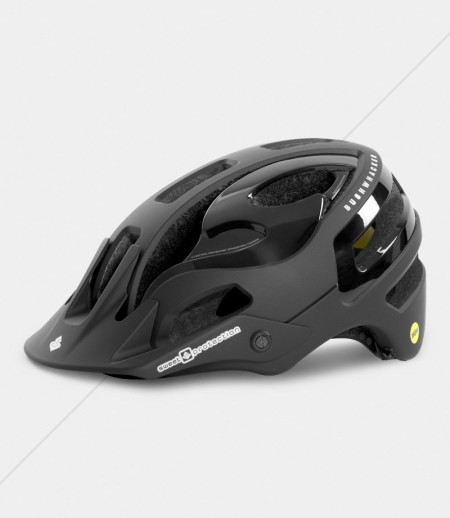
The Bushwhacker II MIPS helmet
Expanding the protection line
Until 2005 all helmet production was manufactured in Trysil, Norway. Due to capacity issues Sweet moved the production to Italy, a necessary move to continue to grow. In 2011 the first bike helmet from Sweet was put into market aimed towards the more aggressive part of the biking community. The biking range evolved to include the award winning Bushwacker, the go to helmet for single track biking. The Sweet gang continues to push revolutionary products into the market and MIPS, with their revolutionary rotational gravity impact technology, becomes an important strategic partner for Sweet, making the helmets even safer.
The Dissenter MIPS helmet
Aksel Lund Svindal proving the Sweet helmets to be first choice for alpine skiers
Sweet takes racing seriously and in 2012 Sweet teams up with Aksel Lund Svindal who gives the hand- crafted Rooster Corsa its debut in the alpine World Cup in Sölden, Austria on October 27 the same year. The helmet, made from pre-preg carbon and thermoplastic fibers, is baked in an autoclave, the same technique used to make Formula 1 racecars.
Aksel Lund Svindal in the slopes. Photo: Red Bull
In 2017 Sweet introduces a new single-track bike helmet named the Dissenter and the iconic Falconer helmet for serious road bikers.
Sweet’s products have since received several domestic and international awards for design excellence as well as best gear.
All photos, except where noted, taken by Dan Milner for the Norwegian brand Sweet Protection.
We thank Sweet Protection for their kind cooperation making this article, Sweet and Safe World-Class Biking on the Norwegian Western Coast, available for Daily Scandinavian.
Celebrated Norwegian architecture firm Snøhetta is designing Norway’s largest astronomical facility. The architects aspire to capture the feeling of being wrapped in nature and at the same time being in space.
The campus, set within a dense forest, 72 kilometers (45 miles) north of Oslo, will include a variety of buildings inspired directly by planets and their orbits. This will be a spectacular destination for astronomy fans. Imagine tripping over a small planetary system in a forest.
The campus, set within a dense forest will include a variety of buildings inspired directly by planets and their orbits
Built for spying during the cold war
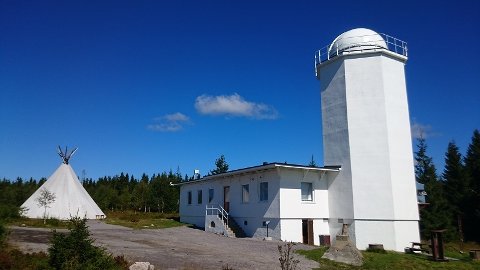
The Solobservatoriet in Harestua was originally built for the total solar eclipse in 1954 and used by the US military to spy on Soviet satellites during the cold war. Today it is operated by Tycho Brahe, an institution whose mission is to perform scientific research and enlighten the public about wonders of the universe.
The planetarium will look like a glowing planet
The planetarium will look like a glowing planet, and the dome of the 100 seats “heavenly viewing theater” will be planted with grass, wild heather, blueberry and lingonberry bushes as a smooth transition from soil to sky. Snøhetta’s designers took astronomy classes and were captivated by the architecture of the galaxy. “We learned about the analemma diagram of eight shapes made by the moon and the sun if you look at them from the same point for 365 days,” says Ingebjørg Skaare, a senior architect at Snøhetta who is working on the project.
Serving groups up to 32 persons
Stargazers who want to spend the night in the forest, can use the designated accommodation, serving groups of two to 32. The circular cabins will scatter loose around the planetarium, by design. A local wood company will work with Snøhetta to develop efficient construction techniques for the cabins. Custom-built furniture will be designed for the rooms’ unusual floor plan.
Snøhetta’s redesign will transform Solobservatoriet’s rather modest facility to an international destination
“A cabin can rise slightly above the ground, partially sunken or just touching the ground like a kiss, creating a planetary system on the site,” explains Skaare and adds: “The intact landscape on the site is one of the most important qualities for the experience.”
An international destination
The planned expansion includes a visitors center as well as several small outbuildings to the observatory’s historic telescope tower. When completed in 2020, the 1,500 sq. m observatory will be the largest solar observatory north of the Alps.
The old Harestua solobservatorium
With cafés, dreamy accommodations, even a generous “bowl-shaped” children’s area on the bowel of the planetarium, Snøhetta’s redesign will transform Solobservatoriet’s rather modest facility to an international destination.
Campus for Astronomy Fans is Being Built in Norway, written by Tor Kjolberg
The Man behind the Montana shelving system, Danish Peter J. Lassen invented freedom in a box – and he never turns old.
“Creating good design demands honesty and respect,” says Peter J. Lassen, the creator of Montana shelf system, whose simple and functional designs have become classics. When he developed the Montana System, there was a detailed mathematic and philosophical principle behind it. That’s why the design has been renowned for its simplicity and the functionality of their design.
From a career as a naval officer, Peter J. Lassen switched to the furniture industry in 1954. In 1982 he founded Montana Møbler A/S in Hårby, on the Danish island of Funen. For many years he worked with the architects Arne Jacobsen, Jørn Utzon, Piet Hein and Verner Panton, by whom he has been strongly influenced. The evidence is seen in the clean lines and functionality of his design.
Peter J. Lassen
The mathematic calculations are complex and based on 5.7 cm, but the philosophy is quite simple: Every Montana element should be able to be infinitely combined and be practical, good looking, durable and independent of changes in fashion.
“It must be possible to revolutionize the interior design culture and provide everyone with the potential to put together a room with a personalized touch,” he says. Father-and-son team Peter and Joakim Lassen have designed many of Montana’s products – often in collaboration with Montana’s design team or with external designers.
“Montana has become a system about freedom, not only at the moment the choice is made, but the freedom to alter the style, composition and function, whenever the urge strikes you,” says Peter Lassen.
The Story of a Danish Shelving System, written by Tor Kjolberg
Ekstremsportveko is the largest extreme sport festival in the world, and is hosted every year in Voss, Western Norway. There are competitions in kayaking, rafting, mtb-bmx, skateboarding, skydiving, paragliding, hanggliding, multisport, freeride, big air, climbing, speed riding, cliff diving, biketrial, wind tunnel, BASE and longboarding.
For one whole week, 24 June – 1 July national and international athletes compete and challenge themselves in the elements. However, competitions are not always the main focus for the athletes. The sharing of knowledge, when hundreds of top athletes are gathering this last week of June, is just as important.
Ekstremsportveko is the largest extreme sport festival in the world, and is hosted every year in Voss, Western Norway
The various sports are the main focus of Ekstremsportveko. However, the music program has become an important part of the total festival experience. The last three days of the event, national and international artists spice up the festival with their vibrant music within the genres; pop, rock, funk and reggae!
Slopestyle and bmx at Elstremsportveko
Ekstremsportveko is owned by the non-profit organization Stiftinga Ekstreme Voss – “The Ekstreme Voss Foundation”. Voss Active, Voss Kayak Club, Voss Hang and Paraglider Club and Skydive Voss are the four local clubs who represent Ekstreme Voss. There are two people working in the administration full time all year round. In addition to this, Ekstremsportveko rely heavily on positive and hard working people. Every year 800+ volunteers from all over the world contribute to make the festival a huge success.
Music is an essential part of the festival, and this year the organizer has dug deep into different genres and carefully selected a line up hard to ignore. Extreme sports during the day. During the night rock, hip-hop, electro-rock, electronic new wave, EDM and more.
The following artists are lined up for this year:
DATAROCK
Datarock
Whether you are a music fanatic or not, we believe everyone should have to experience, for themselves, and see their favorite band perform, live. As for rock music fanatics with a touch of the groove, you cannot call your self an “electric rock fan” if you have not, at least once, seen Datarock perform on a stage. Known worldwide for their playful rock music, Datarock tour the world with millions of fans all over the globe. Their music is all about having fun, known famously by wearing red tracksuits and big glasses. Datarock live performances have so much energy and vigor, the energy in the atmosphere is palpable.
ARIF
Arif
If you are a hip-hop music lover, the Norwegian rapper Arif is a must on your playlist. This young artist has proved to be one of Norway’s most important contributions to the rap and RnB genre. He has the ability to play with words making them flow, and his ability to tell today’s generations stories. His music makes necks turn, heads to nod and feet to move with joy and fascination. In attending any of his concerts, you will get to meet major players in the music industry. After selling out one of the biggest stages in Norway, Oslo Spektrum, Arif is now the talk of the town.
WHALES AND THIS LAKE
Whales and This Lake
Electro-pop music lovers must attend Whales and This Lake’s concerts. They are the true definition of electro-pop genre music. This band, comprising of three artists, are doing “whale pop”, which is characterized as a dark and dancy genre of indie electro pop. The three artists originate from the sparsely populated Norwegian countryside where synths are homemade and the drums have been covered by whale skin for thousands of years. Why attend their live concerts? Whether you have never heard them, listened to them for a few days – or finally getting to see your favorite artists live, this is such an immense feeling to experience live. Whales and This Lake band with no doubt will play a major role in the European music scene for the next decade.
THULSA DOOM
Thulsa Doom. Gere as Conan, the Barbarian
There is no better place to enjoy metal music than a live concert. Thulsa Doom is a metal band, formed back in 1999, based in Oslo, Norway. Springing out from the record label Duplex Records, with bands such as Cumshots, The Dogs, Bare Egil Band, Black Debbath and Hurra Torpedo. Their music is inspired by Kyuss and early Black Sabbath. Stoner rock music fanatics know the true meaning of metal music through this band. This is a very famous band in Norway. They have been in the music industry since 1999. As a health benefit, if you get to see your favorite artists perform live, that tends to bring joy and happiness to people, not to mention the calories one burns when in the moshpit.
KREAM
Kream
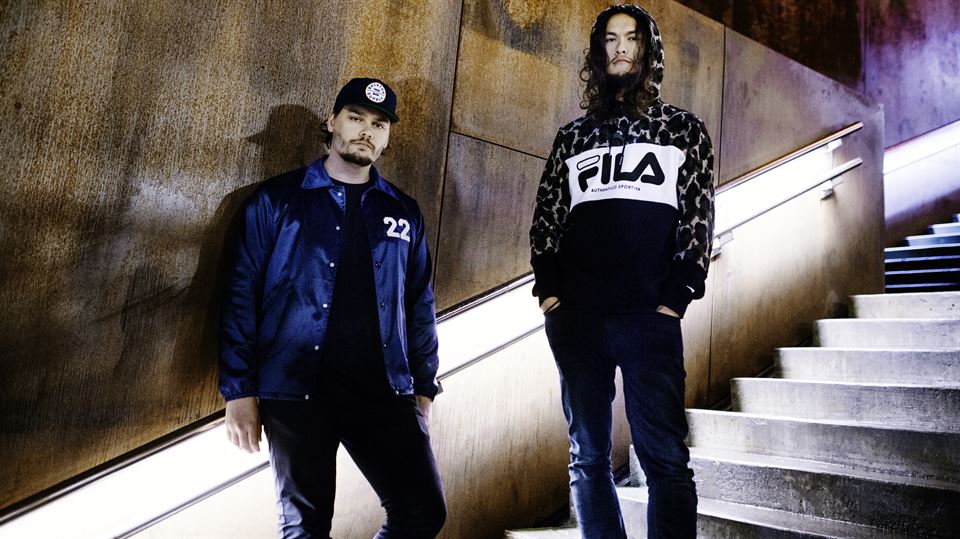
Hailing from Bergen, Norway, and formed in 2015, KREAM features the talents of brothers Daniel and Markus Slettebakken. The Norwegian electronic-based duo is known for their high-energy house-oriented pop music, with gloomy undertones. Attending their concert is a must go for house music lovers. Kream released the song that they co-wrote with Swedish songwriting duo SHY “Taped up Heart” which feature vocals from Clara Hagman. The song has charted on Billboard’s Hot/Dance Electronic Songs chart and peaked at 22. Kream is the cream of house-oriented pop music. In a few year expect Kream to be the cherry.
FUTURE DUPER
Future Diper
Future Duper is a new name in the EDM/Pop music world. With their remixes, they have brought a new life to tunes from Alan Walker, Avicii, and Galantis and among others. Over time, they have developed their own bouncy and melodic tune. The band comprises of two members based in Oslo, Norway. Attending their concert gives their fans a chance to be really close to what was once an underground movement.
HKEEM
Hkeem
Hkeem is the kid on the block in Stovner, Oslo, in Norway. Bringing a new style of rap in the Rap world in Norway, Abdulhakim Hassan, better known as Hkeem, came into the spotlight after he and his youth friend Temur Baig released his breakthrough song “Fy faen”. This song, launched in April 2017, reached the first place on the VG list (Norwegian version of Billboard) in week 17, and became Norway’s most streamed song on Spotify. For the song, Hkeem and Temur were nominated in the class This Year’s song during P3 Gold 2017.
SONNY ALVEN
Sonny Alven
Many of us music lovers have very many different reasons why we listen to music; from enjoyment to idolizing our favorite artists. At Sonny Alven’s live concerts, it is an all-in-one package. He is steadily becoming known worldwide for his dance-inducing yet chilled out beats and signature electronic style. He has performed alongside huge electronic acts like Kygo and Galantis throughout Europe and the United States. If you are a fan of the big names in the electronic music genre, then Sonny Alven should not miss in your playlist as well. One of the main themes of electronic music concerts for people to later say “I saw him when he was up and coming”
AMANDA DELARA
Amanda Delara
If you are looking for the most exciting and promising new artist to surface during 2016, Amanda Delara is your choice. Having attended no musical school, she began playing piano in early childhood. As a teenager, she decided to write her own music. If you are a fan of pop music, you must be an Amanda Delara fan as well. Feeling like your spirits are down? Attending a concert is typically a high energy activity, and it can help to boost your fatigue throughout the day if not the whole extreme sports week.
KURT NILSEN
Kurt Nilsen
Kurt Nilsen is one of Norway’s best-selling artists and is one of the country’s popular live performers. He got his breakthrough in the norwegian TV-show “Idol” (like American Idol) in 2003 and became the year after World Idol. Since then, he has received countless awards, released several critically acclaimed albums and had some of Norway’s biggest radio hits.
Now, he are coming to Ekstremsportveko for a rare and intimate live performance on Wednesday June 27th.
RÖYKSOPP
Röyksopp
The Tromsø squad Svein Berge and Torbjørn Brundtland make up the electronic music group Röyksopp. The duo was officially formed in 1998, but has made electronic music ever since 1988 (!) And is undoubtedly pioneer in the genre. Ever since the debut, they have made great success both at home and abroad, and collaborated with famous artists such as Coldplay, Depeche Mode, Beck, Lady Gaga, Robyn & Susanne Sundfør to name a few. They have released a series of mixtapes & six studio albums, four of which have been in the first place on the VG list. They have won the Norwegian Grammy Awards, P3 Gull Awards and nominations for international awards such as Grammy and Brit Awards.
Röyksopp continues to impress the audience worldwide with their visual sensational DJ and livesets. After decades as DJs, they have delivered the DJ-sets in clubs all over the place; from London, Dubai & New York, to Mexico, Tokyo & Ibiza.
In June they are coming to Ekstremsportveko bringing a DJ-set that will set the Veko Lounge on fire.
Röyksopp continues to impress the audience worldwide with their visual sensational DJ and livesets
Note: Due to serving of spirits in the lounge-tent, this concert will be for age 20+. However, the concert will be streamed to the main stage for age 18 – 20 years.
Extreme Artists at the Extreme Sports Festival in Norway, compiled by Admin






 Kulturtårnet consists of two dining rooms as well as outdoor tables and chairs. On the deck there’s a peaceful atmosphere; inside is cozy and fun. So, once you spot the tower with the big white flag, run over and grab a coffee while taking in the sights and sounds of Copenhagen.