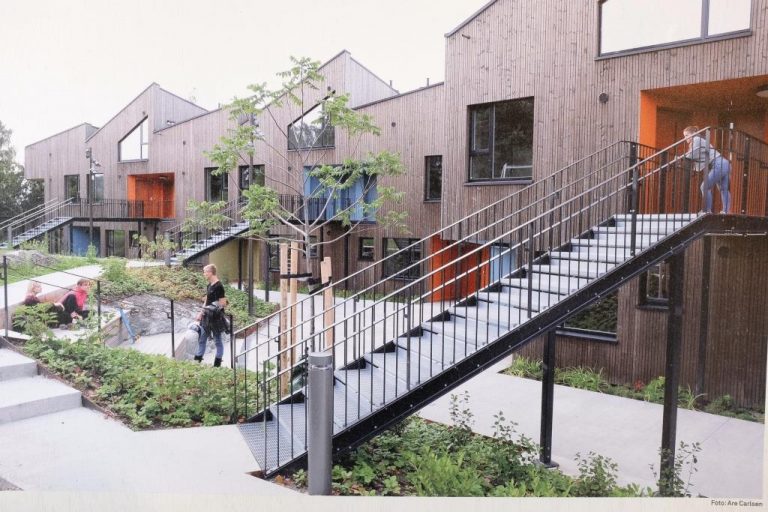
The National Museum of Norway’s decision to focus on the home during 2018 is rooted in the major changes that have taken place in Norwegian housing construction and residential architecture in the past couple of decades.
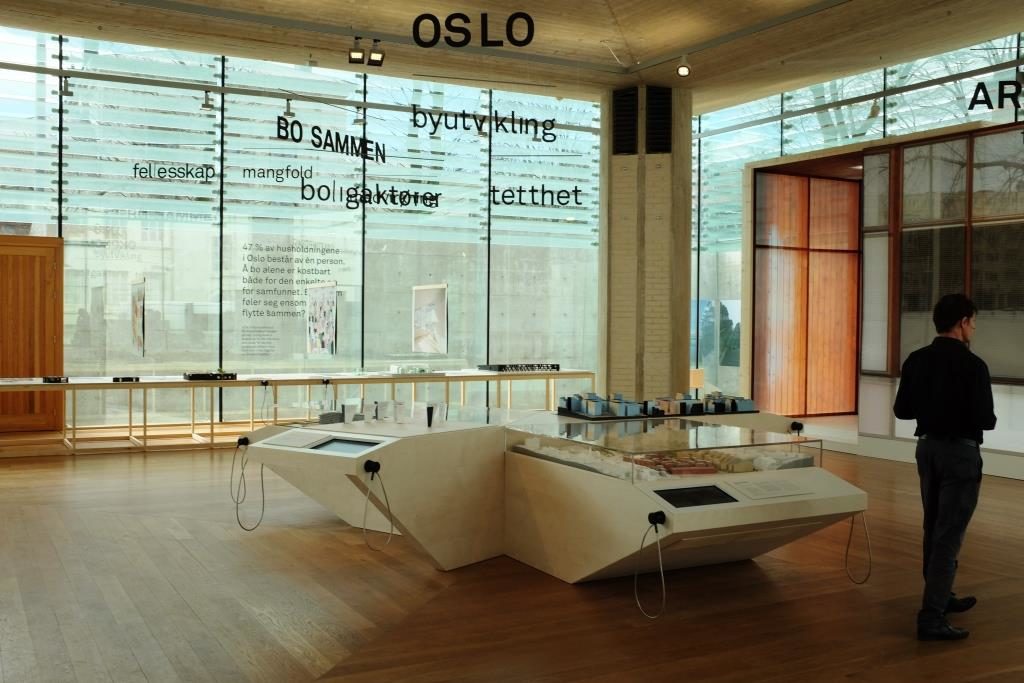
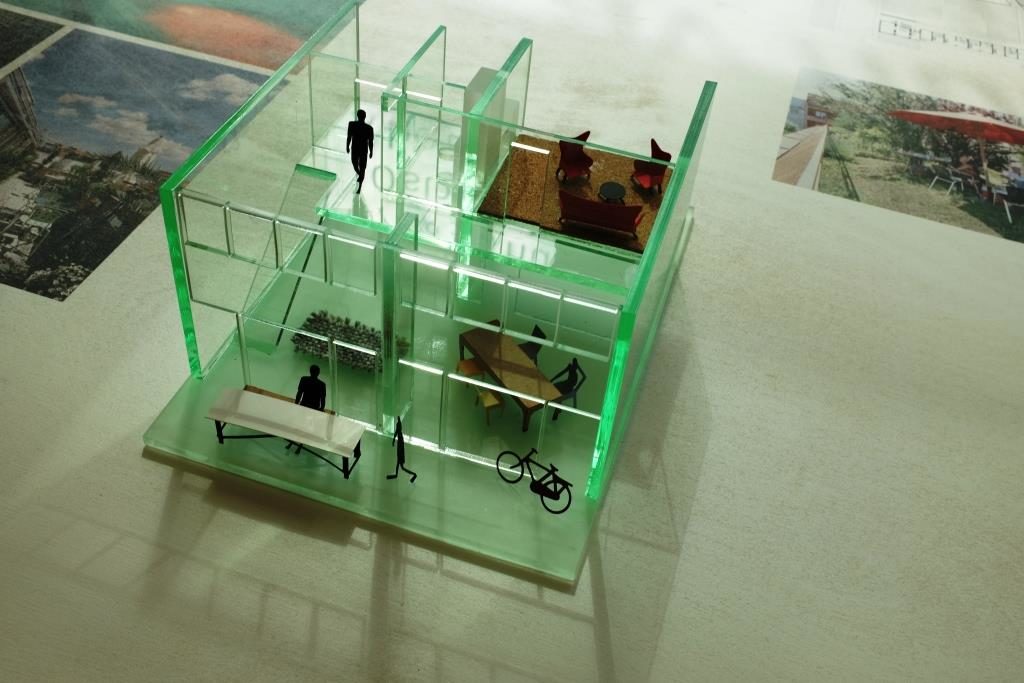
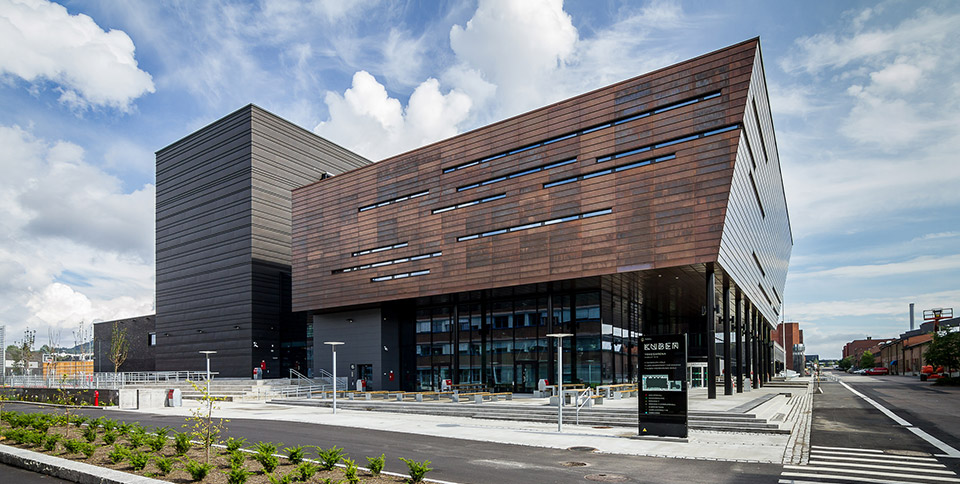
The exhibition “House Viewing” at the National Museum Architecture in Oslo is displayed in the Ulltveit-Moe Pavilion designed by Sverre Fehn and focuses on the current situation in Oslo with references to Copenhagen and Vienna.
The exhibition House Viewing focuses on the current situation in Oslo with references to Copenhagen and Vienna.
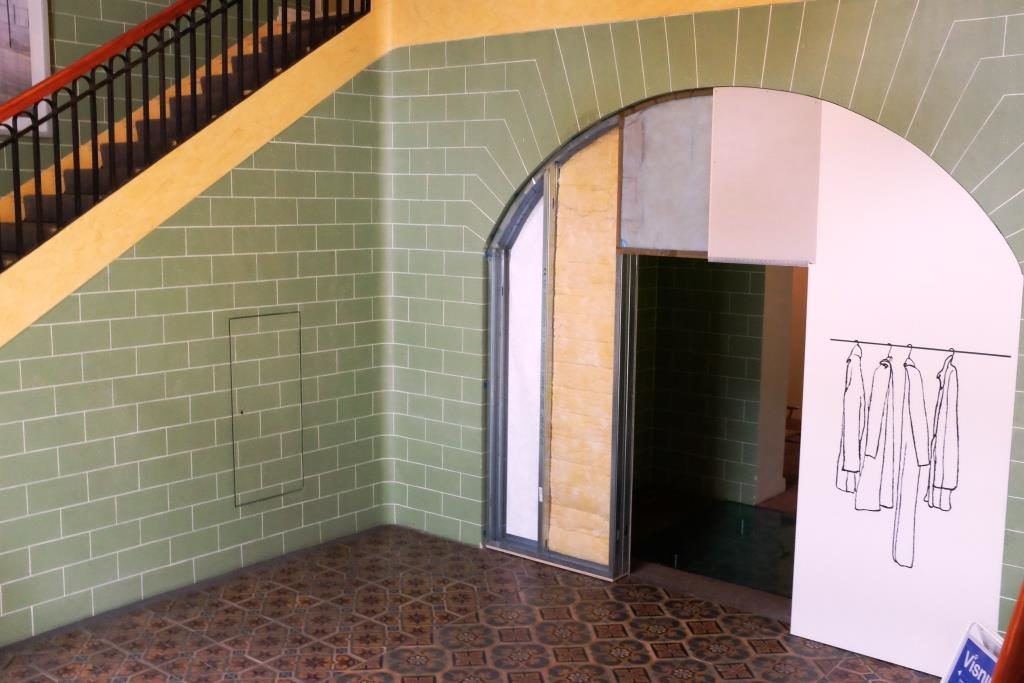
In parallel with the “House Viewing” exhibition un the glass pavilion, the re-designed permanent exhibition “Housing Design” provides a historical backdrop by presenting a selection of residential projects from the past 100 years.
the exhibition is also presenting a selection of residential projects from the past 100 years
The exhibitions are curated by Eva Madshus and Talette Rørvik in collaboration with Ole Haudernack and Marianne Yvenes.
The debate about developments has been dominated by the high prices of homes and the level of speculative development
House viewing in Oslo – Background Since the 2000s, Oslo has been one of the fastest growing cities in Europe, and the quality of the developments has been the subject of heated debates in all imaginable for a and media over recent years. Aside from arguments about quality, the debate has been dominated by the high prices of homes and the level of speculative development.
Experimental approaches to housing design can be found in conversions and extensions of existing buildings
The reason to choose two non-Norwegian cities, Copenhagen and Vienna, is the reputation enjoyed for many years by Danish architects for their quality and housing design, while Vienna since the 1920s has been a role model for social housing in Europe.
Improved isolation materials are important for sustainable modern houses
Housing and welfare in Copenhagen Every month, 1,000 people relocate to the Copenhagen metropolitan area, more than 10,000 newcomers every year. Owner-occupied dwellings dominate the market and are being constructed on the city’s most valuable spots. In consequence, land prices, urban density, and building heights are all increasing.
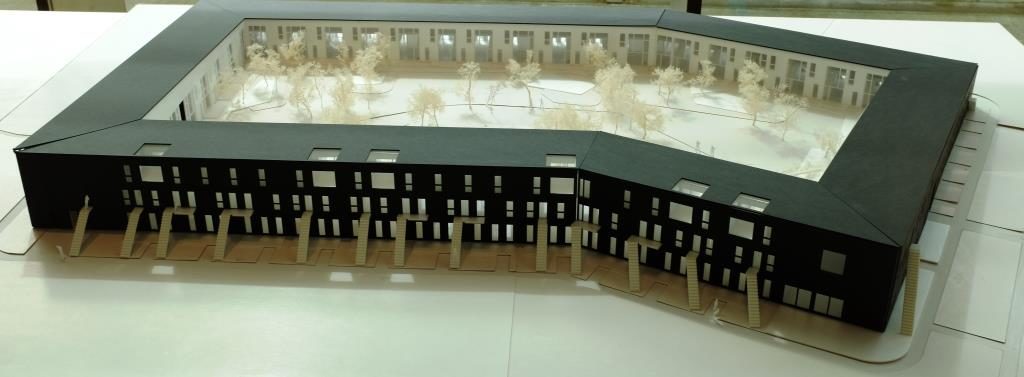
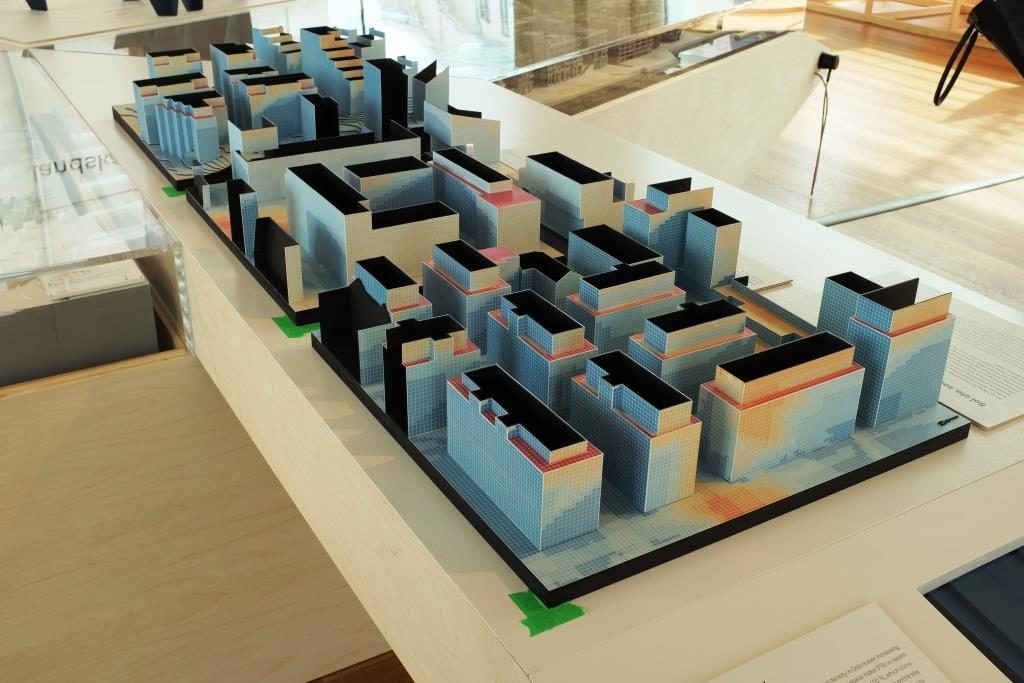
Model of a Copenhagen development
The city authorities are attempting to counter this trend by imposing a requirement that 25 percent of the habitable floor space in new developments must be allocated for social housing. Housing in the owner-occupied sector tends to be uniform and pragmatic, if not downright speculative.
The Copenhagen city authorities are attempting to counter this trend by imposing a requirement that 25 percent of the habitable floor space in new developments must be allocated for social housing
However, experimental approaches to housing design can be found in conversions and extensions of existing buildings. Trends also exist in contemporary Copenhagen social housing, as was the case back in the 1970s and 80s with the move towards low-density development and flat-share movement.
Market-driven densification is still the main driving factor
Contemporary strategies are vital for ensuring sustainability socially, culturally and in the use of resources.
Every month, 1,000 people relocate to the Copenhagen metropolitan area, more than 10,000 newcomers every year
Urban housing architecture in Oslo today: how did we get here? In 1954 architect Frode Rinnan explained the evolution of standard housing in Oslo: “When homes are mass-produced there will always be a tendency to produce a particular main type…that responds best to the economic conditions of the period and is most in accord with contemporary lifestyles.”
An example if housing developments from the sixties
He was thinking particularly of apartment layouts, but the “Rinnan’s Law” temped also to explain to cover the entire house setting, where it is built. After reviewing the typical features of housing construction in Oslo and having shown how “Rinnan’s Law” most probably applies today, it appears that market-driven densification is still the main driving factor.
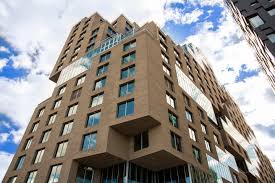
A high-rise building in Oslo
House Viewing in Oslo
House Viewing in Oslo, is extracted from the exhibition’s catalogue, written by Nina Berre, Eva Madshus, Peder DueLund Mortensen and Jon Guttu.
Oslo is loaded with architectural gems, designed by old domestic architectural masters as well as international iconic stars. Therefore, we wanted to make an architectural travel guide to Oslo, showing that the Norwegian capital has it all.
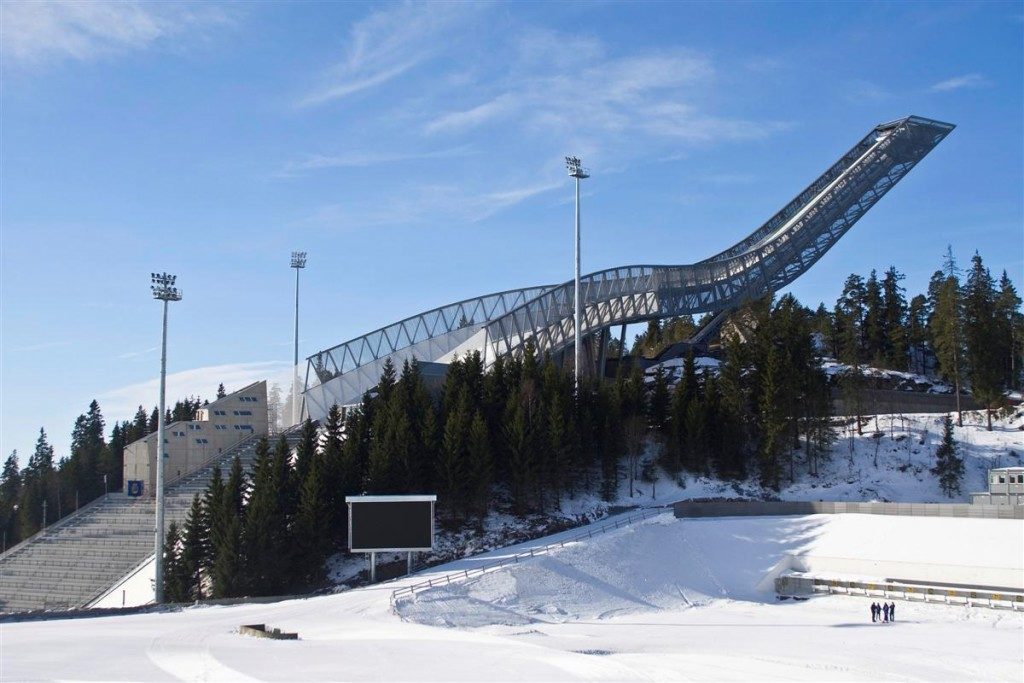
Oslo has several iconic buildings of high international standard, from the Snøhetta’s new opera, to the tourist magnet the Holmenkollen ski jump, rising high above the sea, visible from the city center.
In recent years Oslo has ranked among Europe’s fastest growing capitals, and even if it’s considered a modern city today, it’s more than a thousand years old.
Churches in Oslo
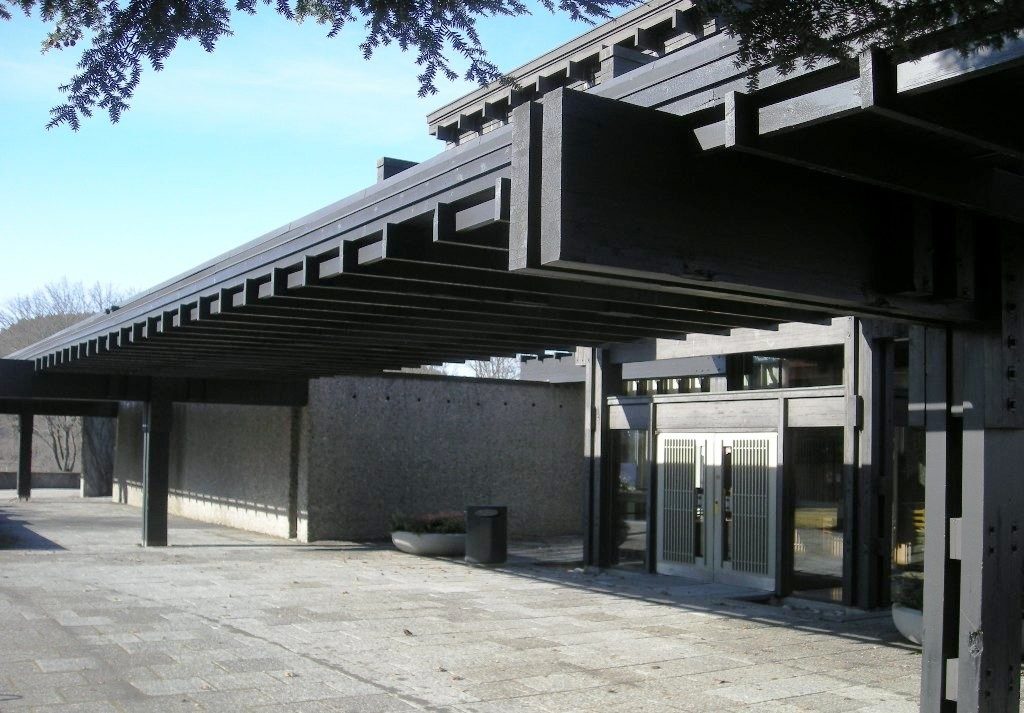
Haslum Crematorium
Many of the churches in Oslo are designed by forgotten but splendid architects. An example is Haslum crematorium, just outside Oslo, designed by John Engh (1915-1996). Engh was educated at ETH Zürich and the Norwegian Institute of Technology where he earned his diploma in 1938. He acted as local architect for the building of the American Embassy in Oslo which was designed by Eero Saarinen.
Haslum crematoria
Engh won an architectural contest in 1962 for the Haslum crematorium, North-East of Haslum Church, The crematorium has been in use since 1966.
Mortensrud church
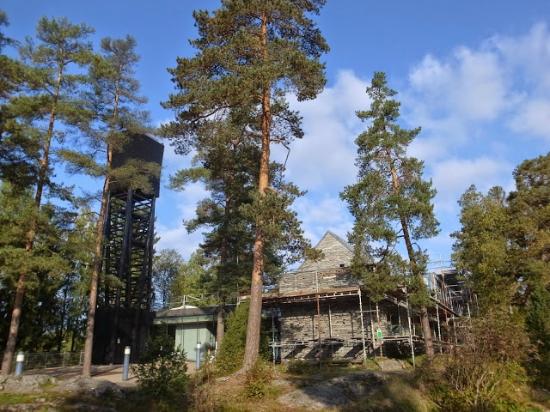
Mortensrud Church Mortensrud Church is located on a small hill surrounded by pine trees. The design by architects Jensen & Skodvin (2002), succeeds in creating a dramatic yet subtle interplay between nature and culture, past and present, tradition and modernization.
Bakkehaugen church
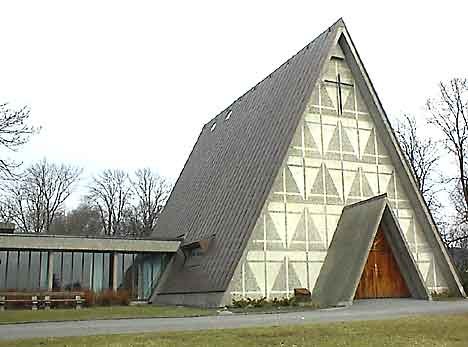
Bakkehaugen Church Bakkehaugen Church is located in Tåsen and designed by architect, Erling Viksjø, who also designed the Norwegian government building complex. The most interesting part of this church is perhaps the tight cooperation between the architect and the Norwegian artists Kai Fjell and Carl Nesjar, who were involved before the building design was finished.
Sinsen church
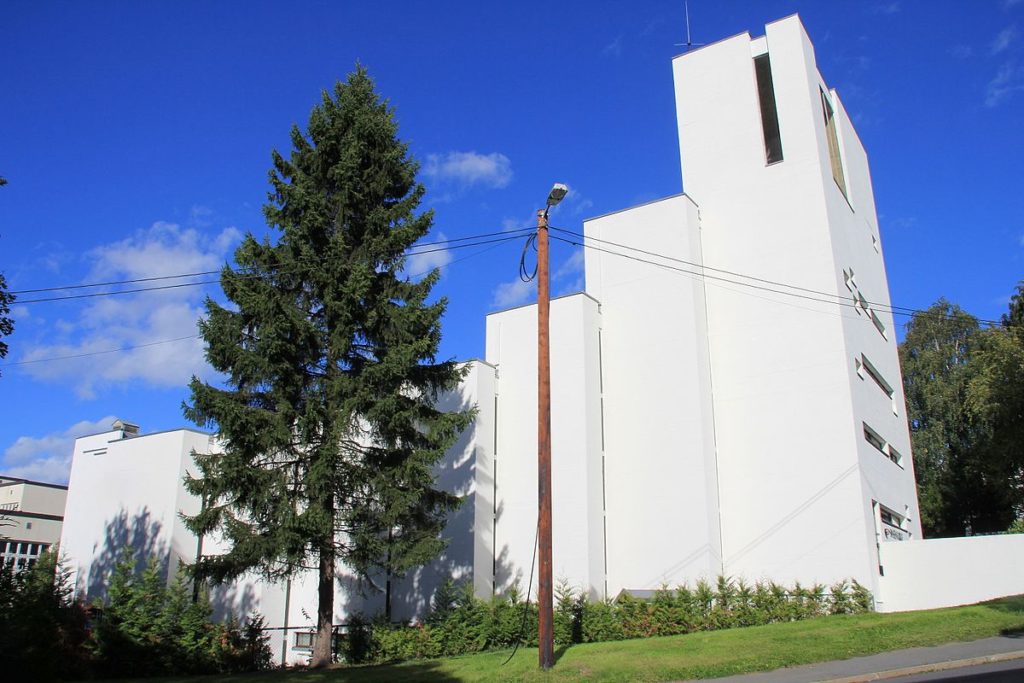
Sinsen Church Sinsen Church is a working-class church, finished in 1971. It’s built in concrete and has 1,000 seats. The church us designed by architects Turid and Kristen Bernhoff Evensen.
American Lutheran church
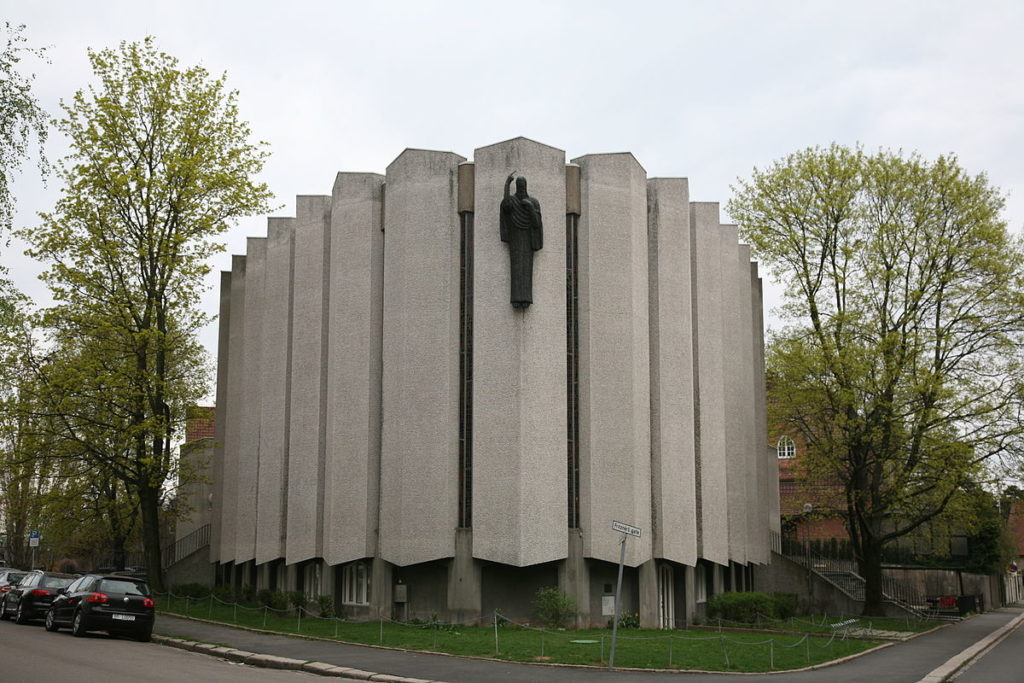
American Lutheran Church The American Litheran Church in Oslo was concecrated in 1964 and is the largest English-speaking church in Oslo with 400 seats. The church was designed by the American architectural firm Sövik, Mathre and Madson of Northfield, Minnesota. An exterior bronze sculpture titled Christ the King by Egon Weiner, former Professor of the Art Institute of Chicago, was unveiled in 1967.
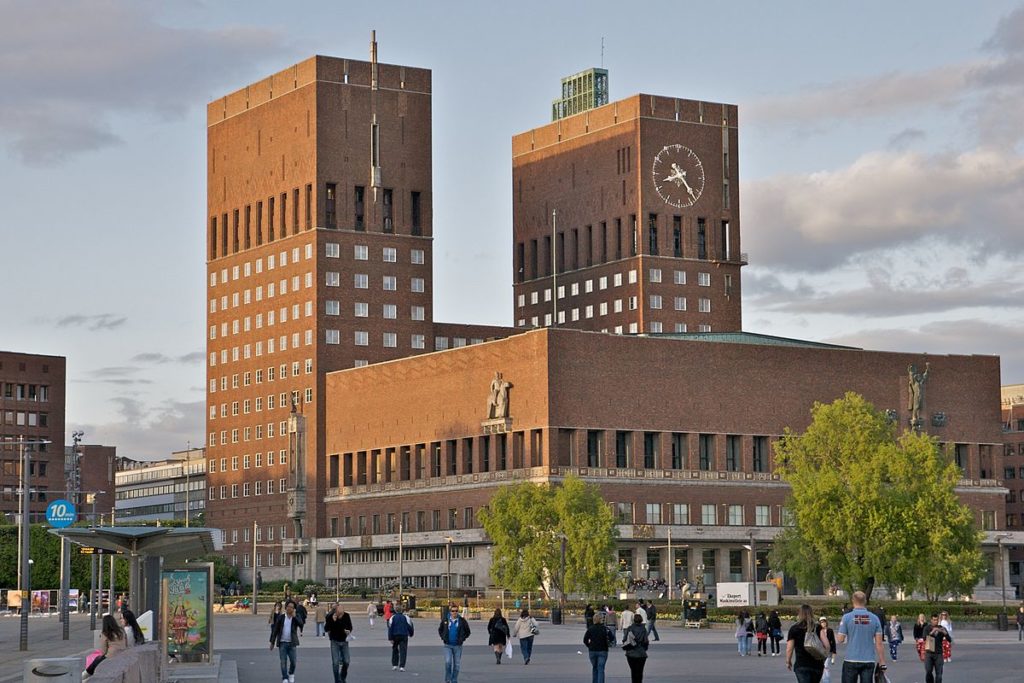
Oslo Town Hall The idea of a location for the Town Hall in Oslo by the fjord in Pipervika, originally a fisherman’s village outside the city proper, was first suggested in 1908. The project was to open up the town towards the sea. 1918 the architects Arnstein Arneberg and Magnus Poulson won the first prize in an architectural design competition with a very historicist proposal inspired by the Stockholm City Hall. In 1929, the architects laid out their eighth and final proposals, the most striking change from the earlier proposals being the division of functions, with two office towers flanking a lower central part, where the main hall, city council hall and other meeting rooms are located.
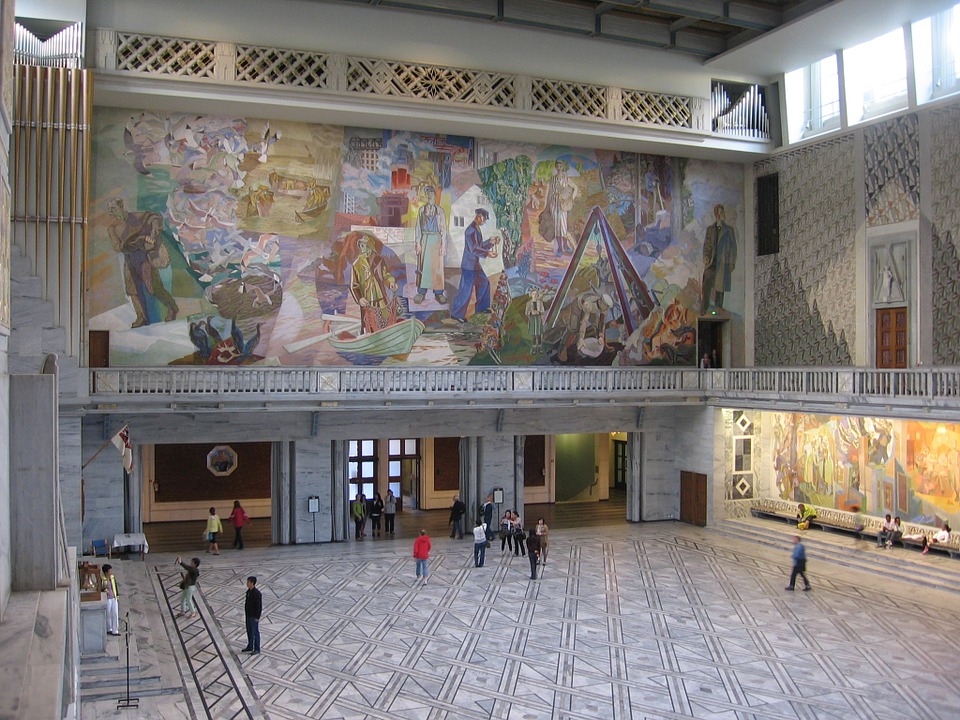
Oslo Town Hall interior
The Nobel Peace Prize ceremony takes place in the city hall, but apart from all official functions, the building was designed as the “living room” of the town, still open to all every day during office hours.
Bærum Cultural Center, Sandvika
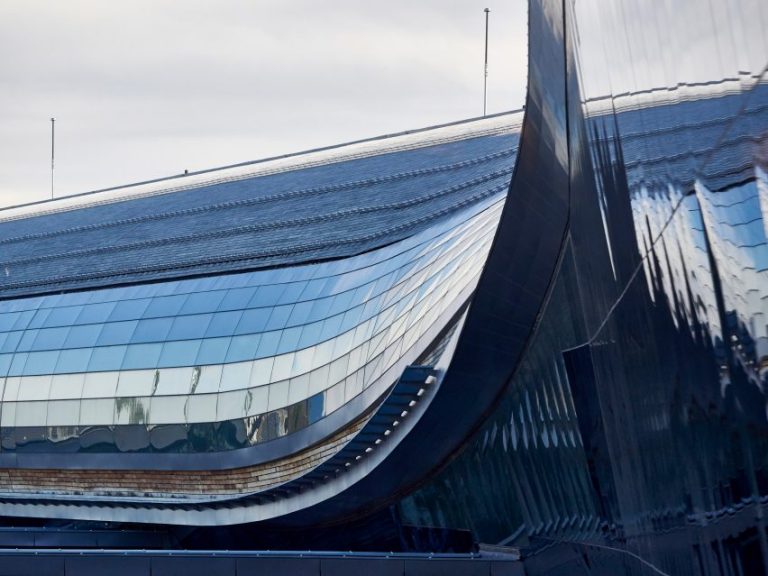
The Bærum Cultural Center was built in a riverside development area, as an extension of the town center of Sandvika, 15 km west of Oslo. It is connecting the old town hall with a bridge crossing the river. The Cultural Center is formed around a 600-seat theater hall, with two rehearsal rooms and a public foyer. The tilted translucent façade elements are strongly present also inside the building, and have been known to play tricks with the sense of balance of visitors.
Barum Cultural Center
The building was designed by architectural firm Snøhetta in 2003.
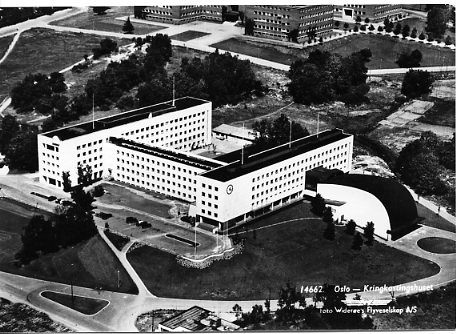
The Broadcasting House – Kringkastingshuset
The Broadcasting House The Broadcasting House (Kringkastingshuset in Norwegian) is the oldest building of the NRK headquarters at Marienlyst, Oslo. The other main building is known as the Television House. It was built between 1938 and 1950 after plans by architect Nils Holter.
Norwegian Bank, Main office
Norwegian Bank Main Office
The building was designed by the architects MNAL Kjell Lund and Nils Slaatto, who won the open architecture competition in 1973. The building was inaugurated on 13 October 1986.
Norges Bank’s Head Office consists of a central block of seven floors surrounded by a rim of four-five floors. The top floors have glass pitched roofs.
Skådalen School Skådalen School was completed in 1975. Its architect, Sverre Fehns says in a text in Byggekunst no. 6-1978 that “the scattered plan was a strategy that allowed the residents to walk from their “homes” to school.” The buildings are as spatially open as possible, and they are designed for children.
The Cube (Kuben)
“Kuben” (The Cube) The project is a combination of secondary and vocational school. It is the largest school of this type in Oslo with 2000 students. The aim of Kuben is to support and encourage lifelong learning. Therefore, the 40,000 m2 building also functions as a meeting place for students, teachers and representatives from the private and public sectors. Kuben is designed by architectural firm Arch Uno.
The Jewel Case (Smykkeskrinet)
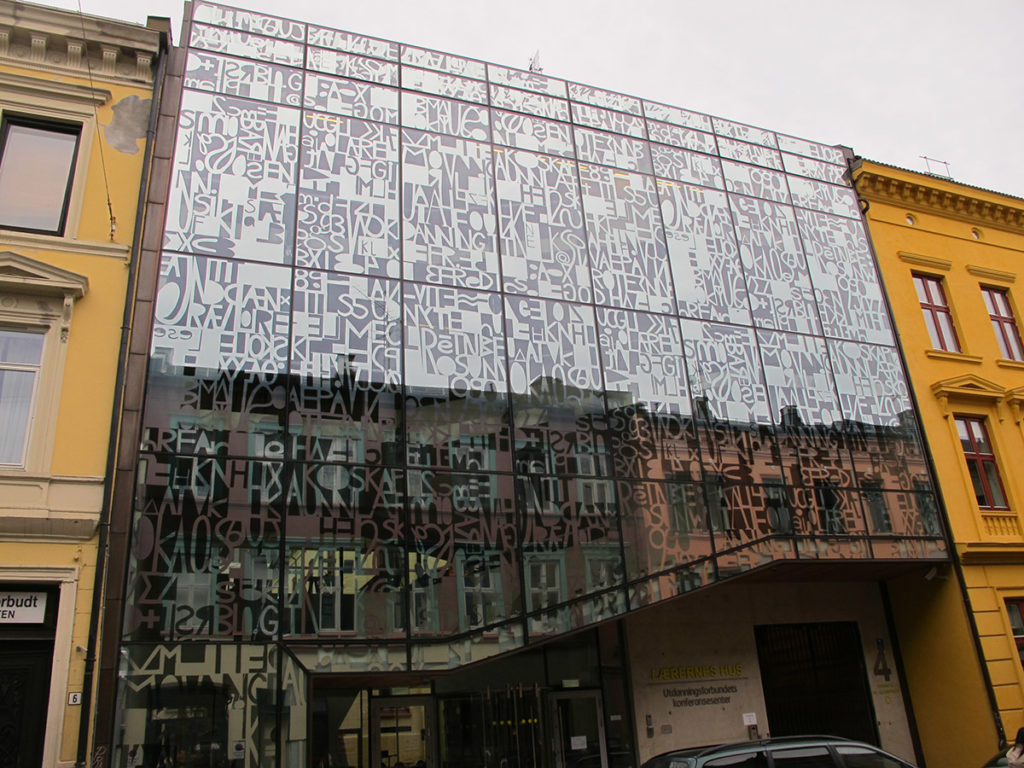
Smykkeskrinet (the Jewel case) Conference Center Element Arkitekter won the competition in 2004 for the Union of Education Norway, which wanted “a conference room as big as possible” on this site. The headquarters for Union of Education is situated in the parallel street and in the backyard. Smykkeskrinet is an extension of the existing facilities.
Artist Jorunn Sannes developed the art on the main facade. The interior concrete work is of a high quality. The spacious stairs just inside the glass façade double as social arenas and are extensively used in breaks between meetings. The top floor has a canteen as well as a generous roof terrace. Some of the furniture of the conference halls is designed by the architects.
Fagerborg Kindergarten
Fagerborg Kindergarten This asymmetrically shaped wooden Kindergarten extends the nearby Fagerborg School with 1.200 sqm of space was designed by architect Reiulf Ramstad in 2011. Besides the big display-windows at ground floor there is a number of smaller windows creating an irregular rhythm and an abstract connection between inside and outside. The different heights allow children of different ages views outside.
Art, Design and Exhibition Centers
DogA Norwegian Design and Architecture Centre
In 2004, Norsk Form and the Norwegian Design Council established this meeting point, gallery and conference center for Design and Architecture in a former Transformer-Station. The building consisted of different additions and alterations from 1860 until 1980. The architects, Jensen & Skodvin, revealed this history by uncovering the “voices” from the past. They removed only the plaster that was in bad shape, thus creating a “story” of the building’s alterations.
DOGA
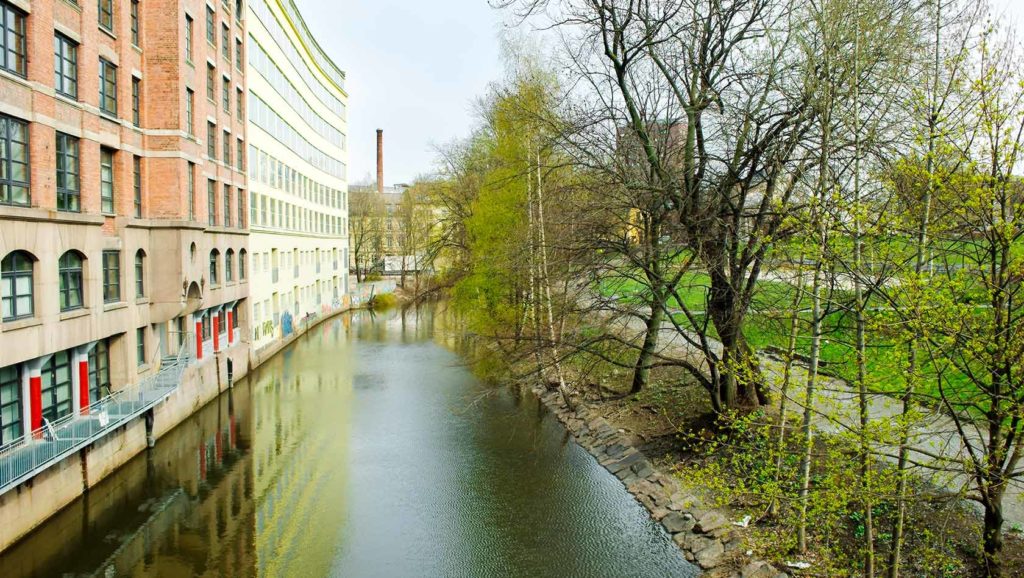
The DogA is a part of an extensive transformation of old industrial structures along the Akerselva river.
Astrup Fearnley Museum of Modern Art
Ferry- and Cruise-ship passenger, who arrive in Oslo from the Fjord are greeted by this private art museum on the waterfront, called Astrup-Fearnley. It was designed by the Italian architect Renzo Piano in 2012. The art collection of foundations based on a former shipping company is seen as Norway’s most important museum for contemporary art.
Astrup-Fearnley Museum of Modern Art
The museum, formerly located in the city center, needed larger facilities. The Tjuvholmen project, an extension of the waterfront Aker Brygge project from the1980’s, is mainly residential and is developed by a private company. Total area of the museum is 4.200 m2.
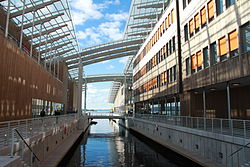
The seaward part of the museum is situated in a small park, with a pebble beach and sculptures. The glass atrium allows views right through towards the beautiful archipelago around Oslo, as does the museum café “Renzo”, which has access to the outside park.
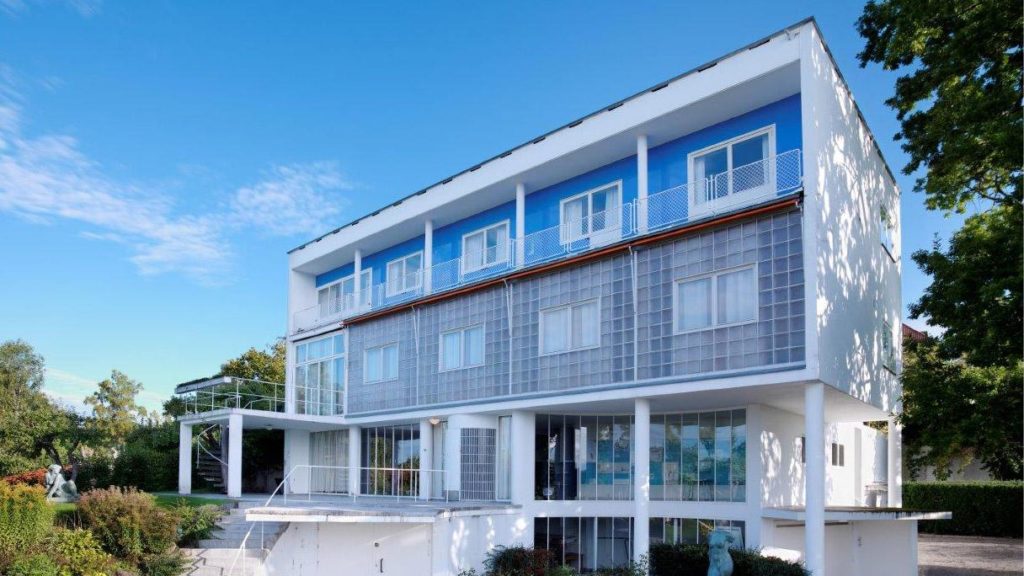
Villa Stenersen Villa Stenersen is considered one of the main works of Norwegian modernism. The private home was built in 1939 for finance broker and art lover Rolf M. Stenersen and his family. Architect Arne Korsmo (1900-1968) applied the international architectural ideas of his time.
Villa Stenersen
The villa was home to works from Rolf Stenersen’s art collection, exhibited in the piano nobile-like first floor, where the façade consists of glass blocks with ordinary windows inserted, partly due to the outstanding view of the city and fjord. Situated on a prominent rise in the landscape, the house has a somewhat monumental character, quite different from the typical coziness of Norwegian villas.
Since spring of 2014, the National Museum of Art, Architecture, and Design is running the villa, restoring the interiors to their original colors, materials and details. Events and exhibitions inform the public of the house’s history and the art, architecture and design of that time.
The Architecture Museum of Norway
The building was once one of the country’s first monumental Empire Style buildings, designed by Christian Grosch in 1830, and its four-story addition of 1910. A branch of the National Museum of Art, Architecture and Design, has taken over the oldest premises of the Norwegian Central Bank.
The Architecture Museum
Sverre Fehn’s introverted Pavilion from 2008 uses daylight, the sky, and the walls of the nearby Akershus Fortress as its references. From the outside, a main motive is the contrast between the concrete outer walls and the dainty glass pavilion. Inside, the pavilion is square in plan with four large concrete columns supporting the shallowly vaulted concrete ceiling.
Visitors enter the museum through the Grosch Building. Reception, bookstore and café are located in the main hall on the ground floor with library and administration on the second floor.
The two top floors of the repository are used as archives for photography and drawing collections and for registration.
In the “Bjørvika” harbor development area the giant, gleaming white opera, built partly into the water, seems like an iceberg in the sun. Most visitors do not enter the spatially refined foyer immediately, but climb the roof of the opera, for the view of the city and an architectural experience. Architecturally the building encourages people to “give it a try”.
Oslo Opera House from above. Photo: birdseyepix.com/Christopher Hagelund.
As Norway’s biggest music-related institution the architects Snøhetta gave it an expression of “horizontal monumentality”, avoiding all “vertical and muscular forms”.
There was a fierce debate about where to build this huge project. Only a few locations had the necessary space available, and for a while the old West Railway Station, which went out of use after a central rail tunnel opened in 1979, was the favored place, next to the City Hall. Snøhetta won the international design competition in 2000 and the building was completed in 2008.
Although modern architecture is as controversial in Oslo as in other cities, the opera has been popular from the start, and locals use it for meeting and greeting, as well as celebrating weddings and other special occasions.
Commercial buildings
Index House (Indekshuset)
Architect John Engh (See Haslum Crematorium above) is most known for his innovative work in stone and concrete. He sat on the board of Norwegian Architects’ Association from 1952 to 1968; from 1964 as president. His designs Include the Oslo Central Station, Indekshuset at Solli plass and several other offices buildings.
The Index House
The name, Index House, is a combination of Industry Export, since it once was the headquarters of Norwegian Industry Association and the Norwegian Export Council. The building was finished in 1964.
Technopolis Fornebu The “portal building” in Fornebu is an extension to the former Airport Terminal housing business and incubation centers for information technology companies on 28.000 m2.
Technopolis Fornebu
Architects A-lab was commissioned to develop the building, after winning the competition in 2004. The building was completed in 2009. A base resolves the height difference of the terrain between the main street and the old terminal.
DNB Nor
The Dutch architects MVRDV from Rotterdam designed the headquarters for the biggest Norwegian Bank. The urban design competition for Bjørvika’s “Barcode” project was won by MVRDV with Dark and a-lab (both from Oslo) in 2003. The building was completed in 2012.
DnB Bjorvika
The Barcode consists of 12 buildings with 10.000 work places and 500 apartments. All buildings are long slender slabs, high volumes with sightlines in between. The great variety of heights, materials and shapes is intentional, and the volumes of the buildings create a unified composition.
The office tower is the central structure of the new DNB bank headquarters, which also occupies the flanking buildings, and has 17 floors stepping forwards and backwards in an irregular pattern, blurring the contour of the tower. 2.000 employees work in the building. A basement hall, 3.000 m2 in size, connects to the neighboring buildings, designed by Dark and a-lab.
The new headquarter is aiming for synergy and a corporate identity concentrating twenty DNB office locations dispersed over the city.
Panoramic 140 seat canteen on the top, the executive lounge with a view over the fjord, the board room, and in the heart a trading room with 250 work stations.
Equinor Offices Fornebu, Bærum Equinor, formerly Statoil, is an energy company with more than 20000 employees developing oil, gas, wind and solar energy in more than 30 countries. 2500 of these work in this office building, with a view over a park and the fjord of Oslo.
Equinor Fornebu
A-lab architects won the competition for the project in 2009. The building balances size and architectural expression with its surroundings, whilst introducing new impulses that enliven the area. The building was completed in 2012.
Inside, the warm oak interior and cool aluminum reflects the soft northern daylight. A unique feature of the design is the artistic decoration on the underside of the cantilevered wings flanking the main entrance.
Restaurants, Hotels and Travel
Lysaker Railway Station
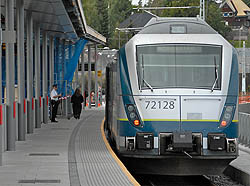
Lysaker station on the Drammen Line and Asker Line is situated in Bærum, near the former airport of Fornebu, making it an important node for both local, regional and airport express trains.
Lysaker Railway Station
The station project is a result of the new train line westwards from Oslo, which made it necessary to double the number of tracks and platforms. The station is elevated and features two island platforms with four tracks. Snøhetta won the architecture competition for the station, the rather sharp curves of which caused some concern about safety. It was completed in 2009. The platform roofs are shaped as sculptured “clouds”, floating above the slim columns, adding visual qualities to the station.
Gardermoen Airport Gardermoen Airport is the gateway to the Norwegian capital and thus to Norway as a whole. After several decades of planning, with proposed locations all around the Oslo area, all of which were rejected by the local communities, the airport was finally built at the existing charter airport of Gardermoen, 50 km north of Oslo, when the inner-city airport west of town could no longer grow.
Oslo Airport Gardermoen
It was designed by a consortium called Aviaplan, which comprised Narud Stokke Wiig (now Nordic Office of Architecture), Niels Torp, Hjellnes COWI civil engineers and Bjørbekk & Lindheim (landscape architects). The consortium was incorporated in 1990. Aviaplan won the architectural competition to design Oslo Airport and continues to design airports including those at Tallinn, Riga, Landvetter, and Hyderabad. The design concept for the main passenger building in Oslo was to create “simplicity, lucidity and a subdued sense of monumentality” according to the architects. The impressive control tower is also designed by the same architects. The Gardermoen line, built specifically for the airport project, and still Norway’s only high-speed railway, is also the main line northwards and brings you to the city center in 20 minutes. The station is integrated in the terminal.
First phase was completed in 1998. The airport is still under development.
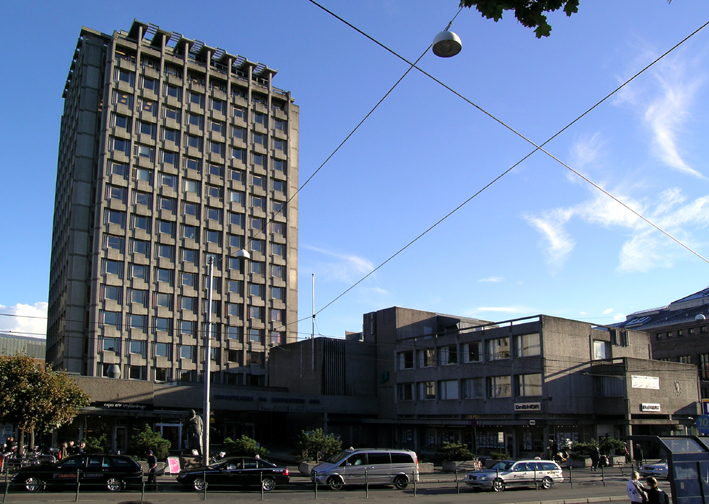
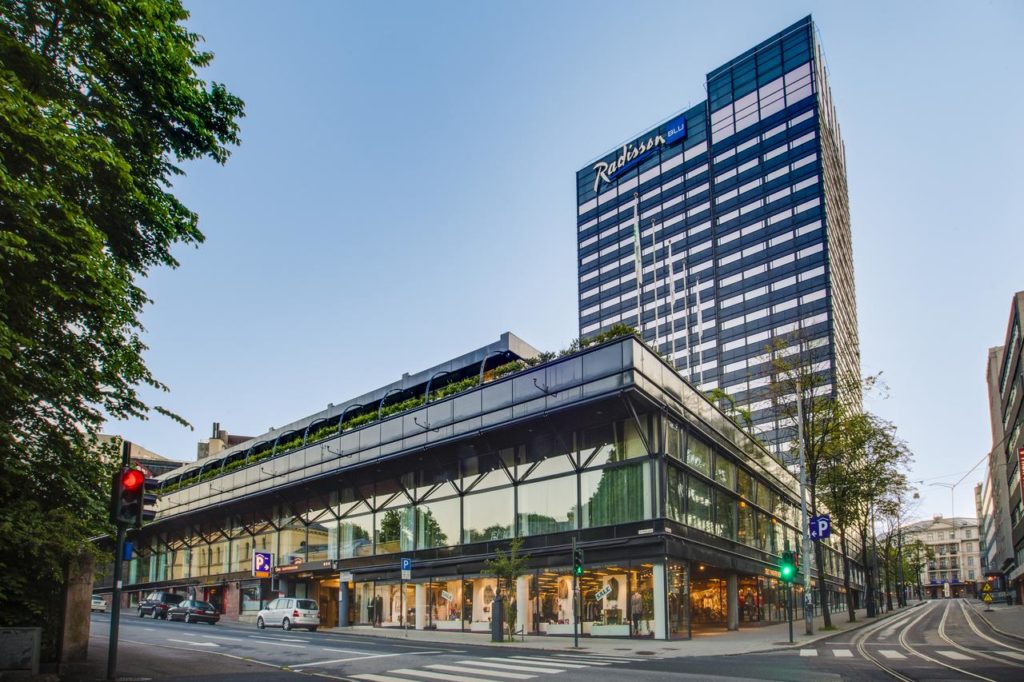
Radisson Blu Hotel Holberg Plass With its 67 meter it used to be the tallest building in Oslo, and even today ranks as third highest. The Radisson Blu Scandinavia Hotel is located just east of the Palace Park. A whole city block of 19th century buildings was demolished to make room for the project, which was the winning design of a Nordic architectural competition in 1969, won by Jon Lunding. The hotel was completed in 1975.
Radisson Blu Hotel Holberg Square
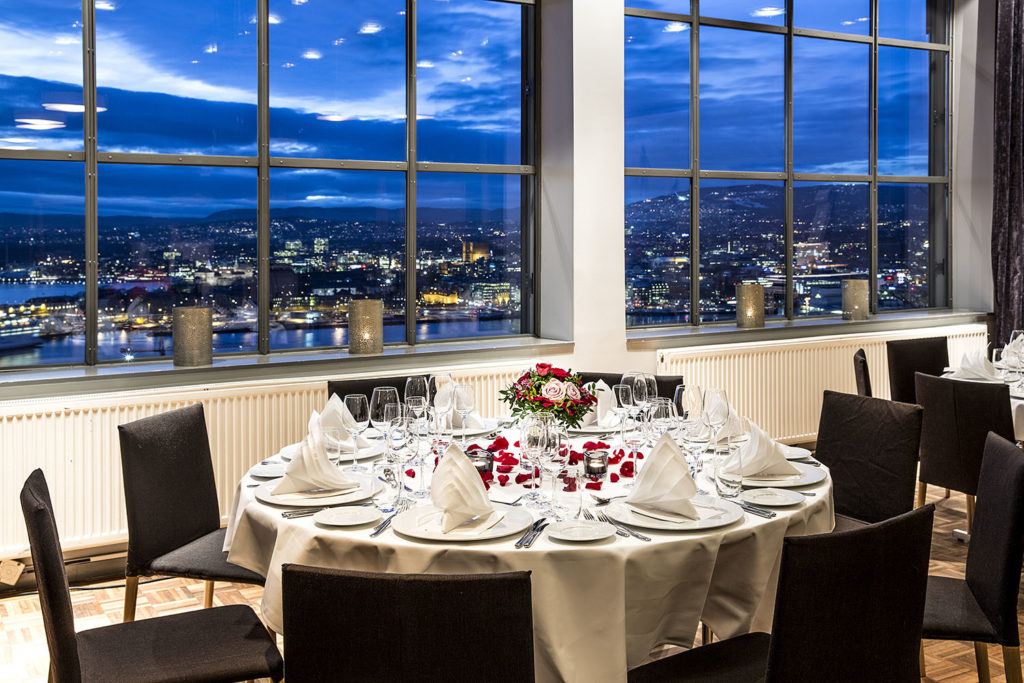
The hotel has 488 rooms and suites on 22 floors, and offers a variety of interior designs. There are great views of the western parts of the city center, the Oslo Fjord and Holmenkollen hill from the panorama bar on the 21st floor. Male guests can also enjoy a breathtaking view from the bar’s rest room.
Ekeberg Restaurant
The elegant Ekeberg Restaurant is regarded as one of “Europe’s foremost functionalist buildings”. Architect Lars Backer won the competition to design the new restaurant in 1927. In 1929 it replaced a predecessor, the Tiedemanns Tobakksfabrikk pavilion of 1916. It was renovated in 2005 by Mellbye Arkitektur Interiør
Ekeberg restaurant
Situated half way up a forested hill above the eastern harbor area it benefits from its site and views over Oslo. It makes good use of its privilege, especially from the second-floor veranda. Towards the end of the 1990’s, Ekeberg Restaurant was closed and was left to decay, and most of the interiors were vandalized. The building is a listed monument and its renovation has been careful, although controversial, as new elements needed to be incorporated into the original design.
The building now contains restaurants for 200 guests, a bar/lounge, conference and meeting facilities, banqueting and wedding suites. The lobby has a small coffee bar, and the outdoor terrace, where drinks and light meals are served, is a favorite of locals in summer.
Holmenkollen Ski Jump
The Holmenkollen is a beacon for the city and a new showcase for ski jumping, Norway’s national sport. Competitions have been arranged here annually since 1892. Holmenkollen is regarded as the Mecca of Nordic ski sports and with more than 600 000 visitors annually, one of Norway’s largest tourist destinations.
Holmenkollen Ski Jump
Originally following the natural landscape, the jumping hill has been more or less continually rebuilt and enlarged to accommodate the ever-increasing jumping lengths. The most extensive renewal was made for the 1952 Winter Olympic Games in Oslo, when spectators reached the record number of 100.000.
In 2005, the International Ski Federation decided that the hill does not meet the standards to award the city the 2011 Nordic World Ski Championships. In 2005 Norway’s Directorate of Cultural Heritage approved the demolition of the ski jump and in 2007 the Oslo municipality announced an open international competition for a new ski jump. Julien de Smedt from Copenhagen beat 103 firms and was awarded the commission. The new ski jump was completed in 2011.
The stand provides space for 30 000 spectators, and the redesigned Iandscape links the stadium and all seven ski jumps. The infrastructure around Holmenkollen was improved by building a new metro station and new paths and streets.
This informal architectural travel guide to Oslo is far from complete
Please note that this guide is far from complete. Along the main street Karl Johans gate, the most important buildings are lined up: from the Royal Palace at one end past the National Parliament, National Theater and Old University to the Central Station at the other, the progress of the building of a new national capital from 1814 onwards can be witnessed.
From Grunerlokka
If you want to go a bit off the beaten track, the old working-class neighborhoods, Grünerløkka and Grønland, teeming with cafés and pubs, is a good place to start. With a foreign-born population surpassing 22% this is Oslo’s most cosmopolitan district.
From Akerselva
Along the Akerselva river, the traditional industrial structures have been transformed into cultural venues, food marked and schools, giving this former polluted part of town a new lease of life.
In addition, additional iconic buildings are under construction in Oslo, scheduled to be finished within the next two years.
An Architectural Travel Guide to Oslo, compiled by Tor Kjolberg
Feature image (on top): Oslo Airport, Photo: Knut Ramstad
The Scandinavian countries, Denmark, Norway and Sweden as well as the Nordic countries Finland and Iceland consistently rank highly in surveys of quality of life around the world. What’s the secret?
The CEO of The Happiness Institute in Copenhagen, Meik Wiking, also a New York best-selling author, is so confident he has the answer, so he’s even produced tutorials about how you can be happier.
Happy Scandinavians
There are six factors that affect happiness, he claims, and sincerely wants individuals to master them all.
The World Happiness Report
The UN’s Sustainable Development Solutions Network has since 2012 released the World Happiness Report every year, backed by the Ernesto Illy Foundation.
Child support contribute to wellbeing
But what exactly does these Nordic countries do differently that makes its citizens so happy? According to Wiking (what an appropriate name) ‘these happy Scandinavian countries ‘are doing something right in terms of creating good conditions for good lives.’
People feel they have a community they can count on
Good neighbors supporting each other
The short answer might be that there is a greater neighborly support between citizens and state support programs for those in need than in most other countries. People feel they have a community they can count on.
Job security and positive working environments are important factors
Scandinavian people have an average high income, long life expectancy and good government support services. As a result, individuals are more likely to return a stranger’s wallet in the Nordic countries. The editors of the report call this ‘social support’.
Climate and positive working environments support Scandinavian countries’ happiness level
Job security and positive working environments are other factors. “People become unhappy in the workplace where there is a culture of easily hiring and easily firing,” says one of the report’s editors, Jan-Emmanuel De Neve. Unemployment insurance – and work experience schemes to get people back into jobs – plus child support also contribute to wellbeing.
. People feel they have a community they can count on
The colder weather and long nights associated with Scandinavia might also help bring communities together.
Practical advice on living a happier life So perhaps a Masterclass consisting of 42 courses can empower you with practical tips and quick wins to make yourself, your loved ones, and even the world happier.
What’s the Secret Behind the Happy Scandinavian Countries? written by Tor Kjolberg
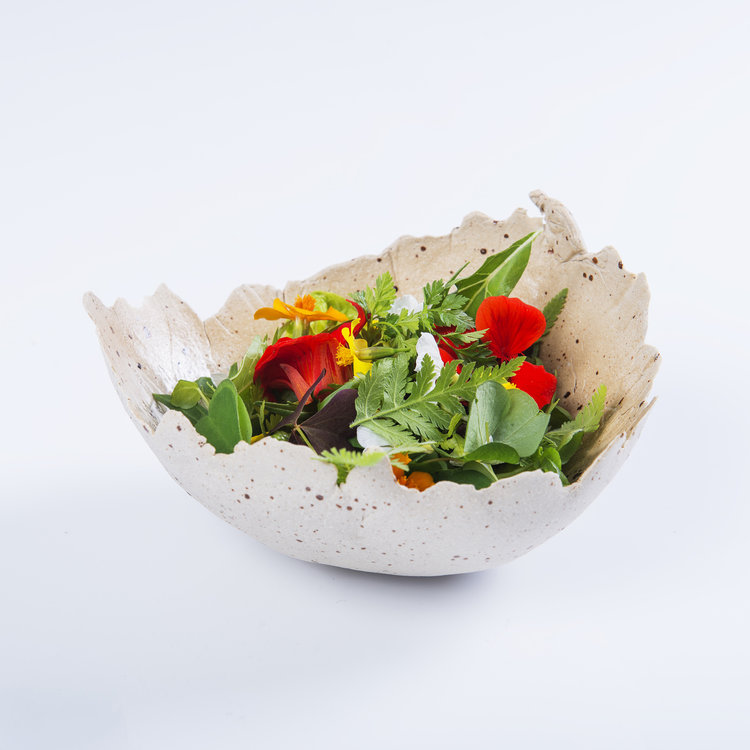
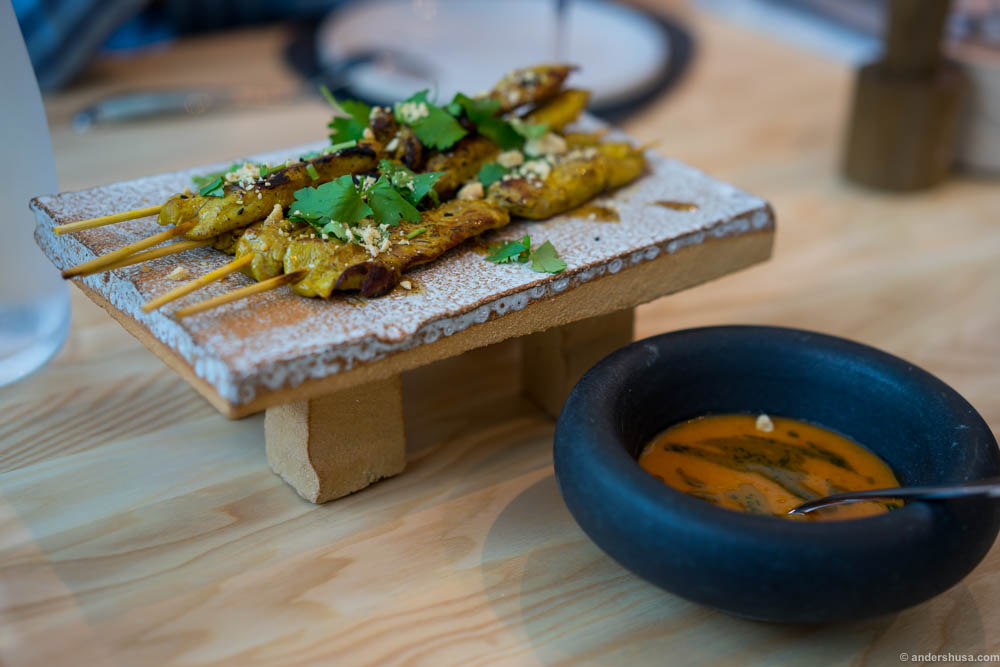
Restaurants from all over the world are now looking to the Norwegian tableware design company Odd Standard, producing tailormade tableware made from all kinds of materials, from juniper twigs and tulle to wood, ceramics and steatite.
Norwegian design firm Odd Standard’s ambition is to make great products for chefs and restaurants, exploring different materials, old craft techniques and modern technology. The creators traveled around Scandinavia collecting thoughts and ideas from famous chefs for the perfect tableware.
The artist duo behind the Norwegian tableware design company
Odd Standard was established in 2014 and is today one of the industry’s most creative hospitality tabletop design firms. The artist duo behind the company, Tonje Sandberg and Constance Kristiansen are very keen not to be overexposed and are therefore very selective when choosing partners. The two worked together at the Norwegian porcelain manufacturing company Figgjo in Sandnes for many years and found a common fascination for the experience of eating, and how tableware products could enhance this experience.
Tonje, who holds a Master of Science in Industrial Design from Trondheim and Buenos Aires, is in charge of sales and marketing as well as finance and administration. She also manages external production of wood, glass and paper products.
Constance, holds a Master of Arts and Ceramic design for industrial production and ran her own ceramic workshop in the 90s. She is the product development manager, head of the Odd Standard micro factory, and manages external production of ceramics and stone.
Custom-made Norwegian tableware enhances the dining experience
Enhancing the eating experiences
Their goal is always to find the recipe for how they can enhance the experience of eating even better. In the tabletop design world very much looks the same, but the two ladies have definitely taken a road less traveled. Their design tableware has reached some selected restaurants in Norway and Scandinavia – and even galleries and comic strips.
For selected customers only
The products are meant to come in limited numbers, from their own workshop and from their portfolio of very skilled collaborative craftspeople. However, Odd standard doesn´t deliver only to restaurants or companies. They also sell to privates who are looking for hand-crafted bowls, plates, cups or whatever you might call their fascinating works.
Tailormade Norwegian tableware for Mondo restaurant in Sandnes
Today, a visit to a restaurant is just as much about the performance as the actual eating. That’s what Odd Standard is all about,
Tailormade Tableware From Norway, written by Tor Kjolberg
In 2016 the excellent restaurant Maaemo in Oslo won three Michelin stars, and since then there has been an excitement around restaurants and bars in the Norwegian capital. A new era fine dining and drinking in Oslo has come for you to enjoy.
When foreigners are asked where they can eat the best food in Scandinavia, many inevitably answers Copenhagen, probably due to the Chef René Redzepi of Noma and the Danish food activist Claus Meyer, often credited for founding the philosophy of the New Nordic Kitchen.
Sentralen in the city center of Oslo specializes in Nordic cuisine with modern twists and excellent natural wines
But in my opinion that is a limited view, since there are equal good food in the other Scandinavian capitals, Stockholm and Oslo, and the most interesting restaurants are not always best defined by Michelin.
At restaurant Brutus you can enjoy a superb taster menu for NOK 595 (USD70)
For instance, Sentralen in the city center of Oslo specializes in Nordic cuisine with modern twists and excellent natural wines and is a very good choice as well as affordable. The restaurant is hidden within the walls of the former Christiania Sparebank building, and was established by Even Ramsvik and lead by head chef Mads Andre Hansen.
Oslo may have had an element of underdog complex regarding the capital’s restaurant scene, but during the past 10 years a lot has happened. The dining and drinking scene has evolved really quickly – and is super focused on quality.
An example is Brutus, perched innocuously on a street corner in the multicultural Tøyen district. There you can enjoy a superb taster menu for NOK 595 (USD70) with dishes such as mackerel with kohlrabi, crab on Icelandic flatbread, free-range Norwegian sweet and sour pork and potato cake with milk ice cream.
On the southern fringes of Oslo docks, the area is thriving with restaurants and bars. A new food hall that opened one year ago is called Vippa.
Arakataka is a proof that New Nordic cuisine doesn’t need to be too precious or fussy
You can enjoy small plates in a communal atmosphere at Arakataka just around the corner from the Rockefeller Music Hall. Arakataka is a proof that New Nordic cuisine doesn’t need to be too precious or fussy. There are high stools for sitting but many diners opt to stand while cradling their drinks.
Oslo also has some of the best baristas and coffee roasters in the world, and we wouldn’t dream of ending a Norwegian meal without a decent brew or a perfectly pulled espresso. Tim Wendleboe is an award-winning barista who spends half the year visiting farms in Africa and Latin America finding the best beans for his cool coffee shop.
Fuglen is a splendid coffee shop during daytime, turning into a cocktail bar by night
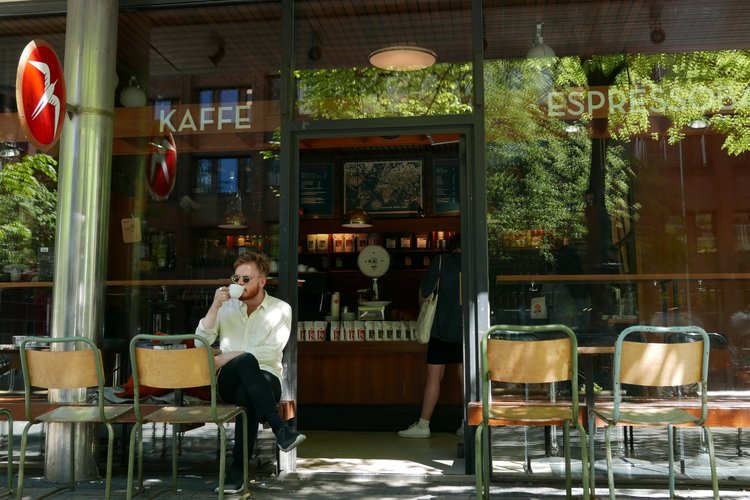
Fuglen (The Bird) is worth a visit for the elegant Scandi decor alone, but also does a great cup of coffee before turning into a cocktail bar by night.
Kulturhuset is ‘always’ open
Kulturhuset is an excellent place to sit down and do some work with a hot drink or catch up with friends in the evening over a beer. It’s a place where young business people as well as students meet. It’s open from 8.00 am to 3.30 pm.
For avant-garde cocktails, head to Himkok, a “hidden” joint in the center with unusual concoctions including several signature drinks.
New Era Fine Dining and Drinking in Oslo, compiled by Tor Kjolberg
From Nyhavn Bredgade and its parallel twin, Store Kongensgade, are the main shopping streets of the residential Frederiksstaden to the north. The area was planned and built in the 18th century for the well-to-do who wanted stately homes close to the center.
At Bredgade 68 is Designmuseum Danmark, featuring classic Danish design as well as European and oriental objects. The building (1757) was originally a hospital.
Alexander Nevski Russian Orthodox Church
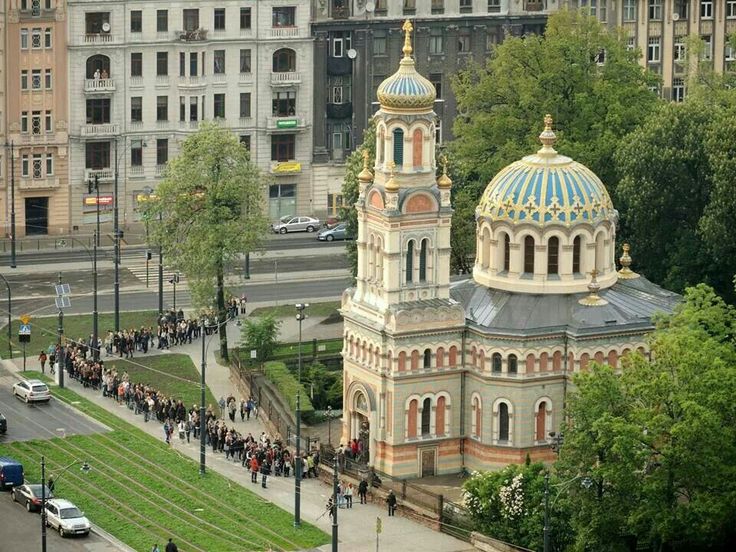
Opposite the museum three domes tower over Alexander Nevski Russian Orthodox Church, which was built in 1881 by the Russian government and contains a number of fine icons.
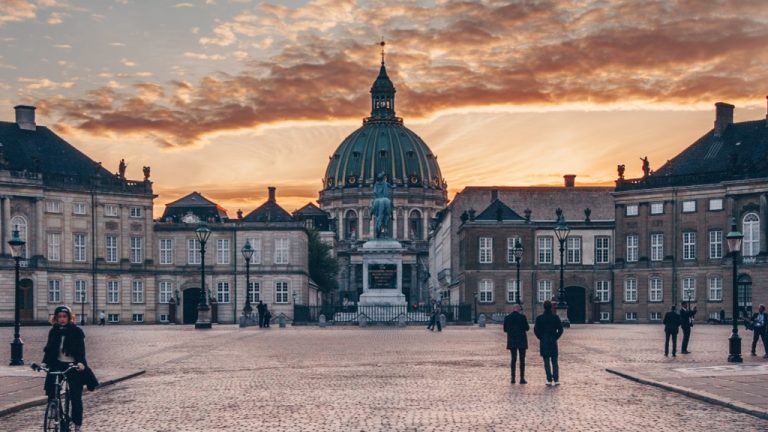
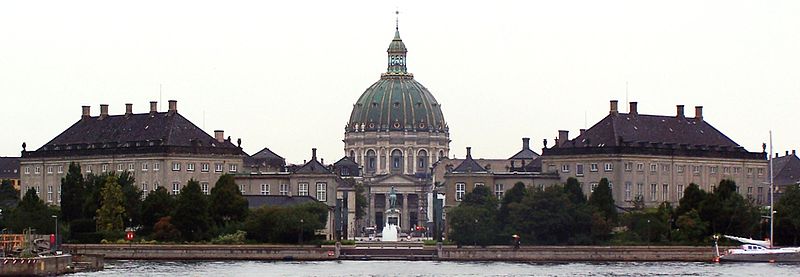
Close by looms the grand copper dome of Fredrikskirke, popular known as the Marble Church. The church was meant to be a majestic rococo monument designed to rival St. Peter’s in Rome, but the king Frederik V ran out of money and the project was cancelled in 1770. The church was not completed until 1894, and when the project was resumed it was built not in marble but in limestone. Join one of the tours and experience the splendid view across Sound to Sweden.
The statues outside the church represent important Danish clergymen and theologians.
Amalienborg Palace, across Bredgade towards the harbor, is the winter residence of the royal family, one of Europe’s less assuming royal domiciles, built in the 18th century. One wing of the palace houses the Amalienborg Museum, whose reconstructed rooms contain exhibitions on the monarchy from 1863 to 1972.
Danish Royal Guard in Copenhagen is always in duty
The Royal Guard are always on duty, and the changing of the guard at noon every day attracts both children and adults. If the flag is flying, then the Queen is in residence and the full ceremony will take place.
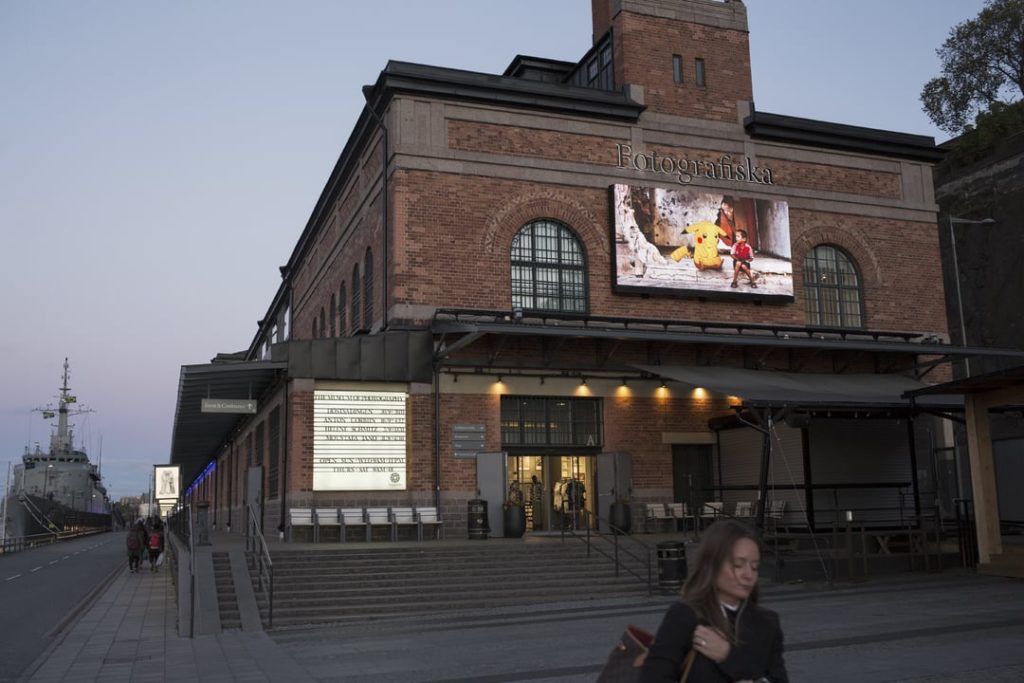
Fotografiska in Stockholm has opened a new photo exhibition, A New Me, displaying images by the 2018 Young Nordic Photographer of the Year, Marie Hald.
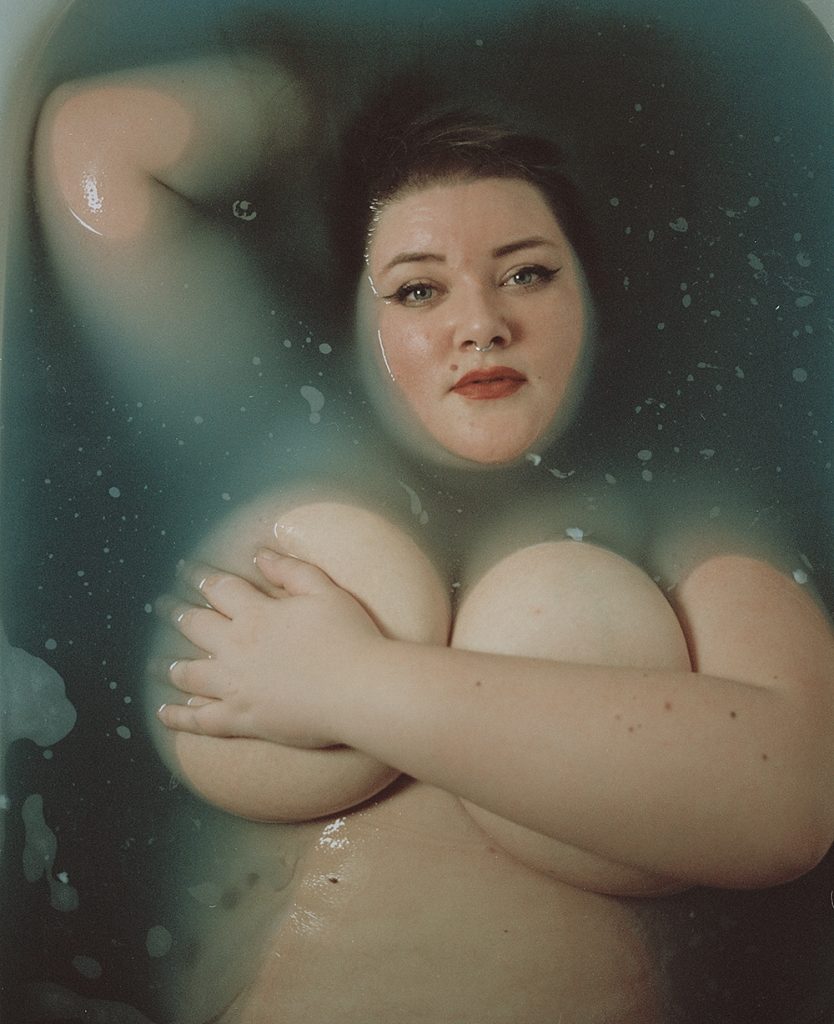
In the company of struggling people, the forces of nature pulsate between magnificent pink rocks that have been rounded by the ravages of time. The people are participants in one of Utah’s many so-called “Fat Camp’s” where new guests are constantly checking in for a few weeks, or up to half a year, of food and exercise programmes. Weight loss camps have become well known worldwide through the TV programme “Biggest Loser”. Marie Hald has, with respect and artistic flair, captured their battle to lose weight.
The exhibition A New Me is a story about people who have all been diagnosed by their doctor as being morbidly obese. This is a story about the struggle for survival. Marie Hald has a special eye for exposing human vulnerability, without exploiting or diminishing the person being portrayed. 30-year-old documentary photographer Marie Hald from Denmark is Young Nordic Photographer of the Year 2018.
“It was among other things, Marie’s unique imagery with its melancholic and calm expression that caught the attention of the jury. In a close and personal way, she explores social problems and the impact of society on us in general, and women in particular”.
Photographer of the Year, Marie Hald
The winner of this prestigious scholarship receives SEK 100,000, a mentor appointed by Fotografiska and a solo exhibition. Marie Hald’s A New Me opened on June 1 and runs until September 2, and as a mentor she has the extremely respected photojournalist Paul Hansen.
“Marie Hald is so skilled that I consider it an honour, and the fact is I see her as a rewarding interlocutor, rather than it being a classic mentorship,” says Paul Hansen.
Marie Hald, who in 2013 was a World Press winner and also won the Picture of the Year prize in Denmark, often focuses on the intense situations in life, when something is brought to a head. These are moments that occur in everyday life, which Hald manages to capture with both tenderness and sensitivity. This could relate to a body or a context.
Fotografiska, Stockholm. Photo: Tor Kjolberg
In her solo exhibition A New Me, she follows life in a so-called fat camp in Utah in the USA, where in a landscape of shimmering pink rock formations people are struggling to lose weight. They all have a story that explains the reason for their considerable weight gain, and their motivation to now reverse this trend.
Marie Hald has, with respect and artistic flair, captured their battle to lose weight
“In previous projects I have closely followed the lives of young people with anorexia and bulimia, and recently I have researched the new wave of activists who are fighting for the right to be fat. For a long time, I have had the desire to explore another side of the story of fat people. The nameless, those that are big and would like to lose weight. It became the exhibition A New Me, a study of the phenomenon of weight loss camps, which are especially popular in the United States, a country where much of the population is overweight,” explains Marie Hald.
Marie Hald in front of one of her photograps
In the United States there is a whole industry for weight loss in the form of slimming products, weight loss-cookbooks, and slimming clothing etc. But it is special weight loss camps, which became well known through the TV series “The Biggest Loser”, which Hald has found interesting to study and describe.
Hald travelled to the state of Utah in Western USA, which is known for being a kind of health hub. This is mainly due to the large group of Mormons living in the state, who have a strong focus on health. The camp she visited, Movara Fitness Resort, has also previously been part of the Biggest Loser concept. Here she shared and followed the everyday lives of a group of women and men who checked in to start a process of weight loss. Common to all of them is that they have been diagnosed by their doctors as being morbidly obese.
«With my photographs I want to get close to the different people who live at the camp, and who are struggling to lose weight. All the people I have met have a dramatic story, and there is always a reason why they have become very fat. This may be due to a life crisis – divorce or death, as well as diseases that make it difficult to maintain a low weight. I think it is important to tell these stories – especially because fat people often face many preconceptions of why they have become fat, such as they are lazy and unintelligent etc. During this project, for example, I have met lawyers, dentists and social workers who have taken themselves to a weight loss camp in order to gain control of their body.»
Hald describes the driving forces behind A New Me as being connected with her previous projects, which focus on the human body and our different approaches to it. In The Girl From Malawa she portrayed girls with anorexia, who are obsessively driven to achieve their definition of perfection. In Fat Front, it was about so-called fat activists in the emerging movement of fat people fighting for the right to be happy with their bodies and to make society accept this.
«Now it was time to focus on those who were extremely overweight and wanted to lose weight. The aim was to emphasize their personal stories so that you will not just see a fat body and be prejudiced about it. It is always a challenge to photograph personal stories like these. I know that many people find it an intrusion and cherish their “personal space,” she says. “So I have to be incredibly sensitive and make sure I do not overstep too many boundaries. It is a balance, where I try to push the boundaries and go a little further than what in the beginning people are happy with. But not so far that they regret they opened up to me.”
Hald is often asked how she is able to get so close to the people she is following.
Fotografiska,. Stockholm. Photo: Tor Kjolberg
“I meet people with openness, sincerity, curiosity and considerable motivation to create a poetic story. They can see that I am sincere and passionate about what I do – and therefore they want to help me. The technique I use is analogue. It contributes to a more sedate process and prevents those I photograph being able to immediately see the picture in the camera, which is a stress factor when working digitally. Analogue photography provides much needed calmness.
Fotografiska’s Exhibition Manager Johan Vikner is very pleased that through Young Nordic Photographer of The Year, he is able highlight and inspire younger photographers in the Nordic region
«With Marie Hald’s A New Me we are proud to continue to present solo exhibitions where exciting young Nordic photography reflects the age in which we live,” he says.
New Exhibition in Stockholm – A New Me, press release from Fotografiska
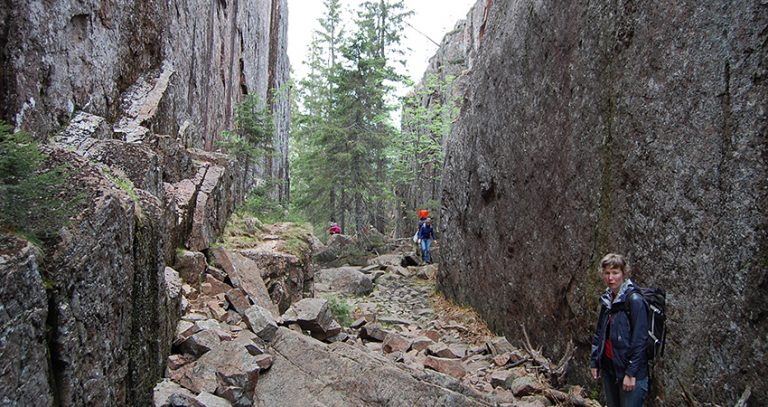
The Höga Kusten (High Coast) in Sweden was formed when the region sank under a gigantic mass of ice during the last ice age.
When the ice retreated, the land sprang back and it is still rising today. This has left a dynamic landscape of vertical cliffs and craggy outcrops, lined with tranquil sandy coves.
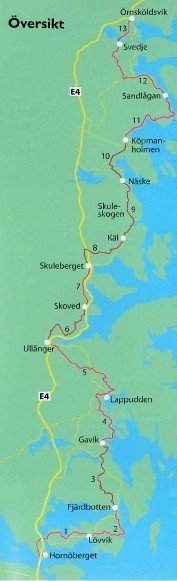
Accessibility and flexibility are the watchwords for the exciting 127 km (80 mi) trail that takes you through the terrain
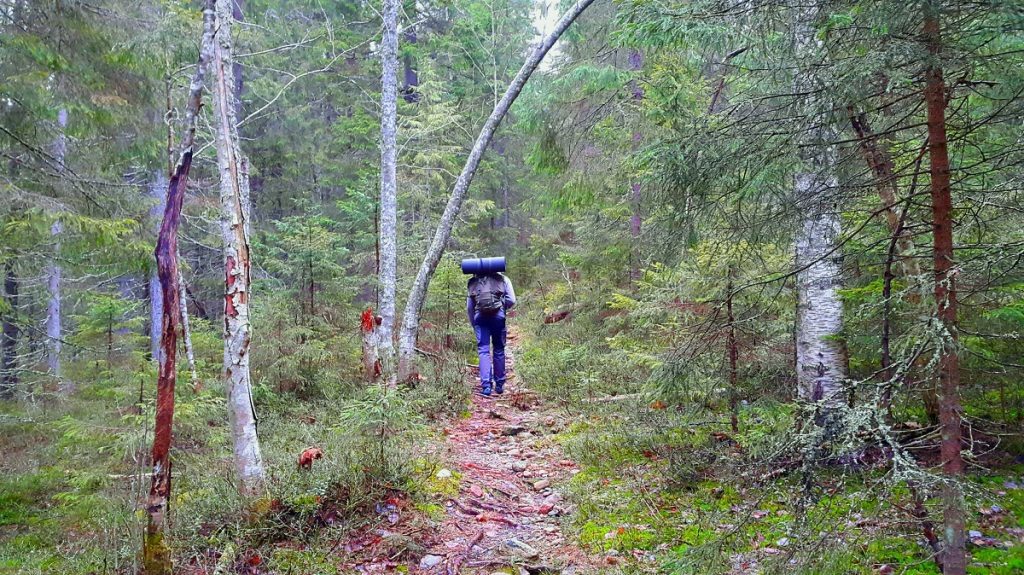
Accessibility and flexibility are the watchwords for the exciting 127 km (80 mi) trail that takes you through the terrain. Divided into fourteen stages, it offers the hikers a wide variety of challenges, whilst each stage is handily reachable by car. There are even organized self-guided tours where you can walk between lodgings, while your luggage is transported for you, allowing you to travel light.
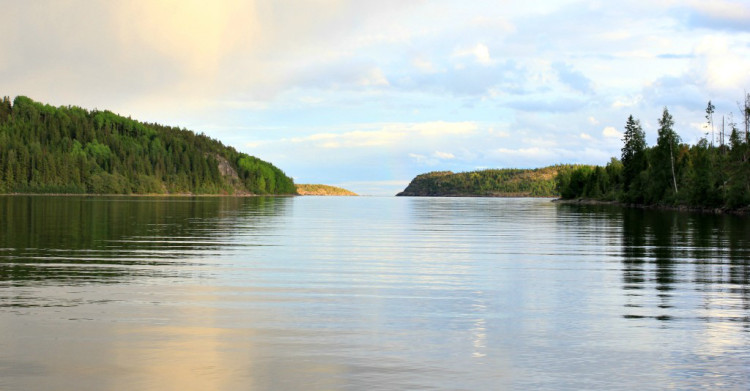
This striking area has been given UNESCO World Heritage Site status and the hike takes you through Sweden’s highest coastal area. A rich diversity of rivers, lakes, inlets and hills makes it a good test for hikers of all levels.
Each day offers varying terrain as well as beautiful views out over the dark blue seas of the Gulf of Bothnia. Starting near central Örnsköldsvik the trail presents the hiker with compact challenges.
Mountains seem more climbable when you know that old-fashioned Swedish hospitality awaits you at the end each day.
Accommodation ranges from simple huts to guesthouses, but for a genuine Swedish welcome, nothing beats staying in a traditional farmhouse, several of which open their doors to tourists in summer.
The hike is fully accessible from May to October. Don’t miss the Skuleskogen National Park and the imposing Slatterdalskrevan Gorge. However, it’s important nit to be too ambitious. Don’t be fooled by the relatively short distances between designated stops – the ruggedness of the terrain can often slow your progress.
The High Coast
Hiking the High Coast Trail in Sweden, written by Tor Kjolberg
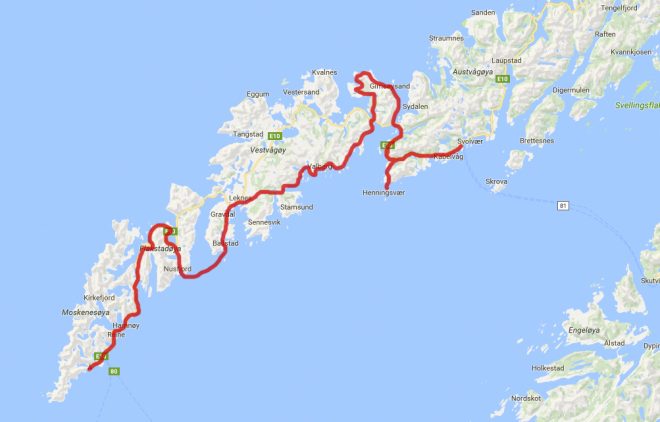
A cycling vacation along the Vestfjord route in Northern Norway is a most memorable experience – new, breathtaking sights appear around every bend.
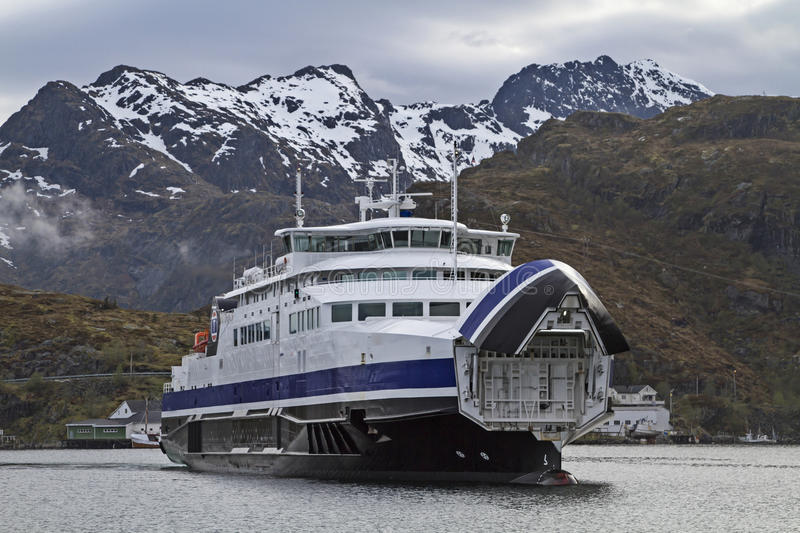
Combining ferry trips with cycling, this route serves up almost everything Norway gas to offer. White sandy beaches butt up against soaring mountain scenery. Archeological relics and historical buildings satisfy those who seek more cultural pursuits, whilst for the more active there is ample opportunities to swim, hike or fish.
The Lofoten islands bike roite
Idyllic little villages of brightly painted wooden houses line the route as you travel from island to island. It is easy to see why locals describe this area as the real Norway and the archipelago features prominently Nordic art, film and literature.
To cover the full 450 km (281 mi) would be to undertake a journey of epic proportions
To cover the full 450 km (281 mi) would be to undertake a journey of epic proportions; however good transport links make it possible to get to almost any part of the trail quickly.
From Steigen, Lofoten
Old market centers such as Løvøy and Grøtøy have been faithfully restored, whilst Steigen is a real hidden gem, teeming with innumerable historic relics. Those who seek more adventure should explore the cave system at Nordskot, whilst those looking for a more sedate outdoor experience can soak up the sun on the wonderful white sandy beaches near Misten.
The Vestfjord rally does have something for everyone. All you need is a bicycle, good waterproofs, a ferry timetable and a spirit of exploration, and a new adventure awaits you around every corner.
May to September provides the best weather. You will need two weeks for the whole route. Forward planning is required to make the most of this trip. Although the ferries are reliable, the faster services take you to the most crowded sections. If you wish to leave the beaten track it may require taking two or more of the less frequent services.
Feature image (on top): Reine, Lofoten islands
Cycling Vacation in Lofoten Islands, written by Tor Kjolberg
Chef Mads Rye Magnussen, known from prestigious restaurants like Noma and Geranium in Copenhagen as well as Mugaritz in Spain, opened a new restaurant in Copenhagen, “Meille” in March this year.
Restaurant Meille in Sankt Peders Stræde serves high-quality food at affordable prices combined with sustainable awareness and traditional cooking methods. Dishes are inspired by season and local, Danish greens and meats.
The recommended accompanying wines were interesting and excellent
Magnussen also successfully runs restaurant Mes down at the end of Sankt Peders stræde at James Plads. Like Mes, we will describe the concept as a gourmet light restaurant. There are no a la carte menus, only fixed menus of three or four dishes at 245 and 295 Danish kroner, respectively. The atmosphere is nice, cozy and elegant, mostly new Nordic without being dogmatic.
For those who appreciate natural wines, the attraction is even a very excellent, reasonably priced wine list with wines at 345 Danish kroner.
Why not start with some excellent snacks bowls at 50 kroner per person? Our first dish consisted of home-made fresh cheese made with buttermilk, was garnished with a crispy salted asparagus and sprouts of radish and green peas in fermented cucumber juice and a spicy bitter beetroot.
Next serving was mackerel garnished with cucumber and spicy fermented ginger, which gave the dish a Japanese sushi / sashimi-like touch.
The brilliant main course consisted of a nice slice of juicy chicken breast, which had a slightly smoked flavor, topped with fermented rose petals and potato “airbags” with dried cabbage and leaf sticks. The accessories consisted of a chicken sauce, a purée of carrot and potato foam.