
The Longing for Scandinavia

0

Swedish Olaus Magnus, the brother of the last archbishop in Sweden to be confirmed by the pope, lived in exile in Italy where he compiled the first detailed map of Scandinavia, Carta marina (1539) in a comparatively accurate manner.

As a young man Magnus traveled around in Norway and Sweden in order to sell indulgences. Believers could in this way pay for forgiveness. The trade was one of Martin Luther’s most powerful accusations against the papacy. After the Swedish Reformation in 1527 Olav Magnus fled south and ended up in Venice.
230915-history-of-the-nordic-peoples-olaus-magnusFrom the late-14th century, Denmark, Norway and Sweden had been united in a personal union. This so-called Kalmar Union continued to exist until 1523. Only a small number of copies of the Carta Marina were made and the map was forgotten about until a copy was discovered in the Hof- und Staatsbibliothek in Munich in the 19th century.

Even if Olaus Magnus (1490-1557) made his early career in Sweden he kept his Swedish identification during his many years in exile.

After he had drawn Carta Marina he started with his literary valiantly Historia de Gentibus Septentrionalibus (History of the Nordic Peoples). It was published in Latin in 1555, comprises 22 volumes and was translated into Italian, English, Dutch, French and German. It was however not translated into Swedish until the first years of the 20th Century. ”History of the Nordic Peoples” was the first edited major work about the Nordic countries and its inhabitants.

Olaus Magnus (Swedish Olaf Mansson)
was born in Linköping, Sweden 1490 and died in Rome, Italy 1557. He studied theology, became a parish priest in Stockholm and cathedral dean in Strängnäs. He had in the beginning a good relation with King Gustav Wasa, but when the king began to introduce the Lutheran faith, Olaus Magnus remained a Catholic. He settled permanently in Italy 1539. There he started a new career as a historic researcher, cartographer and writer.

After 1549 he was also director of St. Brigitta’s, a religious house in Rome.

230915-laus-magnus-norwegian-sea-monster
Olaf Magnus also depicted one of the most famous of the many influential sea monsters, the terrifying Great Norway Serpent, or Sea Worm, which author Joseph Nigg explores in his book Sea Monsters.

The Longing for Scandinavia, written by Tor Kjolberg

100% Norwegian in London

0

Functionality, minimalism and innovation have become Norwegian design features. The exhibition 100% Norway opens tomorrow in London in Old Truman Brewery in Brick Lane, East London as a part of the internationally recognized London Design Festival.

According to Norwegian Industry Minister, Monica Mæland, the times when Norwegian design was a well-kept secret is now history – hopefully for good,

281015_Monica_Mæland_100-percent-norwegian-2015
“If you said “Norway” to a Brit a few years ago, the person would most likely think of fjords and fishing, perhaps oil. Today many will also add good design and furniture icons,” says Mæland.

Between 24 and 27 September, 33 Norwegian designers, both young and established, will display their works. The Norwegian exhibition is part of the London Design Festival, and this is the 12th time 100% Norway exhibits in London. The exhibition is organized by the Ministry of Foreign Affairs, the Norwegian Embassy in London and Norwegian Design and Architecture (DOGA). This year the company Norwegian Icons has been invited as a partner.

281015-100-percent-Norwegian-6
“A recurring theme in this year’s exhibition is the functionalism and minimalism that has become Norwegian designs trademark, says senior curator Benedicte Sunde in Center for Norwegian Design and Architecture (DOGA). Photo: DOGA

“What is new this year is that everything is 100 percent Norwegian: Inspired by Norway, designed in Norway and made in Norway,” says senior curator Benedicte Sunde from the Norwegian Center for Design and Architecture. This year she has curated the exhibition in cooperation with Peppe Trulsen from Norwegian Icons.

“We bring with us is a mix of young, promising designers displaying sensational prototypes, as well as a number of established, award-winning designers. The same applies to producers, who are invited. The range goes from completely startups to enterprises which have been an important part of Norwegian design for decades. A common thread is the functionalism and minimalism that has become a trademark for Norwegian design,” says Sunde.

A reckless newcomer
An exciting, new name in the Norwegian design industry is newly graduated Andreas Bergsaker (25) from Oslo. After participating as an exhibitor at the interior fair Salone Satellite in Milan last spring, he is already in dialogue with four international producers. His visit to Italy also led to permanent employment in the Danish design company HAY.

281015-100-percent-norwegian-1
Exhibitor Andreas Bergsaker. Photo: nyebilder.no

“You must have courage enough to stand out and visualize your design and yourself. It is important to participate in events where you can meet several manufacturers and international contacts. Therefore, I am grateful to be a part of 100% Norway this year,” says Bergsaker.

Not bound by tradition
Kris Bjaadal (35) of Fyresdal in Telemark is something of a veteran in 100% Norway context. The product designer is participating in the exhibition for the third time, and believe it is essential for ambitious Norwegian designers to orient themselves beyond the country’s borders.

“Since there are few manufacturers in Norway, it is important for Norwegian designers to look for manufacturers internationally. The lack of a national manufacturing tradition is perhaps a force in international context, since Norwegian designers thus are freer and less bound by frameworks and conventions,” says Bjaadal.


100% Norwegian in London, written by Henning Poulsen/Pressenytt
Translated by Admin

The Scandinavian Demon Drink

0

Stringent laws on the purchase of alcohol in Norway and Sweden have been somewhat at odds with the figure these countries have wanted to cut in the modern world.

The time-honored yarning for drink can be blamed on long winter nights, but ancient Scandinavians also drank like fish because their food was preserved with lashings of salt.

180915-traditional-scandinavian-drinking-cup
King Sverre of Norway experimented with prohibition as early as the 12th century. In 1775, however, King Gustav III of Sweden turned the distillation and sale of spirits into a royal monopoly and encouraged his subjects to drink because he needed the money.

180915-drinking-modern-viking
Against this backdrop, 20th-century prohibitions had problems. The conundrum in Norway was that France, Spain and Portugal, major consumers of Norwegian fish, had always bartered with wine or brandy. The issue of prohibition led to the downfall of three successive governments in th 20th century.

180915-swedish-systembolag
Sweden, however, put its faith in the “Bratt Liquor Control System”, a certain Dr. Ivan Bratt having worked out exactly how much an individual could consume according to age, physique and other considerations, with the result that it was almost impossible for a married woman to qualify for a single drink in any circumstances.

Today, as in Gustav III’s time, the sale of wines and spirits in both countries, is a state monopoly.

But there was a time when Norwegian by law was forced to brew beer
Strong drinks have been regulated in Norway since early medieval time. While the Gulating law had commanded how much beer should be brewed, when slaves were to be released or an illegitimate son could be annexed to a family, prohibitions characterized the last two centuries.

180915-vinmonopolet-norwegian-alchohol-monopoly-logo
In the Middle Ages beer was the dominant beverage for every occasion, and the farmer who did not comply with the injunction to brew, had to pay a fine equivalent to half a cow to the bishop. If the injunction was broken several years in a row, the punishment was grueling: Expulsion or loss of his estate.

At the end of the 1500s liquor got proper foothold in Norway, and then it became more and more common that festivities could degenerate. Decrees were eventually replaced by prohibition. To prevent people from coming drunk to services on Sundays, sales of alcohol were banned in the cities before church time.

By 1629 drinking had degenerated to such a degree that the priest had an adjunct appointed, who would ensure that church members remained in the glow. If not, the priest could refuse the boozer Communion, or in serious cases excommunicate him or banish him from the congregation.
180915-skaal-in-norway
Skål
(Pronouced sc-all)

Skål is the first thing we hear on a Scandinavian party or a dinner. Skål is a toast to goodwill and friendship. By saying this at a moment of rising glasses, the Scandinavians wish you a good fortune and a good health.

Historically skål is connected with the Vikings’ epoch in Scandinavia. According to legends, as a tribute to their gods, Vikings were drinking wine from bowls made of sculls (Anglo-Saxon “skalle”) of prostrated foes. Therefore, while doing skål, don’t forget to look at each other eyes and say skål back.

The Scandinavian Demon Drink, written by Tor Kjolberg
Norwegian Film invited to Film Festival in Canada

0

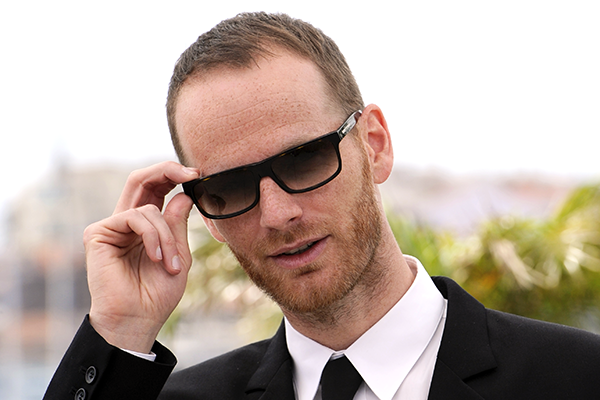
The movie Louder Than Bombs directed by Norwegian director Joachim Trier has been invited to participate in one of the world’s biggest film festivals in Toronto in September.

200815-Joachim-Trier
Joachim Trier did not receive the Golden Palm from the film festival in Cannes last May, but he may now compete for the Public’s Prize during the Toronto International Film Festival.

200815-loader-than-bombs-poster Notable pics making their North American bows in Special Presentations include Joachim Trier’s “Louder Than Bombs.”

“Trier is one of our times’ most capable young directors. His films are characterized by his innovative approximation to storytelling and psychological and moral complexity. I cannot think of other film makers, whose work I am looking more forward to,” says Steve Gravestock at the Toronto Film Festival in a press release from Norwegian Film Institute.

Last year during Special Presentations Liv Ullman’s Miss Julie was presented. Earlier this year Kon Tiki and the Headhunters were shown.

Louder then Bombs sold extremely well during the film festival in France and has so far been sold to 76 countries.

https://youtu.be/u7023fs3DsA
Norwegian Film invited to Film Festival in Canada, source NTB

Scandinavia Scores High on the World Change Readiness Index

The 2015 Change Readiness Index (CRI) indicates the capability of a country to respond to a wide range of change drivers.

The report indicates the capability of a country – its government, private and public enterprises, people and wider civil society – to anticipate, prepare for, manage and respond to a wide range of change drivers, proactively cultivating the resulting opportunities and mitigating potential negative impacts.

160915-CRI-is-made-by-KPMG
CRI is made by KPMG International.

Examples of change include:

  • shocks such as financial and social instability and natural disasters
  • political and economic opportunities and risks such as technology, competition and changes in government.

Since 2012, the CRI has evolved to become a key tool that provides reliable, independent and robust information to support the work of governments, civil society institutions, businesses and the international development community.

160915-KPMG-change-readiness-index-2015
Characteristics of the top 10 countries
Strong representation from Nordic region

Overall    Country                   Enterprise capability              Government capability          People & civil society capability
rank
1             Singapore *                       1                                             1                                             11

2             Switzerland *                   3                                             5                                             2

3             Hong Kong *                    2                                             6                                             10

4             Norway *                        17                                             3                                             1

5            United Arab
Emirates *                                       4                                             2                                             19

6             New Zealand                     7                                             8                                             7

7             Qatar                                   5                                           4                                            20

8             Denmark *                         6                                             11                                          4

9             Sweden                               13                                          9                                             3

10           Finland*                             10                                          7                                             6

Countries marked * are new to the 2015 CRI

You may read the whole report here.

Scandinavia Scores High on the World Change Readiness Index, source: KPMG International

Norway – world’s second best reputation

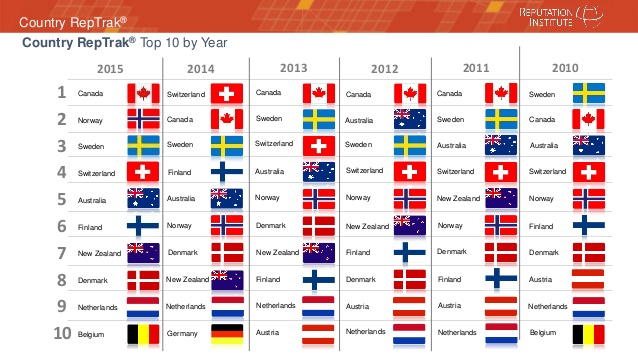
Norway is second only to Canada in terms of country reputation, according to a recent report by Denmark-based Reputation Institute.

Reputation Institute, which is based in Boston and Copenhagen, produces the annual Country RepTrak report to advice countries on how to boost their global reputation.

110815-Norwegian-Flag
Based on a survey of 48,000 people in G8 states and 30,000 in non-G8 countries, the report put the Scandinavian country ahead of its Nordic neighburs, as well as other countries that have consistently scored well over the years such as Australia and the Netherlands.

Canada, which won top position in this year’s ranking has come out as the winner four times out of the six years the report has been produced.

110815-country-reptrak-reputation-index-2015
The report looks at 16 attributes for each nation. Evaluations include the country’s safety, whether the residents are welcoming, whether the government is effectively progressive socially and economically, and even the beauty of the countryside.

Given these criteria, here are the 20 most reputable countries in the world:

Here is the Top 20 list:

1. Canada
2. Norway
3. Sweden
4. Switzerland
5. Australia
6. Finland
7. New Zealand
8. Denmark
9. Netherlands
10. Belgium
11. Ireland
12. Austria
13. UK
14. Italy
15. Germany
16. Japan
17. Spain
18. Portugal
19. France
20. Singapore

The report highlights that it is not necessarily the world’s most powerful countries, or the countries with the largest economies that enjoy the best reputation. The US came in 22nd in this year’s report.

110815-norway-reputation
The survey asked respondents questions such as whether they thought the country had a “good overall reputation” or whether they had a “good feeling” about it in order to establish the way people viewed different places from the outside.

The organization’s managing partner Fernando Prado insisted that reputation was important if countries wanted to attract visitors, noting that when people viewed a country positively it translated into more tourism dollars because it’s reputation dictated whether people were willing to visit.
Innovation Norway’s Audun Pettersen said to the Norwegian paper Dagbladet that many foreigners’ knowledge of Norway was “vague”, and they often associated it with fjords and nature; however, he noted that they also viewed it as having a “strong and open society”.

Norway – world’s second best reputation, written by Admin.

Seducing Northern Lights in Scandinavia

0

The Aurora Borealis (the Northern Lights) is the world’s most brilliant light show.

And each year people travel far and wide for a chance to see it.

But how do they work?

The aurora occurs when highly charged electrons (from the solar wind) collide with oxygen and nitrogen in the earth’s atmosphere. These particles congregate near the Earth’s magnetic field.

Nirthern lights in Greenland
Northern lights in Greenland

What’s even wilder…

The color of the aurora depends on which atom is struck at what altitude:

– Green – oxygen, up to 150 miles
– Red – oxygen, above 150 miles
– Blue – nitrogen, up to 60 miles
– Purple – nitrogen, above 60 miles

These magnetic and electric forces are constantly shifting, creating the auroras “dance”.

Atrora borealis in Sweden

And the best place to get seduced by the aurora is near the magnetic poles, e. g. Greenland and the Scandinavian coast.

October to March are the best months for viewing because it’s darker. In the summer, most northern locations get sun 24 hours a day, making difficult to view.

Northern Lights in Greenland
The dancing northern lights in the night sky are a sight for the gods which winter holidaymakers in Greenland will in all likelihood come to experience. From early autumn the night sky is regularly illuminated by the northern lights’ green glow.

It is a natural phenomenon that always causes excitement and wonder among those who have never seen it before.

Northern Lights in Norway
Alta is the largest town in Finnmark. A world of adventure awaits you there, all framed by the brilliant blue light and contrasts which are so distinctive of Finnmark in the middle of winter.

The world’s first Northern Light observatory was built there at the end of the nineteenth century and has earned Alta the well-deserved nickname “The Town of the Northern Lights”.

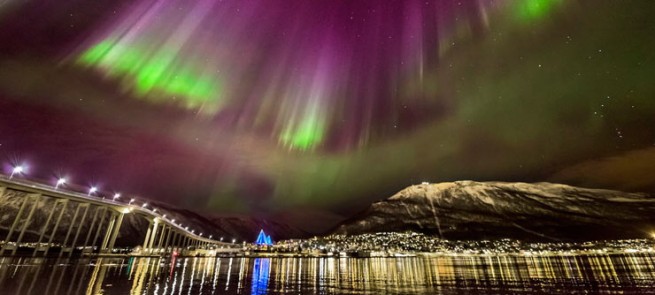
Northern lights in Tromsoe, Norway. Photo: Innovation Norway/Bjorn Jorgensen

But there are other Norwegian places where you can be seduced by the aurora. Just click on the link above to find out more.

Northern Lights in Sweden
On more than one traveller’s list of things to do before you die, you’ll find ‘See the northern loghts’ jotted down. Rightfully so – these lights are one of nature’s most jaw-dropping displays. Click on the link above to find out the best places to watch them in Sweden.

Feature image (on top): Nothern Lights in Tromsoe, Norway. Photo: Visit Norway

Seducing Northern Lights in Scandinavia, compiled by Tor Kjolberg

You might also like to read

Northern Lights in Arctic Norway

Northern Lights

Sleek Norwegian Spiral Stair

0

Last summer architect Tron Meyer (31) launched his spiral stair Risa Meyer, made from Norwegian wood and produced in Norway.

The design has made it possible to replace steel and concrete with a more sustainable alternative, high quality wood.

In a time where most stairs are made from standard materials like steel and concrete produced outside Norway, a Norwegian spiral stair is indeed very uncommon.

The Rita Meyer stair is beautiful, made from sustainably harvested wood and certainly elegant.

100815-risa-meyer-spiral-stair-model
“We looked at conventions like the narrow part of the step along the core, and asked ourselves how we could make it into a valuable part of our design,” explains Tron Mayer. “The staircase has become a balanced dialogue between absolute needs of function and an optimal construction using wood,” he adds.

The stair is offered in two wooden materials, spruce or oak, produced at Massiv Lust in Luster at the West coast of Norway, who won the 2014 Nordic Wood Award. The Nordic Wood Prize was created in 2014 and awarded by the Association of Nordic Wooden Towns, a Nordic cooperation between Nordic cities to promote modern urban development with wooden houses.

Wooden Prize 2014
Wooden Prize 2014

The Nordic Wooden Towns project – a success story and a kick off for further regional co-operation The Nordic countries including Iceland and Denmark (on behalf of the Faroe Islands and Greenland) were very much involved in the Nordic Wooden Towns project carried out in 1970-1972. The common concern was the rapid economic change in the 1960s and 70s and the planners’ visions of the modern urban environment. The small wooden towns very typical of the Nordic countries were threatened. Only a few historic areas had attained conservation area status such as Kyrkbacken in Västerås, Sweden, Old Stavanger in Norway and Old Århus in Denmark.

Massive Lust AS is a Norwegian start-up solid wood manufacturer, producing cross-glued solid wood. In 2013 the company moved into a new production hall at Granden in Gaupne in Luster Municipality, built in solid wood.

Photo:
From left: Project Manager Hans Andrén in association Nordic cities, laureate Jørgen Tycho in Massive Lust, Johanna Kairi, Holzindustrie Schweighofer GmbH and Chairman Vesa Juntilla in association Nordic cities. Photo: Knut Werner Lindeberg Alsén, Byggeindustrien.

Whether you want to call the stair a sculpture or anything else, it’s very functional and will be even more beautiful after years of use.

Sleek Norwegian Spiral Stair, written by Tor Kjolberg


9 Reasons to Visit Scandinavia in the Fall

0

With the strongest exchange rates to Danish, Norwegian and Swedish kroner in nearly a decade, airfare prices dipping, and crowds thinning out for the fall, fall is the best time to visit Scandinavia for both huge savings and the opportunity to take things in at a more luxurious rate.   

Best Exchange Rates In Years
Foreign visitors looking to visit Scandinavia this fall are sitting pretty right now. It’s been nearly a decade since foreign currencies have been so strong against kroner, and all signs point to continued parity through at least the end of the year.

161015-danish-kroner
Use this opportunity to visit the three Scandinavian capitals, Copenhagen, Oslo and Stockholm.
Less Demand Drives Down Fares
It’s basic economics, really: higher demand translates to higher rates and lower demand leads to lower rates. Thus, flights to Scandinavia during the summer high season are very expensive; fall flights, when the demand is lower, are less expensive.

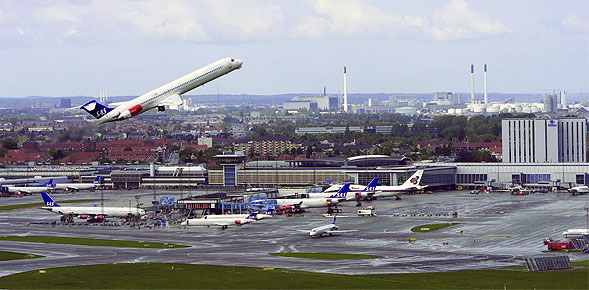
Copenhagen Airport
Copenhagen Airport

For travel to Scandinavia, the sweet spots for airfare savings are just before and just after summer when you stand to see savings of 50 percent off the peak-season prices. We spotted, for example, two round-trip fares between Boston and Copenhagen this fall for about $800 total, taxes and fees included. In July, you couldn’t have purchased one fare at that price, let alone two.

Savings At Accommodations
Airlines and cruise lines have an advantage over hotels: Rooms can’t be relocated to wherever the demand is highest. Rooms either go for significantly reduced rates or they go empty. Lower demand leads to higher risk of vacancies, which leads to a higher opportunity for you to nab cheaper rates.

First Hotels - Grims Grenka, Oslo
First Hotels – Grims Grenka, Oslo

Room prices are negotiable. Brush up on your courage and haggling skills and you stand to save huge sums, especially during non-peak times. If you’ve already prepaid for your stay but find the hotel quite vacant when you arrive, negotiate for a room upgrade.

Shops and restaurants are open – while many are closed during summer season
Shoulder season in Scandinavia is in fact more welcoming to travelers as is the busy summer window, especially in major Scandinavian cities. The only exceptions to this rule are the countryside and remote smaller towns with few year-round visitors.

161015-closed-shop

Sparse Crowds
Those who’ve attempted to climb the Norwegian mountains, tour the canals of Copenhagen or marvel at the Subway art collections in Stockholm during peak season can attest to this: The swarms of aggressive tourists at these popular sites can all but ruin the iconic monuments you traveled so far to visit. Sparse crowds translate to shorter lines and less frustration.

161015-hiking-in-scandinavia

Richer Experiences
Everyone, including locals, feels less rushed in the off season. Local tour guides will have more time to field your questions; shop keepers will have ample time to recommend their best wares or their favorite local restaurant; wait staff will have time to describe the finer ingredients in a dish. The chef will make the rounds to greet his patrons.

Relaxing in Old Town, Stockholm

Dining Is More Affordable
As the crowds thin out, restaurateurs increase incentives to drive customers through their doors. For the shoulder-season traveler, this translates to an increased number of happy hours, two-for-ones, and other dining specials. Take advantage of these savings by upgrading your palette and trying typically costlier items on the menu.

161015-mon-amour-copenhagen
And that months-long waitlist at the world-class restaurant? Just as exclusive and delicious, yet suddenly with an available table.

Mind Your Specific Destination
If you’re the type of traveler who prefers longer days for sightseeing and decent weather, select your destination wisely. Traditionally, destinations that geographically sit further north are colder. For example, this October expect average temperatures of 46 degrees Fahrenheit and 8 percent chance of sunny days in Stockholm.

161015-stockholm-sweden
Perspectives
Sure, the weather may not be as sunny as summer, but with the fewer daylight hours also comes foliage season and its bounty of color. As with most things in life, shoulder-season travel is about your perspective: glass half full or empty.

161015-autumn-in-sweden
9 Reasons to Visit Scandinavia in the Fall, written by Tor Kjolberg

Feature image (on top) Autumn in Lom, Western Norway

Elegance in the Norwegian Mountains

0

Experience the Tverrfjellet Pavillion in Dovre Municipality, designed by the prestigious architectural firm Snøhetta.

The Tverrfjellet Cabin was opened 2011, built on behalf of the Norwegian Wild Reindeer Centre North. The building is made as a box of steel, with a large glass surface against the mountain Snøhetta in the north, and one organic and undulating form of solid wood to the south.

050815-dovre-and-snohetta-map
The building is open and accessible during the summer months, and is reached after 20 minutes’ walk from the parking lot at Tverrfjellet.

050815-Norwegian-Wild-Reindeer-Centre-Pavilion-Dovre-norwayby-Snohetta
The car park is bounded by the front post rows inspired by the old fences that were used to capture wild reindeer in the mountains for more than 800 years ago. Follow the gravel path, which is also accessible to wheelchair users, 1500 meters up to the viewpoint.
050815-Norway_Counties_Oppland_Map
On the way, a series of flagstones tell you the Dovre mountain’s history over the past 10 000 years. At the top you’ll reach Viewpoint Snøhetta with a spectacular view to the Dovre-Sunndalsfjella National Park and the abandoned Hjerkinn artillery range.

The building has won several international awards since it was built and was named the “World Building of the Year” in 2011.

During the past four years over 60,000 people have visited the building.

Hjerkinnhus is located 3 km from Snøhetta Viewpoint.

Snøhetta was long thought to be Norway’s highest peak, and plays a significant role in the romantic nationalism ideology of mountain Norway. “United and faithful until Dovre falls”, the famous quote from the Constitution fathers in Eidsvold, testifies to this.

When you come for the first time into this giant, isolated mountains, especially if you come from Snøheim, you understand why Snøhetta has obtained a special place in the picture of the mountain Norway. Head to Snøhetta and Dovre and see for yourself!

050815-snohetta-viewpoint-dovre-norway

You can find accommodation here.

Elegance in the Norwegian Mountains, written by Admin