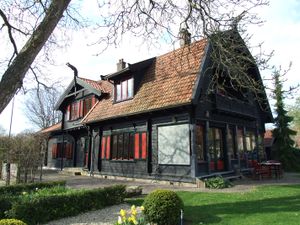
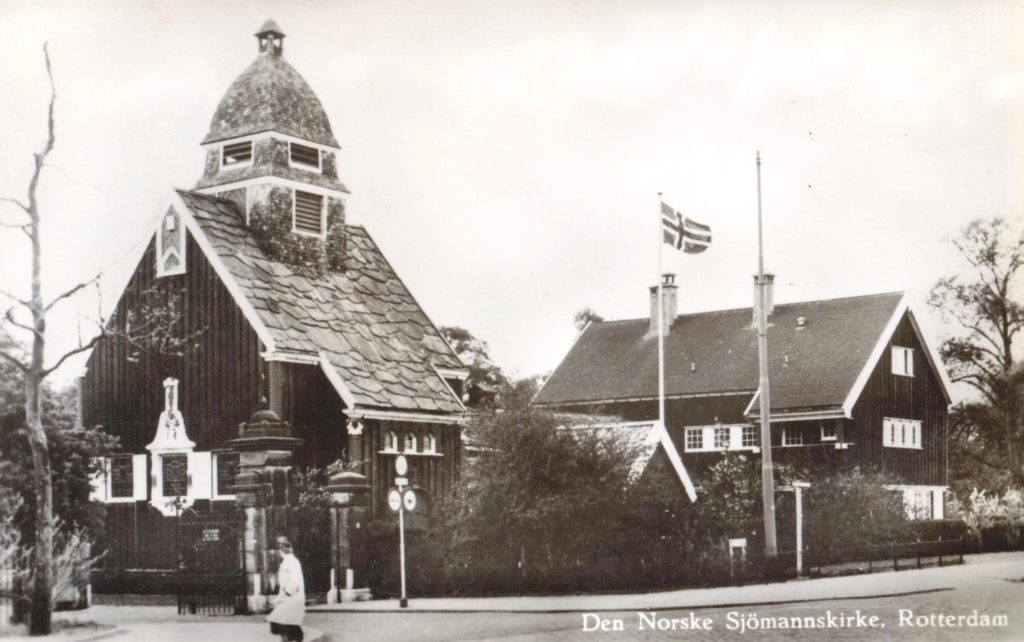
At the end of the 19th century a new architectural fashion arose in Scandinavia based on traditional wooden houses. This romantic movement came to be knowns by the name of Dragistil (Dragon Style), a reference to the dragon heads that used to adorn Viking ships.
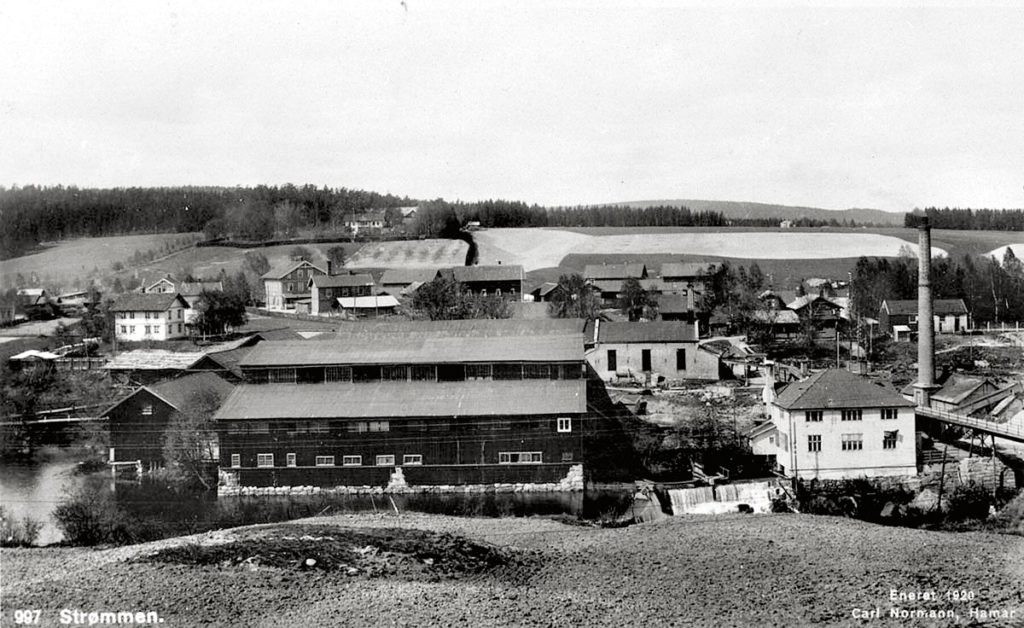
The STRØMMEN TRÆVAREFABRIK outside Oslo, established in the year 1884, was one of the first big steam-powered sawmills to manufacture and export ready-made wooden houses. The houses were built from sawn or milled logs, numbered and dismantled for transportation and reassembled on the buyer’s site. Some order standard models, others custom-made houses designed by architects. In a sense, we can say that Strømmen Trævarefabrik was a forerunner of today’s IKEA.
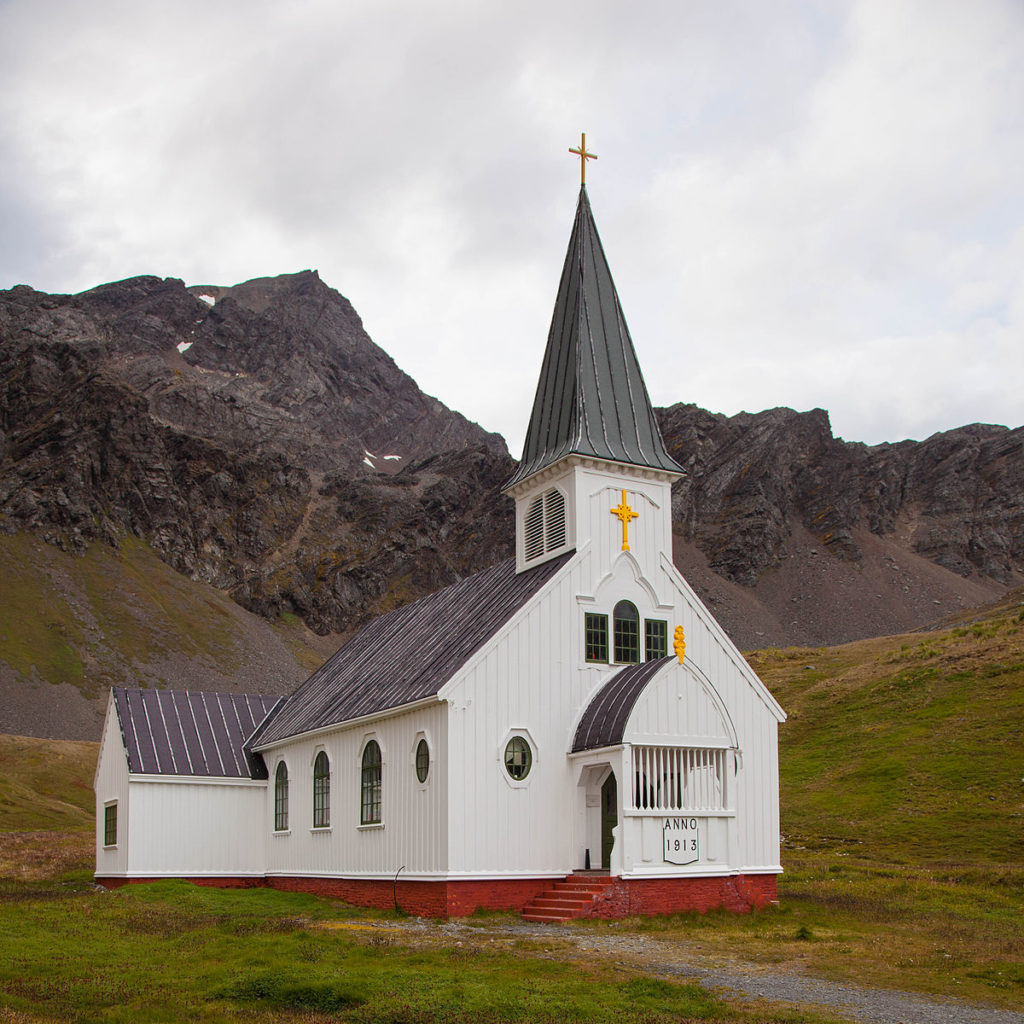
In a marketing catalogue from 1910, the factory says, “In the course of these years, we have built and shipped about 1300 wooden houses, some churches, several barracks, garden houses, and other buildings for different purposes, which are scattered all over the world – from the island Spitzbergen in the North, where we erected the buildings for the Norwegian Wireless Telegraph Station, to the South Pole, where we furnished “The Borchgrevink South Polar Expedition” with the necessary winter dwellings.”
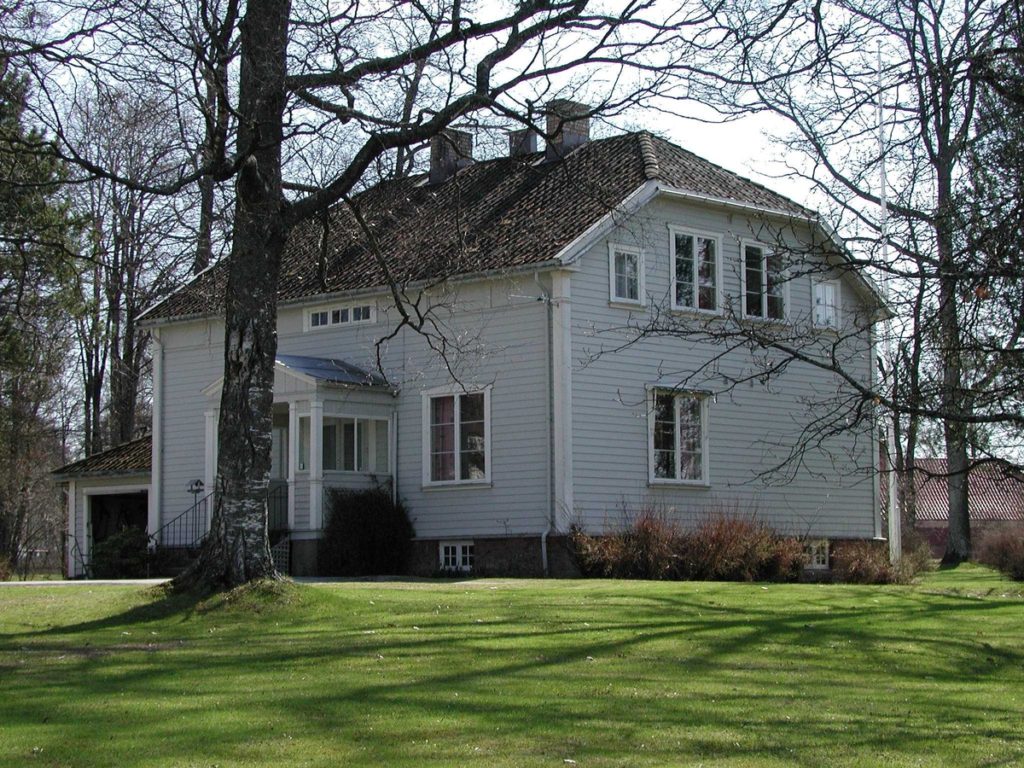
Molenweg 57 in Gorssel, Holland
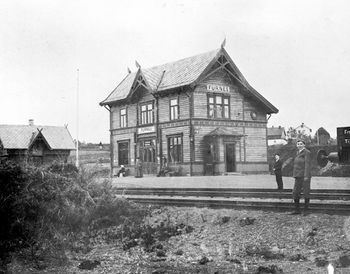
Customers could look through a catalogue and order a range of houses, as well as wooden churches, railway stations and even a sanatorium.
One of the most famous houses delivered by Strømmen Trævarefabrik is probably Høfdi, by architect Olav Olson, designed for the French consul in Reykjavik in 1908, and which the Icelandic government later bought as a representation residence. In 1986, Presidents Reagan and Gorbachev met there for a summit raising public international attention.
Grytviken church
A large number of the houses from the Norwegian factory were shipped to South Africa, Central Africa, South America, the West Indies and other transmarine places, and in like manner they will be found in most European countries. Thus were 90 houses and barracks sent down and erected at Messina and Reggio after the earthquake in 1908.
“Our houses have everywhere proved highly efficacious, so that they have attained an ever-growing reputation. In the regions frequently afflicted with earthquakes, a wooden house well-constructed is indubitably the most secure place of habitation,” states the catalogue.
Typical house from Strommen trævarefabrik AS
Also the residents of Gelderland, Holland, had an opportunity to learn about this building system at an industrial art exhibition in Arnhem. In 1903, and in 1913, a Norwegian house was exported to Gorssel and assembled on site. It had all the modern facilities of the time, including running water and electricity. The house was owned for a time by Vloogenboom and Van Hasselt and was then acquired by Maria Büchner, who left it to a foundation for disabled children after her death.
The railway station in Hamar, Norway
The art of building wooden houses is known to be very old in Norway, where this method of building has, with very few exceptions, been the only one in use from the commencement of history. The country still possesses wooden churches, whose age has been proved to be 800 years.
The factory burned in 1919 and went bankrupt ten years later.
The Exciting Story of a Norwegian House Manufacturer, written by Tor Kjolberg
Feature image (on top): Høfdi, by architect Olav Olson, designed for the French consul in Reykjavik in 1908.
The Scandinavian oyster (Ostrea edulis) is the round-shelled belon, and this is what our oyster shell-middens consist of. Pollution, bad management and overfishing have reduced the native population, however, so most oysters are imported.
Nevertheless, the population of the native oyster is on the rise once again, and as it is much fleshier and in most people’s opinion superior to the imported Pacific oyster, it is good to have the choice. There are not many wild oysters to be had, but oysters have been farmed since Roman times.
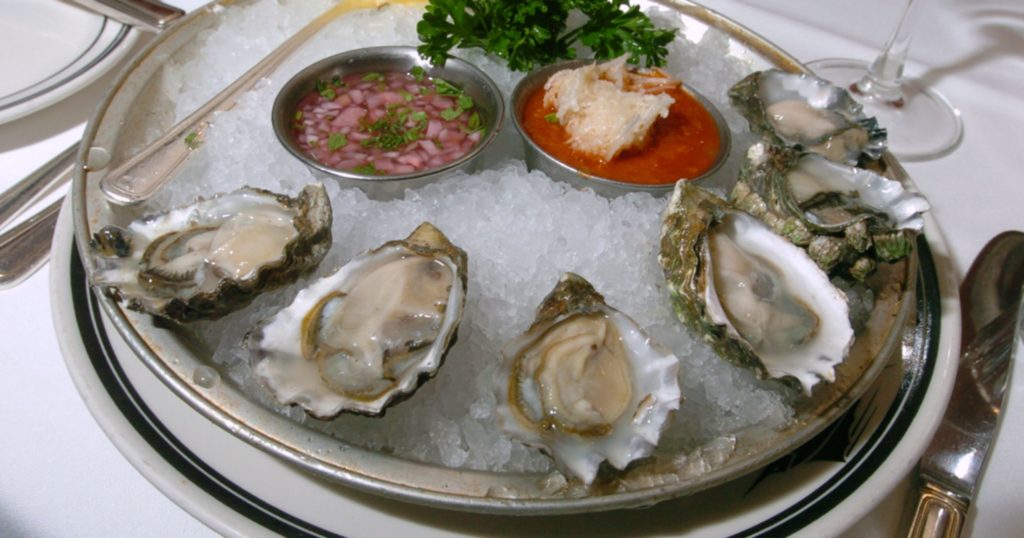
A Scandinavian oyster plate
Appearance and taste A shucked oyster in its prime should have a visible beard ands a light brown or greyish color with a white muscle. It should have a good, clean flavor and be firm and juicy. Oysters contain water, which you either drink, while eating them, or put into any dish with them. The liquid gas a refined sea-breeze quality that you don’t want to miss.
The population of the native oyster is on the rise once again
Native oysters spawn in the summer and are usually not eaten during that time, but other, farmed species are available all year round. There is a great difference in the taste and consistency, depending on whether or not the oysters have spawned; before spawning they are fat and firm, while afterwards, in the autumn, they are thin and exhausted – both have their dedicated fans.
Buying and storing With oysters, you must trust your fishmonger as there is no way of telling how fresh they are, or how long they have been kept out of water. Make sure that they smell fresh and are tightly closed.
Oysters can be stored alive in the fridge for a couple of days, in the container they are bought in, though they lose taste and precious water with prolonged waiting.
Culinary uses If eating raw, live creature seems too much for you, try them in a delicious fish soup or grill them for 3 minutes with a blob of hollandaise and a dusting of breadcrumbs. Warm oysters are lovely, and the gentle way to set your mind at ease while getting addicted to them.
To eat raw, serve with butter, good toasted bread and lemon. Six oysters per person for a first course.
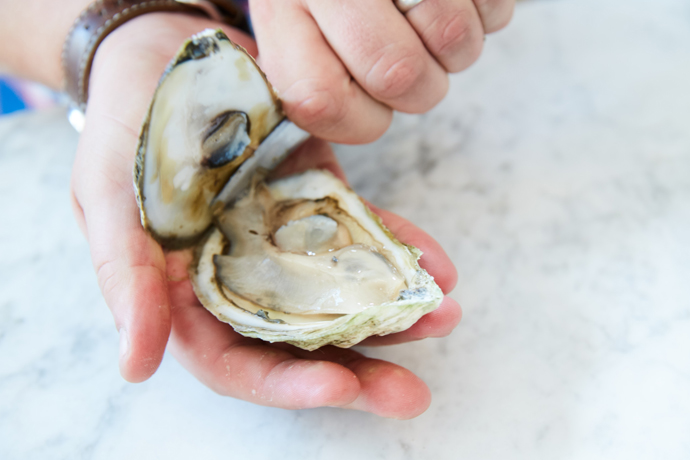
How to suck an oyster Oysters have a flat and a rounded side. Rest the rounded side in the palm of your glove-clad hand and using a short, thick-bladed knife, either cut the valve or tweeze the blade between the two shells at the other end and, in order to cut the stool (the muscle that keeps the shells together).
Remove the flat shell. This operation admittedly takes the nerve, patience, practice, and possibly, the odd plaster. Put your nose to every oyster; it should smell like a swim in cold salt water. If it doesn’t discard it.
Rest your shucked oyster in the deep shell on a bed of crushed ice, or seaweed, so the juices stay in the shell. And continue with the other oysters. Any that are not well inside should be rejected. Once shucked, the oysters should be eaten as quickly as possible.
It’s anyone’s guess what the Swedish sculptor John Tobias Sergel (1740-1814) might have thought of the huge illuminated obelisk, fountain and square that bears his name, and of the modern city around it.
The heart of this business and commercial area is not large, but it sits somewhat uneasily with the rest. From Sergels Torg it is hard to miss the five towering office blocks on Sveavägen, which cast their shadow over the other buildings.
Spring in King’s Garden
In the 1960s. Stockholm City Council, like so many others, succumbed to the temptation to knock things down and build concrete and glass high-rise buildings.
The destruction of many fine old buildings continued until it threatened the King’s Garden with the statue of the warrior king Karl XII on its southern side. At this point the Stockholmers had had enough. Normally placid and biddable, they mustered at the King’s Garden, climbed the threes that were in danger of the axe, and swore that if the trees went so did the people.
The City Fathers retreated, and Kungsträdgården survives to soften the edges of the new buildings and harmonize with the older buildings that are left. This the place to take a leisurely stroll or sit beside the fountains on a summer day and enjoy a coffee at its outdoor café.
In summer it is the venue of many outdoor festivals and rock concerts. In winter, part og Kungsträsdgården is flooded with water and becomes a popular ice rink, and the restaurant moves indoors.
The Hallwyl Collection
A short stroll east is the early 20th-century private palace housing one of Stockholm’s most unusual museums, the Hallwyl Collection. It’s the magpie collection of one person, Countess von Hallwyl, from her ornate piano to china, beautiful furniture and personal knick-knacks.
The Café at King’s Garden
Just north of the museum on Östermalmtorg, stop to snack at Östermalmshallen, a classy deli-style market.
King’s Garden in Stockholm, written by Tor Kjolberg
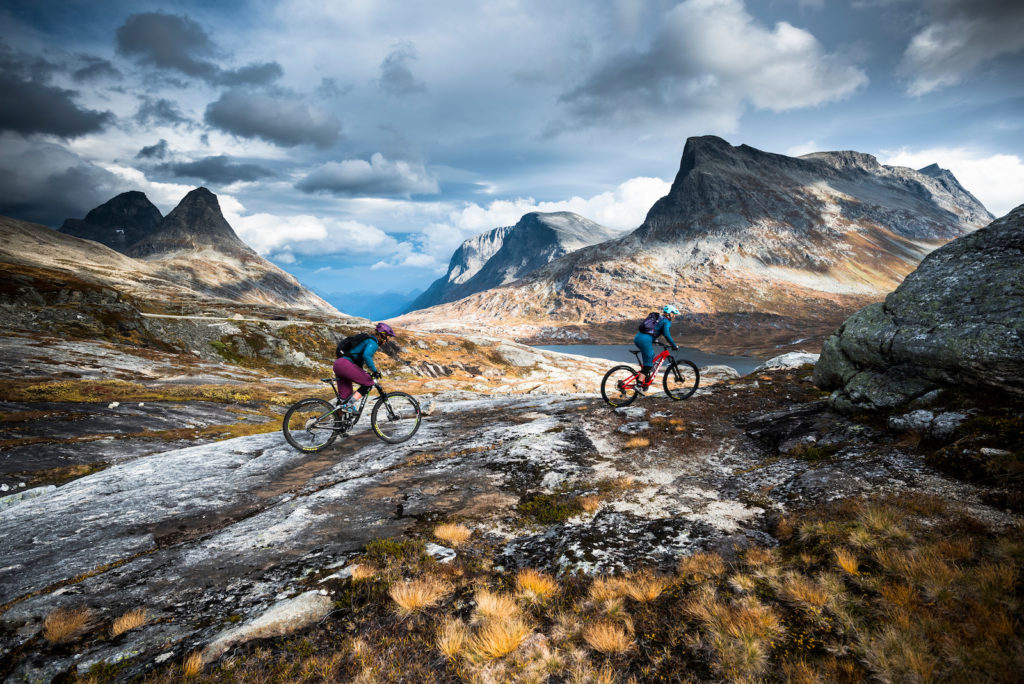
Sweet Protection, the Norwegian maker of the most advanced helmets, protective gear and apparel for ski, snowboard, bike and paddle sport, set out for the small village of Valldal on the West Coast of Norway to test and shoot the bike gear for this season.
Valldal, a small village on the West Coast of Norway known for its amazingly juicy strawberries is also a world-class mountain biking destination. It was a natural choice for both testing and shooting this season’s new bike gear.
Valldal was a natural choice for both testing and shooting the season’s new bike gear
The Sweet Protection photo shoot Last summer you might have seen Sweet Protection ambassador Mads “Makken” Haugen biking on what looks like the edge of the world in Norway’s west coast town of Geirangerfjorden. Playing host to some of the most dramatic landscapes anywhere, Geirangerfjorden is a popular tourist attraction with its unique fjords, abundant waterfalls and towering mountains.
You can escape the throngs of cruise ship tourists for a quieter place with world-class mountain biking
Paradise for mountain biking
However, less than an hour away you can escape the throngs of cruise ship tourists for a quieter place with world-class mountain biking and the juiciest strawberries you will ever taste. Some would say it’s mountain bike paradise on Earth, others just call it Valldal.
Valldal was for a long time a hidden gem mostly enjoyed by the locals
Placed between the two main tourist attractions of Trollstigen and Geirangerfjorden, Valldal was for a long time a hidden gem mostly enjoyed by the locals. Due to its location in a small valley away from the coast, Valldal is often a couple of degrees warmer than its neighbors (hence the extraordinary strawberry situation), making it the perfect summer outdoor adventure location. And indeed, it is. At least if you enjoy mountain biking.
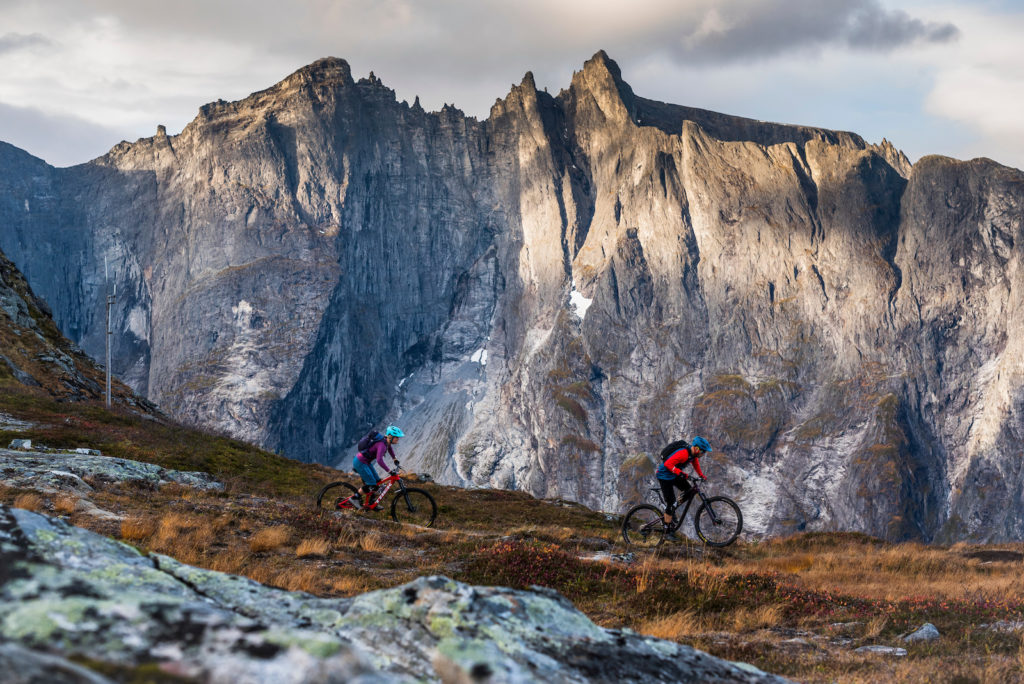
Riding on the West Coast is spectacular and well worth the effort
Spectacular biking
Mountain biking on the West Coast is tough. There are no lifts to take you to the top. And with some climbs rising so quickly, this is definitely hike-a-bike territory, meaning you’ll have to earn your turns in the summertime, too. However, riding on the West Coast is spectacular and well worth the effort. If you aren´t convinced by the views at the top, the ride down is guaranteed to win you over.
ValldaL is placed between the two main tourist attractions of Trollstigen and Geirangerfjorden at the Norwegian western coast
Whether you prefer smooth, flowy trail or a more technical ride, Valldal offers it all. The quality ride, small-town coffee shop, strawberry fields, fjords and unique mountain views make it sound like a cliché, but it´s not. It´s Valldal.
Whether you prefer smooth, flowy trail or a more technical ride, Valldal offers it all
Perfect for bikers as well as photographers
There’s no such thing as bad weather. Every day is a single-track kind of day! Don’t let a little rain stop you. Try the Hunter series from Sweet Protection if you´re in need of an upgrade.
Valldal was the perfect location for the Sweet Protection photo shoot
This was the perfect location for our Sweet Protection photo shoot. The views, the unique terrain and the best trails were searched for, like for instance the Romsdal´s Horn.
Sweet Protection searched for unique terrain and the best trails
Another upside of the choice of location, is the fact that you will never run out of water. Waterfalls are not a rare sight, and the water quality is first class.
Biking at Roimsdal’s Horn
The History of Sweet Protection
The Sweet Protection story started in Trysil, a mountain village in Østerdalen, Norway close to Swedish border in 1988. The Sweet mantra, stronger – lighter – better, can be traced back to a school paper from 1988, made by one of the founders and design manager, Ståle N. Møller. A pioneering and visionary industrial designer on a relentless mission to let action sport enthusiasts benefit from the properties of high tech materials and manufacturing methods.
Ståle N. Møller, the creator of Sweet Protection, Photo: Wikipedia
Some years down the road, and the scribbles on a paper have become the core of a unique brand identity, and in the process the mantra has evolved into a purified sentence: We create superior protection inspiring people to push their boundaries.
From the Sweet Protection photo shoot
How an illegal skate ramp was the start of a successful protection company Skateboarding was prohibited in Norway until 1989, as the only country in the world. Judged to be dangerous by the government. Growing up in a small town in the deep forests of eastern Norway, Ståle and his friends were clueless of how the banned sport of skateboarding was developing in other parts of Norway. Together they built a 7 meter high vert ramp hidden in the woods, and this was where it all went down until the prohibition law was repealed and a better ramp was built in the center of town.
Local shredders were supplied with handmade boards made of fine Norwegian wood out of the garage of Ståle´s parents. Ståle was also always busy improving and creating clothing and equipment for the boys, even making his own snowboard. In the mid 90’s, they made the clothes and backpacks they wanted and needed for their own expeditions, built to stand the harsh conditions on the biggest mountains.
Straight out-of-the-garage products made the world championships In 1997, freestyle kayaking was gaining ground. The existing kayaks were crap, and Ståle made a kayak revolution by developing a Kevlar wonder for his friend and top kayaker Erik Martinsen. This was the first spark of the Sweet brand emerging. With Ståle still in design school, he made another head turner, a carbon fiber helmet Erik could use in the freestyle kayaking world championships.
Ståle’s innovative approach and fresh design was breathtaking. Everybody wanted it. In 1999 Gøran, a member of the crew, came up with the idea of establishing a new company: “Sweet North”. However, half of the name was dropped, and Sweet was born.
Snowboard legend Terje Håkonsen on board The company was founded in 2000, and one of the first moves was to approach another uncompromising Norwegian; snowboard legend Terje Håkonsen. He saw the potential in the helmet prototype that was presented and joined the team. With Terje on board, Sweet made the move from the local garage to the international scene. Today no Sweet products leave Trysil without the influence of the team.
Terje Håkonsen. Photo: Sweet Protection
In 2003 Sweet made their first ISPO appearance, and immediately won the Brand New Award for best newcomer. The products had close ties to the initial, homemade gear the boys used exploring mountains in their youth.
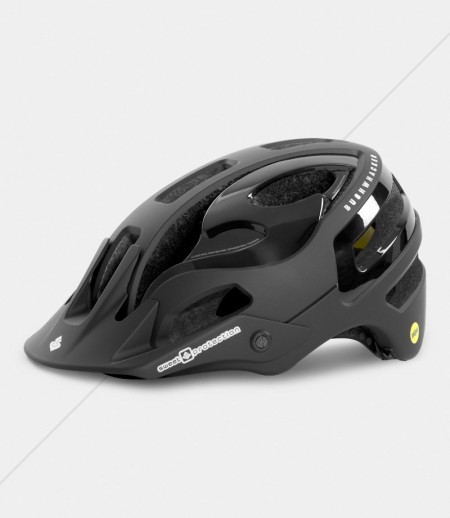
The Bushwhacker II MIPS helmet
Expanding the protection line
Until 2005 all helmet production was manufactured in Trysil, Norway. Due to capacity issues Sweet moved the production to Italy, a necessary move to continue to grow. In 2011 the first bike helmet from Sweet was put into market aimed towards the more aggressive part of the biking community. The biking range evolved to include the award winning Bushwacker, the go to helmet for single track biking. The Sweet gang continues to push revolutionary products into the market and MIPS, with their revolutionary rotational gravity impact technology, becomes an important strategic partner for Sweet, making the helmets even safer.
The Dissenter MIPS helmet
Aksel Lund Svindal proving the Sweet helmets to be first choice for alpine skiers
Sweet takes racing seriously and in 2012 Sweet teams up with Aksel Lund Svindal who gives the hand- crafted Rooster Corsa its debut in the alpine World Cup in Sölden, Austria on October 27 the same year. The helmet, made from pre-preg carbon and thermoplastic fibers, is baked in an autoclave, the same technique used to make Formula 1 racecars.
Aksel Lund Svindal in the slopes. Photo: Red Bull
In 2017 Sweet introduces a new single-track bike helmet named the Dissenter and the iconic Falconer helmet for serious road bikers.
Sweet’s products have since received several domestic and international awards for design excellence as well as best gear.
All photos, except where noted, taken by Dan Milner for the Norwegian brand Sweet Protection.
We thank Sweet Protection for their kind cooperation making this article, Sweet and Safe World-Class Biking on the Norwegian Western Coast, available for Daily Scandinavian.
Celebrated Norwegian architecture firm Snøhetta is designing Norway’s largest astronomical facility. The architects aspire to capture the feeling of being wrapped in nature and at the same time being in space.
The campus, set within a dense forest, 72 kilometers (45 miles) north of Oslo, will include a variety of buildings inspired directly by planets and their orbits. This will be a spectacular destination for astronomy fans. Imagine tripping over a small planetary system in a forest.
The campus, set within a dense forest will include a variety of buildings inspired directly by planets and their orbits
Built for spying during the cold war
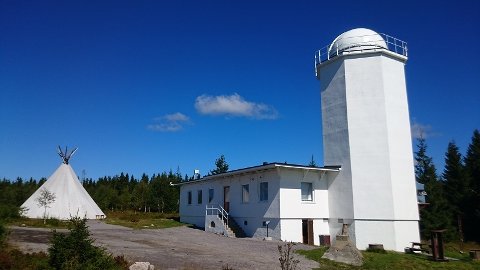
The Solobservatoriet in Harestua was originally built for the total solar eclipse in 1954 and used by the US military to spy on Soviet satellites during the cold war. Today it is operated by Tycho Brahe, an institution whose mission is to perform scientific research and enlighten the public about wonders of the universe.
The planetarium will look like a glowing planet
The planetarium will look like a glowing planet, and the dome of the 100 seats “heavenly viewing theater” will be planted with grass, wild heather, blueberry and lingonberry bushes as a smooth transition from soil to sky. Snøhetta’s designers took astronomy classes and were captivated by the architecture of the galaxy. “We learned about the analemma diagram of eight shapes made by the moon and the sun if you look at them from the same point for 365 days,” says Ingebjørg Skaare, a senior architect at Snøhetta who is working on the project.
Serving groups up to 32 persons
Stargazers who want to spend the night in the forest, can use the designated accommodation, serving groups of two to 32. The circular cabins will scatter loose around the planetarium, by design. A local wood company will work with Snøhetta to develop efficient construction techniques for the cabins. Custom-built furniture will be designed for the rooms’ unusual floor plan.
Snøhetta’s redesign will transform Solobservatoriet’s rather modest facility to an international destination
“A cabin can rise slightly above the ground, partially sunken or just touching the ground like a kiss, creating a planetary system on the site,” explains Skaare and adds: “The intact landscape on the site is one of the most important qualities for the experience.”
An international destination
The planned expansion includes a visitors center as well as several small outbuildings to the observatory’s historic telescope tower. When completed in 2020, the 1,500 sq. m observatory will be the largest solar observatory north of the Alps.
The old Harestua solobservatorium
With cafés, dreamy accommodations, even a generous “bowl-shaped” children’s area on the bowel of the planetarium, Snøhetta’s redesign will transform Solobservatoriet’s rather modest facility to an international destination.
Campus for Astronomy Fans is Being Built in Norway, written by Tor Kjolberg
The Man behind the Montana shelving system, Danish Peter J. Lassen invented freedom in a box – and he never turns old.
“Creating good design demands honesty and respect,” says Peter J. Lassen, the creator of Montana shelf system, whose simple and functional designs have become classics. When he developed the Montana System, there was a detailed mathematic and philosophical principle behind it. That’s why the design has been renowned for its simplicity and the functionality of their design.
From a career as a naval officer, Peter J. Lassen switched to the furniture industry in 1954. In 1982 he founded Montana Møbler A/S in Hårby, on the Danish island of Funen. For many years he worked with the architects Arne Jacobsen, Jørn Utzon, Piet Hein and Verner Panton, by whom he has been strongly influenced. The evidence is seen in the clean lines and functionality of his design.
Peter J. Lassen
The mathematic calculations are complex and based on 5.7 cm, but the philosophy is quite simple: Every Montana element should be able to be infinitely combined and be practical, good looking, durable and independent of changes in fashion.
“It must be possible to revolutionize the interior design culture and provide everyone with the potential to put together a room with a personalized touch,” he says. Father-and-son team Peter and Joakim Lassen have designed many of Montana’s products – often in collaboration with Montana’s design team or with external designers.
“Montana has become a system about freedom, not only at the moment the choice is made, but the freedom to alter the style, composition and function, whenever the urge strikes you,” says Peter Lassen.
The Story of a Danish Shelving System, written by Tor Kjolberg
Ekstremsportveko is the largest extreme sport festival in the world, and is hosted every year in Voss, Western Norway. There are competitions in kayaking, rafting, mtb-bmx, skateboarding, skydiving, paragliding, hanggliding, multisport, freeride, big air, climbing, speed riding, cliff diving, biketrial, wind tunnel, BASE and longboarding.
For one whole week, 24 June – 1 July national and international athletes compete and challenge themselves in the elements. However, competitions are not always the main focus for the athletes. The sharing of knowledge, when hundreds of top athletes are gathering this last week of June, is just as important.
Ekstremsportveko is the largest extreme sport festival in the world, and is hosted every year in Voss, Western Norway
The various sports are the main focus of Ekstremsportveko. However, the music program has become an important part of the total festival experience. The last three days of the event, national and international artists spice up the festival with their vibrant music within the genres; pop, rock, funk and reggae!
Slopestyle and bmx at Elstremsportveko
Ekstremsportveko is owned by the non-profit organization Stiftinga Ekstreme Voss – “The Ekstreme Voss Foundation”. Voss Active, Voss Kayak Club, Voss Hang and Paraglider Club and Skydive Voss are the four local clubs who represent Ekstreme Voss. There are two people working in the administration full time all year round. In addition to this, Ekstremsportveko rely heavily on positive and hard working people. Every year 800+ volunteers from all over the world contribute to make the festival a huge success.
Music is an essential part of the festival, and this year the organizer has dug deep into different genres and carefully selected a line up hard to ignore. Extreme sports during the day. During the night rock, hip-hop, electro-rock, electronic new wave, EDM and more.
The following artists are lined up for this year:
DATAROCK
Datarock
Whether you are a music fanatic or not, we believe everyone should have to experience, for themselves, and see their favorite band perform, live. As for rock music fanatics with a touch of the groove, you cannot call your self an “electric rock fan” if you have not, at least once, seen Datarock perform on a stage. Known worldwide for their playful rock music, Datarock tour the world with millions of fans all over the globe. Their music is all about having fun, known famously by wearing red tracksuits and big glasses. Datarock live performances have so much energy and vigor, the energy in the atmosphere is palpable.
ARIF
Arif
If you are a hip-hop music lover, the Norwegian rapper Arif is a must on your playlist. This young artist has proved to be one of Norway’s most important contributions to the rap and RnB genre. He has the ability to play with words making them flow, and his ability to tell today’s generations stories. His music makes necks turn, heads to nod and feet to move with joy and fascination. In attending any of his concerts, you will get to meet major players in the music industry. After selling out one of the biggest stages in Norway, Oslo Spektrum, Arif is now the talk of the town.
WHALES AND THIS LAKE
Whales and This Lake
Electro-pop music lovers must attend Whales and This Lake’s concerts. They are the true definition of electro-pop genre music. This band, comprising of three artists, are doing “whale pop”, which is characterized as a dark and dancy genre of indie electro pop. The three artists originate from the sparsely populated Norwegian countryside where synths are homemade and the drums have been covered by whale skin for thousands of years. Why attend their live concerts? Whether you have never heard them, listened to them for a few days – or finally getting to see your favorite artists live, this is such an immense feeling to experience live. Whales and This Lake band with no doubt will play a major role in the European music scene for the next decade.
THULSA DOOM
Thulsa Doom. Gere as Conan, the Barbarian
There is no better place to enjoy metal music than a live concert. Thulsa Doom is a metal band, formed back in 1999, based in Oslo, Norway. Springing out from the record label Duplex Records, with bands such as Cumshots, The Dogs, Bare Egil Band, Black Debbath and Hurra Torpedo. Their music is inspired by Kyuss and early Black Sabbath. Stoner rock music fanatics know the true meaning of metal music through this band. This is a very famous band in Norway. They have been in the music industry since 1999. As a health benefit, if you get to see your favorite artists perform live, that tends to bring joy and happiness to people, not to mention the calories one burns when in the moshpit.
KREAM
Kream
Hailing from Bergen, Norway, and formed in 2015, KREAM features the talents of brothers Daniel and Markus Slettebakken. The Norwegian electronic-based duo is known for their high-energy house-oriented pop music, with gloomy undertones. Attending their concert is a must go for house music lovers. Kream released the song that they co-wrote with Swedish songwriting duo SHY “Taped up Heart” which feature vocals from Clara Hagman. The song has charted on Billboard’s Hot/Dance Electronic Songs chart and peaked at 22. Kream is the cream of house-oriented pop music. In a few year expect Kream to be the cherry.
FUTURE DUPER
Future Diper
Future Duper is a new name in the EDM/Pop music world. With their remixes, they have brought a new life to tunes from Alan Walker, Avicii, and Galantis and among others. Over time, they have developed their own bouncy and melodic tune. The band comprises of two members based in Oslo, Norway. Attending their concert gives their fans a chance to be really close to what was once an underground movement.
HKEEM
Hkeem
Hkeem is the kid on the block in Stovner, Oslo, in Norway. Bringing a new style of rap in the Rap world in Norway, Abdulhakim Hassan, better known as Hkeem, came into the spotlight after he and his youth friend Temur Baig released his breakthrough song “Fy faen”. This song, launched in April 2017, reached the first place on the VG list (Norwegian version of Billboard) in week 17, and became Norway’s most streamed song on Spotify. For the song, Hkeem and Temur were nominated in the class This Year’s song during P3 Gold 2017.
SONNY ALVEN
Sonny Alven
Many of us music lovers have very many different reasons why we listen to music; from enjoyment to idolizing our favorite artists. At Sonny Alven’s live concerts, it is an all-in-one package. He is steadily becoming known worldwide for his dance-inducing yet chilled out beats and signature electronic style. He has performed alongside huge electronic acts like Kygo and Galantis throughout Europe and the United States. If you are a fan of the big names in the electronic music genre, then Sonny Alven should not miss in your playlist as well. One of the main themes of electronic music concerts for people to later say “I saw him when he was up and coming”
AMANDA DELARA
Amanda Delara
If you are looking for the most exciting and promising new artist to surface during 2016, Amanda Delara is your choice. Having attended no musical school, she began playing piano in early childhood. As a teenager, she decided to write her own music. If you are a fan of pop music, you must be an Amanda Delara fan as well. Feeling like your spirits are down? Attending a concert is typically a high energy activity, and it can help to boost your fatigue throughout the day if not the whole extreme sports week.
KURT NILSEN
Kurt Nilsen
Kurt Nilsen is one of Norway’s best-selling artists and is one of the country’s popular live performers. He got his breakthrough in the norwegian TV-show “Idol” (like American Idol) in 2003 and became the year after World Idol. Since then, he has received countless awards, released several critically acclaimed albums and had some of Norway’s biggest radio hits.
Now, he are coming to Ekstremsportveko for a rare and intimate live performance on Wednesday June 27th.
RÖYKSOPP
Röyksopp
The Tromsø squad Svein Berge and Torbjørn Brundtland make up the electronic music group Röyksopp. The duo was officially formed in 1998, but has made electronic music ever since 1988 (!) And is undoubtedly pioneer in the genre. Ever since the debut, they have made great success both at home and abroad, and collaborated with famous artists such as Coldplay, Depeche Mode, Beck, Lady Gaga, Robyn & Susanne Sundfør to name a few. They have released a series of mixtapes & six studio albums, four of which have been in the first place on the VG list. They have won the Norwegian Grammy Awards, P3 Gull Awards and nominations for international awards such as Grammy and Brit Awards.
Röyksopp continues to impress the audience worldwide with their visual sensational DJ and livesets. After decades as DJs, they have delivered the DJ-sets in clubs all over the place; from London, Dubai & New York, to Mexico, Tokyo & Ibiza.
In June they are coming to Ekstremsportveko bringing a DJ-set that will set the Veko Lounge on fire.
Röyksopp continues to impress the audience worldwide with their visual sensational DJ and livesets
Note: Due to serving of spirits in the lounge-tent, this concert will be for age 20+. However, the concert will be streamed to the main stage for age 18 – 20 years.
Extreme Artists at the Extreme Sports Festival in Norway, compiled by Admin
If you’re visiting the National Museum in Copenhagen, you should set aside time to enjoy a selection of Danish smørrebrød at the museum’s restaurant Smör, which opened with new owners, late March this year.
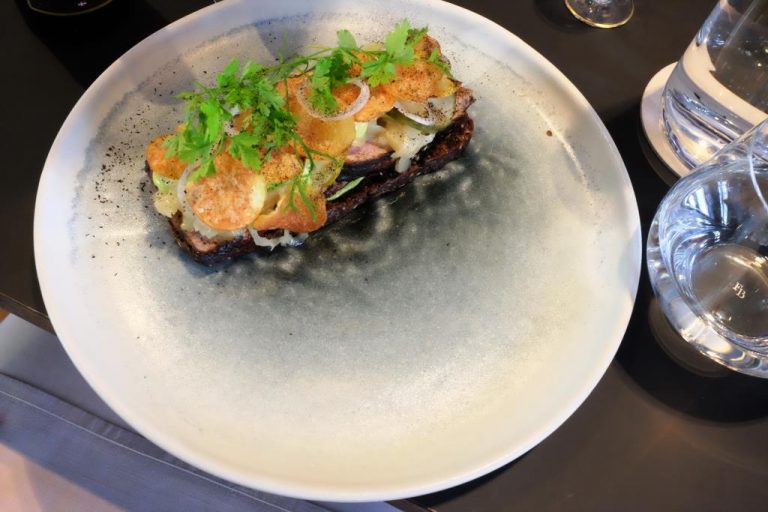
Our charming waiter Niclas Klixbüll explains that Restaurant Smør (Engl.: Butter) relies on a kitchen of Danish gastronomic pedigree. The menu consists of traditional smørrebrød with a modern twist and executed to perfection. The drinks to pair with the food are carefully selected from local breweries and distilleries.
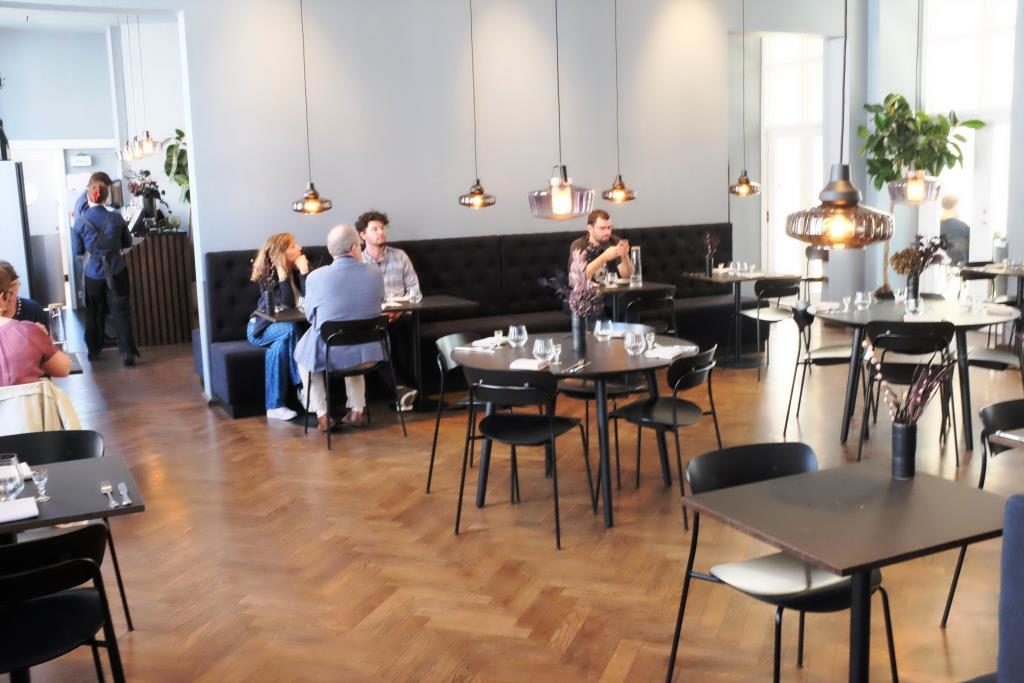
The venue with its light walls and dark Danish designer chairs is inviting and cozy. Here you feel welcome to a country obsessed with rye bread! Rye bread provides the foundation for the open-faced sandwich, or smørrebrød. Typically slathered with butter, and topped with meat, fish or cheese. At Restaurant Smör inside the National Museum in Copenhagen they give this beloved treasure a modern twist. The open sandwiches here are made with seasonal, mostly local, ingredients.
welcome to rhe country obsessed with rye bread!
What about….
Soft boiled egg, lumpfish roe, Buretta from Rødovre with a crispy chicken skin, or
Smör’s Salami on Beef and Mangalitza, Portwine aspic, onion, traditional Danish flavored lard and green tomato, or
Creaky chicken salad on Danish free range chicken, Madagascar pepper, bacon and asparagus, or
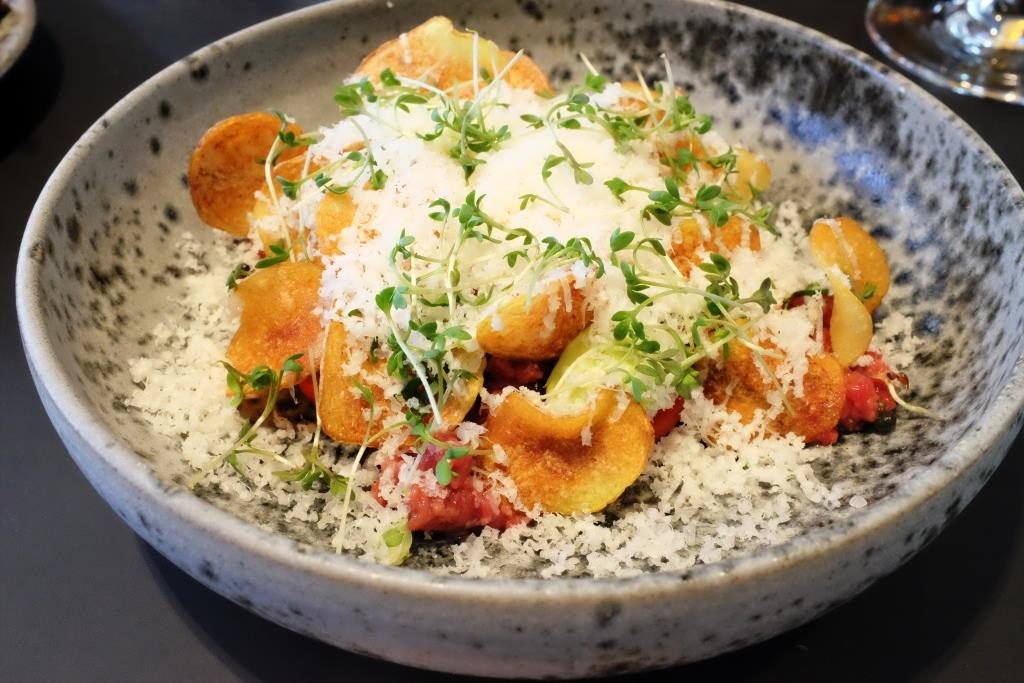
Tatar of beef topside, ramson, pecorino, tomato and egg yolk.
Smörrebröd from a kitchen of Danish gastronomic pedigreeRye bread provides the foundation for the open-faced sandwich, or smørrebrød
Although two pieces of smørrebrød (which each cost around USD 15) should suffice for a filling lunch, it’s a shame to miss out on a slice of the Danish free range beef fillet with Tarragon Crème, caramelized onions and fried egg.
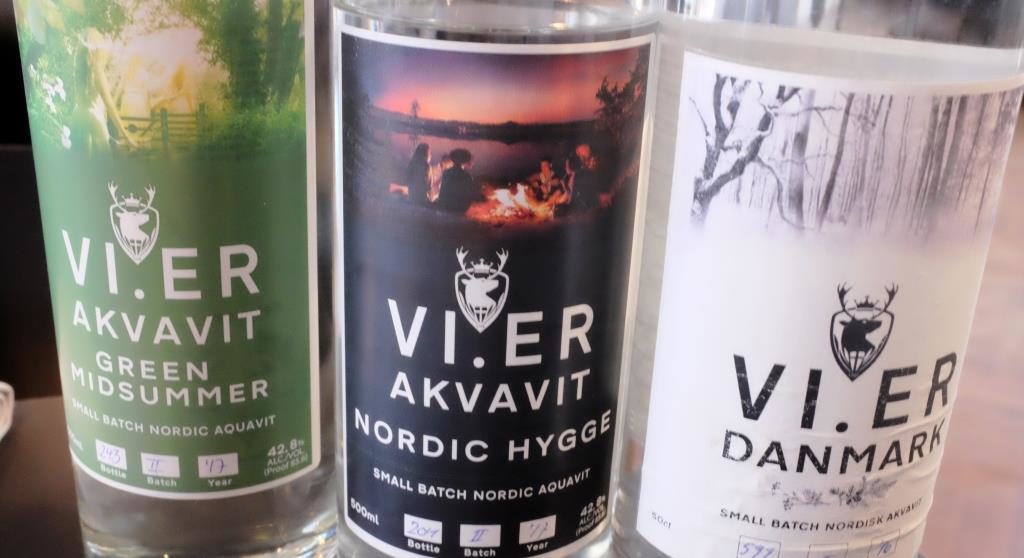
Local beer at Restarurant Smör“Vi er akvavit” translated into English means “We are aquavit”
Beer and aquavit fans will appreciate the handful of interesting local brews.
The venue with its light walls and dark Danish designer chairs is inviting and cozy
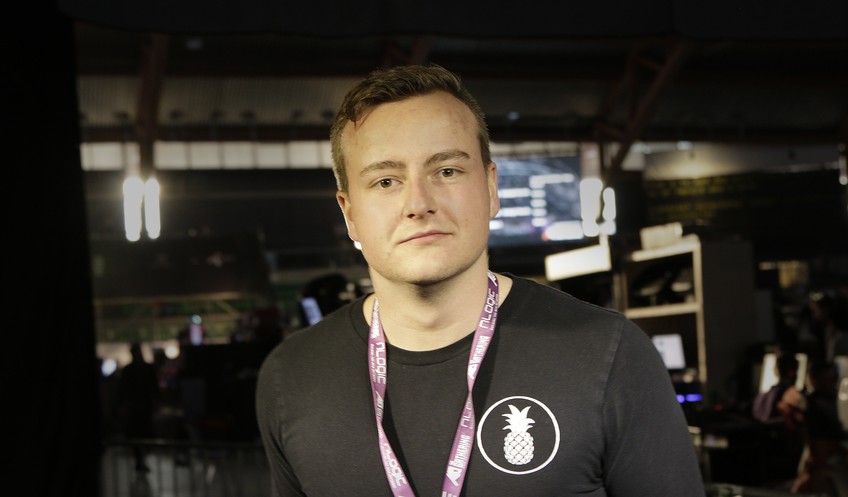
SMÖR is the brainchild of Madkastellet, famous for their award-winning, edgy food concepts. Ulrika Mortensen is Head of Communication & Brand Development.
Ulrika Mortensen, Head of Communication & Brand Development and head waiter Niclas Klixbüll
All photos: Tor Kjolberg
Reinvented Traditional Smørrebrød in Copenhagen: Restaurant Smör reviewed by Tor Kjolberg
A new report, Oslo: State of the City 1918, shows that Oslo is recognized as a capital for business as well as vigorous growth.
It is 5 years since Oslo decided to re-shape the city-region’s international identity, visibility, reputation and positioning and to frame the Oslo brand. In those 5 years, Oslo has emerged as a new and distinctive player on the European and global stage. The Region has taken responsibility for bringing into being an additional economic model for 21st century Norway, during a cycle of great change for both the country and the world.
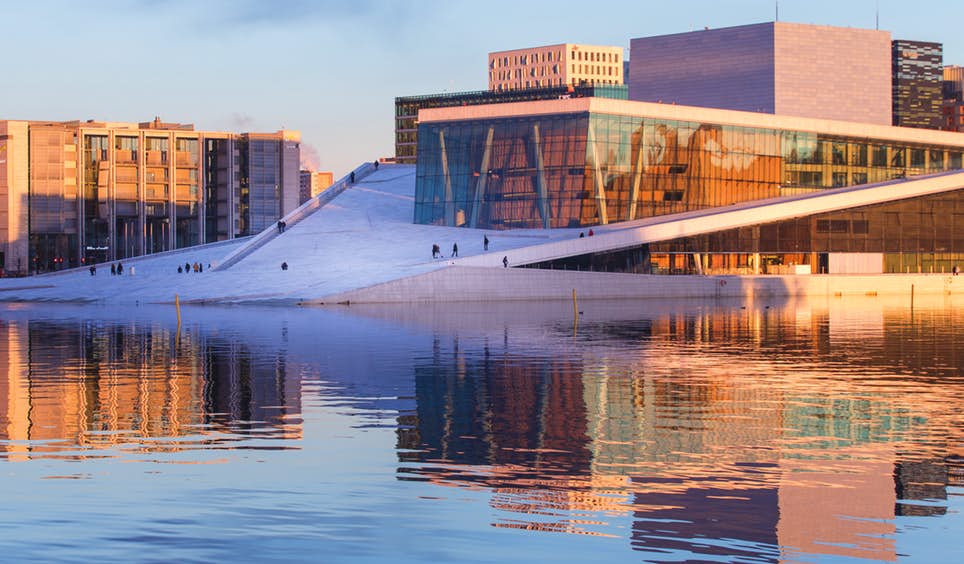
The Oslo Opera House
A new economy and a new Oslo
In this cycle the changed commodities outlook and an aging population means that Norway has to shift decisively from an oil/gas and corporate economy towards a more diversified set of sectors powered by knowledge systems, small and medium sized companies, and a new generation of exponential technologies that will create the next generation of jobs.
The winds of change are global in scale. Urbanization, globalization, digitization and cross-border capital flows are all tending to concentrate opportunities in the most competitive, innovative and adaptive city regions. The global contests between cities and regions are shifting away from attracting banks and corporate HQs to a focus on science, technology, entrepreneurship, talent, lifestyle, institutions and soft power.
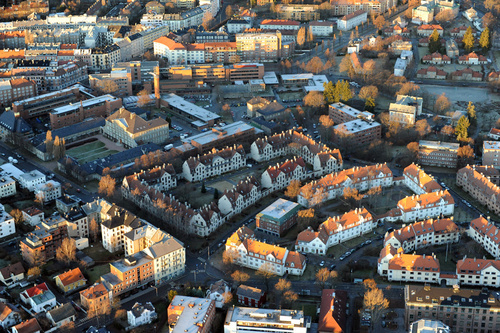
Groruddalen in Oslo from above. Photo: Lasse Tur
The Oslo region has been the fastest growing capital city in Europe. Since 2000, the Region’s population has grown by more than 25%, and many of the key dynamics are in place for growth to continue up to 2050. Oslo’s high standard of living, buoyant labor market and increased recognition of the region’s standard of public services has seen it become more attractive to young people within Europe and also beyond.
It is 5 years since Oslo decided to re-shape the city-region’s international identity, visibility, reputation and positioning and to frame the Oslo brand
In 2018, for the first time, 25% of the Oslo population is born overseas. High levels of in-migration of young people have transformed the demographic profile of Oslo and created the conditions to expand the city’s innovation and cultural scene.
In 5 years, Oslo has emerged as a new and distinctive player on the European and global stage
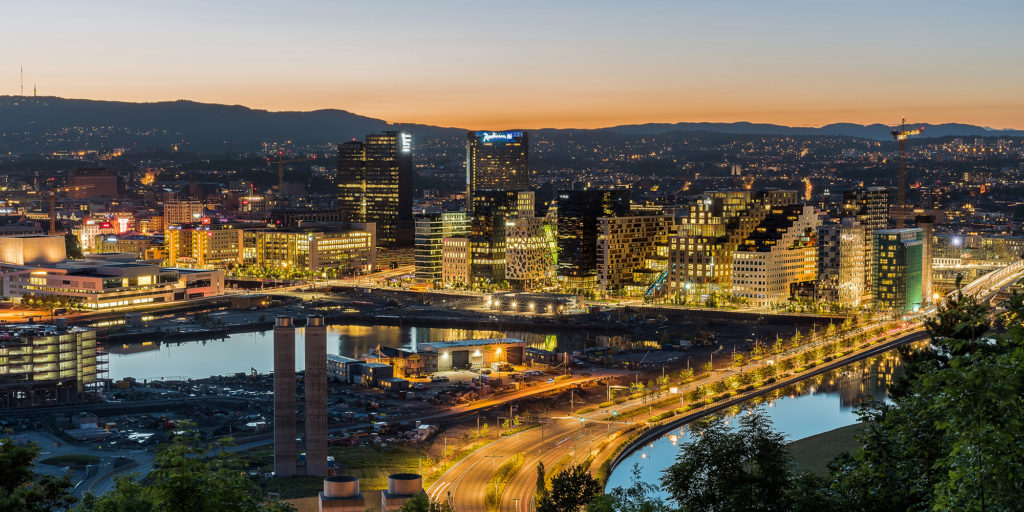
Oslo’s rapid regional growth has seen local governments and national government recognize that to accommodate this growth the capital has to develop a regional approach that involves intelligent use of regional infrastructure and assets, and large scale urban restructuring. This has not only seen Oslo grow its successful new airport into an internationally connected hub. It has also involved a process or urban densification and redevelopment to connect its harbor to the city center.
The Oslo region has been the fastest growing capital city in Europe
Oslo is not only a city of finance and business serving its national commodities and maritime economy – it is a diversified city of knowledge, culture, medicine and advanced technology. Since 2010, many of its emerging sectors have grown rapidly, including telecoms and IT (4% jobs growth per year), technical advisory (4%), and arts, culture and entertainment (3%).
Both the New York Times and Lonely Planet have recently listed Oslo as one of the top places to visit worldwide,
For the new wave of fast-growing and rapidly globalizing city regions, culture is an essential ingredient if the region is to successfully accommodate the innovation and creative economy. This is very true in Oslo. As the region competes at the global cutting edge, cultural investment is helping to cement Oslo’s reputation for quality of life, boost its destination appeal, meet the preferences of the innovation economy, and communicate its core values in a time of change.
Oslo: State of the City 2018
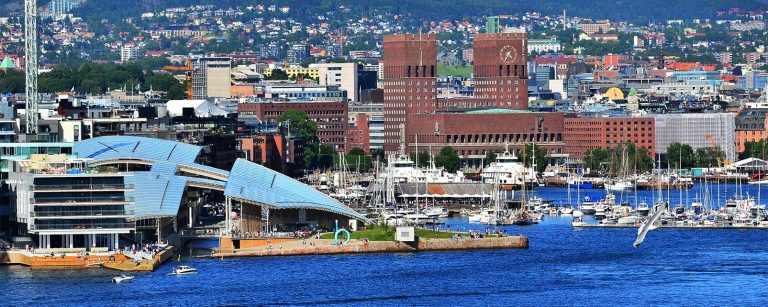
Oslo’s growing cultural reputation is the product of a 10 years cycle of investment which began with the Opera House followed by The National Museum, the Astrup Fearnley Museum of Modern Art, the new Public Library and the Munch Museum, all providing a major boost to the competitiveness of Oslo’s cultural amenities while also improving public services, public space and public access.
One international survey identifies 92% of Oslo residents are quite or very satisfied with cultural facilities in the city, such as concert halls, theatres, museums and libraries.
Both the New York Times and Lonely Planet have recently listed Oslo as one of the top places to visit worldwide, in recognition of the city’s ever-improving offering of exciting architecture, cultural and art experiences.
Oslo has always been something of a pioneer in adopting green and sustainable models
Oslo has always been something of a pioneer in adopting green and sustainable models, but this has really accelerated in the last 5 years. Oslo has become renowned globally for implementing some of the most ambitious greenhouse gas reduction targets anywhere in the world. The City plans on reducing greenhouse gas emissions by 50% compared to 1990 levels by 2020, and by 95% by 2030. If successful, this will make Oslo faster at reducing emissions than any other city or country.
it appears that there are three core dimensions to the way the region has evolved in this latest cycle. Oslo has emerged as an innovation region on the international stage. Relative to other small regions around the world, Oslo region continues to grow more firms, create more co-working spaces, incubators, accelerators and startups.
The Acrobat, by Rolf Thoresen
A cycle of investment in cultural infrastructure and neighborhood redevelopment is capturing the imagination of prospective talent. Oslo is also a region promoting new approaches to social cohesion and inclusion, family-friendly urban living, and healthy lifestyle at all stages of life
What does this all mean for Oslo?
As a result, it is fair to say that Oslo’s new business model (innovation, science, culture) is increasingly in demand. It also increasingly benefits from an integrated region that adds scale and capacity to help Oslo absorb demand in a well-managed way.
Oslo was known for being a small, pleasant, safe, domestically oriented city that was on the cusp of change. Today, more of Oslo’s edges are known by the world: its urban quality and vibrancy is being recognized, its work-life balance is feted, and its diversity, innovation and ambition is widely perceived by external observers. Oslo is becoming a leader.
eRoads Arlanda – world’s first electrified road for charging vehicles has opened in Sweden. The first working tracks on Road 983 was started in October 2017 and has now been completed and electricity turned on. Modified electric vehicles can now be charged while they’re driving.
eRoadArlanda is one of several projects in the Swedish Transport Administration’s pre-commercial procurement of innovation for the development of electrified roads and the project was started in June 2013. The newly opened stretch of road outside Stockholm transfers energy from two tracks of rail in the road, recharging the batteries of electric cars and trucks.
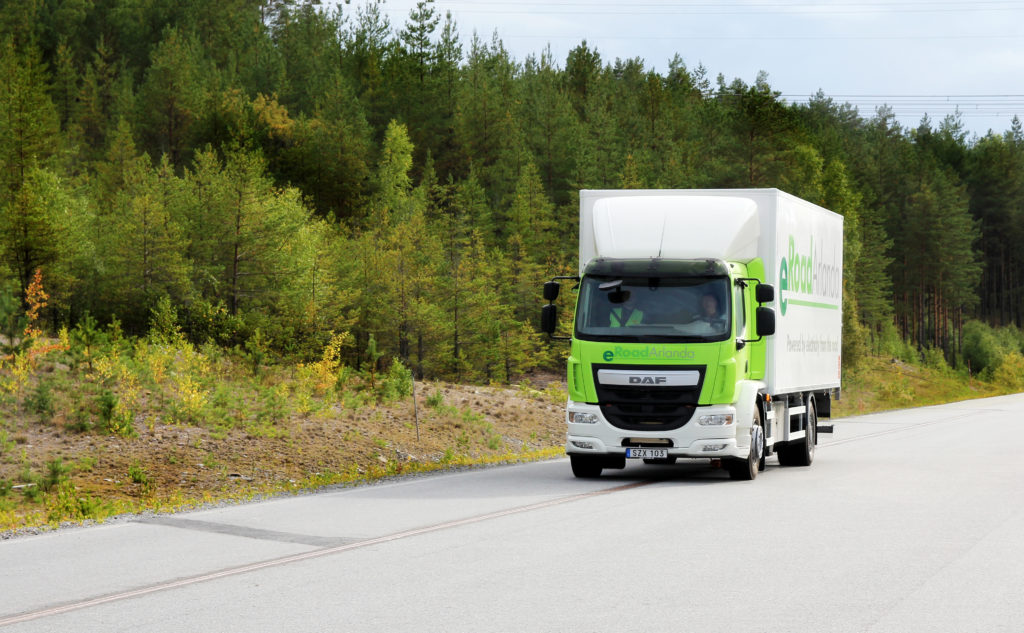
First out on the 2km (1.2 miles) long road was an 18-ton electric truck transporting goods between Arlanda and the PostNord terminal in Rosersberg
First out on the 2km (1.2 miles) long road was an 18-ton electric truck transporting goods between Arlanda and the PostNord terminal in Rosersberg, and the road is set up to bill the driver for the amount of electricity the car pulls from the road as it moves. The techniques that have been developed in recent years are based on conductive technology that use an electric rail installed in roads to power and recharge vehicles during their journey.
The first working tracks on Road 983 was started in October 2017
The goal of the project is to generate knowledge, experience and decision data that is conducive to the creation of a platform for the electrification of larger transport routes in Sweden. The Swedish government’s road agency has already drafted a national map for future expansion. The project is an important part of Sweden’s target of achieving independence from fossil fuel by 2030 requires a 70% reduction in the transport sector.
A conductive technology uses an electric rail installed in roads to power and recharge vehicles during their journey
“The electric road project and the shift away from fossil fuels will help boost Sweden’s competitiveness,” the organization says. Energy is transferred from two tracks of rail in the road via a movable arm attached to the bottom of a vehicle. The electrified road is divided into 50m sections, with an individual section powered only when a vehicle is above it.