Sweden wants to position itself as a hub for commercial satellites and is launching a base in the Arctic wilderness aiming to be Europe’s first. Will Sweden beat SpaceX founder Elon Musk’s Starbase plans in Texas? Will Sweden be the next hub for commercial satellites?
The reindeer will probably not be happy when the Swedish government is turning an old research base above the Arctic Circle into a state-of-the-art satellite launching center. The business development agency LTU Business has on behalf of the northern Swedish regional space development program RIT2021 undertaken a study which concludes that a space center in and around the town of Kiruna could double in size over the next 15 years and result in a directly-employed workforce of 1,000.
The Esrange Space Center shares a landing zone that is more than 2,000 square miles and will be the testing ground for Europe’s first reusable vertical rocket next year.
The Arctic space research center was first handed over to Sweden in 1972 and may now be taken into a renewed sense of purpose. The Esrange Space Center shares a landing zone that is more than 2,000 square miles and will be the testing ground for Europe’s first reusable vertical rocket next year.
Home to Space technology intelligence
Kiruna is the most northerly town in Sweden. It is the site for the Esrange Space Centre, the Swedish Institute of Space Physics, and the Department of Space Science of the Luleå University of Technology, as well as various space sector enterprises, most notably the state-owned Swedish Space Corporation (SSC).
The Arctic space research center was first handed over to Sweden in 1972 and may now be taken into a renewed sense of purpose.
The Arctic Circle has its advantages when it comes to launching satellites into the space. It gives the satellites a more comprehensive view of Earth, while requiring less energy for a satellite to actually get into space. Sweden will be the first orbital launch site for orbital satellites in Europe – capable of launching spacecrafts into the orbit around Earth or interplanetary trajectories.
Academic and commercial growth “New technology enables easier and cheaper access to space, transforming the industry from having been exclusive to expensive national initiatives to becoming a market for virtually anyone and everyone with interest and ambition,” says project manager for RIT2021, Johanna Bergström and adds, “This enables the space sector to expand both academically and commercially, and creates opportunities for small businesses to contribute, compete and grow.”
There should be no shortage of interested parties on hand as Esrange ramps up its efforts to become Europe’s preeminent launching pad for orbital rockets. According to a report from New York Times ISAR Aerospace Technologies in Germany has secured $100 million in funding from an ex-SpaceX VP and is already on site testing out engines.
A unicorn in the space business “We are a bit of a unicorn in the space business,” said Philip Pahlsson, vice president for strategy and innovation of the Swedish Space Corporation, referring to the government’s ownership of the site. “But we do plan on being the awesomest company in the government’s portfolio.”
Establishing a satellite launch capability at Esrange would probably make Sweden the second country in Europe (after the UK), and the first in the European Union, to have such a capability from its home territory.
Though the effort is certainly ambitious (and has elicited occasional concerns from locals who appreciate the area’s vast wilderness), the Swedish Space Corporation believes Esrange is vital not just for the Scandinavian country’s ambitions but for the continent as a whole.
Space experts claim that with a fast-growing space market, Europe will have an increasingly need for smaller rockets carrying smaller satellites. “Sweden will become a launching state, providing a capability of great importance for research, technology development and expanded international cooperation,” said SSC CEO Stefan Gardefjord.
The Arctic Circle has its advantages when it comes to launching satellites into the space
Excellent infrastructure
“Europe really needs to build infrastructure to get to space. We can provide a proper space base,” said SSC senior VP Stefan Gustafsson.
Kiruna (also the site of a major iron-ore mine, which was the cause of the town’s foundation at the start of the twentieth century) has excellent infrastructure, and benefits from the ameliorating effects of the Gulf Stream current that originates in the Gulf of Mexico and crosses the North Atlantic.
Sweden – A Hub For Commercial Satellites, written by Tor Kjolberg
The coronavirus pandemic has affected the entire world, and that’s a fact. Starting with the overall wellbeing of the entire population, to every branch of the industry, the pandemic has heavily impacted every one of us. Learn more about how COVID-19 affects Scandinavian countries.
Even though we had no other choice than to adapt to this new lifestyle, the impact this pandemic has left is huge, and you can see that everywhere you turn your head around: it’s reflected in tourism, it has impacted small businesses, our general physical and mental health, etc.
Scandinavian countries have been affected in the same way most European countries have.
The impact this pandemic has left is huge, and you can see that everywhere you turn your head around. Photo: Nordforsk
Tourism Generally, tourists tend to visit Nordic countries in the summer – starting from June, until late August or even September. As Scandinavian countries are not the warmest countries, people plan their visits around that time.
Even though these countries have similar policies and ethics, the way they’ve handled the virus was a bit different, especially in the beginning of the pandemic. For instance, from the very beginning, Norway has shut down the doors of the educational institutions, sports and cultural activities have been interrupted, it had a stringent protocol in wearing face masks and so on.
Sweden, on the other hand, has kept most of these facilities open, in hope of keeping people’s morals high. When the international governments adopted the full lockdowns, borders have also closed. That’s when the tourism has started to struggle to survive. The number of foreign visitors has dramatically decreased, and this resulted in many hotels, restaurants and cafes to lose their businesses. Even though you were able to visit the country, there were a lot of rules that had to be respected.
Even though you may have been able to visit Norway, there were a lot of rules that had to be respected.. Photo: Fusion Medical Animation/Unsplash
Population Of course, as the rest of the countries of the world, people have been confused. Even though it has been expected that most Nordic countries will adapt the same COVID-19 policies, it was surprising to see that Sweden decided to take some different decisions than the rest of the countries.
While everyone else was in a total lockdown, Sweden has kept the doors open for many services. However, it is not to say that that was the best approach, neither the worst. While it might have helped people, psychologically, to know that they can still carry on with their usual daily lives, there were still plenty of restrictions that were only to show that the situation was quickly aggravating, and the high mortality note can confirm it.
Many workers have had to start working from home, and had to learn how to cope with that. Photo: Branimir Balogovic/Unsplash
Businesses Some of the businesses have had a lot to suffer, while others, on the other hand, have thrived during the pandemic.
The main ones have been, no doubt, the businesses in the tourist industry. Owners of hotels and restaurants have gone through probably the worst period of their entire careers. A big part of them have had to shut down entirely, especially smaller, family-owned businesses.
Many workers have had to start working from home, and had to learn how to cope with that. The entire daily routines for most of us has entirely changed.
A large number of businesses have asked their employees to work from home, which has had both positive and negative effects for the overall business. On one hand, working from home has diminished a lot of costs, which was great for employers. On the other hand, in some cases, there has been noticed a big leap in productivity, especially in the beginning of all this, when people had to learn how to manage their time and tasks from home, and still be productive.
The businesses for which the pandemic has brought more workload have been the online businesses, mainly.
The top industry will probably remain Information Technology, and after that comes other businesses that can be done entirely online. For example, the pandemic was a great time for an independent entrepreneur to launch his first online course. Being a writer for an assignment writing service was also a great remote job, as students have not interrupted their studies.
Education Even though Sweden, for example, has adopted a different approach for education, meaning that they have implemented a hybrid where students have gone through a mix of going to school and homeschooling, education has been highly impacted by the pandemic.
It is true that schools remained open even during the lockdowns, but it has also been proven that online school has not been as effective. While many teachers were familiar with distance/remote learning and teaching, some of them were not, and have had a hard time pulling themselves together. Besides the regular teaching skills, school employers had to ensure that teachers also possess the necessary technological skills to be able to conduct their classes using a tablet/computer and specific pieces of software, which has not been easy in some situations.
John Peterson
How COVID-19 Affects Scandinavian Countries is written exclusively for Daily Scandinavian by John Peterson. John is a journalist with 4 years’ experience working in London magazine “Shop&buy”. He is a professional mini-tennis player and he has written a novel “His heart”. He is also one of the free essay writers at a well-known essay writing service. You can find him at fb.
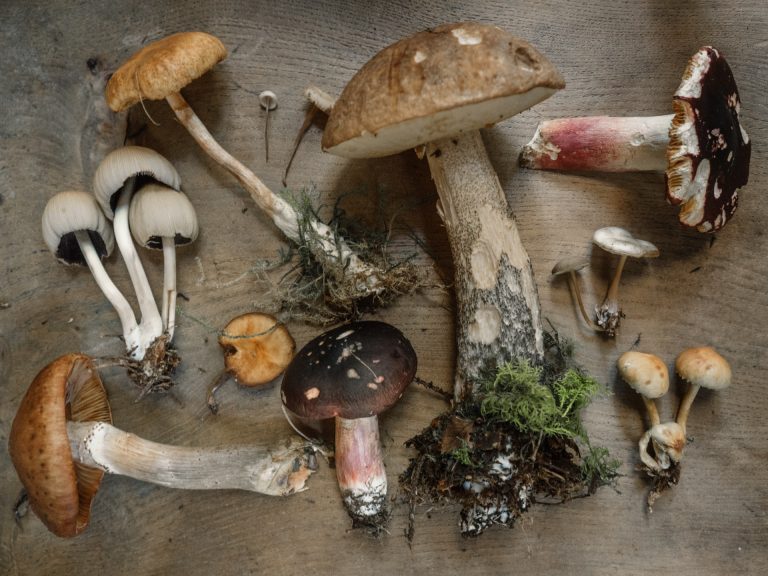
Northern Scandinavians have an obsession with mushrooms, a passion shared with the Russians. In times of famine, they have made up as significant part of the diet in northern Scandinavia – many species picked and used are not even considered good to eat in other parts of the world and by means of salting, pickling and drying, mushrooms can even be preserved through the winter. In southern Scandinavia mushrooming is not so popular, maybe because there are not so many woods to pick them in. Learn more about Scandinavian mushrooms.
Mushrooming is a national pastime in the autumn, every family having their secret places, which they do not share. It’s quite fun if you meet someone in the woods in the mushroom-picking season as they might pretend they are not there at all, and they will try to escape or hide behind trees; or, if anyone encounter is unavoidable, they are definitely not out to pick mushrooms, just walking the dog.
A lot more mushrooms than you might think are edible, and quite tasty at that, but only a few are really delicious. Mushrooms are as much about consistency as they are taste. Many have a lovely flavor, but are too slippery or gummy to be good when roasted.
When you pick a variety, the less good ones can be made into a very tasty soup, while the best should be eaten on their own, in all their glory.
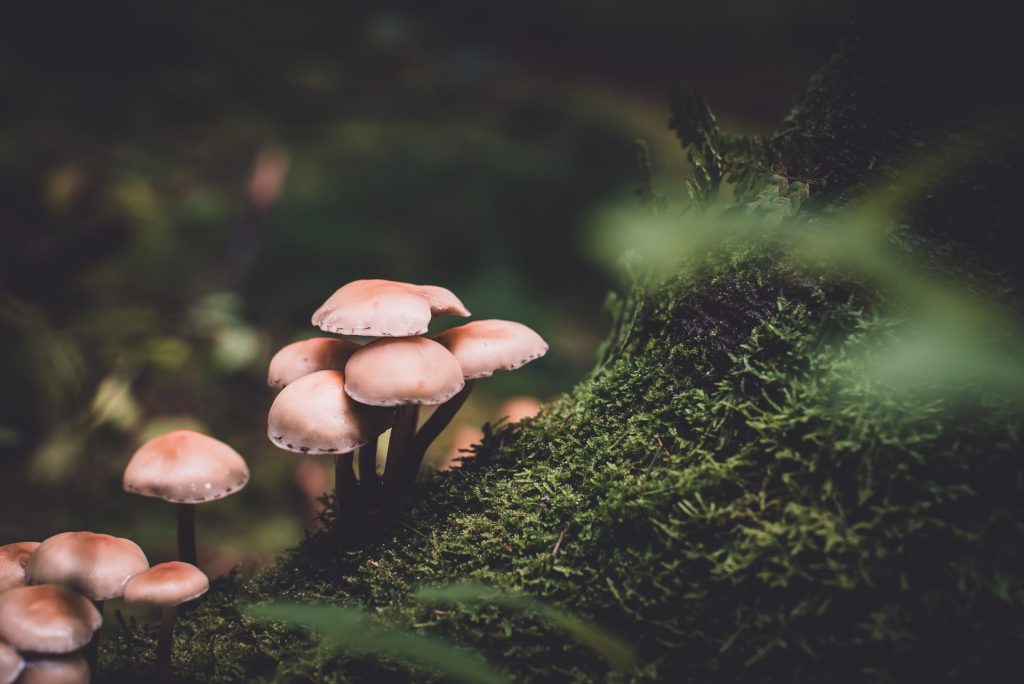
Mushrooming is a national pastime in the autumn, every family having the secret places, which they do not share. Photo: Presetbase Lightroom Presets/Unsplash
The huge northern woods The huge northern woods are home to hundreds of edible mushrooms, and a few deadly ones, if you do not have an experienced mushroom picker or book at your side, it is a dangerous business.
Norwegians and Swedes are taught from childhood what to pick and what not. Since species are easy to find and identify, but, even then, you must take a comprehensive mushroom book with you. I am absolutely not saying this to put anyone off the experience – it’s greatly rewarding – but just to remind you to play safe.
You must also remember that mushrooms vary, and the following descriptions apply strictly to those found in Scandinavia: mushrooms described as safe in Scandinavia, in other parts of the world there may be very similar-looking mushrooms which are poisonous.
Mushrooms can be found everywhere, even on old, withering elders by the sea, and in apparently barren landscapes, but the majority are found in woods in the autumn; the morel is a delicious exception, which shows itself in spring and early summer. Chanterelles can already be found from late June, if it has been raining, and ceps from early August. The season ends with oyster mushrooms, growing by the kilo on broken-down beech logs on the forest floor.
Habitat is very important when determining the identity of mushrooms. A few grow almost anywhere, but the majority live with certain trees, and in certain habitats, which makes it easier to identify them correctly.
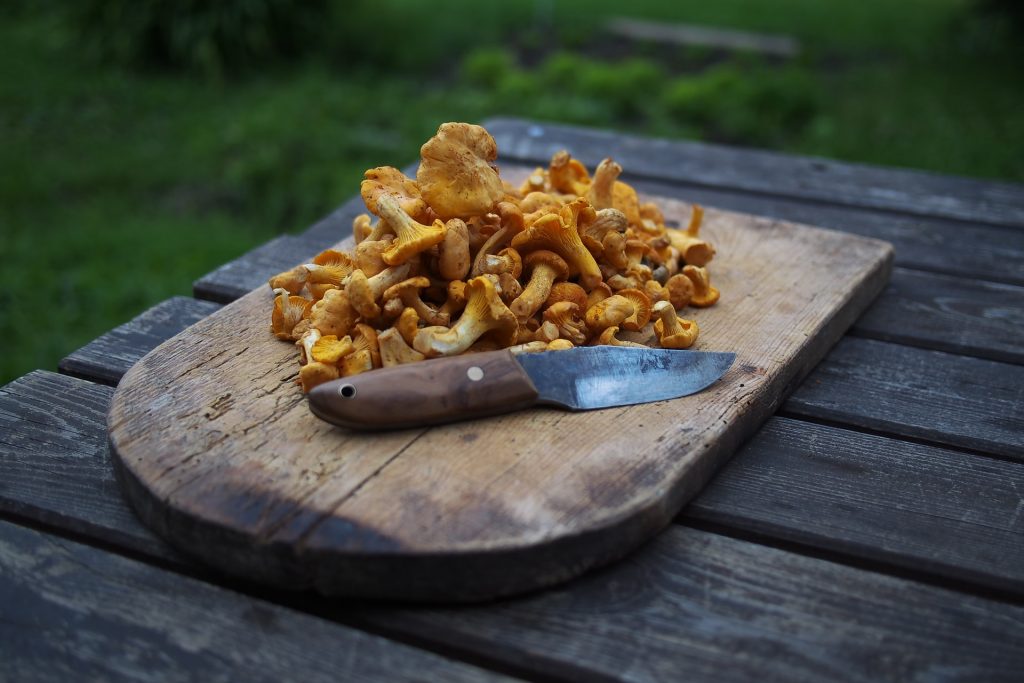
Chanterelles. Photo: Nick Grappone/Unsplash
Chanterelles It is safe to pick the abundant chanterelle (Cantharelus cibarius), which I consider to be the best mushroom to eat. It is entirely orange, darker when growing under pine or spruce, lighter when found in oak and beech woods. It grows in huge colonies in both deciduous and coniferous woods.
Its close relative, the horn of plenty or trumpet of death (Craterellus ornucopiodies), is an easily recognized and delicious mushroom. It is black, with a grey bloom, and completely hollow. The folds of very thin flesh look like scalloped leaves about to be drawn into the ground by earthworms only the color betrays them. The name ‘trumpet of death’ refers only to the black color, not to anything more sinister.
Another chanterelle, the yellow-foot (Craterellus tubaeformis), is hard to find as its cap has the color of rotting leaves, but when you do come across it, you will find enough not just for soups and stews, but for drying and pickling as well.
The small but pretty mushrooms form virtual carpets with their bright yellow, twisted stems and pale gills resembling fine lace.
All three types of chanterelle are firm and dry-fleshed, and have a delicious, chewy consistency when cooked. They are also perfect for drying.
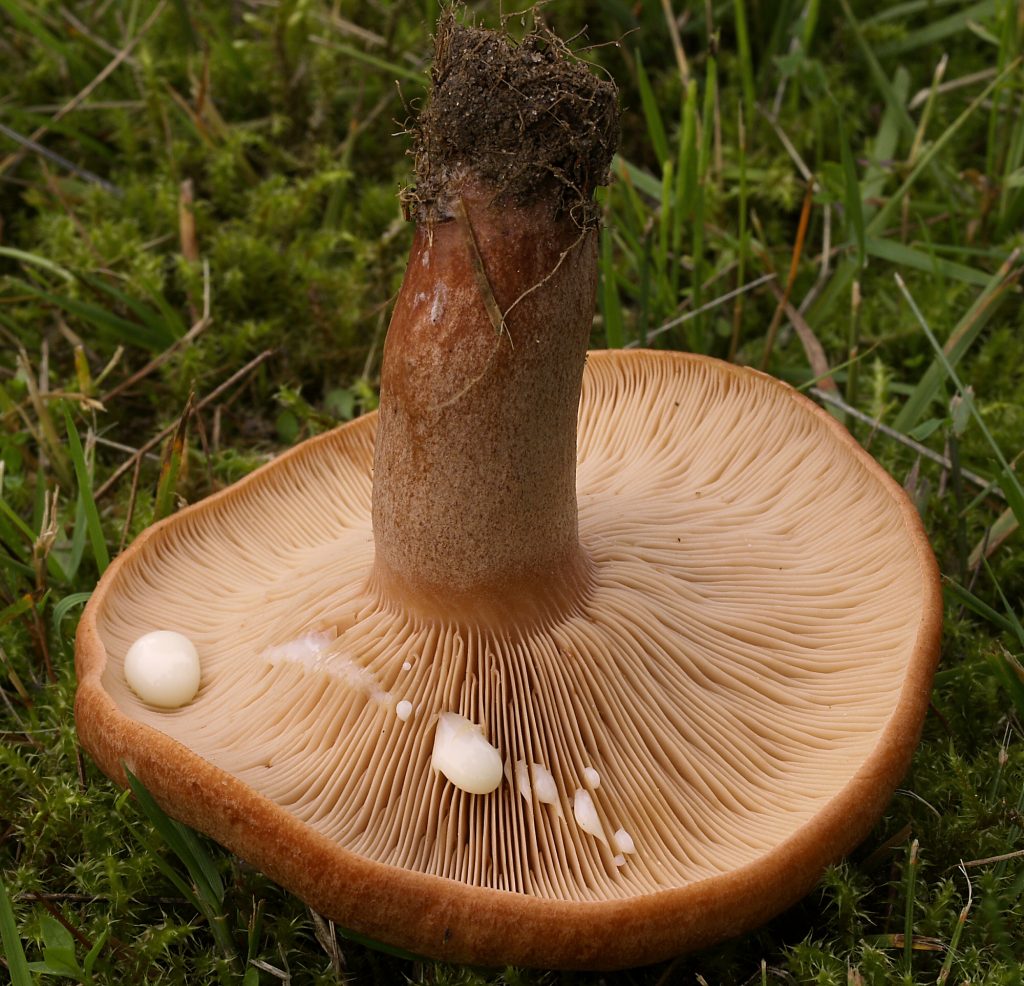
Milk-caps. Photo: Wikipedia
Milk-caps The different varieties of milk-cap in the Lactarius genus are recognizable for the fact that they all bleed ‘milk’ when cut. The ‘milk’, actually latex, is often white at first but change color to various shades of yellow, orange and red. There are many, many types of milk-cap, and the best way to determine if they are edible is to taste the milk – if it’s bitter, don’t pick them (though the Finnish and Russians eat most of them). Because of the mushroom’s natural bitterness, milk-caps are often salted in brine, which draws out the bitter juices.
Russulas. Photo: Wikipedia
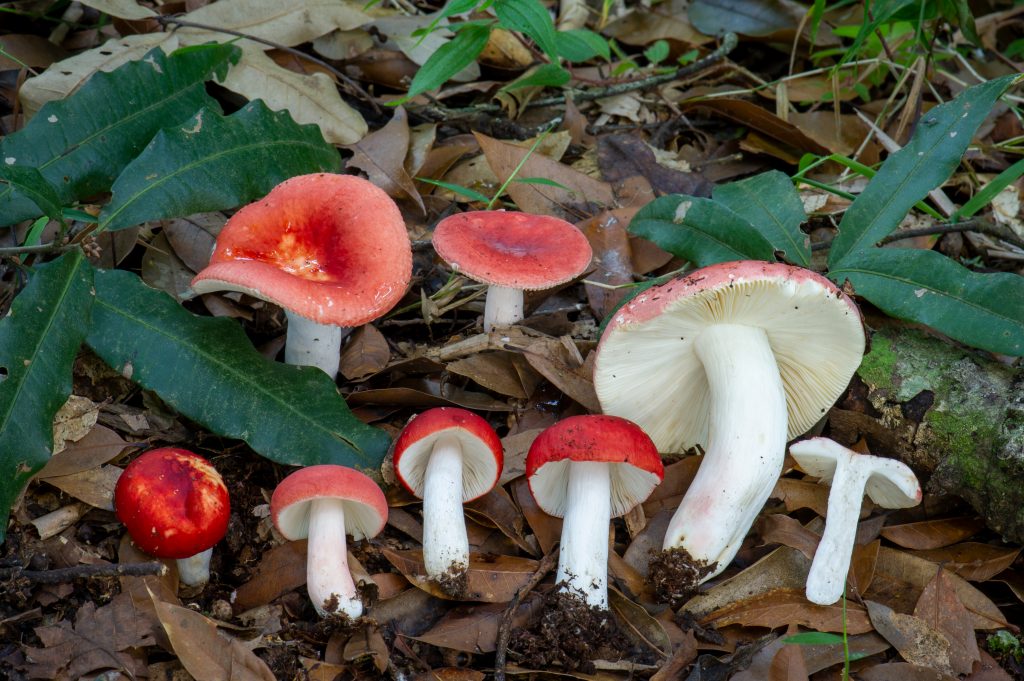
Russulas There are hundreds of types of mushrooms in the Russula (meaning ‘reddish’) genus. In Scandinavia, russulas are everywhere, their beautiful caps strewn across the ground like brightly colored toys. Despite the genus name, they can be pretty much any color except bright blue: pink, red, burgundy, canary yellow, pistachio green, dark green, black-grey or violet. The gills and stems are usually white, and the fleshy stems have a certain cheesy consistency, with no rings attached, and with no detectable fibre. They are good to eat if they have mild taste; bitter or sharp, peppery ones are not good to eat, or can even be slightly toxic.
Boletus edulis. Photo: Wikipedia
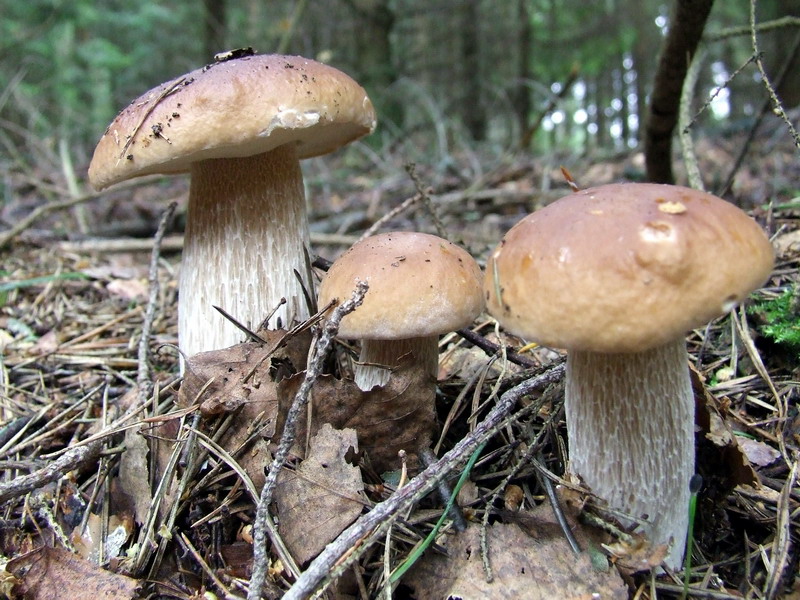
Boletus Boletus mushrooms are visually very different from other varieties. There are no gills, but a spongy layer on the underside of the cap, made up of tiny tubes, which are easy to recognize. Many Boletus mushrooms are particularly good to eat. There are, however, a couple of toxic species (albeit rare) and two extremely bitter ones. The bitter ones are not poisonous, but will ruin the rest of your mushrooms if you cook them together. So take your mushroom book with you on your hunt.
The best known is Boletus edulis, the giant cep or porcini, and the king of mushrooms. It grows to an impressive 30cm in height, and one, fully grown, is enough to feed a whole family. The top is the color and size of a lightly burnt bun, the stalk thick and cream-colored. When young, the mushroom resembles Humpty Dumpty, the cap folded over the fat stem, and this is when it’s at its best. Later, it can still be wonderful, as long as it’s firm-fleshed.
Boletus edulis is abundant in Scandinavia and very much sought after. It is delicious however you cook it, and is the only mushroom besides the button mushroom that you can eat raw. If you want to fry it, do so in plenty of very hot oil or unsalted butter, as any salt in the frying will make it soggy. Fry it at high heat, until barely tender and season with salt and pepper, garlic and plenty of chopped parsley. It’s beautiful on toast, or as an accompaniment to almost anything.
Common morel. Photo: Missouri department of conservation
Morels Mushrooms in the Morchella genus are often found where wood has been cut, even in strange places where you do not expect them, for example among wood shavings used for ground cover in private gardens and public parks.
There are two common species, as well as so-called false morel, in Scandinavia. They are all hollow inside. The black morel (Morchella conica) has the characteristic deeply grooved cap, resembling honeycomb, in the shape of a pointed goblin’s hat. It comes in many shades, from whitish grey to pitch black.
The common or yellow morel (morchella esculenta) is another species, much larger, with yellowish, rounded heads. There is a fairly good chance of finding them from April to June in beech woods, especially where white and yellow anemones grow together, though the wood-shavings that they also grow on can be found anywhere they are spread by man. Yellow morels are not quite as intensely flavored as the black ones, but you are bound to find many of them, and this will more than make up for the disappointment in flavor.
Both these species are poisonous when raw, and will make you sick unless they are thoroughly cooked.
The false morel (Gyromitra esculenta) is not a true morel, and it is poisonous. The toxins are not destroyed completely by either drying or cooking. The cap looks like a twisted brown brain, and it is found in continuous woods from March to June.
When you pick your own mushrooms, just yank them out of the ground. Photo: Artur Aldyrkhanov/Unsplash
Picking mushrooms When you pick your own mushrooms, just yank them out of the ground. The very bottom of the stalk can be the only way to determine a deadly mushroom, as it often carries the remnants of the membrane that covers the entire mushroom when it is young. Clean them straight away, with a small knife and a soft brush. If you wait, the dirt will settle and be very difficult to remove. Place the mushrooms in a basket, not a plastic bag, because the spores can then blow away while you walk through the forest (and initiate new colonies of fungi), and also because they can lie separately in a dry basket, rather than sweating together in plastic.
Don’t mix mushrooms you know to be safe with other interesting mushrooms or an unknown species that you want to check out or sample – collect them in a separate basket. If you actually collect a deadly mushroom, even a small piece will make you very sick. Once at home, go through the unidentified mushrooms with a book or an experienced collector by your side.
Try not to wash the mushrooms; if you have cleaned them while picking, they won’t need it. If you must, however, fill a basin with cold water and wash them very quickly (don’t leave them to soak), then dry them on kitchen paper. Mushrooms should be eaten the day they are collected, though you can fry them in butter and then freeze them.
Bought mushrooms must be very fresh, unblemished and clean. Photo: Meny
Buying and storing The range of mushrooms that can be cultivated successfully is extremely small, which is why such limited variety is available in the shops, often restricted to button, portobello or cremini mushrooms, all versions of Agaricusbisporous. However, the recipe below can be made using bought mushrooms.
Bought mushrooms must be very fresh, unblemished and clean. Fresh, young mushrooms can be kept in the fridge – on a dish covered with a clean tea towel and not in a plastic container – for a few days. The reason for being so careful is that other fungi, or mould, can grow on them, and this can be slightly poisonous, or can just ruin the original mushrooms.
Mushrooms all have the strange ability to add a meaty flavor to other ingredients, and are good in almost all stock soups and vegetable mixtures. Photo: Sundqvist Norge A/S
Culinary uses Mushrooms all have the strange ability to add a meaty flavor to other ingredients, and are good in almost all stock soups and vegetable mixtures. We have some lovely mushroom soups in Scandinavia, and these are the best way to use nondescript common mushrooms. Only ceps and button mushrooms can be eaten raw, and they make a lovely salad, carpaccio-style.
Firm mushrooms can be turned into a versatile pickle, which is good with cold cuts, fried meats, venison and game. They are lovely on a plain green salad when pickled in vinegar with spices and kept in olive oil.
Dried mushrooms have been a staple for millennia: for centuries, drying was the only way to keep mushrooms through the winter, long before salting and pickling. They were often dried over open fire, giving them a smoky flavor which matched the mushrooms’ meatiness perfectly. Dried mushrooms have a strange, alien beauty, and will keep for years if stored in closed jars. They can be crumbled into a stew or used whole.
Both dried and fresh mushrooms are perfect with game and venison, being at their peak season at the same time.
This is a classic wherever people pick mushrooms, and always tastes lovely if prepared carefully. Photo: Meny
Creamed mushrooms on toast This is a classic wherever people pick mushrooms, and always tastes lovely if prepared carefully. You can use chanterelles, button mushrooms or other firm mushrooms, but it does not work with caps. If you should ever tire on this traditional recipe, you can always spice it up by adding wine, onion or garlic.
500-600g button mushrooms or chanterelles, cleaned
25g salted butter
250ml whipping cream
Coarse sea salt and freshly ground pepper
Lots of finely chopped parsley
4 slices sourdough bread, toasted
½ teaspoon lemon juice
Serves 4
Quarter the mushrooms, then fry in the butter, in a thick-bottomed pan at a high heat. Fry until the juices have run and then evaporated and the mushrooms are golden.
Pour in the cream and season with salt, pepper and a little lemon juice, then reduce until the cream is a thick coating on the mushrooms. If this goes too far, and the sauce separates, you can put it back together with a little cold water.
Pile on the toast top with parsley and eat immediately.
Stockholm is built on a total of 14 islands. Each of these has its own uniqueness, its own routines and manners. Södermalm, the old bohemian clave, has its bespectacled hipsters and retired alcoholics, on Skeppsholmen you’ll find wooden boat builders and art academy students, Gamla Stan is famous for its ceramicists and souvenir sellers, and on exclusive Djurgården, yacht owners and amusement park workers share daily routines. Learn more about the 14 islands of the Swedish capital.
The capital of Sweden is virtually situated on the water, built on 14 islands and on the banks to the archipelago where Lake Mälaren meets the Baltic Sea. One-third of the city areal consists of water, another of green space and a final third is entrusted to urbanity. In Stockholm, nothing feels concentrated or clustered and fresh air is in abundance.
Anywhere you go in the historic center of Stockholm, you find yourself at the water’s edge or crossing a bridge from one island to the next. During the two last decades, Stockholm’s global reputation as a city of culture, art, design and fine cuisine has grown enormously. However, at heart it is the same city it has been for over 800 years. Exploring the islands and the unique layout is part of its attraction.
From Beckholmen. Photo: Wikipedia
Beckholmen is a small island in central Stockhom connected by the wooden Beckholmen bridge, originally built in 1848-1858 when the first docks were constructed in Stockholm. It is the only remaining wooden bridge on Stockholm still used by heavy vehicles.
Having served the city’s shipping industry for centuries, Beckholmen is now regarded as a historical monument of national interest, and, by its location just south of Djurgården it also forms part of Royal National City Park, and Stockholms Sjögård (literally, “Sea homestead of Stockholm”), an area of the harbor of Stockholm containing maritime environments of historical interest.
Strömsborg is part of Gamla stan. Photo: Wikipedia
Strömsborg
The small islet is located north of Stadsholmen, and west of Helgeandsholmen, between the bridges Centralbron, a motorway passing through central Stockholm, and Vasabron. Strömsborg is part of Gamla stan, the old town of Stockholm and is connected to the rest of the world by the bridge Strömsborgsbron leading over to Vasabron.
From Stadsholmen. Photo: Visit Stockholm
Stadsholmen
The island is connected to the mainland via several bridges. Together with the small islands of Riddarholmen and Helgeandsholmen it forms Gamla stan, the old town of Stockholm. The name Gamla stan can also refer to the island itself, as the name Stadsholmen is rarely used in daily speech.
Stadsholmen is the location of Stockholm Palace, official residence and major royal palace of the Swedish monarch. The offices of the King, the other members of the Swedish Royal Family, and the offices of the Royal Court of Sweden are located here.
From Kungsholmen. Photo: Wikipedia
Kungsholmen and Långholmen Västerbron, a steel structure from 1935, arches mercilessly towards the sky between Kungsholmen and Långholmen. From the top you have a splendid view over the whole city. From there you can meander further through Stockholm passing the north of Söder (Södermalm) to the right and into Gamla Stan.
From Långholmen. Photo: Visit Stockholm
Riddarholmen «The Knights’ Islet” forms part of Gamla Stan and houses a number of private palaces dating back to the 17th century. The main landmark is the church Riddarholmskyrkan, used as Sweden’s royal burial church from the 17th century to 1950, and where a number of earlier Swedish monarchs also lie buried.
From Riddarholmen. Photo: Wikipedia
The western end of the island gives a magnificent panoramic and photogenic view of the bay Riddarfjärden, often used by TV journalists with Stockholm City Hall in the background. A statue of Birger Jarl, traditionally considered the founder of Stockholm, stands on a pillar in front of the Bonde Palace, north of Riddarholm Church.
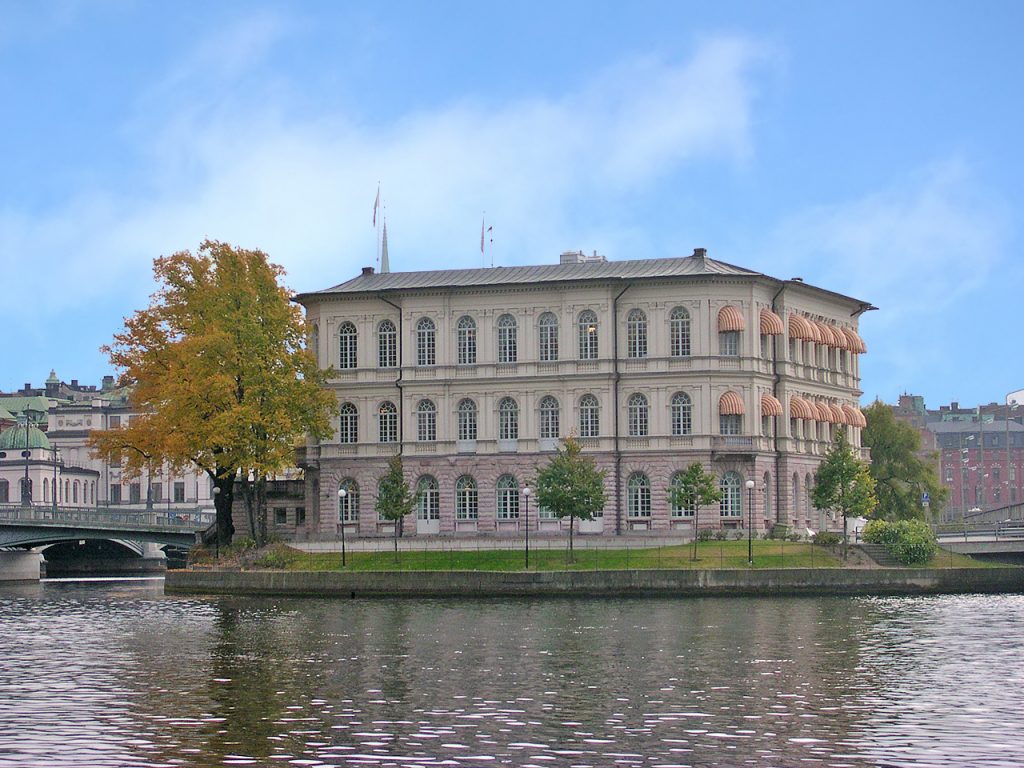
Other notable buildings include the Old Parliament Building in the south-eastern corner, the Old National Archive on the eastern shore, and the Norstedt Building, the old printing house of the publisher Norstedts, the tower roof of which is a well-known silhouette on the city’s skyline.
From Helgelandsholmen. Photo: Wikipedia
The small island Helgeandsholmen is located north of Stadsholmen, and east of Strömsborg, with which, together with Riddarholmen, it forms Gamla stan, the old town of Stockholm. The island contains the Riksdag Building and the Museum of Medieval Stockholm, and is connected to neighboring islands through three bridges.
The terrace in the eastern end, called Strömparterren (“The Stream Parterr”), is a public park with a restaurant dating from 1832, while the flight of stairs leading down to the water is from 1807–1810. The quay west of the Riksdag Building once surrounded Sweden’s central bank Sveriges Riksbank and was thus named Bankkajen (“The Bank Quay”), while the streets on southern and northern sides are called Norra/Södra Helgeandstrappan (“The Northern/Southern Helgeand Stairs”), all of them named in 1925.
The historical name for Gamla Stan (Stockholm Old Town) was “The city between the bridges”, a name which is still used for the entire city which spans over numerous islands, islets, and hills. During the course of centuries, the city has seen many bridges relieve each other.
The Old Town is cobbled around the Royal Palace, which is located near Stockholm’s oldest building, Storkyran. The ‘Great Cathedral’ dates to the mid-thirteenth century and features a rich, robust interior with redbrick columns and a whitewashed ceiling.
The traits from the old industrial district on Kungsholmen were swept away in the early 20th century and replaced by housing and public institutions. The residential areas in Fredhäll and Kristineberg were built in the 1930s. The Stockholm metro was drawn through Kungsholmen in the 1950s.
Långholmen can be reached via two bridges, Pålsundbroen in the east and Långholmsbron in the west.
Långholmen is a popular spot for walks, picnics and swimming. The small beaches, located right outside the former prison, are usually crowded in summer.
From Södermalm. Photo: Wikipedia
Södermalm
When leaving Gamla Stan on the way to Södermalm we come to Slussen, a junction of intersecting car and train bridges. When it was constructed in 1935, it was hailed as an infrastructural masterpiece. Now it appears mostly as a monument from an age when traffic was synonymous with increasing prosperity.
Södermalm is connected to its surrounding areas by a number of bridges. It connects to Gamla stan to the north by Slussen and to Långholmen to the northwest by Västerbron.
Södermalm was once known as the “slum” area of Stockholm. However today, Södermalm is known as the home of bohemian, alternative culture and a broad range of cultural amenities. Meanwhile, the growing demand for housing, as well as an increasing gentrification of Stockholm’s central parts, makes apartments in Södermalm more and more difficult or expensive to come by. Thus, what was once a working-class district is now somewhat a district of the privileged.
From Reimersholme. Photo: Wikipedia
Reimersholme
This small island is lying to the west of Södermalm and to the south of the neighboring Långholmen. Its present name refers to Anders Reimer (1727-1816), a hatter and magistrate whose estate can still be found to the east of the island. A wool manufacturing plant, Stockholms Yllefabrik, was built during the 1860s where prisoners from Långholmen Prison used to work.
Reimersholme was not incorporated into the city of Stockholm until 1913. In the 1980s the remaining southern part of the island, previously a site occupied by the alcohol manufacturer Reymersholms Spritförädlings AB, was transformed into a housing area.
From Skeppsholmen. Photo: Wikipedia
Skeppsholmen Positioned strategically at the Baltic Sea entrance to Stockholm, Skeppsholen has traditionally been the location of several military buildings. Today, the military presence is low, and several museums can be found there instead, such as the Museum of Modern Art (Moderna museet), the main modern art museum of Stockholm, the architectural museum in the same building, and the East-Asian museum (Östasiatiska Muséet). On the southern shore is the old sailing ship af Chapman which is now used as a youth hostel. Stockholm Jazz Festival is a popular annual summer event held on Skeppsholmen.
It’s pretty easy to walk most of the central part of Stockholm, trams and boats offer trips further afield. How many islands you visit depends on how long you have in the city.
From Kastellholmen. Photo: Wikipedia
Kastellholmen
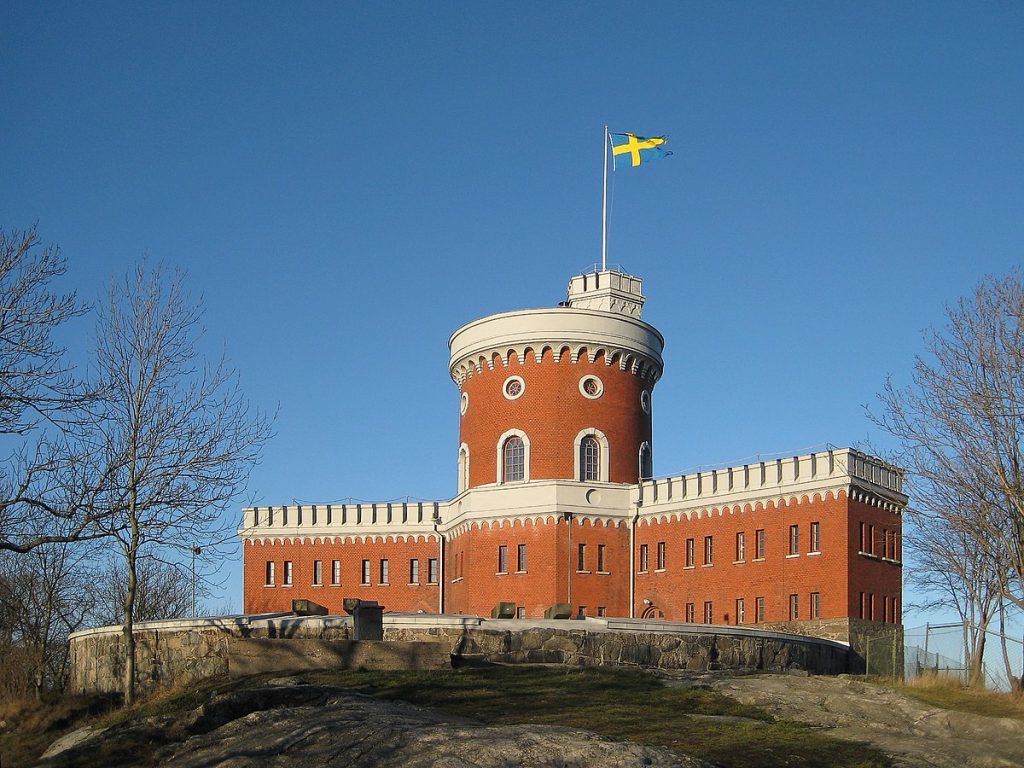
Kastellholmen is connected to adjacent Skeppsholmen through the Kastellholmsbron bridge. On the island there is a small castle, Kastellet, which was built between 1846-1848 and designed by the Swedish officer and architect Fredrik Blom.
From Djurgården. Photo: Wikipedia
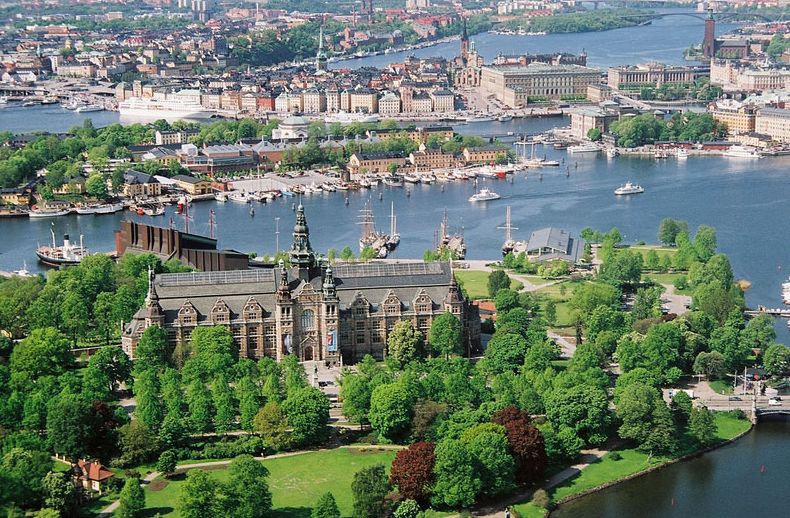
Djurgården Djurgården is home to many historical buildings, monuments, museums, galleries and the amusement park Gröna Lund and the open-air museum Skansen. Today, the ABBA Museum and the Vasa Museum are two of the most visited museums on Djurgården. There are also extensive stretches of forests and meadows and around the small residential area Djurgårdsstaden you’ll find several yacht harbors. Djurgården is one of the Stockholmers’ favorite recreation areas and tourist destinations alike, attracting over 10 million visitors annually, of which 5 million come to visit the museums and the amusement park.
From Lilla Essingen. Photo: Visit Stockholm
Lilla Essingen
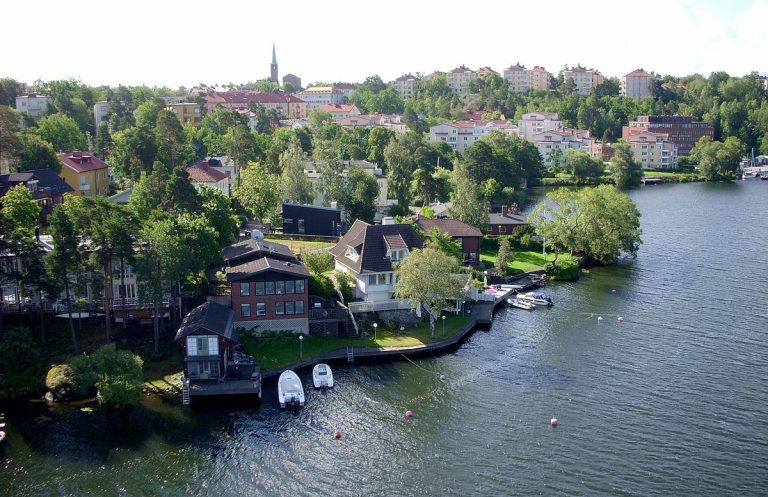
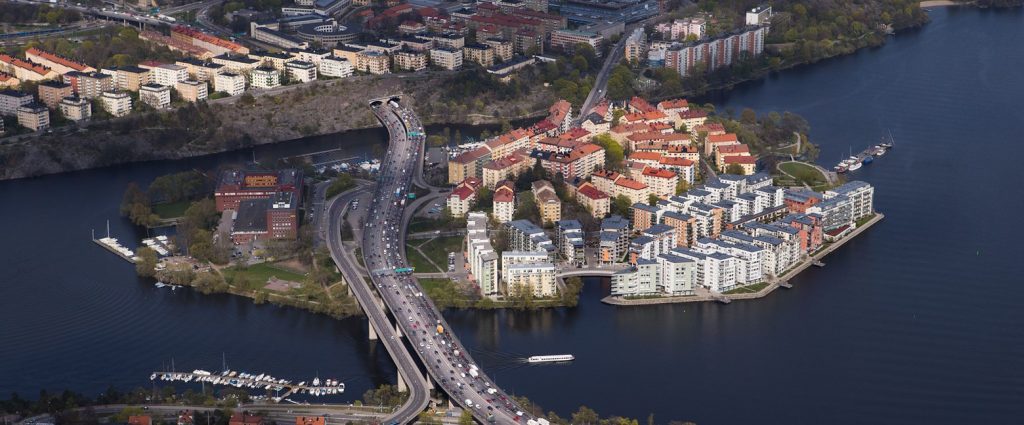
This island is located on Lake Mälaren next to the larger neighboring island Stora Essingen. Both islands (Essingöarna) are mainly residential areas, the smaller densely packed with apartment buildings while the larger is scattered with private houses and, to a lesser extent, apartment buildings. The Essingeleden motorway, part of the European routes E4 and E20, passing over both islands is named after them.
From Stora Essingen. Photo: Wikimedia commons
Stora Essingen
The island is located adjacent to Lilla Essingen on Lake Mälaren. Both Essingen Islands are mainly residential areas. Stora Essingen is scattered with private houses and apartment buildings.
A truly modern metropolis
Today, Stockholm is a world-class city with a wealth of history blended with cutting-edge trends in architecture, art, technology design, fashion and food. Stockholm is a truly modern metropolis with friendly inhabitants that is worth exploration.
The 14 Islands of the Swedish Capital, compiled by Tor Kjolberg
Feature image (on top): From Stora Essingen. Photo: Wikipedia
Traveling in Dalarna is like experiencing Sweden in a miniature with red cottages, the Sami culture, the lakes and mountains, the craft tradition and an exciting industrial history and attractions on the world heritage list. Learn more about the attractions in Dalarne Sweden.
The word “Dalarna” means “the dales” (valleys). The area is a vacation destination for Swedes from the south, who often travel there for summer vacations, drawn by its fishing lakes, campgrounds and forests. Some Swedes own or rent a second residence in Dalarna, where they are likely to have a vegetable garden and apple trees.
Dalarna is located between the Swedish regions Härjedalen and Värmland, and borders the county Innlandet in Norway. The region can entice visitors with floating accommodation in wooden tents, the world’s largest Dala horse, sparkling lakes, the popular Vasaloppet and fun theme parks. Much of what we think of as ‘typical’ Swedish come from Dalarne, for instance the decorated Dala horse, the big midsummer party and the characteristic rust-red color “Faluröd”. The region goes by the name “Sweden’s cultural heart” and was last year one of the most popular destinations to visit for Swedes.
Red cabin in Dalarne. Photo: Jonas Forsberg/Visit Sweden
Here is a selection of places and experiences in the region:
Activities in Nature There is something special about nature in Dalarna. Here you can easily experience untouched wilderness, bathing sites in quarries, high waterfalls and hidden caves. Go for a walk in the nice forests or in Dalafjellet (Dala mountain), a dip in a fresh lake or paddle through calm water. Find places you have never been before and enjoy the sunset over green-clad hills. Thanks to the right to public access, you can move around freely throughout Dalarna, as long as you do not disturb or destroy.
Looking for mushrooms. Photo: Johan Willner/Visit Sweden
Mountainbike Biking, whether it is adrenaline-filled MTB biking or calmer road biking, is a great way to be active and simultaneously experience nature. Biking Dalarna, which is a collaboration between Dalarna’s regions, offers guests high-quality biking experiences. There are a total of 21 biking areas in the region, with a total of 140 km of remarkable cross-country trails and 25 downhill trails. The trails are well marked and graded according to degree of difficulty. Here you can adapt the trip to your own wishes and skills.
Falufjället National Park Falufjället National Park covers 385 km2 and is the largest national park in the southern parts of Sweden. Here you’ll find Sweden’s highest waterfall at 93 meters and the world’s oldest tree, which is 9550 years old. The area is well suited for hiking trips for brisk visitors.
From Lake Siljan. Photo: Jacque de Villers/Visit Sweden
The Siljanleden Trail The Siljanleden trail stretches around the large lakes, Siljan and Orsa. The trail is 340 kilometers long and is perfect for either biking, skiing or hiking. The round-trip exposes the idyllic Dalarne at its best and is one of 12 signature hikes in Sweden. On a round-trip, you’ll be visiting a mighty and hilly landscape, with a diverse selection of lakes, hills, farms and forests along the way. Try your luck with a fishing rod or enjoy a wonderful break with a view.
Accommodation in farm-environments
There are several farm environments in Dalarna. Explore what the Swedes call “fäbod”, which may be translated into English as a ‘mountain pasture’. They are located in scenic areas among grass, meadows, forests and water. One of the places you can visit is Fryksås, outside Orsa, where you can combine accommodation with hiking in green surroundings.
Art and cultural experiences
Let the culture lead your way through Dalarna. The culture in the region is diverse and full of contrasts. Here you’ll find classic cultural landscapes, exciting exhibitions, and new, creative meeting places for art, design, crafts and Sami culture. Combine cultural inspiration with a charming accommodation and a better meal in one of the region’s good restaurants.
Artist Carl Larsson’s homestead. Photo: Jann Lipka/Visit Sweden
The cultural route
The cultural route is a cooperation between 9 selected destinations. Among the attractions you’ll for example will find the artist home of Carl Larsson, where you get an insight into the life and work of the famous painter. Ornässstugan, which is a 500-year-old building where you can learn more about how Gustav Vasa started his journey towards the throne. And the Falu Mine, which is a former copper mine, takes you through teeming passages at a depth of 67 meters. The mine is listed on the UNESCO World Heritage List and in the area, you will also find the Mining Museum.
Children’s Dalarne Traveling with children in Dalarna is enriching for the whole family and a great opportunity to create memorable experiences together. All year round, Dalarna offers a large selection of children’s activities both indoors and outdoors.
From Orsa Predator Park. Photo: Visit Dalarne
Orsa Rovdyrpark Greet wild animals in Orsa Predator Park. In the forest outside Orsa you will find Europe’s largest predator park, including brown bears, wolverines, polar bears, snow leopards and Siberian tigers. The park gives you the opportunity to follow the animal keepers’ work closely and join various guided tours. There are also a number of playgrounds and stations that are designed for children to acquire knowledge about animals and nature in a playful way.
The Fairy Tale World Tomteland. Photo: Santaworld
Play with the elves in Tomteland In the forest outside Mora is the fairytale world Tomteland. Among stumps, trees and moss you’ll find Santa’s house, the elves’ forest, the witch’s house and magical places that have only previously been visited in the fairy tales. You are drawn into a fairytale world populated with elves, trolls, goblins and other exciting characters.
Attractions in Dalarne Sweden is based on a press release from Visit Dalarne
Hardly any other building in post-war Norway has been met with such interest and recognition as the new Franciscan monastery on Enerhaugen in Oslo. Learn more about this protected spot in the capital of Norway.
The above words were written by editor Christian Nordberg-Schultz in the magazine Byggkunst In 1966 in connection with the opening of the newly erected St. Halvard’s Church and monastery.
Not far from the former medieval St. Hallvard’s Cathedral on Enerhaugen in Oslo, you’ll find St. Hallvard’s Church and Monastery. The Catholic parish church for eastern Oslo was run by the Franciscans until 1 September 2008.
St. Hallvard’s is on the site where the last of the wooden buildings of the Enerhaugen neighborhood’s working-class quarters used to be. Photo: Visit Norway
Enerhaugen neighborhood
St. Hallvard’s is on the site where the last of the wooden buildings of the Enerhaugen neighborhood’s working-class quarters used to be. The wooden houses were moved to the Norwegian Folk Museum (Norsk Folkemuseum) on Bygdøy. The church is hidden in the midst of the five large residential high-rises on Enerhaugen hill, and hence not very frequently visited.
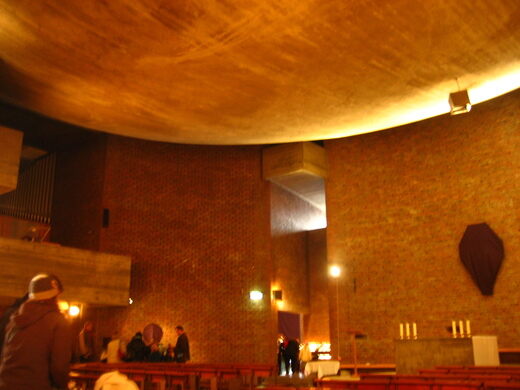
Admittedly, the building, amidst this circle of residential apartment blocks, would be a rather nondescript brick building if not for the extraordinary inverted dome that hangs from the ceiling of its main hall.
Architects Kjell Lund and Nils Slaatto
Responding to this unusual urban situation, the church establishes a central reference point to the area and its enclosed appearance gives the building a concealed expression. Since the opening in the autumn of 1966, the church and monastery designed by the architects Kjell Lund and Nils Slaatto have become one of the most talked about Norwegian post-war buildings in the world. The architects followed the Brutalist architectural style that was popular in Europe at the time.
The church, which is the home base for the country’s largest Roman Catholic parish, is named after the city’s guardian saint, St. Hallvard. Photo: Sverre Bergli/Oslo Museum
The three sections of St. Halvard’s
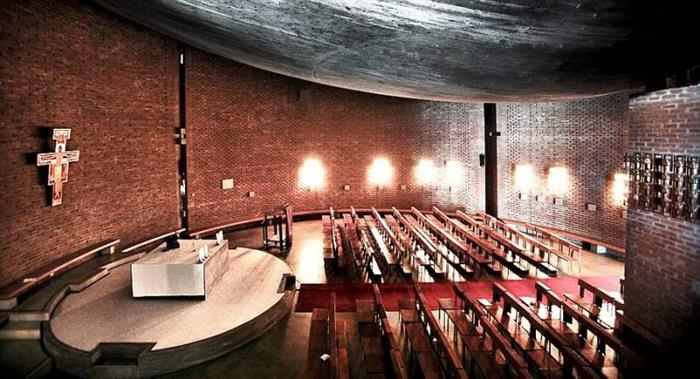
St. Hallvard’s monastery and church in Oslo have three sections: the monastery, parish offices, and the church, surrounding a circular central nave. The building has three levels, built of brick and concrete exposed both to the interior and exterior.
The church, which is the home base for the country’s largest Roman Catholic parish, is named after the city’s guardian saint. Unlike most churches, where the highest point of the interior rises above the building’s center, St. Hallvard’s ceiling swoops downward to create an inverted dome above its central sacred space. According to the church, the downward-facing dome symbolizes God bending toward his creation, rather than reaching toward the Heavens.
According to the church, the downward-facing dome symbolizes God bending toward his creation, rather than reaching toward the Heavens. Photo: Rune Aakvik/Oslo Museum
This majestic inverted cupola appears as being molded from above, a sensation of power from the heaven and sky, creating this majestic shape. Though majestic, the cupola also creates a sacral, intimate space and its thin concrete shell gives the spectator a chance to wonder of what may be hidden on its other side.
The inverted dome
Precisely the inverted dome contributes to make St. Hallvard’s Church a unique room which, according to Nordberg-Schultz, “has the lowest height where it was traditionally highest”. The round room is dominated by a sky that meets the congregation. The fact that the light input is minimal helps to further emphasize the church’s distinctive character and make it a room unlike any other in Oslo.
The walls slope gradually outwards, 3 degrees, for acoustic reasons. Apart from the large glass entrance door, hardly any natural light slips into the sacred room. The church seats from 300 to 350, with additional seating for 70 in the chapel.
Magic and richness
“The force of the structure combined with the subtlety of detail is most moving” wrote Juhani Uolevi Pallasmaa, the Finnish architect and professor of architecture.
“The converted dome seems to represent ‘the great mystery’. What is it, seemingly descending over the church room? The simplest way to describe it is that the roof has a strong character of heaven, as it has always had in the church buildings of the past. But this is a new and unknown heaven, a heaven that is not far off,” wrote Nordberg-Schulz.
“And in some of the work, particularly St. Hallvard’s, Oslo, Lund+Slaatto have added a level of magic and richness to which the Master (Mies van der Rohe) never aspired – the church is one of the most numinous buildings of the twentieth century,” wrote the British artist Peter Davey
The church attracted much attention in academic circles when it was completed. Photo: Visit Oslo
Protected by the Norwegian National Heritage Board The church attracted much attention in academic circles when it was completed, and during the years after the inauguration the modernist monument has won several architectural awards. It was protected by the Norwegian National Heritage Board in 2012.
The building houses the largest Catholic congregation in Norway, so mass takes place on Sundays. Access it by walking from Tøyen or Grønland. From downtown, the easiest route is taking bus 37 to Politihuset and walking uphill from there.
Protected Spot In the Capital of Norway, written by Tor Kjolberg
Feature image (on top), photo by Sverre Bergli/Oslo Museum
You can fall in love with the capital of Sweden at first sight. Many articles have already been written about the city, but for now, here are 7 reasons to visit Stockholm and return there again.
Stockholm’s Islands
Stockholm consists of 14 different islands. It is advisable to visit the island of Djurgården. It can be reached on foot across the bridge, by tram, bus or by ferry from Slussen station. It’s immediately evident that the locals love this place for jogging, walking and brunching. It’s a huge green area with lots of things to do.
Central station, Stockholm. Photo: Wikipedia
You can also get to the Djurgården island by ferry, which is also included in the ticket for 24 or 72 hours. It’s interesting to see Stockholm from a different angle, and it only takes 8 minutes to sail.
Architecture Stockholm architecture combines old and modern. The historic buildings are preserved in excellent condition and it is evident that proper attention is paid to it. A great place to observe the architecture of the city is the Strandvägen promenade. You look around and think about how well maintained everything is.
Modern Swedish architecture as well as design is laconic. Sweden is known for its responsible attitude to the environment and recycling. So in modern construction, a lot of attention is paid to making sure that building materials are energy efficient and environmentally friendly.
Scandinavian Design Sweden is a great choice for those interested in interior design or fashion. The Swedes definitely know something about creating interiors and decor elements, so there are a lot of interesting design stores here.
As for fashion, Sweden has given this world a lot of mass-market. For example, H&M, COS, & Other Stories, ARKET and Cheap Monday. There are also other interesting Swedish brands from the premium segment, like Acne Studios, Filippa K or Whyred.
Stockholm is simply an immense paradise with over 50 museums. Photo: Ingemar Edfalk/Visit Sweden
Museums For museum lovers, Stockholm is simply an immense paradise with over 50 museums. For example, Sweden’s first open-air museum, Skansen, founded in 1891, or Vasa, the Swedish Maritime Museum. For music lovers, there is even a museum dedicated to the Swedish band ABBA. It seems that there are museums for all tastes and interests.
Stockholm Metro The locals call it Stockholms tunnelbana. This is a whole underground gallery filled with unique paintings, mosaics, sculptures and art objects. The only metro in Sweden was opened in 1950 and today has 100 stations on three lines. Many metro stations are cut right into the rocks and look very impressive.
To see it for yourself, all you have to do is pay the subway fare and ride the stations. It is worth noting that the stations Solna Centrum, Kungsträdgården, T-Centralen, Tekniska Högskolan and Stadion for their beauty hit the top not only for tourists but also for locals.
Tasty food The food often forms the impression of a country. In Stockholm, that puzzle also took shape. In its essence, Swedish cuisine is quite simple, but no less delicious. The food is hearty; it warms well in their cold climate.
One of the basics of Swedish cuisine is considered herring, cooked in various forms. Moreover, the Baltic Sea is nearby, where there is plenty of it. Traditional meatballs and mashed potatoes are often found on the menu.
Extraordinary taste of lingonberry sauce supplements many dishes. Also in almost every place, whether it is a street food or a restaurant, a delicious crispy bread “Knäckebröd” is served with the meal. Also in almost every place, be it a street food or a restaurant, a delicious crispy bread “Knäckebröd” is served with the meal.
The Swedish capital deserves attention, walks and memories. Photo: Mike Kienle / Unsplash
Swedish Way of Life The people in this country are truly inspiring: relaxed, smiling and able to enjoy life. Despite the cold climate, for example. And this inner calmness exactly contributes to the standard of living, because the Swedes, most likely, know what will happen tomorrow and even the day after tomorrow.
Conciseness and practicality are valued here. It is not for nothing that this Scandinavian minimalism is valued in the world. It can be seen in the interiors, in the streets, and in the clothes of the Swedes.
We can definitely say that the Swedish capital deserves attention, walks and memories.
Jean Hartley
7 Reasons to Visit Stockholm is written exclusively for Daily Scandinavian by Jean S. Hartley. Jean is a professional essay writer for the writing service. For 6 years now, she has been helping students learn to write correctly, and also assists in preparing for exams.
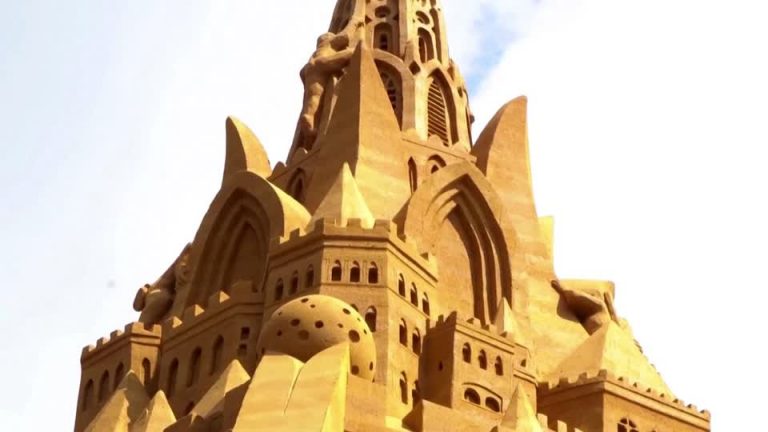
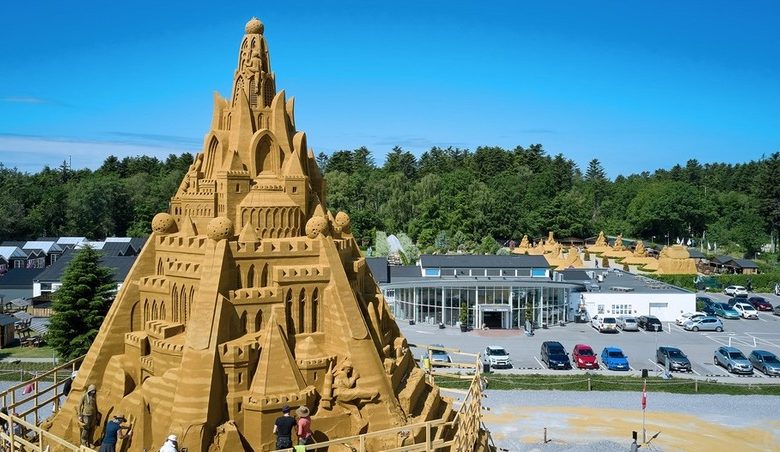
Enlisted in Guinness World Records, the sandcastle in Denmark is 21.16 meters (69.4 ft) in height. The sandcastle beat the previous record holder by 3 meters (10 feet). Find out more about the world’s biggest sandcastle in Denmark.
The sandcastle in Denmark is built in the small seaside town Blokhus and weights nearly 5.000 tons and beats the earlier Guinness World Records holder from 2019, Düngen in Germany. The intricately decorated structure is reminiscent of a pyramid.
30 of the world’s best sand sculptors
The creator of the castle, Dutchman Wilfred Stijger, had the world’s 30 best sand sculptors assisting him throughout his castle building journey. He said he wanted the castle to represent the power the coronavirus has had over the world since the beginning of the pandemic. On top of the sandcastle is a model of the virus wearing a crown.
The creator of the castle, Dutchman Wilfred Stijger, had the world’s 30 best sand sculptors assisting him throughout his castle building journey. Source: Twitter
A coronavirus inspired sandcastle So, this sandcastle is not just the world’s largest sandcastle, it’s possibly the world’s first coronavirus-inspired sandcastle. “We’ve created the sandcastle to represent the power the coronavirus has held over the world,” said Dutch artist Wilfred Stijger. “It’s ruling our lives everywhere. It tells you what to do…. It tells you to stay away from your family and not go to nice places. Don’t do activities, stay home”, he added.
The sand contains 10% clay, and a layer of glue has been applied to the sand to make it more cohesive. Thus, it can stand up to the chilly and windy conditions during the cold season in Denmark. The sandcastle is expected to stand until February or March 2022.
The sandcastle in Denmark is built in the small seaside town Blokhus .
The World’s Biggest Sandcastle in Denmark, written by Tor Kjolberg
The Danish manufacturer Vifa is in the top tier when it comes to the sound of portable speakers. The company is in good company with other Danish hi-fi producers like Bang & Olufsen and Libratone. Vifa’s portable model Oslo, which weighs 2.4 kilos, has been given the sympathetic name Oslo, which probably indicates that it is only half as big as its big brother Copenhagen. However, Oslo is portable, and the same cannot be said about Copenhagen. Read more about the sound of Oslo.
Obtaining the best possible rendering of sound is a matter of orchestration. It’s a complex calibration of multiple technical components. Vifa’s founder N. C. Madsen realized this when he decided to replace his career in auto-mechanics to follow his true zeal, load-speaker technology in 1933. Since then, Vifa has kept its position in the hi-fi market.
Vifa Oslo Bluetooth load-speaker looks more like a handbag than those cylindrical blasters you can see and hear in parks and on beaches during the summer
Vifa Oslo Bluetooth
I must admit I hadn’t heard much about Vifa until I realized there were several load-speakers on the market bearing the name of Nordic cities like Helsinki, Reykjavik, Stockholm, Copenhagen and Oslo.
Vifa Oslo Bluetooth load-speaker looks more like a handbag than those cylindrical blasters you can see and hear in parks and on beaches during the summer. Vifa Oslo has a charming and exemplary simple design with a built-in carrying handle.
Vifa Oslo is composed of six load-speaker elements; two full-tone elements, two bass elements and two passive bass radiators. Together they create a soundscape with lots of punch and dynamics and impressive bass. Oslo also reproduces the important midrange sounds better than most portable wireless speakers I have listened to.
Vifa Oslo was launched in 2016 and was awarded the special IF Gold Award by The German IF International Forum in 2017
Vifa Oslo was launched in 2016 and was awarded the special IF Gold Award by The German IF International Forum in 2017.
A gorgeously appointed Bluetooth speaker
“The Danish-designed Vifa Oslo is a gorgeously appointed Bluetooth speaker that will look great in your living room: the perfect link between technology, sound quality and long-lasting design. The soft and well-formed handle extends in a single stroke from the speaker body, while upholstery-grade fabric covers the rest of the unit. The interface is hidden. Nothing more and nothing less!” said the jury.
The Danish-designed Vifa Oslo is a gorgeously appointed Bluetooth speaker that will look great in your living room
However, I must admit that after hearing the new JBL Charge 5, weighing only half a kilo, I get more music enjoyment for my money than more expensive speakers.
Hiring a marketing agency is a big deal. Marketing and advertising efforts are directly correlated to business growth. The thought of choosing the best team can be daunting. You might think, what if I make a bad move? Or what if I choose the wrong firm? Thankfully, with proper research and vetting, these issues won’t even be on your radar. There are a few things to consider before selecting a group to work with. Learn the4 things to consider when hiring a marketing agency In Sweden.
There are business sectors that function a lot differently than the majority. Illustration: Pixabay.
Industry Most marketing strategies, like the use of social media campaigns, can be modified and applied to nearly any industry. This being said, there are business sectors that function a lot differently than the majority. Some businesses require very technical and specific work. When you’re looking at an agency, consider their past clients. Are there any companies in their portfolio similar to yours? Do they have any experience in your niche? Their past work can provide valuable insights on whether or not a partnership with them could be successful. When you’re window shopping for prospective firms, be sure to ask about their experience in your field. While marketers in an agency are experienced professionals, some areas of business just require more specific training.
You may find you identify more with a smaller, more personal firm. Photo: Pixabay
Firm Size You might think the more clients, the better the firm. While this isn’t necessarily untrue, it is not the rule of thumb when it comes to marketing agencies. Larger firms tend to have the resources, the time, and the staff to handle large numbers of clients. This being said, if they handle them all equally is a different story. You shouldn’t rule out agencies simply because they are on the smaller side. It’s likely these firms understand that to provide quality work with the staff and resources they have, they simply can’t have too many clients. You ideally want to find a team that makes you feel like your work is as important as other clients’ work. A place where you consistently deliver top-tier strategy and great execution. You may find you identify more with a smaller, more personal firm. Or perhaps a large industry with many resources is more your speed. This consideration is up to you.
Marketing may be an investment with long-term ROI, but it shouldn’t bankrupt your company. Photo: Stephen Phillips -Hostreviews.co.uk
Budget While this one may seem obvious, take a good look at your budget. You need to decide how much of the company money you are willing to spend on marketing and advertising efforts. Marketing may be an investment with long-term ROI, but it shouldn’t bankrupt your company. Inevitably you will run into marketing agencies that ask for a lot of money. Whether or not these prices are justified is up to you. You may find that the cost of services doesn’t necessarily equal the quality of services. This being said, don’t settle for the first quote you get. Talk to various agencies with varying price ranges and then decide which one fits best with your needs and goals. It may still be the most expensive one, but at least you vetted all other options.
If a firm you consider disagrees with your goals, hear them out, then decide. Photo: Campaign Creators / Unsplash
Goals
When you think about the future company, you probably have some specific goals you want to reach. What is important to you in terms of success may vary from what someone else thinks. When looking to hire a marketing agency, consider if your goals align. There is a chance the firm you speak to thinks your money should be placed in a different area. You may really want to push social media efforts while they think radio and tv would be more beneficial. This kind of conversation can be difficult, but it is very important. While trained marketers tend to be knowledgeable about what will work and what doesn’t, that doesn’t necessarily mean that you’re automatically wrong for thinking something different. If a firm you consider disagrees with your goals, hear them out, then decide. You shouldn’t let go of your ideas simply because a “professional” told you they were not viable. As you will be working closely together, you want to make sure your thoughts and desired results align.
4 Things To Consider When Hiring A Marketing Agency In Sweden – Bottom Line Ultimately the agency you choose is your choice. As you speak to different groups, you’ll see the differences that exist from an agency. Whether that’s in past experience, past clients, costs, or resources. The goal is not to find the best choice out of all the agencies, but rather, the best choice for you out of all the agencies. Marketing efforts are highly individualized and you may find that the biggest or most well-known firm just isn’t a match for you. Proper research and staying true to your needs will get you the right partnership for your business.
Gavin Pierce
4 Things To Consider When Hiring A Marketing Agency In Sweden is written exclusively for Daily Scandinavian by Gavin Pierce. As a professional blogger and business consultant, Gavin helps emerging leaders, executives, and budding entrepreneurs define their goals, communicate their brand message, and navigate the ever-evolving business landscape.