On Sunday 3 November, a monument of one of the world’s most important authors, Fjodor Dostojevskij (1821-1881), was unveiled at the historical Assistens Cemeteries outside the City of Copenhagens´s Nørreport. But why was a Dostojevskij monument unveiled in Copenhagen?
Actor Viktor Melnikov has since 2013 provided a sparklingly sharp insight into Dostoevsky’s writing, a unique acting performance with the dissemination of the authorship on stage, which has been performed in the small Chapel there. He created an authenticity and intensity on the stage room, entirely in the Dostojevskij’s spirit. Dostojevskij’s writing allows us to look into the secret corners of our fellow human beings.
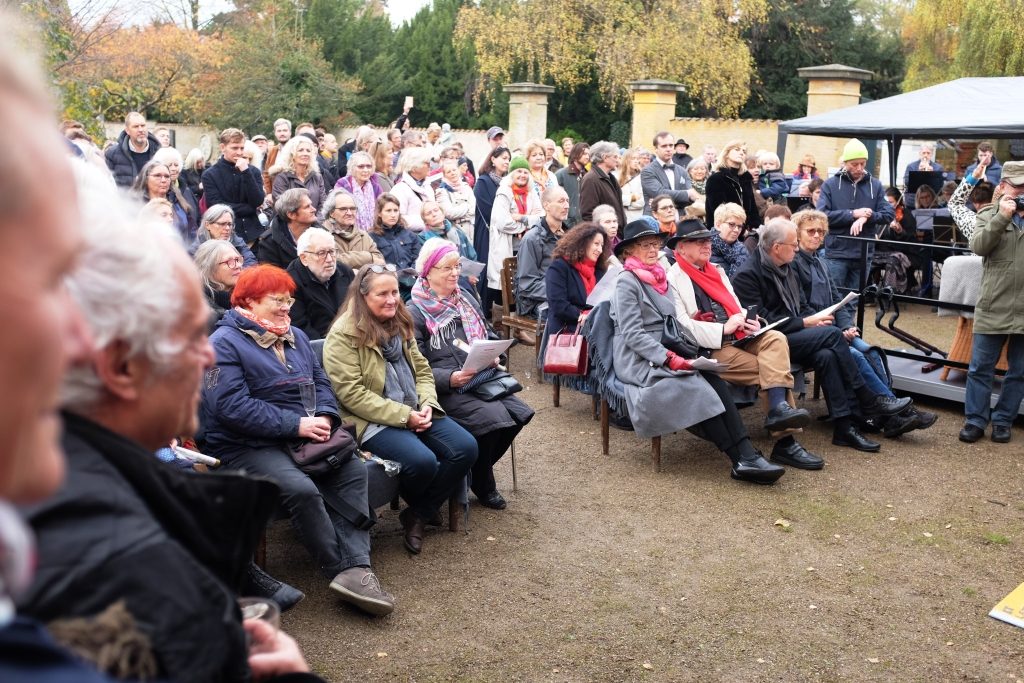
A lot of invited guests as well as interested visitors attended the event
The Dostojevskij monument in Copenhagen
The unveiling ceremony consisted of live music, pantomime art and speeches by, among others, cultural adviser Christoffer Jørgensen, Dostoevsky experts and the Russian ambassador to Denmark, Vladimir Barbin. The young Russian artist Andrey Tartishnikov was present, saying that his biggest problem when he created the sculpture was when he should make the eyes. He said, he chose to leave two black holes in his face which symbolized how Dostoevsky was able to see the depth and contradictions of his heroes.
The monument is given in appreciation of the Dostoevsky theater trilogy, The Dream of a Rediculous Man, Krotkaja and The Little Orphan.
From left: Russian ambassador to Denmark, Vladimir Barbin, with interpreter mime artist, cultural adviser Christoffer Jørgensen
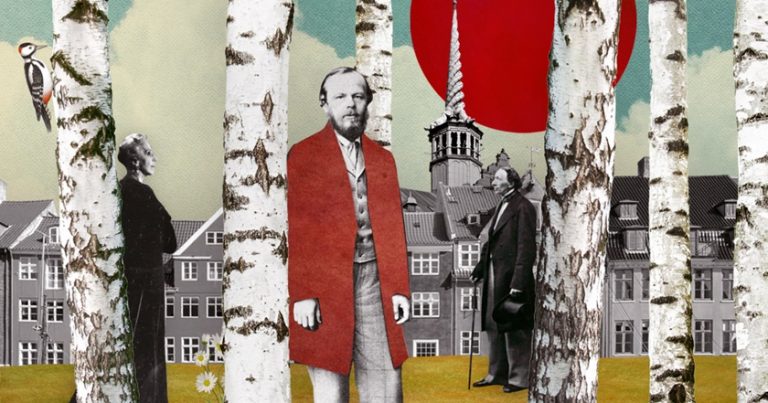
Fjordor Dostojevskij, Hans Christian Andersen and Søren Kierkegaard
Hans Christian Andersen (1805 – 1875) used Assistens cemetery as a place where he could be inspired, and where he could – in his mind – bury persons on whom he was annoyed. In Greek mythology we find the nucleus of the double motif in the myth of Narcissus. Dostojevskij as well as Andersen was engaged in this theme. Dostojevskij wrote his novella The Double in 1846 and Andersen his fairy tale The Shadow in 1847.
The Danish philosopher Søren Kierkegaard introduced existentialism in the 19th century. The philosophical movement was followed by philosophers such as Nietzsche and Heidegger and authors like Camus and Dostojevskij. Both H. C. Andersen and Søren Kierkegaard are buried at Assistens Cemetery in Copenhagen. Dostojevskij visited the cemetery in 1865.
The Dostojevskij monument in Copenhagen. Photo: Helgard Mahrdt
So, the Dostojevskij monument can now be appreciated by all visitors to the Assistens Cemetery in Copenhagen.
Feature image (on top): Official poster
All photos by Tor Kjolberg, except unless stated otherwise.
Dostojevskij Monument Unveiled in Copenhagen, written by Tor Kjolberg
There are 11 historical hiking routes in Norway. One of the most popular is the one along magic Jotunheimen National Park. Stay at different cabins, explore the mountain area and learn about the pioneers in Norwegian mountaineering history. Hike your way through historical routes in Norway.
The trails along the Jotunheimen National Park were among the first in Norway and is a truly authentic mountain hiking experience. If you decide to hike in Jotunheimen we recommend that you spend at least three days and stay two or three nights in the generously equipped cabins supported by DNT (Norwegian Trekking Association). You can hike from cabin to cabin and enjoy breathtaking views.
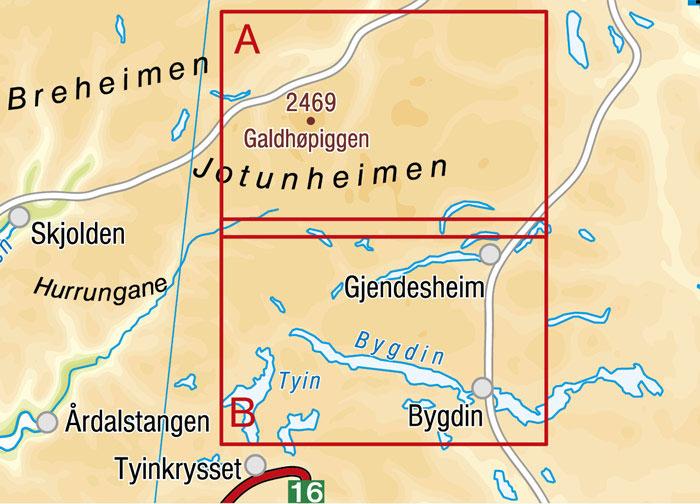
Jotunheimen map
The Norwegian Trekking Association
The Norwegian Trekking Association was formed more than 150 years ago and the two lakes Gjende and Bygdin were the important gateways into the remote parts of Jotunheimen. The first cabin was built at Tyin in 1870.
A good starting point is the historical cabin at Gjendesheim. Buses to Gjendesheim run from Oslo between late June and late September and take 5-6 hours. Take the trip the day before and spend the night at the Gjendesheim cabin so you can start hiking the next morning.
Gjendesheim cabin
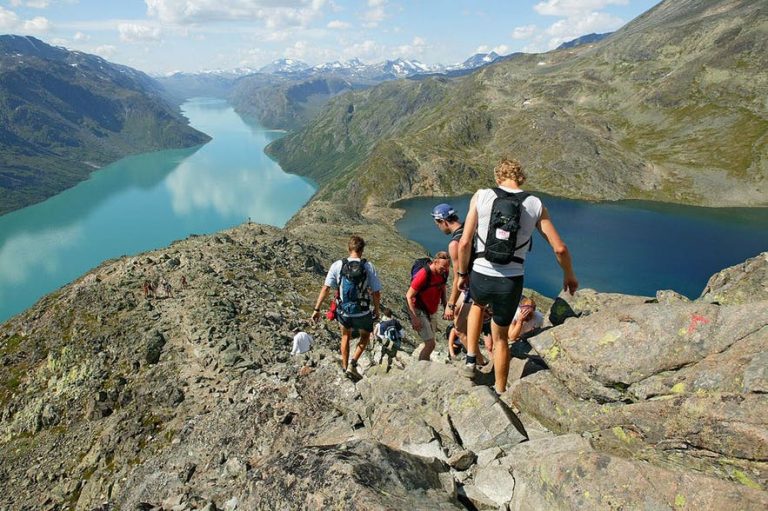
The impressive Besseggen Ridge
From Gjendesheim hike westwards above the Gjende Lake and along the impressive Besseggen Ridge to Mermurubu. This route is located in the heart of Jotunheimen National Park and is one of the world’s most famous hikes, rooted in the history of Norwegian mountain life and outdoor culture. Besseggen Ridge has even been written into literary history by the famous Norwegian author, Henrik Ibsen, who detailed the spectacular ridge in his known piece, Peer Gynt, set to music by Edvard Grieg.
From Mermurubu continue west to Gjendesbu, where the trail heads south through the Svartdalen valley to Torpfinnsbu on the shore of the Bygdin Lake. You will experience a steady climb up to the Mermurutunga plateau and will hike among a variety of beautiful trout-filled lakes – a great place to catch your lunch.
Well-marked trails
Finally, follow the lake to Eidsbugarden. Million of hikers have enjoyed the trails and peaks in this area, for recreation as well as adventures.
Eidsbugarden hotel
Every stage allows you to follow in the footsteps of some of the most historic pioneers and artists in the Norwegian mountain history. The trails are very popular and well-marked with large elevation changes along the way.
The route is best hiked from July to September and is easy to access by public transport. Boats are available to transport heavy backpacks and travelers looking to break up the hike.
Hike Your Way Through Historical Routes in Norway, written by Tor Kjolberg
How do hoteliers deal with requests, bogus requests and property visits? Travel journalists want to share their experiences in an honest and storytelling way so that visitors can make up their own minds, mapping a hotel on their ‘wish’ list or their ‘avoid’ list. Travel-writing is a profession, and hoteliers should therefore be encouraged to make a journalist’s visit a part of their overall marketing mix. My visit to Stockholm recently was a poor example of such an understanding. So, here you have it, a travel journalist’s contemplations on a hotel stay in Stockholm.
I had booked a room at Berns Hotel in Stockholm weeks before my arrival, and a dedicated person should be available to show me the facilities and tell me about the history of the hotel.
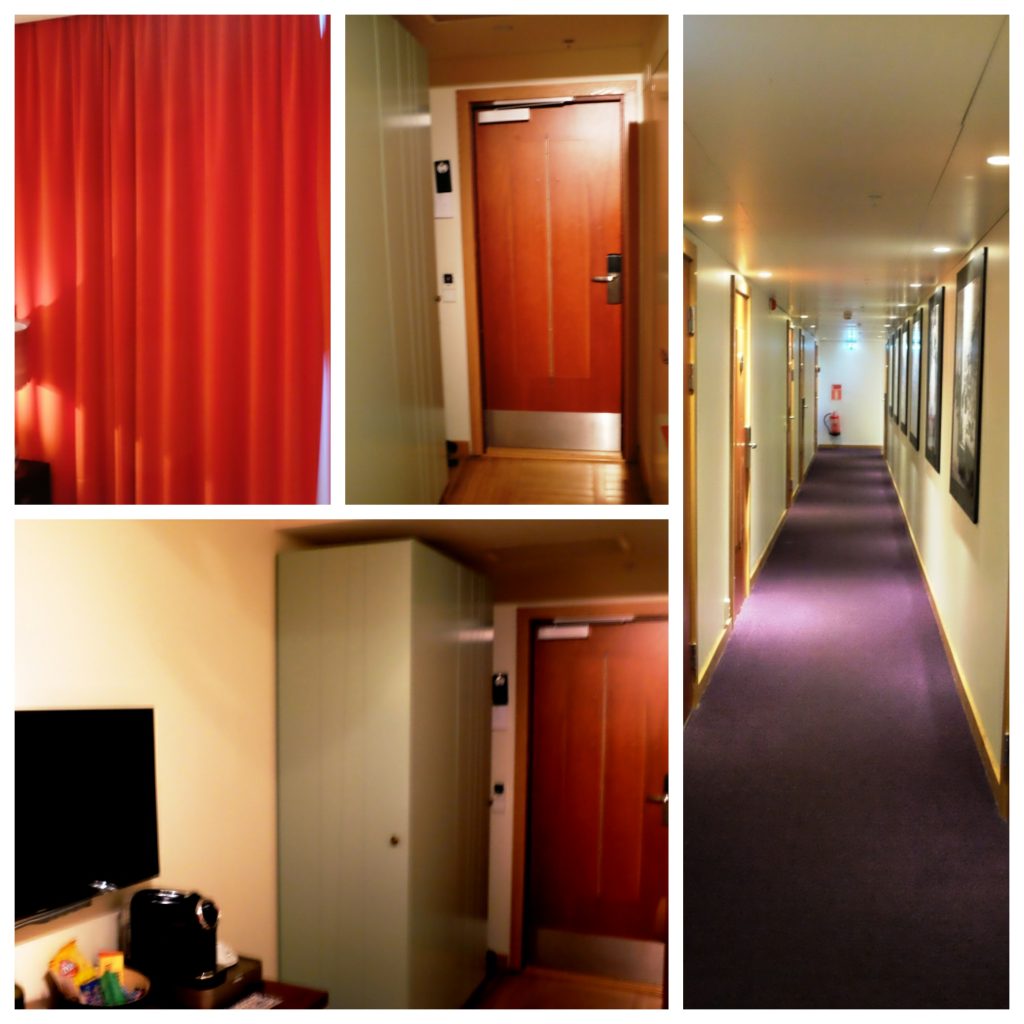
My ‘standard room’ at Berns hotel in Stockholm had a bit stern décor and ugly furniture with a certain 90s air
A cultural gem
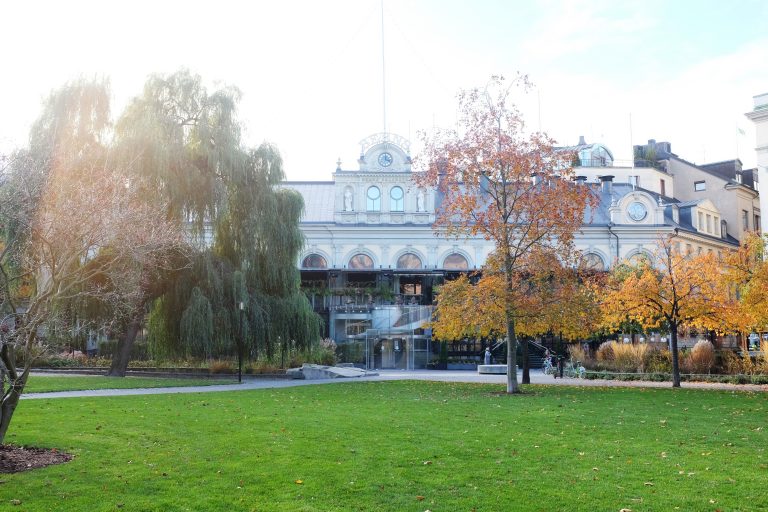
To my generation, Berns Salonger by Berzelli Park in Stockholm is a cultural gem which since 1863 has offered visitors food, drinks and theatrical experiences. In 1866 cancan was performed there for the first time for a Swedish audience. Berns Salonger featured in Strindberg’s classic 1879 novel The Red Room, which follows broke young locals searching for freedom and truth.
Berns hotel
The adjoining hotel opened in the 1980’s with rooms designed by Olle Rex and immediately attracted a well-heeled crowd of people not afraid to splash the cash and enjoy noisy club nights and concerts. Bill Gates and Rihanna have apparently spent the night here, not together, I hasten to emphasize.
Why has Berns salonger been turned into an Asian restaurant?
The main restaurant, once a music hall is beautiful with amazing chandeliers and ambient decor, but why have the hoteliers in cooperation with British designer and restaurateur Terence Conran chosen to make it an Asian restaurant?
A Travel Journalist’s Hotel Contemplations
Arriving at the hotel, I was disappointed to experience that I had been squeezed into perhaps the smallest room in the hotel (categorized ‘standard room’) with a bit stern décor and ugly furniture with a certain 90s air. The air conditioning did not work which is really unusual for a four-star hotel. During the night, I had to keep the balcony doors open, but then it was impossible to keep the warmth under the synthetic tiny bedclothes, which today is unusual for any number-of-star hotel.
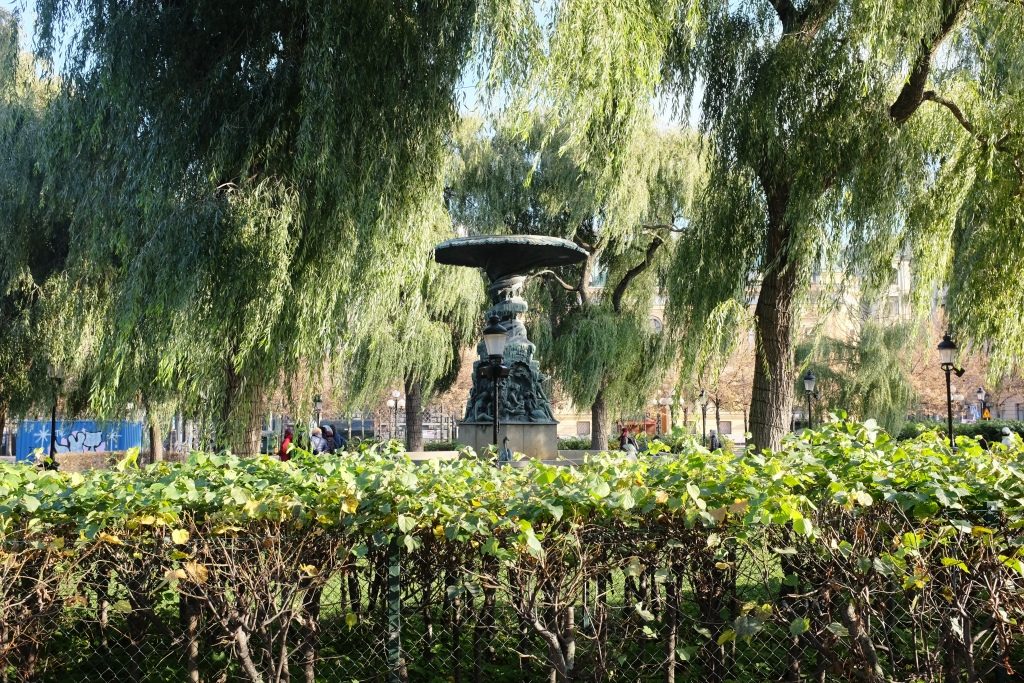
The Berzelli Park
Related: Södermalm Artistic Center in Stockholm That being said, the reception informed me that the ‘press guy’ was busy in a budget meeting and could not see me until the next day. Since I had a full schedule in Stockholm for the next two days, I decided I would write these contemplations instead.
In my opinion, the biggest pitfall a hotelier can do is to treat a writer as a VIP and neglect their customers. Journalists do not expect that. But when they treat a writer as a mere backpacker, they should realize that journalists also pick up on all of that.
For me the best part of the hotel was the central location for everything I had scheduled to do in Stockholm during my stay. And nearby Grand Hotel has a wonderful wine bar.
All photos: Tor Kjolberg
A Travel Journalist’s Contemplations on a Hotel Stay in Stockholm, written by Tor Kjolberg, editor-in-chief
Stavanger in Norway is a small metropolis, with a lot to offer and everything within easy reach. Norway’s former oil capital has a lot to offer all year round. When visiting the little big city in Norway you can enjoy both gastronomic delights and a varied program of events.
Stavanger’s highest point is Ullandhaugtårnet (the Ullanhaug Tower). From there you can see the mountains of Ryfylke to the west. To the north lies Ryfylke, with the legendary Lysefjord and the Pulpit Rock vantage point. Just below the tower to the west, lies Hafrsfjord, where in 872 Harald Fairhair won a great sea battle that resulted in the unification of Norway. The memorial’s Swords in Stone marks the spot where Harald Fairhair achieved his objective. In the evening sun, the three giant swords with the sea in the backgreound are a power sight.
The Ullandshaug Tower in Stavanger
The wide agriculture landscape of Jæren spreads out to the south. Out towards the coast a series of long, lovely beaches stretch from Sola in the north to Brusand in the south, only interrupted by stretches of shingle.
In Stavanger nothing is very far away. Whether you want to go to Siridalen for the skiing, chug out to the sea in Ryfylke or take a stroll along the beaches and watch the North Sea rolling in. And in many ways, the town itself is a mini-metropolis.
From Vågen
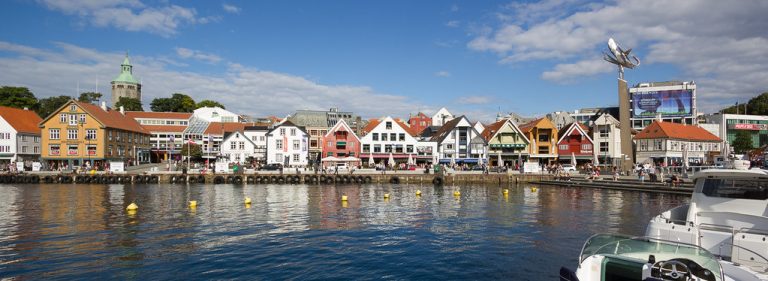
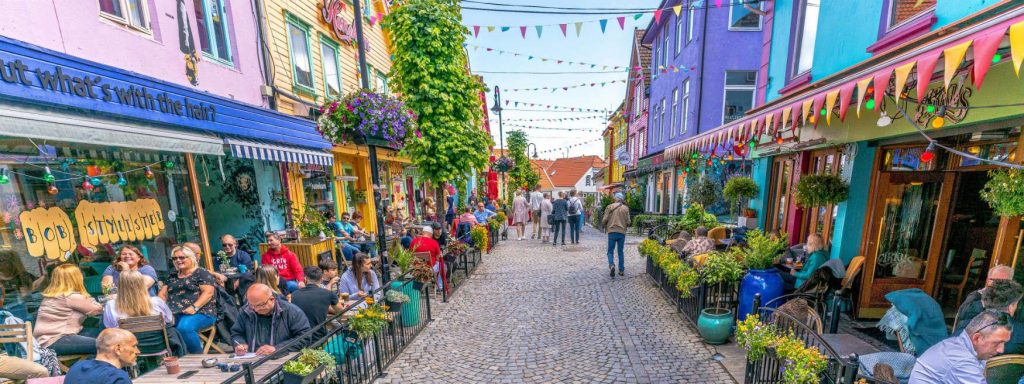
The streets are lined with shops, restaurants and bars. The harbor area, Vågen, is packed with people all year round, although it is in the spring and summer that the town really shows itself to advantage. Vågen is Stavanger’s beating heart.
Along the harborside bars and restaurants pop up as the day ends. A cold beer and a bucket of fresh shrimp at Hansens Hjørnet does the trick, while you watch the world pass by.
Museums
In the center of Stavanger, near Kjerringholmen, lies the Norwegian Petrolium Museum. The museum looks out over Rosenberg Shipyard, which has built many of the rigs and platforms in use in Norway’s oil fields. The museum is modern and has a lot to offer both adults and children. In addition to a presentation of Norway’s oil industry from its beginnings until today, you can also find out what it is like to work on an oilrig.
The Archeological Museum is a ten-minute walk from the town center. Here you can see a permanent exhibition showing much of the country’s history, or visit one of the special exhibitions. The temporary exhibitions are designed and built in the Museum or presented on loan from other Museums and institutions.
From old Stavanger
Old Stavanger If you want to take a short walk and are looking for a peaceful spot not far from the town center, Stavanger’s old town (Gamle Stavanger) is the place for you. This idyllic area filled with classic, wood-clad houses was only just saved for posterity during the 1970s when Stavanger underwent large-scale modernization. In the old town’s narrow cobbled streets you are shielded from all traffic. Here you can relive Stavanger as it was more than a hundred years ago. And here you can find traces of the canning industry which made Stavanger rich at the turn of the 20th century.
Shopping Today, the town center, made up of pedestrian shopping streets, is a busy place all year round. The chain stores rub shoulder with small specialist boutiques, where the shopkeepers display their newest items. Here you will find the latest fashion, or second-hand 1950s memorabilia. And if the weather should be at its west-country worst, the shopping centers Stavanger Storsenter and Arkaden are good alternatives. Here you can stay warm and dry while the rain or sleet lashes down outside.
Shopping is hungry work. At Bøker og Børst you can enjoy wholesome sandwiches. But if that doesn’t tickle your fancy, you are never far from a restaurant, whether you want traditional Norwegian rissoles in gravy or more international fare.
From the Utopia Festival in Stavanger
Festivals A festival curiosity which deserves mention is Stavanger Wine Festival. The festival is brought together by 12 of the city’s best restaurants and some of Europe’s best wine makers, fantastic chefs and suppliers will be present. There will be a wine parade with 8 stops for tasting wine and food. The Stavanger Wine Festival runs from 4 to 7 March 2020.
4 to 10 May 2020, the Stavanger Jazz Festival (MalJazz) takes place. Over the years MalJazz has grown into one of the country’s foremost jazz festivals, presenting top international jazz artists and the best in national and local jazz.
The biggest musical festival in the region is the Utopia Festival, which follows the trends of young people presenting some of the biggest and most popular artists in pop, EDM and urban music. It takes place in the Stavanger Concert Hall’s outside area 28 to 29 August 2020.
Stavanger is known as Norway’s capital of Street Arts. Since 2001, the non-profit festival NuArt has widely been considered the world’s leading celebration of Street Art among its peers. It takes place in September.
The Little Big City in Norway, written by Tor Kjolberg
Scandinavian Mountains Airport at the border between Sweden and Norway is one of the first airports in the world to pioneer new remote air traffic control technology. Designed to improve safety and cut costs, there will be no physical control tower at the airport. Scandinavian Mountains Airport – without air traffic control tower – a world’s first!
The operators do their work in a low-rise building in Sundsvall some 300 kilometers (186 miles) away. The solution could pave the way for drastic changes to the way smaller airports operate around the world.
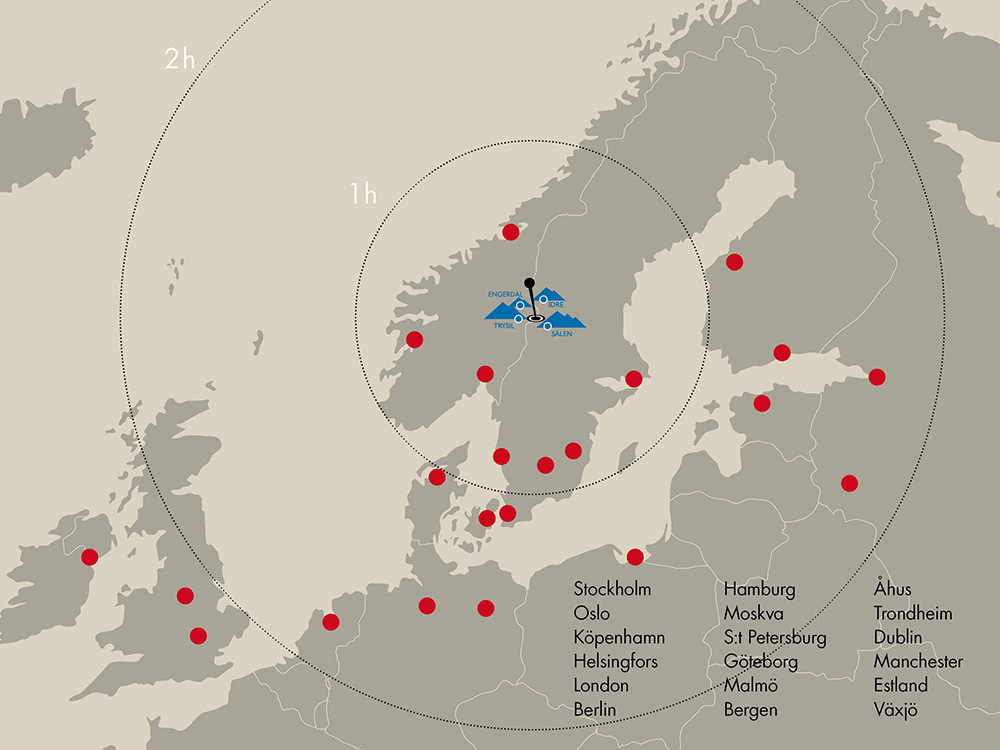
The terminal at Scandinavian Mountains Airport serves Scandinavia’s largest alpine ski areas, Trysil in Norway and Sälen in Sweden
“The idea has been around for a while,” says R. John Hansman, professor of aeronautics and astronautics at MIT. According to CNN, multiple cameras and sensors will be installed around the airfields and its immediate surroundings. High-definition screens will give operators at the airport’s remote tower 360-degree views of the airport. The sensors, however, will be scaled back to a “225-degree arc”, which will in ways offer a more comprehensive overview than a traditional tower.
Swedish defense company Saab has been trialing remote air traffic control for around a decade, with testing taking place everywhere from Ireland to the US to Australia. “From a tech standpoint we have better surveillance,” Hansman told CNN.
BRA (Braathens Regional Airlines) and SAS will fly ski enthusiasts to the Scandinavian Muntains Airport
The remote technology has other advantages as well. Vision is for instance improved at night in adverse conditions, and the operators are able to zoom in and out with ease. “Virtual towers in principle work like any person who works remotely using technology, whether it is education, software, meetings and so on,” said David Gillen, a professor at the University of British Columbia
The terminal at Scandinavian Mountains Airport serves Scandinavia’s largest alpine ski areas, Trysil in Norway and Sälen in Sweden, and is designed to handle four flights simultaneously, from the airlines SAS and BRA (Braathens Regional Airlines). The airfield will open December 22, connecting winter holiday-makers in Scandinavia, the US and the UK with Norway and Sweden’s largest ski resorts.
During the 2019-2020 winter season SAS is going to start direct flights from Copenhagen, Aalborg and London to Scandinavian Mountains Airport.
The flight center at Sundsvall in Central Sweden is already looking after flights from nearby Sundsvall-Timra Airport, Örnsköldsvik in northern Sweden and, as of April 2019, Linköping in the south.
According to The Economist, in Norway, 15 airports will be shutting their towers and transferring operations to remote control rooms. Air traffic control towers, those mighty symbols of aviation dominating airports around the world, might one day disappear from view. “They operate using radar and other sensitive information transfer devices. The move to virtual towers is a relatively small step technically and operationally,” says Gillen.
The terminal at Scandinavian Mountains Airport serves Scandinavia’s largest alpine ski areas, Trysil in Norway and Sälen in Sweden
During the 2019-2020 winter season SAS is going to start direct flights from Copenhagen, Aalborg and London to Scandinavian Mountains Airport. The new airport is only a short distance from around 250 ski slopes in Sweden and Norway. The new services will give snow lovers from Denmark, Southern Sweden and the United Kingdom a totally new way of enjoying Scandinavia’s leading winter sports area.
The new airport is only a short distance from around 250 ski slopes in Sweden and Norway.
The services from Denmark and the United Kingdom will operate during the winter season until Easter. “We are delighted that SAS is able to offer the first international flights to the new airport. Short journey times, attractive timetables, combined with fantastic opportunities for skiing and other winter activities in the Swedish and Norwegian mountains are what a lot of people are looking for. We are going to continue to develop our collaboration with SkiStar in order to improve the services we can offer our passengers and make it a whole lot easier to enjoy the Scandinavian winter experience”, says Karl Sandlund, Executive Vice President Commercial, SAS.
Scandinavian Mountains Airport – Without Air Traffic Control Tower, compiled by Tor Kjolberg
Telemark in Norway is best known for its stave churches and canal system. However, the beautiful rural Telemark region in Norway has much else to offer; lakes, mountains, forests and fjords.
The regional capital is Skien, where Henrik Ibsen (1828-1906) spent his childhood. His home, Venstøp, forms part of the Telemark Museum. In summer, tulips bloom en masse there in the elegant English gardens, which are surrounded by stylish mansions.
Northwest of Skien lies Ulefoss, a village that until the end of the 19th century was a major exporter of ice, which was transported along the waterways of the Telemark Canal, a 105 km (65 mile) long waterway linking Skien to Dalen. Blasted out of the rocks over 100 years ago, the canal wends a scenic route through 18 locks. From late May to early September, two venerable passenger launches – the M/V Victoria and M/V Henrik Ibsen – ply the watercourse on pleasure cruises lasting from 2 to 11 hours.
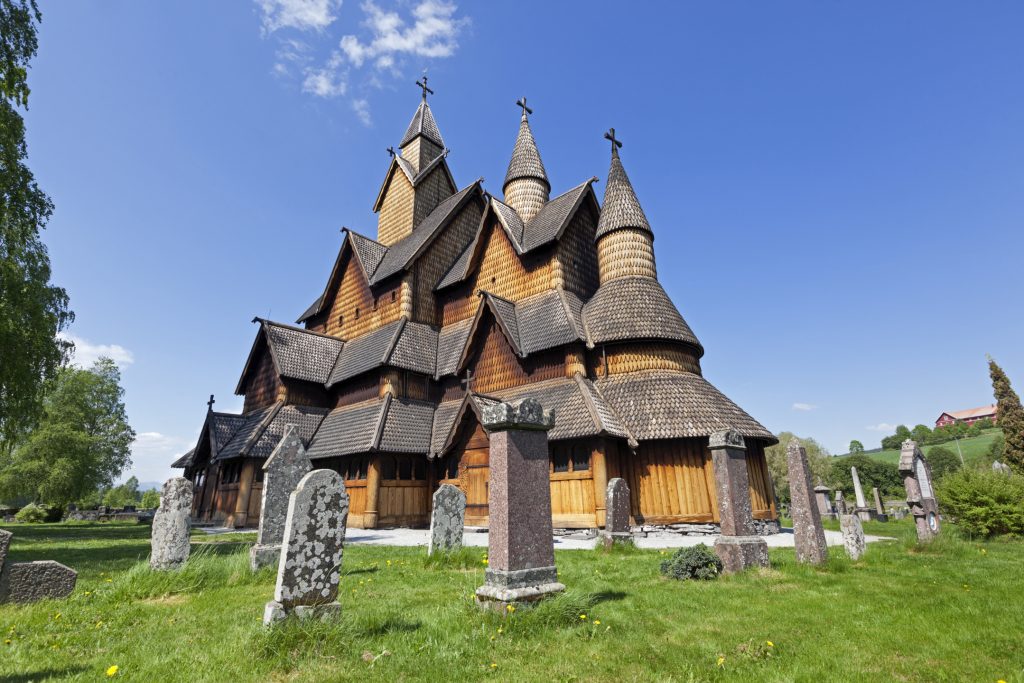
The small industrial town of Notodden is unremarkable in itself, but just 5 km (3 miles) along Route 11 is one of Norway’s top attractions, the medieval Heddal Stave Church, considered a masterpiece in wood. Its ornate carvings are rivaled only by the beautiful period rose paintings in the Ramberg room of the nearby museum Heddal Bygdetun.
About 10 km (6 miles) further on, Route 17 branches north past Tinnsjø lake towards Rjukan. The principal attraction here is the former Vemork hydroelectro plant, just west of Rjukan. Dating from 1910 and surrounded by beautiful scenery, it now houses the Norwegian Industrial Workers Museum (Norsk Industriarbeidermuseum).
The museum details the story of the brave attempts of the Norwegian Resistance to sabotage the plant where heavy water was once produced which the Nazis were using to develop nuclear weapons. In 2010, a new exhibition was installed which focuses on the everyday lives of workers from 1950 until the present day.
The Beautiful Rural Telemark Region in Norway, written by Tor Kjolberg
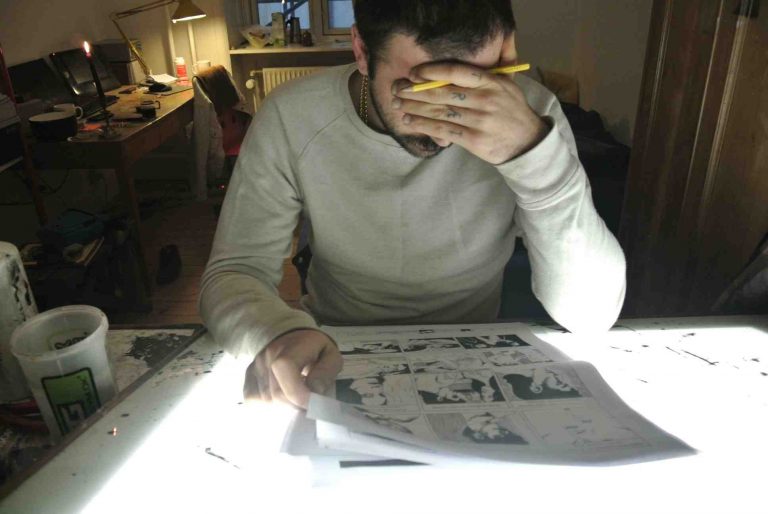
Danish cartoonist Halfdan Pisket (b. 1985) graduated from the Royal Danish Academy of Fine Arts in 2009 and is inspired by visual artists such as Edvard Munch and Palle Nielsen as well as comics such as Dave McKeane, the Spanish Crime Series “Torpedo”, David B “Epilep” and “Cages”. Now he has drawn the story of his father’s criminal past.
After two years at the Academy he got fed up with the structures and absurdities of fine arts and started making comics. Now he is a full-time cartoonist and illustrator.
From Diserter by Halfdan Pisket
The first comic Halfdan Pisket published was deemed too artistic by the critics. Therefore, he started to follow a more traditional format.
The Dane-Trilogy
From 2014 to 2016 he produced the so-called “Dane-trilogy” consisting of three books; Desertør (Deserter), Kakerlak (Cockroach) and Dansker (Danes). These books as well as his work in general are inspired by linocuts from the sixties and the seventies and tells the fictionalized story of his father’s criminal background – to great pleasure of the Danish press.
Linocut by Halfdan Pisket
Best Comic Award
In January 2019, he won the award for best comic in Festival International de la Bande Dessinée, which is considered the comic industry’s counterpart to the Cannes Film Festival. The linocut technique, black and white imagery and sharp contours, has until now served as the main source of inspiration for Pisket’s work.
“I have learned more from the American TV-series The Wire than any lesson I’ve ever had in art history,” Pisket once told a journalist.
Halfdan Pisket, No escape – from Bureaucracy
Danish Cartoonist Tells the Story Of His Father’s Criminal Past
Halfdan Pisket plays an important role in the cartoon about his father, but says he has no interest in making an autobiography about himself. “We live in a society with an extreme focus on the self, and it was important to me that my father became the protagonist, not me,” he says.
The story came to life when Halfdan Pisket’s father was diagnosed with incipient dementia, and Pisket saw the opportunity to get to know his father before his memory would slowly fade away. The result is the story of a Turkish immigrant who deserted from the Turkish army and fled to Denmark to create a life for himself and become a naturalized Danish citizen.
“The story is 100 percent based on reality, but it’s not true,” Pisket emphasizes.
Danish Cartoonist Tells the Story Of His Father’s Criminal Past, written by Tor Kjolberg
In 2014, when the Norwegian Constitution could celebrate its 200th anniversary, publisher Trond B. Olsen put together a book tracing the US Constitution’s influence of its Norwegian counterpart. 1814 – 2014 Red, White and Blue is a fascinating book about the second-oldest living constitution in the world and the Norwegian constitution and Norway’s links to the USA.
The Norwegian constitution has for more than 200 years been the backbone of a society that has created political stability, economic development and personal freedom for generations of Norwegians. The book, 1814-2014 Red, White and Blue, edited by Gudleiv Forr, is a cooperation between 10 artists and 15 authors. The book tells how the Norwegian constitution was created in Eidsvoll northeast of Oslo in 1814, how it has functioned and the authors do not forget the democratic challenges it faces.
The Norwegian constitution was created in Eidsvoll northeast of Oslo in 1814
About the book
Although the true Norwegian sovereignty did not happen until 1905, when the country broke free from its union with Sweden, May 17 has become Norway’s national day. Many notable political figures have contributed to the book, including former US Vice President Walter Mondale (whose paternal grandparents were Norwegian). The book features 15 essays by writers and scholars alongside artworks by Norwegian contemporary artists inspired by the Constitution, among them Sverre Bjertnes and Inger Sitter, a one-time young rebel who became a pioneer of Norwegian abstract in the post-World War II years.
1814 – 2015, The book
The writers as well as the artists focus on what it means to have a national identity. EU researcher Erik Oddvar Eriksen’s chapter deals with the Norwegian connection to the EU, and how it influences and challenges Norway’s sovereignty. According to Eriksen, the Norwegian participance in the EEA has constitutional implications, and every administration since 1994 has brough the country closer to the EU.
The Norwegian Constitution and Norway’s links to the USA
Norway’s link with the USA goes back around 1,000 years, when Norse Vikings first landed in North America. The largest waves of emigration occurred, however, in the 19th and early 20th centuries, first for religious reasons, and then for work.
17 May, Norwegian constitution day celebration in Oslo
“The United States has always been fortunate to have a special relationship with Norway due to the thousands of migrants that left Norway for America at the turn of the last century,” writes Vice President Mondale in the book’s preface. “The impact of this has been that Norwegian-Americans have made and continue to make, significant contributions to US politics, to the arts and sciences, and to the all-round betterment of our society. Their Norwegian ancestors passed down values from one generation to the next that focus on hard work, service to society and placing the public good above all.”
Famous Norwegian Americans Here are just a few of famous Norwegian Americans. Actor James Arness, Actor James Cagney, the inventor of the outboard motor Olav Evinrude, creator of the animation series The Simpsons Matt Groening, founder of the Hilton Hotels Conrad Hilton, entrepreneur Fred Kavli, actor Robert Mitchum, actress Marilyn Monroe, icon from the Prohibition Eliot Ness, musical director for Frank Sinatra Axel Stordahl, violinist Camilla Wicks,
The Norwegian Constitution and Norway’s links to the USA, written by Tor Kjolberg
For almost 30 years her voice has captivated and fascinated a discerning audience. Silje Nergaard (b. 1966) has been successful both as a vocalist and songwriter. She is one of the best-selling jazz artists on the official sales chart in Norway and became known worldwide after the release of the international bestseller Tell Me Where You’re Going, featuring Pat Metheny on guitar. The power of Norway’s Best-selling Jazz-artist Silje Nergaard has reached a world-wide audience.
She says, “I cannot live without music. It is like the air I breathe. Music is my way of existing in the world. Everything I do, experience and feel goes through a music filter. Could this be the inspiration for a song? Does it have a resonance I can use? Then starts the slow, intuitive process of creating music. At the beginning I sit tinkling at the piano, fumbling my way forward. And suddenly it’s there – one or two key phrases. I can feel it in my whole body, that’s it. Then comes the time-consuming and laborious work of building a song around those key phrases. The foundation is there, but you have to build the walls and roof, and other instruments to my voice. And then the melody need to go off and get some clothes – a set of lyrics created by Mike McGurk.”
Tell me where you’re going
Silje entered the music scene at the age of 16, and her first hit single “Tell Me Where You’re Going” made it to no. 1 in Japan as well as top 10 in Norway and other countries. Part of what makes Silje an exciting artist is that her songs can float in a room like an atmosphere, cool, elegant and ingratiating. But then, suddenly, a note wakens you from your trance and challenges you: Hey! I’ve got something to say.
At first light Her album “At First Light” (2001) is the best-selling Norwegian jazz album ever recorded and entered the official sales chart in Norway at no. 1 in its first week. The album “A Thousand True Stories”, which Silje recorded with the Metropole Orchestra in 2008, was a great success in both Europe and Asia. Silje is one of the few Norwegian artists to have been commercially released all around the globe, on most continents and major music markets including Japan, Brazil, Germany, the United States, and the United Kingdom.
The Power of Norway’s Best-selling Jazz-artist
“Since I sing for an international audience, it feels right to sing in English,” she says. It is difficult to place Silje in any kind of box or genre. You could call her a jazz artist and point to her collaboration with the legendary Pat Matheney, and listen to her 2003 album “Night-watch”, which is more cool jazz than anything else.
But you could also call her a pop singer, and point to her version of Chicago’s “If you leave me now”, from her album “Be still my heart”. You could also point to her role model, Joni Mitchell, and simply call her a ‘singer’.
“I cannot live without music,” says Silje Nergaard
Silje’s special blend
Or you could mix all the different genres together and call it ‘Silje’s special blend’. Silje has recorded and performed songs with Al Jarreau, Pat Metheny, Toots Thielemanns, and Morten Harket of A-ha. She has had Tord Gustavsen and Jarle Vespestad as two pillars in her bands. Vince Mendoza received a Grammy Award Nomination for the Best Instrumental Arrangement Accompanying Vocalist(s) Award for the song “A Thousand True Stories” in 2011.
Now, Silje has ventured into an exciting collaboration with the great jazz pianist Espen Berg. Espen is considered a world class pianist and was the recipient of Molde Jazz Festival’s renowned music award in 2016.
EFG London Jazz Festival 22 & 23 November 2019
At the EFG London Jazz Festival 22 & 23 November 2019, the duo will perform carefully selected songs from Silje’s vast musical catalogue, including Be Still My Heart, The Waltz, Japanese Blue, and Tell Me Where You’re Going.
Espen is a masterful pianist, and Silje’s beautiful and expressive voice is truly allowed to shine in this wonderful musical landscape created with Espen’s dynamic and playful piano. This duo will give you a unique concert experience – nothing less than pure medicine for your ears, your heart, and your soul!
Rumors say, they also have surprises in store, with their very own interpretations of well-known classics.
The Power of Norway’s Best-selling Jazz-artist, written by Tor Kjolberg
It seems a paradox, a sailing boat goes a third of the speed of a motorboat, but travels three times as far during a season. There must be an explanation. Find out more about the Scandinavian passion for sail.
You will find the explanation when you get out to sea. It’s when we have left our home port and motored out to the wind and the beast below decks (the engine) has been switched off it all happens, every time. Peace descends. All we hear is the wind and the sea, which begins to ripple along the hull.
All we hear is the wind and the sea, which begins to ripple along the hull.
The boat slips through the waves and picks up speed. It’s like flying, but we’re sailing. Hooray, that’s even better!
Alone with the forces of nature It is fantastic to run before the wind. That means we have the wind right behind or slightly to one side at our backs. We are pushed along, and everything is plain sailing. The wind is mild and there is not much to do, apart from enjoy life, perhaps even with the warmth of the sun not being blocked out by the sails.
The boat slips through the waves and picks up speed
But what if the wind is blowing one way and we want to go another? Then we harness the forces of nature and use them against her. We trim our sail and get a good speed out of the boat, even if we are sailing 45 degrees to the wind, e. g. into it. We ‘saw’ our way towards our destination. It is called sailing ‘close-hauled’, and if you are a philosophical turn of mind, you might say that running close-hauled is a metaphor for human life itself.
Noble race Scandinavians have a long history when it comes to moving from one place to another under canvas. It is scarcely more than two or three generations ago that all movement of people and transport took place by sea, either with oars or under sail.
A race against the wind and the water.
Now, as in days of yore, we want to sail as efficiently as possible, with its inevitable consequence. As soon as we spot another sail, we have to see who is sailing the fastest. It could be said, and only partly in jest, that a regatta is two sailing boats on the same heading. It really is not so strange. We are already engaged in a race which is both intellectual and physical; a race against the wind and the water. So why not test our prowess?
Traditionally a ‘man thing’ The great thing about racing is that many regattas, both short and long, can be completed in using the family tourer. But it is mostly with only the man on board. Regatta sailing is pretty much a ‘man thing’, which is a shame because those women who do join the fray can beat the boys. If they try just as hard. There are only one or two female international champions, after all!
So women are not inherently less capable than the men, either at the helm navigating or putting into port.
It is fantastic to run before the wind.
Novice mistakes A lot of people sail with too much canvas spread. That is a typical novice mistake, which can have a number of unfortunate consequences. Firstly, the boat heals right over, making it difficult to steer. Secondly, the boat will drag through the water, going slower than it should. It is no fun being aboard a boat like that. It may not be dangerous, but it can feel very uncomfortable.
The experienced sailor shortens his sail in time, perhaps even before it is really necessary. Then everything is so much better on board. The waves no longer seem perilous, they just give a wonderfully lively cruise. Yes, good sport! Now a little sea spray over the deck seems like a gush of champagne. Wow, we’re really moving!
Wind against the current And here is another mistake that novices make. They don’t take the wind seriously. Those sailing along the coast of Scandinavia, should be aware of meteorological phenomenon whose cause is difficult to describe in detail, but whose consequences are tangible enough.
As the day progresses, the sun sets up a special wind system which blows along the coast from right to left when you have your back to the land. It churns up the waves, with a lot of water spilling over the deck, because the current is running in the opposite direction along most of our coatline. The smart people choose that moment to enjoy life in port, and go out either late in the evening or early in the morning. Then your sailing holiday will be a great experience for everybody on board. And that is the objective, isn’t it?
Easy and hard Sailing is either easy or very demanding, depending on the size/type of boat, the waters you are sailing in and your level of ambition. But that sailing requires a different kind of knowledge from that needed to pilot a motorboat cannot be disputed. In fact, you have to know rather a lot to get a sailing boat to go where you want it to in all weathers.
Scandinavians have a long history when it comes to moving from one place to another under canvas.
In earlier times such knowledge was handed down from generation to generation. Today, more and more people are out on the water, and many of them know absolutely nothing about boats in general and sailing in particular.
There are several ways to learn. You can go out with an experienced sailor and learn from him or her, while also studying some of the many good books to be found on the market. There are local sailing clubs all over the place, so all you have to is check out the web.
Cath ‘em young We adults can only envy the young. They learn all that stuff so easily, so easily. Enroll them at a local sailing club and you will soon see. They understand instinctively and become very competent very quickly.
Luckily more and more sailing schools for adults are popping up too, both for singles and couples. Yes, there is even sailing schools for girls. So, if you are worried about making a fool of yourself with a man at the helm, that is the answer for you.
The Scandinavian Passion for Sail, written for Daily Scandinavian by Odd Lindboe