2021 Scandinavian Interior Design Trends You Need to Know

Over the last year, homeowners around the world have been spending more time indoors as we practice social distancing while fighting off COVID-19. While it is not the ideal situation, it has resulted in many people looking around their houses with an eye on updating the decor. Whether you are purchasing a new home or you are just looking to spruce up your existing space, here are the 2021 Scandinavian interior design trends you need to know.

Popular Scandinavian designs include minimalist but functional spaces, neutral colors that bring out the brightness of any room, and a focus on lighting for those darker days. Below we will discuss some of these trends to give you a better idea of how you may improve your own home in the new year.

2021 Scandinavian Interior Design Trends You Need to Know
As with previous years, the color trends of Scandinavian design continue to be earthy and neutral tones. Photo: Jotun Norway

Start with Neutral Colors
Before we get into the trends, it is important to mention that you don’t have to go big by redecorating or remodeling your home all at once, especially if money is a concern. Instead, you can go room by room and make adjustments as time and funds allow. To make the process easier, it is recommended that you create a budget that takes into account all potential costs, including materials and labor. Once you know for sure that you have the funds to continue, do your research about how to best go about the project and bring in friends to help if possible.

As with previous years, the color trends of Scandinavian design continue to be earthy and neutral tones. In fact, earthy tones are a trend around the globe right now because they mimic the feeling of being outdoors while you are in your cozy home, which is especially important for those working from home. Neutral colors have many other benefits as well, including creating the illusion of a larger space and providing a wider appeal to buyers, so if you ever plan to sell your home, you will be ahead of the curve.

Some of the hottest neutral tones in style right now include the hues of India yellow and dead salmon. Gray is also making a big comeback. Warm and rustic colors like natural clay, earthy brown, and even the muted desert pink are very popular. The trick is to work these colors together in the walls, floors, and furniture. If you like a little more brightness, look for a natural blue, which is also a big hit this year.

2021 Scandinavian Interior Design Trends You Need to Know
The central core behind most Scandinavian design is simplicity, both with the neutral tones and the furniture that fills the rooms

Simple Style
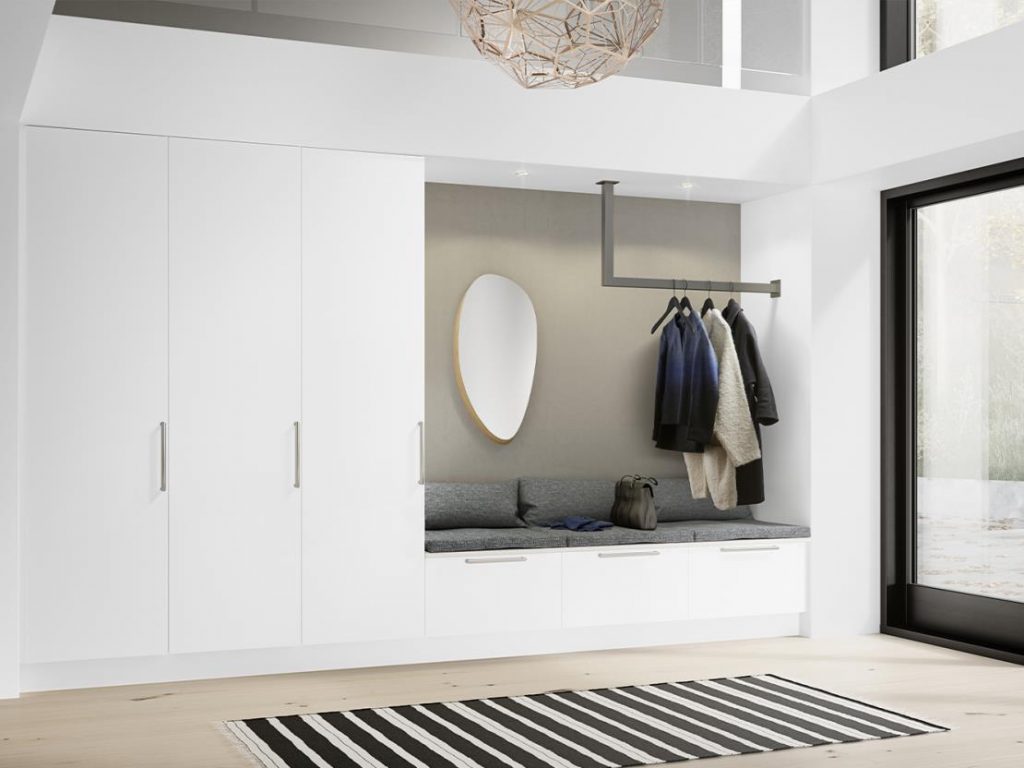
The central core behind most Scandinavian design is simplicity, both with the neutral tones and the furniture that fills the rooms. Going forward in 2021, this simplicity will be paired with function, especially for storage. The idea is to get rid of any filler so you only see what you use and clutter is virtually non-existent. To meet this trend, ottomans in neutral colors in the living room should store accessories like remote controls and magazines. In the bedroom, nightstands can store medication and other knick-knacks.
2021 Scandinavian Interior Design Trends You Need to Know
Going forward in 2021, this simplicity will be paired with function, especially for storage. Photo: Kvik

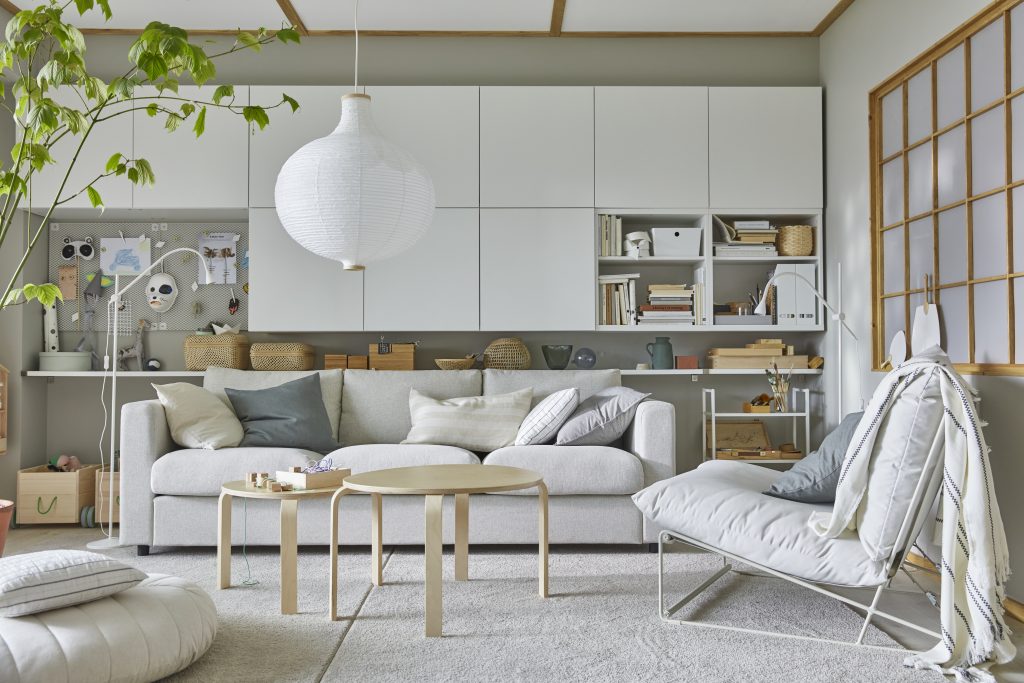
In the family room, simple furniture including couches, chairs, and loveseats should stay with the trend of neutral colors of creams, greens, and light pinks. Thick cushions provide absolute comfort but also grace in design, as is the case in the models shown here. While the trend is simplicity, you don’t want to have an empty room. Instead, go for a couple of seating options with a couch and chair and a side table and main table. For tables, the latest trends show birch plywood and beech construction to be the go-to.

Simple style is important in the bedroom as well. Bright white bedding is king right now, as are storage compartments underneath for clothing and other items you don’t want laying around. Big open windows are key here as well to bathe the room in that welcoming morning light. White flooring completes the bright appearance.

Lighting is Key
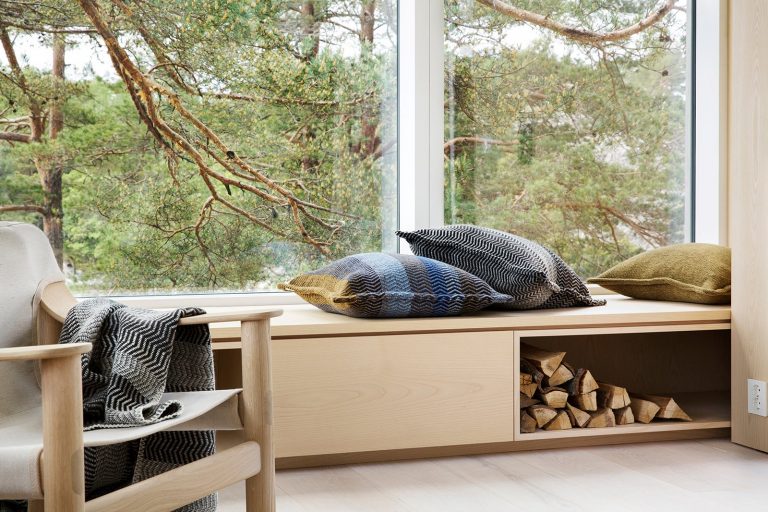
As 2021 surges along, strong and stylish lighting will continue to be a big trend. There are only so many hours of daylight to play with, so smart design choices will maximize the lighting during the day and keep your space well-illuminated during the darker hours. Large windows in all rooms continue to be the trend. Out are heavy drapes, and instead, undressed windows, or at most, light sheers are desired.

2021 Scandinavian Interior Design Trends You Need to Know
As 2021 surges along, strong and stylish lighting will continue to be a big trend. Above: Balance wall landscape from Northern. Photo: Chris Tønnesen

To help that natural light illuminate your rooms, other design trends are seeing a resurgence. One is the use of ornament candle holders that are easily mounted on a wall in the living rooms and bedrooms, which make for a classy yet traditional look that is functional and impressive to guests. The use of mirrors is also key to bounce both natural and artificial light around the room. While hanging mirrors are always a given, mirrors that sit on the floor and lean against the wall are also seeing a resurgence.

Standalone lighting is also popular these days, especially fixtures that create pools of light throughout the residence. Floor lamps of simplistic style provide great light and are made even better when paired with a dimmer. Bowed and arching lamps are great choices as they are unobtrusive, and they can be easily placed behind a couch to provide general illumination or task lighting for reading.

In essence, Scandinavian interior design is all about maximizing natural light with strong fixtures partnered with neutral colors and simple furniture choices. The new trends discussed here will make for a wonderful and comfortable residence.

2021 Scandinavian Interior Design Trends You Need to Know
Beau Peters

2021 Scandinavian Interior Design Trends You Need to Know, written exclusively for Daily Scandinavian by Beau Peters. Beau is a creative professional with a lifetime of experience in service and care. As a manager, he has learned a slew of tricks of the trade that he enjoys sharing with others who have the same passion and dedication that he brings to his work. When he is not writing, he enjoys reading and trying new things. Check out his website Stories by Beau Peters.

Feature image (on top): Photo by Røros Tweed

New Norwegian Airline

A new Norwegian carrier founded in the midst of the global health crisis is set to enter the Norwegian and European market when air traffic opens again after the COVID-19. Read more about the new Norwegian airline.

The startup airline Flyr (Flying in English) plans to operate its first passenger flight from Oslo to Tromsø late June and is set to take aim at the two low-price carriers Norwegian Air and Wizz Air. On its website Flyr states:

New Norwegian Airline
According to the airline, employees and partners are “very eager to get started”

“Flyr was created for the Norwegian market after the coronavirus pandemic. …Norway is dependent on air travel – but perhaps a bit less than in previous years. Therefore, we built an airline from scratch, based on many years of experience, with a size, organization, and business model that is adapted to this future.”

Related: New Flight Connections Between Scandinavia and Spain

In a press release from the company ticket sales will begin in May, made possible with the Norwegian government providing a concrete plan for reopening the economy and explains:

New Norwegian Airline
Boeing-737-800 cockpit. Photo: Wikimedia Commons.

“In order not to get into a situation with significant changes in the route program and subsequent re-bookings that will be unfortunate for customers, our start-up is adapted to the Government’s plan for the reopening of Norway.”

Related: Will Norway Be The First Market For Electric Commercial Flights?

Flyr is expected to operate a fleet of between 28-30 Boeing 737-800 aircraft in a 186 seat configuration. The aircraft is currently awaiting approval of its Air Operator’s Certificate which was submitted in October last year.

New Norwegian Airline
CEO Tonje Wikstrøm Frislid. Photo: Nikolas Tourrence

According to the airline, employees and partners are “very eager to get started”. The carrier will also launch service to additional destinations in Norway “and well-known and beloved destinations in Europe,” says CEO Tonje Wikstrøm Frislid. These ‘beloved destinations will include Malaga and Alicante (Spain) and Nice (France).

Flyr claims that the flying will be simplified, flexible and customer-friendly’ and will be based on passenger demand. “Flying is what we do best and that is the only thing we plan to be doing,” is the message.

Related: Scandinavian Mountains Airport – Without Air Traffic Control Tower

Flyr’s team consists of professionals that have worked extensively in the regional aviation sector, including at airlines like SAS, Norwegian, Widerøe, and Braathens.

Flyr’s first pair of aircraft will be delivered in May, with more being delivered in June. Data from Planespotters.net indicates that these two initial aircraft will be Boeing 737-800s that have previously flown for Turkish budget airline Pegasus. Configured with an all-economy 189 seats, the average age of the jets is about eight years.

After the summer season, the fleet will be expanded through the autumn. Assuming the airline keeps with an all 737 fleet with an all-economy layout, it appears that Flyr will be a Norwegian version of Ryanair. The route network will be expanded when they receive deliveries over the next couple of years.

Seemingly, Flyr is well-staffed with a team of professionals who know the regional market and have extensive experience in Nordic aviation. Only time will show whether this impressive-looking start-up will succeed in undoubtedly tough years to come for aviation.

New Norwegian Airline, written by Tor Kjolberg

Photo credits:
Staff and aircraft: Flyr
Cockpit: Wikipedia Commons
CEO Tonje Wikstrøm Frislid © www.tourrenc.no


The Iconic Norwegian Baby Stroller

Awarded the prestigious “Red Dot: Best of the Best” design award 2021, the Norwegian Stokke® Xplory® X is the perfect choice for conscious parents who want the best for their baby. The iconic Norwegian baby stroller is back in the limelight.

This brand-new version of the Xplory pushchair has a unique design made to bring you and your baby closer by raising your baby higher to promote eye contact and connection. Xplory has been THE “it-stroller for over a decade and this new model, developed in collaboration with Norwegian EGGS design, proves that the classic look now has been future-proofed through trend analysis, product strategy and insights.

Related: In Love With a Norwegian Furniture Maker

The Stokke® Xplory® X offers quality, safety and style in spades, providing you and your child with everything you need to explore the world together. Combining the Scandinavian design Stokke is famous for, with brilliant style and a long list of useful features, the new model is the perfect pushchair for parents who want it all.

The Iconic Norwegian Baby Stroller
The height-adjustable seat ensures the perfect height for café tables

Stokke in partnership with the professional team at EGGS have set a new industry standard and made a WOW product that really resonates with their key customers. With its style and functionality the Stokke® Xplory® X is made for big city strolls and restaurant stops, thanks to effortless maneuverability and 360º swivel wheels. It is made for comfort for both parents and their precious passenger, not least when going for a lunch on the go and the height-adjustable seat ensures the perfect height for café tables.

You may also like to read: When do Scandinavian Babies Sleep in Their Own Bed?

The Iconic Norwegian Baby Stroller
Stokke also uses extra soft premium fabrics with UPF 50+ sun protection.

The protective hard shell bucket seat with active rest and sleep positions gives your child ultimate comfort every step of the way. Stokke also uses extra soft premium fabrics with UPF 50+ sun protection. The exclusive, scratch-proof matte chassis houses a huge detachable shopping bag, so you can travel about town with complete ease.

The Iconic Norwegian Baby Stroller
The Stokke® Xplory® X offers quality, safety and style in spades, providing you and your child with everything you need to explore the world together

The Stokke Xplory X is suitable from birth up to a weight limit of 22kg. The stroller offers parents perfect versatility with the ability to use a carrycot and car-seat for newborns, then you can switch to the seat unit which can be parent or forward facing.

You may also like to read: Norwegian Invention Automatically Rocks the Cradle

The Red Dot Design Award breaks down into the three disciplines of Red Dot Award: Product Design, Red Dot Award: Brands & Communication Design and Red Dot Award: Design Concept. With more than 18,000 entries, the Red Dot Award is one of the world’s largest design competitions. In 1955, a jury convened for the first time to assess the best designs of the day. In the 1990s, Red Dot CEO Professor Dr. Peter Zec developed the name and brand of the award. Ever since, the sought-after distinction “Red Dot” has been the revered international seal of outstanding design quality. The award winners are presented in the yearbooks, museums and online. More information is available at www.red-dot.org.

The Iconic Norwegian Baby Stroller, written by Tor Kjolberg

All images © STOKKE

House on a Hill Overlooking the Capital of Norway

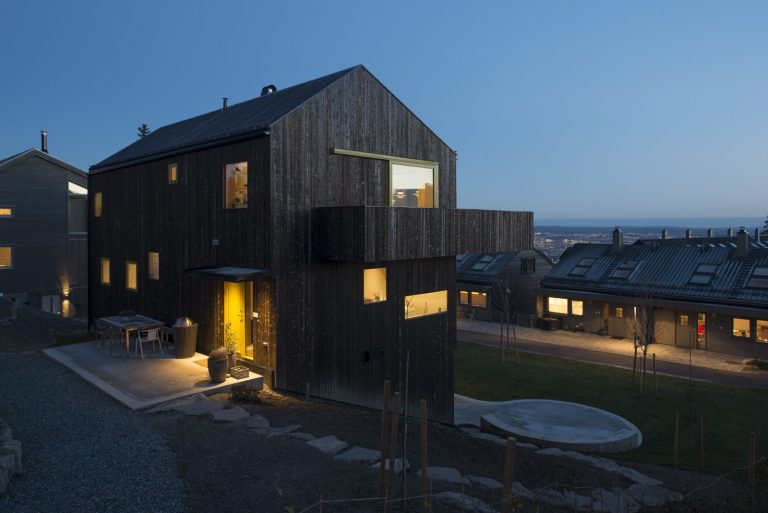
On a hill overlooking Oslo, in Holmenkollen, past the world-famous ski jump, the ski museum and the statue of King Olav V, you find a residential area with town houses and large detached houses. Because it is built on the very edge of Nordmarka, strict regulations have been set for both design, roof angle, size and color. Read how architects Schjelderup Trondal solved the complicated task of building a house on a hill overlooking the capital of Norway.

Nordmarka with its forests is a popular site for hiking, biking and skiing, and most of the forests are protected, so it is not possible to obtain building permits for houses or cabins. The buildings on this area are therefore relatively massive. The living rooms in the Schjelderup Tronsdal’s single family house are therefor on the top floor, high up below the maximum permitted height where the window locations ensure free lines of sight over the neighbors’ roofs.

Related: 24 Architecture Students Created New Life at Historical Farm in Northern Norway

House on a Hill Overlooking the Capital of Norway
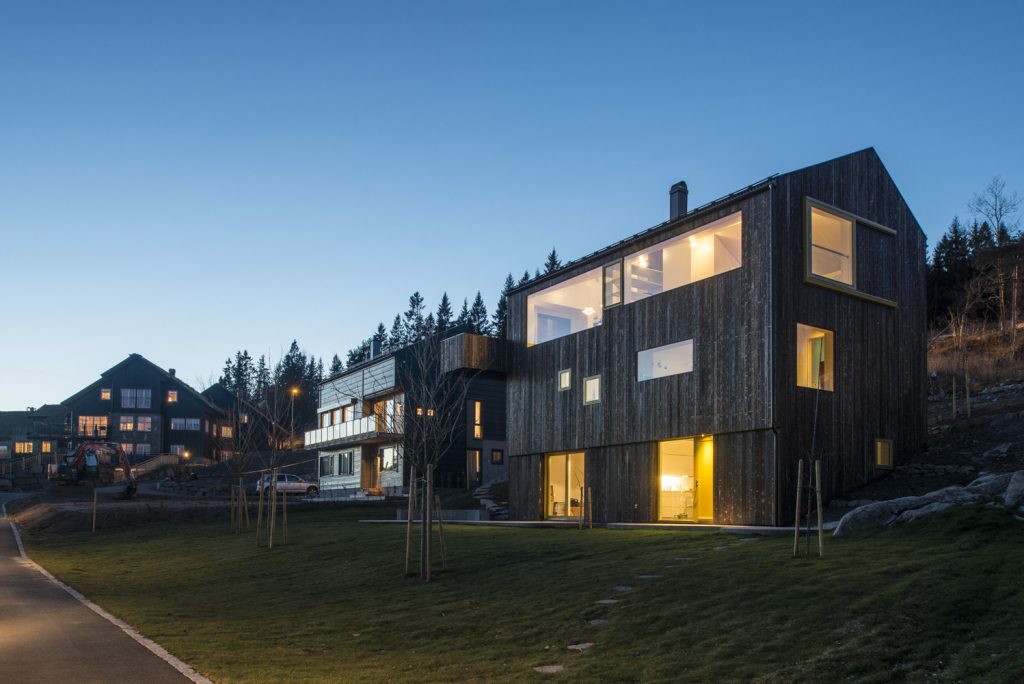
The living area is eqipped with windows as large as possible.

It also means that the site is situated at the highest point over the city with a formidable view over the urban landscape, the fjords and hills in the distant horizon.

Three-storey property
The three-storey property is partially embedded into the steep slope and is clad in planks of spruce, which have been charred and oiled to highlight notches and irregularities in the timber.

House on a Hill Overlooking the Capital of Norway
Inside House Linnebo

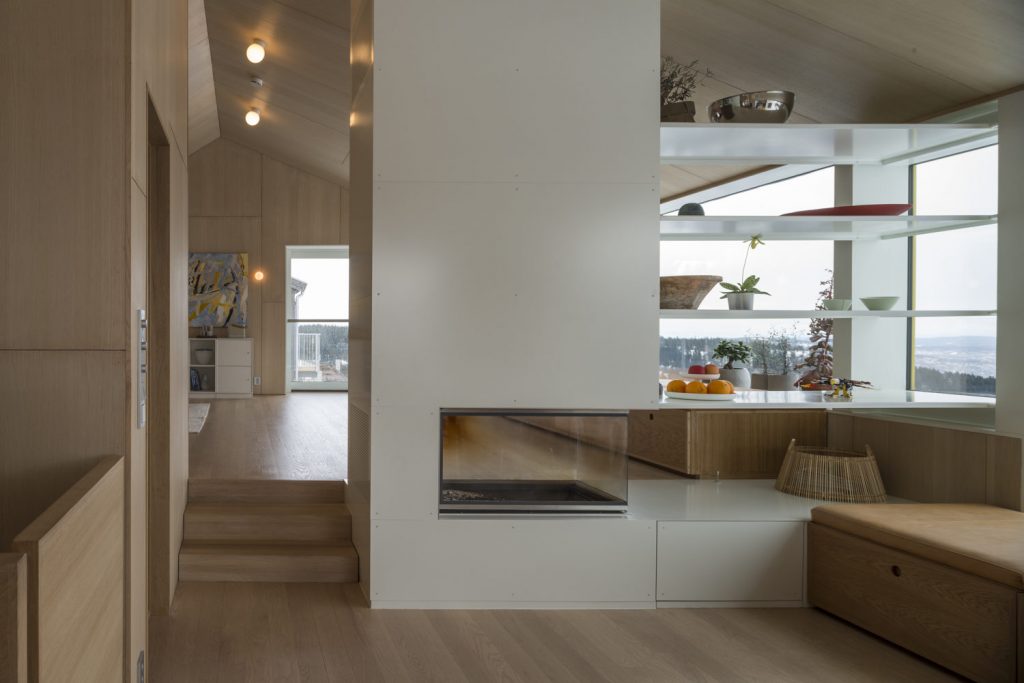
The top floor, which measures 11.7 meters in length, is only divided by a fireplace, a small storage room and a toilet that together create a natural separation between the two living rooms. The kitchen and dining room are placed a bit down from the main living area, partly because of architectonical differentiating of the floor, but also to fine tune the view in the most probable sitting positions in each area to frame the view with as large windows as possible, and at the same time to “hide” the massive developments just in front of the house from the great view. The dining area is similarly leveled for dining chair sitting height.

House on a Hill Overlooking the Capital of Norway
The top floor, which measures 11.7 meters in length, is only divided by a fireplace, a small storage room and a toilet that together create a natural separation between the two living rooms

Related: Spectacular Architecture in the Norwegian Ocean Gap

Well balanced character
Large panels of glazing on both of the house’s gabled ends allow cross-ventilation through the living space from east to west. One is a window, while the other is a sliding door that provides access to a narrow spruce-clad balcony.

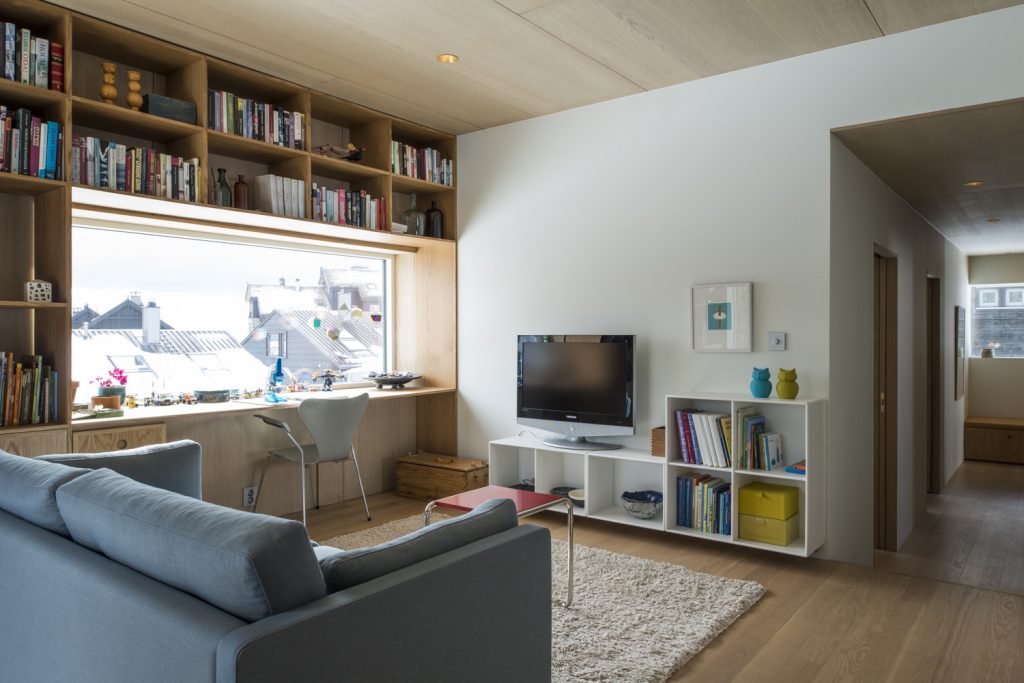
All surfaces in prioritized areas are clad with oak, either as solid floor boards or plywood boards, all with same surface treatment – white pigmented wax oil. The materiality gives the clean space dimension. Fireplace, kitchen and all main furnishing are site made by skilled craftsmen in oiled oak and white lacquered aluminum and painted fiberboards.

Related: Japanese-Inspired Summer House in Oslo

“The facades are perhaps monotonous, but at the same time well balanced to reflect its character and inner life,” explained architects Stian Schjelderup and Øystein Trondahl.

House on a Hill Overlooking the Capital of Norway
The building is situated at the highest point over the city with a formidable view over the urban landscape, the fjords and hills in the distant horizon

Strict regulations
The entrance floor is compact, with bedrooms and bathrooms stacked in the north-eastern and south-western corners and with a fluid space from the hallway diagonally through to a family room in the end and a square window towards the local trees and hills of Vettakollen. All bedroom- and secondary furnishings are site made from colored Valchromat MDF.

«There was a conscious desire to stay within the regulations with this house, even if they are strict,” says architect Schjelderup. “We are particularly pleased with the top floor, where the view is formidable over the big city and the fjord landscape,» he adds.

The house was built in 2015.

House on a Hill Overlooking the Capital of Norway, text provided by the architects

All images © Jonas Adolfsen

Scandinavian Poor Man’s Asparagus

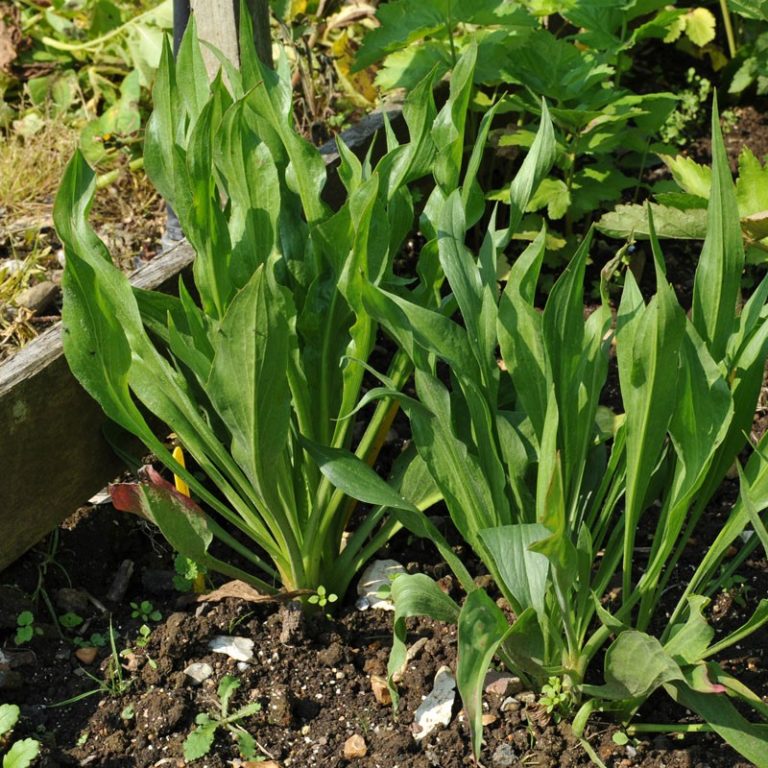
Scorzonera and salsify are not very much in use today but were formerly an important part of bourgeois cooking. It has been grown in Sweden since the 17th century, although at first it was only grown in the gardens of aristocrats. It acquired the name fattigmanssparris (poor man’s asparagus), because when cooked it looks and tastes like white asparagus. Read more about Scandinavian Poor Man’s Asparagus.

Svartrot, as it is called in Swedish, has a special buttery texture and a pleasant taste reminiscent of lamb lettuce. Found wild as escapees from cultivation, they are not indigenous to Scandinavia. It belongs to a huge genus, and other plants from it are eaten in similar ways elsewhere.

Related: Scandinavian Vegetables

Scandinavian Poor Man’s Asparagus
Svartrot, as it is called in Swedish, has a special buttery texture and a pleasant taste reminiscent of lamb lettuce

How it grows
Salsify has beautiful purple blooms, opening in the morning and closing by noon. Scorzonera is similar, but with bright yellow flowers. They are generally grown as annuals, for the roots, but can be grown on as perennials, just for the leaves. It’s an art to grow the fine roots to perfection, as their extremely long, fragile roots need a very deep loam. They are, however, extremely hardy, and can even be harvested the spring after they are sown, or you can choose to use the young tuff of leaves and shoots for a salad.

Appearance and taste
Scorzonera can be 1m long, and up to 2cm thick, with a pitch-black, strangely dry skin. Salsify is paler and only 5cm long. Both have a high content of insulin, a sugar that will trick your taste buds into believing that anything you can eat and drink with them is extremely sweet. The taste is very different from other roots, as they are not sweet and seldom mealy, but retain their shape, and certain juiciness when cooked. They have a deliciousness not found in other roots, which is done justice by the recipe below.

Related: Scandinavian Beetroot

The roots’ taste is a little like a day at the beach, and in fact salsify is sometimes known as oyster plant. Actually, the oyster taste is much more prominent in young borage leaves, hence its inclusion in the oystered vegetables.

Buying and storing
Both must be freshly dug, with no soft spots, and must not be bendable. They can, however, be restored in cold water. They keep for a long time wrapped in wet newspaper in the fridge.

Culinary uses
Both go well in soups, pies, salads, baked, in a gratin, or marinated but they are not good raw, or boiled and mashed.

Both salsify and scorzonera will secrete a white rubbery substance, which will turn red and taint anything it touches, including your fingers and the roots themselves. To avoid this, handle them with gloves, and put the roots in a bowl of cold water with a drop of lemon juice, the second you have peeled them.

Related: Scandinavian Cucumber

Scandinavian Poor Man’s Asparagus
Grilled svartrot. Photo: Arla

Oystered vegetables

If you like the idea of eating molluses, but do not dare to eat them raw, this will be a gentle way of introducing them. Six oysters will go a long way, their intense sea flavor spreading over a seabed of vegetables.

1kg mussels
750g scorzonera or salsify (cleaned weight)
Salt
6 oysters
100g salted butter
1 bunch of very young borage leaves, chopped
1 bunch of flat-leaf parsley, chopped

for the cooking liquid

500ml hard cider
2 tablespoons sherry or cider vinegar
1 large sprig of thyme
4-5 red onions, quartered
4-5 garlic cloves, sliced
1 teaspoon black peppercorns

Serves 6 as a starter

Boil the cooking liquid for 5 minutes in a large saucepan.

Rinse the mussels and discard any that will not close, or are broken. Dump them into the pan and steam until they open, which will take just a few minutes. Lift them out with a slotted spoon, together with the onions, and set aside, discarding any which are still closed. Remove half of the shell of each mussel if you have the time.

Try scraping the bottom of the pan if it feels like there is sand in it, poor off the liquid very gently, leaving the sand behind. Wash the pan, then pour the liquid back in and continue. Bring the liquid back to the boil and reduce to almost nothing. Peel the roots and cut into bite-sized pieces. Boil until almost tender in salted water, then keep warm.

Shuck the oysters with a blunt knife, wearing thick gloves. Save every drop of the juice inside them. Chop the oysters. Whisk the butter into the sauce and stir in the roots, mussels, oysters, and juice from the oysters. Season with salt if necessary. Serve with the chopped herbs.

Scandinavian Poor Man’s Asparagus, written by Tor Kjolberg

The Father of Eskimology

Greenlandic–Danish polar explorer and anthropologist Knud Johan Victor Rasmussen (1879 – 1933) was called the “father of Eskimology” and was the first European to cross the Northwest Passage via dog sled. He remains well known in Greenland, Denmark and among Canadian Inuit.

Knud Rasmussen was born in 1879 in Ilulissat, Greenland, to a Danish missionary and his inuit-Danish wife. He grew up among the Kalaalit, learning to speak Kalaallisut, hunt and drive dog sleds. He was later educated in Lynge, North Zealand.

The Father of Eskimology
Knud Rasmussen in Thule. Photo: Visit Denmark

Related: The Voyages of a Modern Viking

Rasmussen embarked on his first expedition from 1902 – 1904, the Danish Literary Greenland Expedition, to investigate and document Inuit culture. Afterwards he went on a speaking tour describing his findings and, in 1908, he married Dagmar Andersen.

In 1910, he founded the Thule trading station in Cape York, Greenland with his friend Peter Freuchen, which became the starting point for Rasmussen’s seven polar expeditions from 1912 – 1933. The trips were very dangerous – explorers could freeze or starve to death, or be crushed by ice. Two crew members died on the second expedition, and Rasmussen was once attacked by a walrus.

Related: The Viking Mystery on Greenland

The Father of Eskimology
Two fishermen working near the front of the Knud Rasmussen glacier in East Greenland. Photo: Polar research and policy initiative

The aim of the treks was varied, from collecting more information on the inuit to trying to establish whether a water channel existed between Greenland and Peary Land (it does not). Rasmussen also became the first European to cross the Northwest Passage via dog sled.

Related: Can You Name the World’s Largest Island?

Rasmussen died of pneumonia in 1933, contracted after he suffered a bout of food poisoning on the final Thule journey. He died in Copenhagen and is buried in the city’s Western Cemetery. The Rasmussen family home in Hundested has been preserved as a memorial.

The Father of Eskimology
Knud Rasmussen (right) and Lauge Koch (left). [Photo: Holger Damgaard, National Library of Denmark.
Knud Rasmussen in numbers:
He spent 2 years of failed auditions. From 1898 – 1890, Rasmussen tried to make it as an actor.

He spent 16 months travelling across North America by dog-sled on a single expedition.

He has donated 15,000 archeological and ethnographic objects to Copenhagen National Museum.

He died at age 54 after eating kiviaq (fermented auks in a dead seal) – a Greenlandic specialty.

The Father of Eskimology, written by Tor Kjolberg

Sweden – A Genuine Summer Wonderland

Enjoy the silence, listen to the sound of the birds and animals and smell the green season. Experience the blue skies of summer over rustling golden wheat fields swaying in the warm summer breeze. You should experience Sweden in summer – a genuine summer wonderland.

The rolling Swedish landscape is pricked with red poppies and blue cornflowers, and shimmering sweet-water lakes are surrounded by lush green trees. The diary cows are in the fields next to the popular red Swedish summer cottages. In the distance you may hear squeals of kids enjoying their summer vacation. Swedish forests, lakes and mountains are medicine for the soul.

Sweden – A Genuine Summer Wonderland
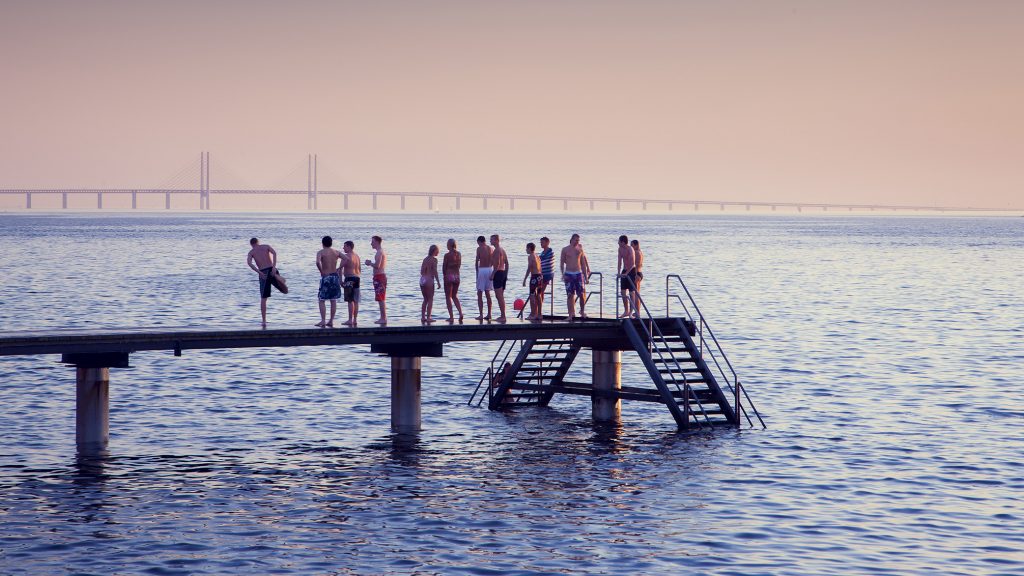
Swimming in Malmö. Photo: Sweden.se

Twilight time
In Sweden, the sky darkens briefly to twilight, then lightens again. The evenings know no darkness. No wonder, the Midsummer party is so essential for most Swedes. And the Swedish summer is brief and intense. The shibboleth of summer worshipping Swedes takes place in many forms.

Sweden – A Genuine Summer Wonderland
Bergaliv loft house. Photo: Martin Edström / Visit Sweden

Swedish National Flag Day
A relatively new celebration in Sweden is the National Day, 6th June. Historically, the 6th of June is remembered as the day King Gustav Vasa was crowned in 1523 which led to the formation of the state and constitution. However, it wasn’t until the 1900s this day became the Swedish National Flag Day after the dissolution of the union between Sweden and Norway.

Sweden – A Genuine Summer Wonderland
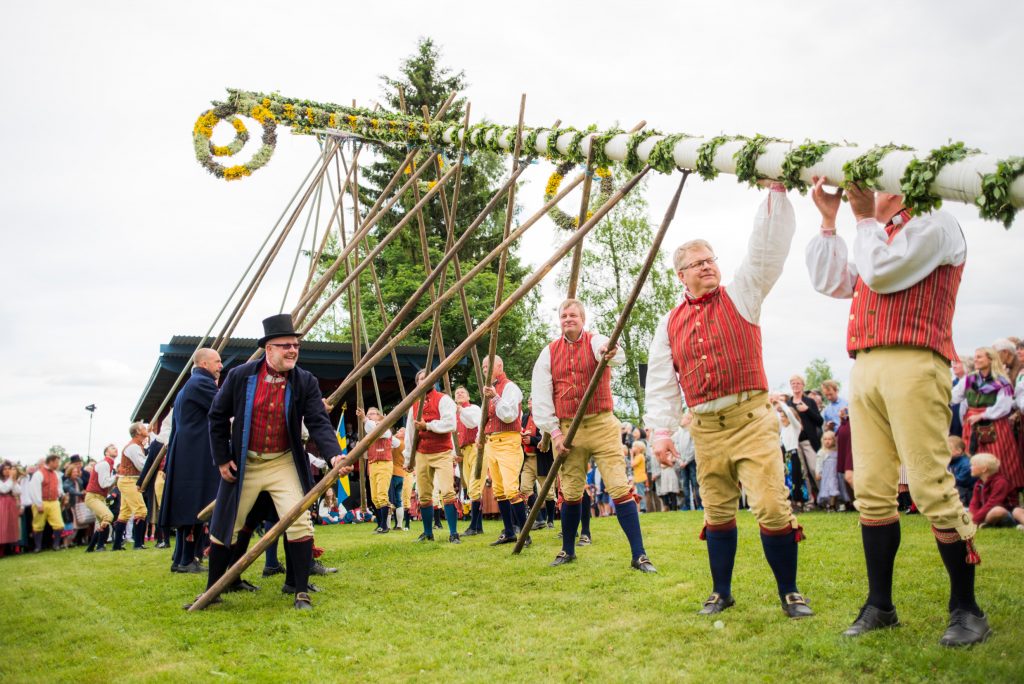
Midsummer in Dalarna. Photo: Per Bifrost / Visit Sweden

The Midsummer Day
The Midsummer Day has, however, been around for centuries. According to Sweden’s Nordic Museum, Midsummer celebrations originally developed from a Christian holiday for John the Baptist, which took place on 24 June. But in 1953, it was decided that the ‘official Midsummer’s Day’ should always be on the Friday closest to June 24. Over this weekend, thousands of Swedes head for the country to celebrate the longest day of the year at an open field. Midsummer are decorated with leaves and flowers, flags and fetishes. Happy people are dancing and singing around the pole, playing traditional games and consuming enormous amounts of food and drink.

Midsummer’s Day is a true celebration of mother nature, fertility and family. More recently, midsommar is the start of the traditional 6-week summer holiday that many Swedes take in July. The absolute mark of summer in Sweden.

Sweden – A Genuine Summer Wonderland
Red cabin. Photo: Doris Beling / Visit Sweden

Swedish red cottages
It’s time to go far away from the cities – preferably to a red summer cottage surrounded by mushrooms, blueberries, lingonberries, cloudberries and smultron (forest strawberries). Late evenings often end with a swim in the sea or a sun-warmed lake. Sweden is surrounded by water both inland and along the coast. So don’t forget to pack floaties for your kids because they won’t be able to resist the water. So don’t forget to pack floaties for your kids because they won’t be able to resist the water.

Sweden – A Genuine Summer Wonderland
Traditional crayfish party. Photo: Patrik Svedberg / Visit Sweden

Crayfish parties
Another summer tradition in Sweden is the crayfish party. Like the name implies, the guests of honor at this party are the crayfish which are devoured by the dozens. This tradition began in the late 19th century, when heavy exportation threatened Sweden’s crayfish populations. A ban on harvesting was instituted, and it ran until August – when the locals celebrated its end by throwing crayfish feasts.

Autumn leaves
In northern Sweden, autumn arrives early. In some areas, leaves turn yellow, orange and red as early as August.

In Gotland, early August means Medieval celebrations, and in Stockholm it means outdoor living, enjoying the cafés, outdoor dining, excursions to the Archipelago and picnics in one of the many parks. Stockholm’s water is among the purest found within a world city, and it is completely safe to swim and fish in. So, Sweden is a genuine summer wonderland.

Sweden – A Genuine Summer Wonderland, written by Tor Kjolberg

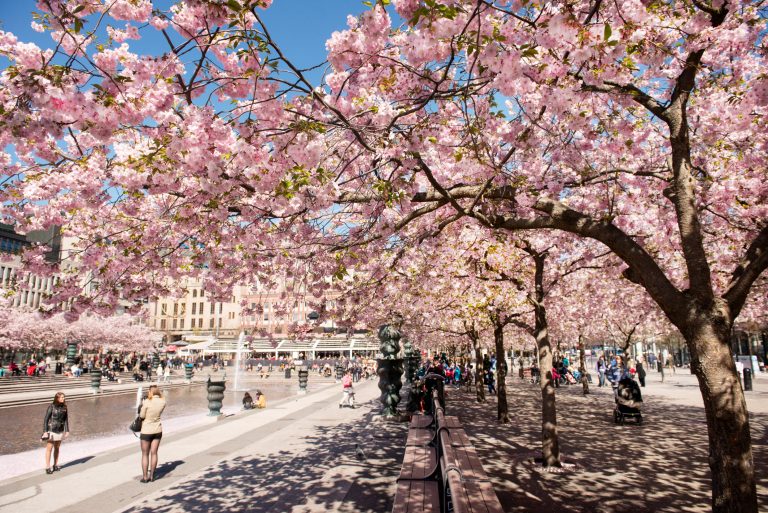
Feature image (on top) Photo: Kungsträdgården Photo: Cecilia Larsson / Visit Sweden

6 Scandinavian Health Philosophies We Should All Embrace

Scandinavian countries are regularly ranked at the top of the healthiest and happiest countries in the world. So, what’s their secret? How do millions of people living with little sunlight and in some of the coldest regions become so physically, mentally, and emotionally healthy? Here are six Nordic health philosophies you can incorporate into your daily routine to improve your health, happiness, and contentment with life. Learn more about the 6 Scandinavian Health Philosophies We Should All Embrace.

The Scandinavian Diet
Health specialists everywhere agree that no diet is the best diet – and Scandinavians have embraced that philosophy wholeheartedly. As the name suggests, the Nordic diet simply focuses on eating food that is locally sourced and traditionally consumed in Scandinavian countries. Staples from the Scandinavian region include:

Whole grains like rye, barley, and oats
Berries and various fruits
0Legumes and root vegetables like carrots, potatoes, and beans
Fish like herring, mackerel, and salmon

6 Scandinavian Health Philosophies We Should All Embrace
The Nordic diet simply focuses on eating food that is locally sourced and traditionally consumed in Scandinavian countries. Photo: Møllers

You won’t see much sugar, red meat, or processed foods in the Nordic diet. While those types of food in moderation don’t cause poor health, followers of this eating philosophy tend to focus on plant-based meals. If you want to shift to the Nordic diet, start with small changes in your diet so you have a better chance of sticking to the new lifestyle. Easy switches could include slowly cutting down your sugar intake, swapping out a meal with red meat for fish, or simply eating more vegetables throughout the day.

Get Heated
Everyone loves a good sauna session. Popular across Sweden and Norway, heated thermal baths are an excellent way to relax and revitalize yourself. They consist of a range of hot, cold and scented waters, all with different health-enhancing properties. The health benefits of regularly going to the sauna are plentiful. Studies have shown that a quick 30-minute sweat session in a sauna reduces blood pressure and even increases your heart rate to what it would be during a moderate workout. They’re also great for relieving stress and sweating unhealthy toxins out of your body.

6 Scandinavian Health Philosophies We Should All Embrace
Heated thermal baths are an excellent way to relax and revitalize yourself. Photo: Visit Telemark

Make sure you take a cold shower or hop into an ice bath after a sauna session. This helps to close your pores and also boosts your body’s circulation since the cold water forces your body to conserve heat. Not only does this help your skin’s texture health, but it also gives your cardiovascular system an extra boost.

Getting Outside
A powerful part of the Scandinavian way of life is “friluftsliv”. Loosely translated, it means “free-air life” and focuses on living a healthy lifestyle that involves enjoying your place in the natural world. Practicing friluftsliv includes spending more time outdoors and in nature than other countries often do.

6 Scandinavian Health Philosophies We Should All Embrace
There are many health benefits to incorporating outdoor time into your daily routine. Photo: UiT

There are many health benefits to incorporating outdoor time into your daily routine. Not only does the fresh air do wonders for your lungs, your cardiovascular system and mental health also benefit from the exercise and mental reset.

Daily Movement
Scandinavian countries have mastered the morning commute and daily workouts. Biking to work and being active throughout the day is thoroughly ingrained into the Scandinavian culture. Almost 30 percent of Danes and Swedes who live in cities bike to and from work on a daily basis, and it’s common to see friends get together for a yoga class instead of heading to the bar. Exercise is such a big part of the Nordic lifestyle that workplaces often also make efforts to get employees up and moving during the day.

6 Scandinavian Health Philosophies We Should All Embrace
Biking to work and being active throughout the day is thoroughly ingrained into the Scandinavian culture. Photo: Nextbike / Unsplash

If you want to incorporate the Scandinavian appreciation for daily movement into your life, you don’t have to change everything about your routine. Small changes like going on a hike during the weekend with friends, riding your bike to work once a week, or going to a yoga class can all help you get you moving and appreciating your body.

Having Less
Scandinavian design is all about open spaces, minimalist and functional furniture, and bright homes. They don’t clutter their homes with unnecessary items—instead they only bring in furniture and objects that they will actually use and appreciate.

6 Scandinavian Health Philosophies We Should All Embrace
Scandinavian design is all about open spaces, minimalist and functional furniture, and bright homes. Photo: IKEA catalogue, spring 2020

This doesn’t mean you have to strip your home to bare essentials and get rid of all your personal belongings to start incorporating Nordic minimalism into your life. Just start with a single object in your home. Take a page from minimalist Marie Kondo’s book, pick up an object you have, and ask yourself: does it spark joy? If the item in your home doesn’t spark joy, donate it. Decluttering your home will help you declutter your mind and help you spend time focusing on things in your life that actually do spark joy.

6 Scandinavian Health Philosophies We Should All Embrace, read further

Embracing Community
Scandinavian countries don’t get a lot of sunlight—but the long, dark days and freezing temperatures don’t seem to get them down. Study after study has ranked Nordic countries as having some of the happiest people in the world. Their appreciation for and involvement in their local community may be a big part of their high happiness levels.

6 Scandinavian Health Philosophies We Should All Embrace
Study after study has ranked Nordic countries as having some of the happiest people in the world. Photo: YouTube

People living in Scandinavian countries lean on their communities and friend groups much more than other countries do. Spending time with yourself is important, but it’s also important for your mental and emotional health to carve out regular time with friends. That support system is crucial to getting through the difficult times in your life and having a happier overall mindset.

6 Scandinavian Health Philosophies We Should All Embrace
Emma Davis

6 Scandinavian Health Philosophies We Should All Embrace, written exclusively for Daily Scandinavian by Emma Davis.  As true digital nomad, Emma spends her time writing and traveling the globe in pursuit of her next great adventure. From travel guides to career advice, she hopes to help readers see the world as she experiences it – helping others craft a life where they can work hard and play often. Join the journey @Emma_G_Davis.

Norway’s World-Famous Composer – Now With Lyrics in English

Most Western countries have their “national composer”. The Scandinavian countries are no exception. Danes have Christian Lundby, Sweden has Hugo Alfvén and Norway, obviously Edvard Grieg. People around the world love the music of Stephen Foster, called the father of American music. With respect to all the great composers, not mentioned here, we’re focusing on Edvard Grieg in this short article because his beloved Norwegian songs now, for the first time, has been recorded with English lyrics. Learn more about Norway’s world-famous composer – now with lyrics in English

The Edvard Grieg Society of Minnesota is behind the first professional recording of songs by Edvard Grieg, sung in English. The songs were recorded at the Landmark Center in Saint Paul in the summer of 2020 by the Norwegian-American soprano Melissa Holm Johansen and American pianist Stephen Swanson. The new English translations have been made by the celebrated Grieg scholar, Dr. William H. Halvorsen.

Norway’s World-Famous Composer – Now With Lyrics in English
The Edvard Grieg Society of Minnesota is behind the first professional recording of songs by Edvard Grieg, sung in English

Related: 150th Anniversary of Norway’s Peer Gynt

The Edvard Grieg Society of Minnesota (EGSMN) was founded in 2005 to promote the study and performance of Norwegian composer Edvard Grieg and his Nordic counterparts. Grieg-scholar William Halvorsen has translated the nearly 200 songs Grieg composed into English.

Grieg aspired to reach an international audience and realized that to achieve this, he needed to get his Norwegian song texts translated into other languages. So, the songs have been translated earlier, in 1875 into German. Grieg was fluent in German and was able to work with German translators until they achieved a result that was acceptable to him. These translations have been the source for translations into other languages. Halvorsen’s translations, however, are a result of his roots to the Norwegian language and are translated from the original Norwegian lyrics.

Norway’s World-Famous Composer – Now With Lyrics in English
Grieg-scholar William Halvorsen has translated the nearly 200 songs Grieg composed into English. Photo: EGSMN

Related: Lunch Concert at Troldhaugen

“I think it’s very important that someone who could have easily sung it in Norwegian chose to sing it in English in order to reach a new audience,” said Dr. Halverson, who was first commissioned to translate the lyrics way back in 1988.

Edvard Grieg introduced the sound of the Nordics to the rest of the world. Norway House and EGSMN exist to bolster a continued appreciation for Norwegian and Nordic music.

Related: Beautiful Bergen: Its Art and Artists

Norway’s World-Famous Composer – Now With Lyrics in English
Edvard Grieg Museum Troldhaugen. Photo: Vard

“Edvard Grieg: Songs From the Heart” features 25 Grieg songs recorded in English for the first time. You can order the CD here.

Norway’s World-Famous Composer – Now With Lyrics in English, written by Tor Kjolberg

Feature image (on top): Norwegian-American soprano Melissa Holm Johansen and American pianist Stephen Swanson. Photo: EGSMN

A Norwegian Artist Reviewing the Magic of Norwegian Stone

Norwegian artist Kaja Solgaard Dahl was trained at Beckmans College of Design in Stockholm and at Ecal in Lausanne. She began working with interior design and furniture, but today, she has fallen in love with Norwegian stone – and the dirty work of making magic out of this raw material. Read more about the Norwegian artist reviewing the magic of Norwegian stone.

At the present time, Kaja says she is working with larvikite (from the Sandefjord/Larvik area), masi (from Finnmark), Norwegian Rose (marble from Fauske) and will be adding romeporfyr (from central Norway).

A Norwegian Artist Reviewing the Magic of Norwegian Stone
The Stoneware Ritual, sculpture by Kaja Dahl

“My works are about sensory and contrasts between the raw and the processed,” Kaja explains. “Over the last three years I have focused more and more on stone and think this is an exciting material to work with. It opens opportunities to work with larger design projects for landscape architecture, sculptures for galleries, interior products as well as small jewelry design objects.”

You may also like to read: Columna Transatlantica in Norway

A Norwegian Artist Reviewing the Magic of Norwegian Stone
“Over the last three years I have focused more and more on stone and think this is an exciting material to work with,” says Kaja. Photo: Tor Kjolberg

Kaja Solgaard Dahl is a pleasure to talk with and she tells me that most of her present projects are based on different forms of collaboration – that being producers, craftsmen or meetings with other creatives. Over the past year she has established a close collaboration with a stone workshop in Sandefjord.

“Together with them, I can take on larger assignments in stone and I can develop my own products and sculptures together with skilled craftsmen. In addition, I have had a couple of projects where I have collaborated with my mother who is a jewelry artist,” she says.

A Norwegian Artist Reviewing the Magic of Norwegian Stone
Cutlery, by Kaja Dahl

Related: Friends of an Artist

Why have you chosen to specialize in Norwegian stone?
“In recent years, I have had the opportunity to work with stone in various ways both as a designer and sculptor. I have always been fascinated by nature’s raw materials and the more I work with stone the more I discover. We have an incredible number of exciting natural stone in Norway which is also more sustainable to use locally,” Kaja explains.

Vases from Fram, Oslo. Photo: Inger Marie Grini

What is the joy of working with Norwegian stone?
“What I love in my work is the possibility of learning new processes, and design as an endeavor in itself. The greatest joy is probably to go on a journey of discovery and select ingenious rocks in the quarry – and making something completely unique out of them every time is endlessly fascinating.”

Read more about the Norwegian artist reviewing the magic of Norwegian stone.

What is your biggest source of inspiration – what triggers you?
“Crafts, nature and various materials. In addition, it is exciting and inspiring to meet people with different skills and different perspectives.”

A Norwegian Artist Reviewing the Magic of Norwegian Stone
Fragrance, sculpture by Kaja Dahl

You may also like to read: Norwegian Designer Creates Minimalist Jewelry in Silver

Are there special things to be aware of when it comes to turning stone into an art object?
“Stone is a natural material so it can be unpredictable; something unexpected can be lurking in the middle of it. On top of that, more than 100-year-old stonemason tools are still standard today, while at the same time we use modern tools and technology that provide completely new possibilities. My goal in all my projects is to transfer old traditions into contemporary objects and design. My interpretation and processing are based on my unique approach to the world, and this can result in art”

Can you tell us a little about the creative process? Do you have any systems (habits) that help you get started?
“I think of being creative as a practical thing. I don’t want to idealize it. Habits that help me get started in a workday, where you are both boss and employee, is a basic combination of good coffee, dressing for work (I never work in sweatpants or pajama), walking, calling or meeting people for lunch and to plan your week with lists and calendars.

My personal creative process always looks different from project to project, but is a lot about reflecting, sketching, doing research in various forms, seeking experiences relevant to the project, learning new things and tactile sketching; contact with materials is incredibly important in my process.”

Do you have your studio at home, and if so, what is it like to combine work and private life?
“I work in different places. I have previously been a consultant and worked in Paris and Bangkok, among other places. I have also traveled to Cape Town and New York to create projects. Now, I have a studio and workshop in Oslo, but when I work with stone, I go to Sandefjord. In addition, I have a home office, which has always been part of the way I work as a designer. Many artists and creatives have long experience in working from home and could probably be some of the best advisory consultants for large companies that have introduced this kind of workday during the pandemic.”

A Norwegian Artist Reviewing the Magic of Norwegian Stone
Kaja Dahl working with larvikitt

Do you feel that being an artist is a lonely job?
“On the contrary, I’m rarely working by myself. All different projects often involve meetings with new people. When I have assignments that require more competence than my own, I have some permanent consultants abroad who I work with. We skype or email and act like nerds over curves and millimeters. In my opinion, the idea of the artist as a lonely person standing alone in a large bright studio and painting is outdated. Very few have such luxury and with the creative career choice in our time comes a lot of project management, application writing, accounting, PR and sales, own production, research and collaboration.”

What three things do you prioritize when not working with art?
“Be on the move and being social, sleep and nature.”

Have you always been creative?
“Yes, there was a lot of creativity at home when I was growing up. I am lucky to have grown up in a family where creativity was encouraged and seen as a valuable skill.”

Has it been (and is it) a difficult journey?
“It hasn’t always been easy, but as more and more people value my skills it’s exciting. It is important to take decisions as you go, being an optimist and perhaps a little naive. This is my 6th year after graduation. They say it takes five years to stand the acid test, and here I am, so I believe I have made it – so far.”

In later years, Kaja Solgaard Dahl has also had teaching assignments. She has just completed her second lecture assignment in crafts design for Hjerleid School of Craft, where the students learn about traditional crafts like woodcarving and furniture carpentry.

“ It’s great that I’m able use my specialization arrived from my master’s from Ecal,” says Kaja. “the master called ‘Design for luxury and craftsmanship’ was just about using crafts in contemporary ways. Teaching can be very rewarding when you get the opportunity to inspire others. This is more or less the responsibility of all artists.”

Kaja is planning to work with stone in Sandefjord this summer. That includes new Larvik vases for the Norwegian company Fram Oslo, sculptures for QB Gallery in Oslo and several unique stone vases in Norwegian Rose marble.

Together with Sandefjord Stenhuggeri, she is also planning an exciting collection in stone that we will be exhibited 2021/2022. She will not disclose what it contains, but says it will be unique and different.

A Norwegian Artist Reviewing the Magic of Norwegian Stone, Kaja Solgaard Dahl interviewed by Tor Kjolberg

All images © Kaja Dahl, except where otherwise noted