
The Silver City in Norway

A legend has it that two shepherd children discovered silver in a valley in the Kongsberg area, Norway in 1623. When the Kongsberg Silved Mines were closed in 1958 it was the largest mining field in Norway from pre-modern time, with more than 200 different mines. At its peak in 1770, 4,000 workers were engaged there. Visit the silver city in Norway. The silver mines are still open for tourists.

The city of Konsgsberg (meaning ‘the mountain of the king’) lies just a little more than one hour by train from Oslo. The Silver Mines in Kongsberg were once the place where all the silver was mined to produce coins for the whole country. Today, the city still has an eerie energy that brings Middle Earth to mind.

The Silver City in Norway
The Silver Mines in Kongsberg were once the place where all the silver was mined to produce coins for the whole country

Related: Norway’s Mining Past

Silver mining
Between 1623 and 1957, silver mining made Kongsberg Norway’s second largest city for a brief period. The city produced over a million kilograms of the world’s most coveted form of silver, the native wire silver. Today, you can join a train ride that takes you, 342 meters below the surface and 2.3 kilometers into the deepest mountains through stopes, adits and shafts- The “Fahrkunst”, a mine elevator built in 1881 is just one of many attractions to experience on a guided tour which takes about 1,5 hours.

Kongsberg’s Mining Museum is in fact five museums housed under the same roof and there you can see one of the biggest raw silver collections in the world, learn the history of coinage and even brush up your knowledge on Norwegian minerals in a range of extraordinary presentations. The exhibitions include the world’s largest crystalized silver exhibition, the Ski exhibition, The Royal Norwegian Mint Exhibition, the Kongsberg Industry exhibition and the Norwegian Minerals and Mining exhibition. The Mint Collection holds the Norwegian central bank’s collection of coins and medals dating back over 300 years.

Related: The Cobalt Works and Mines in Norway

The Silver City in Norway
The Silver Mines,are located 8 kilometers west of Central Kongsberg

The Stone Chambers
Be sure to be dressed warm, for the temperature in the mines is just 6 degrees Celsius. The Stone Chambers, built in 1943, was once a storage room for the National Archives of Norway with 2,000 shelf meters of documents. From July 1943 to June 1945 a dozen people had their daily work there. Today, it is a banquet hall with a capacity for 200 people used for events, concerts and company get-togethers.

The Silver Mines, located 8 kilometers west of Central Kongsberg, are open seven days a week from May to September.

Related: The Silver Treasure in Bergen, Norway

The Silver Mines, located 8 kilometers west of Central Kongsberg
The mines produced over a million kilograms of the world’s most coveted form of silver

The Activity Square
Outside the Silver Mines, the Activity Square provides fun and educational activities where children can learn and take part in the tasks of a traditional miner. You can make your own coin in the same technique as was used in Kongsberg 300 years ago. With a hammer and chisel you can “excavate” minerals that are yours to keep.

There is also a popular spot for bathing, a café (Sakkerhuskroa) and a museum shop in “Sakkerhusene”. Sakkerhusene was traditionally the shelters used by the miners during the week. These magnificent buildings were built by architect Georg Andreas Bull between the period 1867 and 1874. Sakkerhuskroa is open daily from 18 May to 30 August, and during weekends in September.

The Silver City in Norway
Take a mining safari in Kongsberg

Beer as cold as your ex’s heart
Kongsberg Bryggeri is a small microbrewery hidden in an alley. Once they had a sign declaring that they served “beer as cold as your ex’s heart”. The beer selection is indeed cool and not to be missed. Groups should definitely arrange a beer tasting.

Cultural center
Krona Kino in Kongsberg is part of a cultural center and also a part of the local university. Going to watch a movie there feels almost like you just stepped on campus. When it comes to your viewing experience, however, the shows are just as professionally as in any good cinema in the world with 4D movies, latest releases and all.

The Silver City in Norway
Today, Kongsberg is Norway’s leading industrial technology enterprise in a number of fields within the maritime, defense, aerospace, oil, gas and digitalization sectors

The Silver City in Norway
In 2014 Kongsberg celebrated 200 years in business, emerging as a pioneering global technology provider. Today, Kongsberg is Norway’s leading industrial technology enterprise in a number of fields within the maritime, defense, aerospace, oil, gas and digitalization sectors.

In April, Kongsberg Maritime parent company Kongsberg Gruppen, following European Commission approval, completed the acquisition of Rolls-Royce Commercial Marine (RRCM). Officially part of Kongsberg Maritime, RRCM will operate under the Kongsberg brand and the Kongsberg Maritime legal entity.

The Silver City in Norway, written by Tor Kjolberg
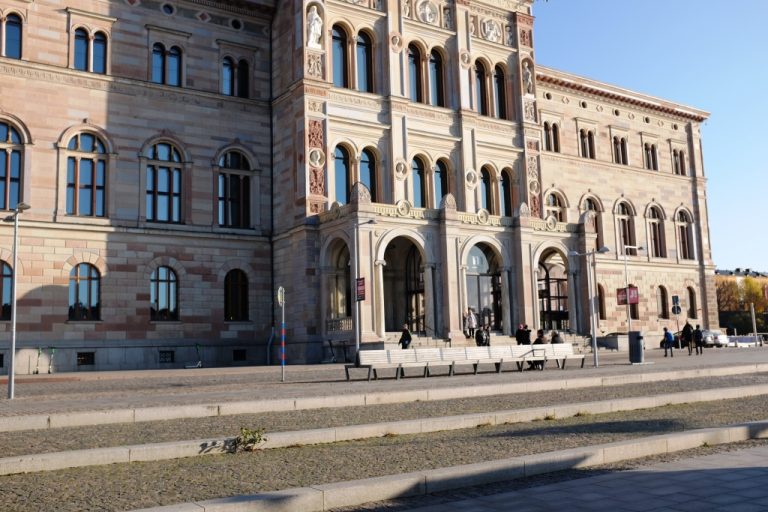
Nationalmuseum in Stockholm in a New Light

Nationalmuseum in Sweden opened its doors for the first time in 1792 in the Royal Palace, Stockholm. In 1866 it was moved to the current building at Blasieholmen was considered one of the most modern museums in Europe. 150 years later, however, the museum was outdated and the Swedish government decided to close the museum for five years to undertake a renovation project. Today, you can experience the Nationalmuseum in Stockholm in a completely new light.

Last year, Sweden’s museum of art and design, Stockholm reopened in a new light. Daily Scandinavian has interviewed senior curator Dr. Helena Kåberg, who took an essential part in the process and has also edited and co-written the book, Nationalmuseum in a New Light.

Nationalmuseum in Stockholm in a New Light
Dr. Kåberg tells us that the biggest challenge of the renovation process, was to develop the building for modern requirements and needs

Dr. Kåberg tells us that the museum had never been renovated and the biggest challenge of the renovation process, which started in 2014, was to maintain the 150-year-old cultural building and develop it for modern requirements and needs,  including climate, lightning, logistics and extensions.

Related: The Island of Skeppsholmen in Stockholm

Nationalmuseum in Stockholm in a New Light
The collections comprise of painting, sculpture, drawings and prints from 1500-1900 and applied arts, design and portraits from early Middle Ages up until present day.

A demanding task
In October last year, the museum building designed by the German architect Friedrich August Stüler, had undergone a wide-ranging renovation and refurbishment carried out by the National Property Board Sweden.

Related: Sweden’s Largest Art Museum Reopens after 5 years of Renovation

Nationalmuseum in Stockholm in a New Light
It was important to find the right colors on the walls to present different paintings in the best possible way

“Collaborating with architects as well as the National Property Board Sweden has been a demanding task,” says Kåberg, “but it has been a constructive process to get an old building to function as a modern museum able to offer diverse activities as well as exhibitions. The construction of technical installations has been a challenge in itself, but we are proud of the result», she adds.

Related: Sweden’s Largest Art Museum Reopens After 5 Years of Renovation

Nationalmuseum in Stockholm in a New Light
Even if the color scheme is new, it has been inspired from the Stühler’s color scales from the 1860s

From 1,700 to 5,300 pieces of art
5,300 cubic meters of stone carved out from the ground have been removed and given place for both technical rooms buried in the rock under the museum and raised the capacity to display works from about 1,700 pieces to 5,300. Now, the National Museum can have up to 2,000 people in its premises at the same time, twice the previous number.

Kåberg emphasizes that the most important part of the whole process has been to present the artworks in the best possible way. For most paintings, it’s essential to consider the background as part of the composition. Therefore, it was important to find the right colors on the walls to present different paintings in the best possible way. Even if the color scheme is new, it has been inspired from the Stühler’s color scales from the 1860s, and in our view the result has become a fine-tuned balance of creativity and elegance.

Nationalmuseum in Stockholm in a New Light
The museum building designed by the German architect Friedrich August Stüler

Related: National Museum in Copenhagen – a Journey in Time and Space

Background colors and light
Deciding on the colors was, however, not an easy process, admits Dr. Kåberg.  In the 1800s, architects were more focused on colors other than white on the walls, and the cultural-historical views eventually gained a foothold.

Nationalmuseum in Stockholm in a New Light
The wide-ranging renovation and refurbishment h ave been carried out by the National Property Board Sweden

A background color is best suited to a particular type of images, while other colors emphasize others better. Combining paintings with sculptures and artefacts from the same period, has also proven to create environments that other museums can learn from.

The windows to the south atrium were covered by bricks in the 1960s and turned into an auditorium and a magazine. Other windows were covered from the inside. These windows have now been opened up, letting the light in. The atrium has been given new roofs and an impressive, enormous lift has been installed to take a large number of people and artworks up and down the three floors to simplify the logistic. Imagine an elevator big enough to host an opening party for the co-workers.

Nationalmuseum in Stockholm in a New Light
Climate, lightning, logistics and extensions have all been an important part of the renovation process

One million visitors last year
Since the opening last year, more than one million people has visited the Nationalmuseum compared to about previously 390,000 annually.

Nationalmuseum in Stockholm in a New Light
Dr. Kolberg beside one of the fire security solutions

«The future challenges», says Kåberg, “is to present more diversified exhibitions and attract a younger audience. This can be done by linking stories to exhibitions from different eras and thereby creating relevant conversation topics based on visual experiences».

Nationalmuseum In A New Light book-cover

National Museum in Stockholm Stockholm in a New Light
In the beautiful book, Nationalmuseum in a New Light, Dr. Helena Kåberg and other experts invite the reader to follow the entire process, from the founding of the Nationalmuseum and on through its early developments and the changes in the 20th century and the beginning of the 21st century. The book is richly illustrated with the original watercolor drawings of Friedrich August Stüler, archive pictures and newly taken photographs by Bruno Ehrs. This publication marks a milestone in the museum’s history. Nationalmuseum in a New Light is published in a Swedish as well as an English version.

The renovation has been financed by the Swedish government and some private funds.

All photos: Tor Kjolberg

Nationalmuseum in Stockholm in a New Light, Dr. Helena Kåberg interviewed by Tor Kjolberg

The Norwegian Lorck Schive Art Award

The sleepy town of Trondheim in Norway, with a population og less than 200,000 people houses an art museum called the Trondheim Kunstmuseum. In 1878, a year before his death, a local wealthy landowner, Christian Lorck Schive, established a trust, the Norwegian Lorck Schive art award, that decreed a percentage of all rental income from his local properties to support artists, centered around the local museum. He was said to own around 30% of the town.

The area owned by the trust is known as Bakklandet, on the east bank of the river Nidelva that runs through the center of Trondheim. Today, the area is home to sundry cafes, restaurants, craft shops and the like. Part of the rent funds the Lock Schive prize every second year.

The Norwegian Lorck Schive Art Award
Christian Lorch Schive

Norway’s biggest art award
The Lorck Schive art prize is Norways biggest art award. At NOK 500,000 (£38,000) it’s comparable to the UK’s Turner Prize. In 2015, Vanessa Baird was announced the winner of the Lorck Schive art prize.

In 2017, Vibeke Tandberg was the recipient of the prize, and this year, Eline Mugaas receives the Lorck Schive art award. Mugaas has, together with artist Elise Storsveen, since 2008 published the fanzine ALBUM. ALBUM is comprised of ubiquitous images culled from Scandinavian etiquette manuals, cookbooks, travel magazines, craft books, fashion magazines, and sex guides.

The Norwegian Lorck Schive Art Award
Eline Mugaas

The Norwegian Lorck Schive Art Award 2019
Mugaas has researched extensively on Norwegian artist Siri Anker Aurdal (b 1937) and thereby brought visibility to a body of work that had largely disappeared from art history. Currently, Mugaas is working on issue two of a series of five visual essays under the title Dyslexic Times.

This year’s committee has consisted of Heidi Ballet, an independent curator based in Berlin and Brussels; Per Formo, an artist who studied in Trondheim; and Maria Lind, a curator, writer and educator from Stockholm. Together they had the arduous task of whittling down four nominees to one winner.

Related: Wonderland in Trondheim

The Norwegian Lorck Schive Art Award
Trondheim kunstmuseum

Trondheim Kunstmuseum
Trondheim Kunstmuseum houses today a national collection of both modern and contemporary art that is almost 150 years old and provides great insight into the history of the country’s cultural legacy. The paintings by great artists, little known past the country’s borders, display scenes full of domestic interiors and gloomy weather.

Trondheim, which was once the medieval capital of Norway, has now cemented its place as Norway’s second city of art. The Lock Schive Prize at Trondheim Kunstmuseum is on show until 19 January 2020.

The Norwegian Lock Schive Art Award, written by Tor Kjolberg
The 2019 Nobel Peace Prize Exhibition in Oslo

0

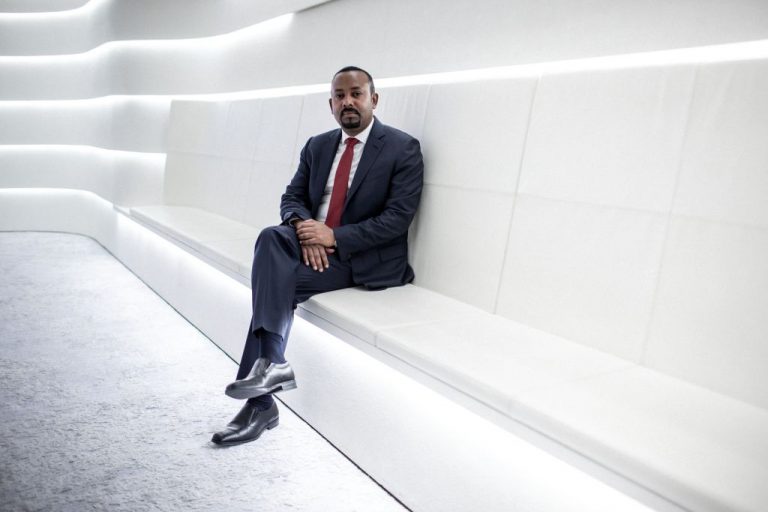
Today, Nobel Peace Prize Laureate Abiy Ahmed Ali will be present at the opening of this year´s Peace Prize Exhibition at the Nobel Peace Center in Oslo. The 2019 Nobel Peace Prize exhibition in Oslo, Crossroads Ethiopia, shows portraits of the Laureate himself, but also a close-up on change, hope and challenges in his country.

The Exhibition is called Crossroads Ethiopia and portraits Ethiopia´s ongoing process of peace and democracy.

The 2019 Nobel Peace Prize Exhibition in Oslo
Photo: © Finbarr O’Reilly for the Nobel Peace Center Photo: © Finbarr O’Reilly for the Nobel Peace Center Photo: © Finbarr O’Reilly for the Nobel Peace Center

Peace is an ongoing process
“It is exciting to create an exhibition about an ongoing process. Abiy Ahmed has great ambitions, but he also faces great challenges. Through this exhibition, we want to show how complex and time consuming the road to peace and democracy is, and also the risks involved”, said Programme Director Toril Rokseth.

Ethiopia’s Prime Minister Abiy Ahmed Ali received the 2019 Nobel Peace Prize yesterday for his reforms at home and his efforts to create peace with his neighboring country Eritrea.

Related: Controversial Nobel Peace Prize Winners

The 2019 Nobel Peace Prize Exhibition in Oslo
Photo: Mulugeta Ayene (From Addis Foto Fest Archives, curated by Aida Muluneh for DFA)

The 2019 Nobel Peace Prize Exhibition in Oslo
The exhibition, which will open for the public tomorrow at 12:00, consists of a series of photographs taken by the award winning Irish-Canadian photographer Finbarr O´Reilly who visited Ethiopia in November 2019 on assignment by the Nobel Peace Center.

“I had very limited time with the Laureate – just a few minutes to make a handful of portraits. So, I focused on documenting some of the political changes implemented by the Laureate, and how he has positioned himself to lead his country as it heads towards elections scheduled for next year,” says O’Reilly.

The 2019 Nobel Peace Prize Exhibition in Oslo
Chair of the Nobel Committee Berit Reiss-Andersen. Photo: Wikipedia

Related: Danish Nobel Winner Foiled the Führer

Experience O’Reilly and Ethiopia’s seven highest ranking photographers
O´Reilly has captured some of the women assigned to power in Abiy´s new government and how the changes inflict the society in Addis Ababa. He has also visited the disputed areas of the North where traces of the conflict with Eritrea still lingers.

Ethiopia’s capital Addis Ababa has a thriving photograph scene which is also depicted in one part of the exhibition with photographs captured by Ethiopia´s seven highest ranking photographers, curated by Aida Muluneh. The images show the transition the county has gone through. This is in cooperation with the Photo Festival Addis Photo Fest.

“To tell the story of what is happening in Ethiopia now, it is important to include the voices of Ethiopians. The images themselves also show how freedom of speech is increasing in the country”, said Rokseth.

Related: Peacetime Recovery in Scandinavia

The 2019 Nobel Peace Prize Exhibition in Oslo
Ethiopia’s Prime Minister Abiy Ahmed Ali received the 2019 Nobel Peace Prize yesterday

Crossroads Ethiopia
The Exhibition is created by the Nobel Peace Center in cooperation with photographer Finbarr O´Reilly. It is curated by Project Manager Asle Olsen and Head of exhibition Liv Astrid Sverdrup

One part of the exhibition shows images captured by Ethiopian photographers from the archives of Addis Photo Fest, co-curatert by Aida Muluneh, Desta for Africa Creative Consulting Plc (DFA).

The Exhibition is supported by the City of Oslo, 5th element group and Canon (print&imaging partner).

The exhibition will be on display at the Nobel Peace Center from 12 December 2019 till November 2020.

Feature image (on top): © Finbarr O’Reilly for the Nobel Peace Center Photo: © Finbarr O’Reilly for the Nobel Peace Center Photo: © Finbarr O’Reilly for the Nobel Peace Center

The 2019 Nobel Peace Prize Exhibition in Oslo, press release from Nobel Peace Center, Oslo

Norwegian Painter’s Exceptional Universe

0

Norwegian painter Harald Sohlberg’s (1869-1935) paintings were exhibited for a broad European audience in London earlier this year. This month, one of his paintings, Ripe fields, is expected to be sold for more than one million pounds at Sotheby’s.

The exhibition at Dulwich Picture Gallery in London, “Harald Sohlberg. Painting Norway” marked the 150th anniversary of the artist’s birth. Sohlberg created works that evoke the wild nature of the Nordic landscape, from the harsh beauty of its winters to the softness of its flowers.

Norwegian Painter’s Exceptional Universe
Harald Sohlberg portrait

Harald Sohlberg is one of Norway’s most famous landscape painters. He studied drawing in Kristiania (now Oslo) and traveled to Copenhagen in 1892 to study at Kristian Zahrtmanns School of Painting. The painter focused in general on parts of Norway that had attracted little interest among other artists, like Røros and Rondane. Despite their apparent realism, his paintings stand aloof from time and geographic location.

Norwegian Painter’s Exceptional Universe
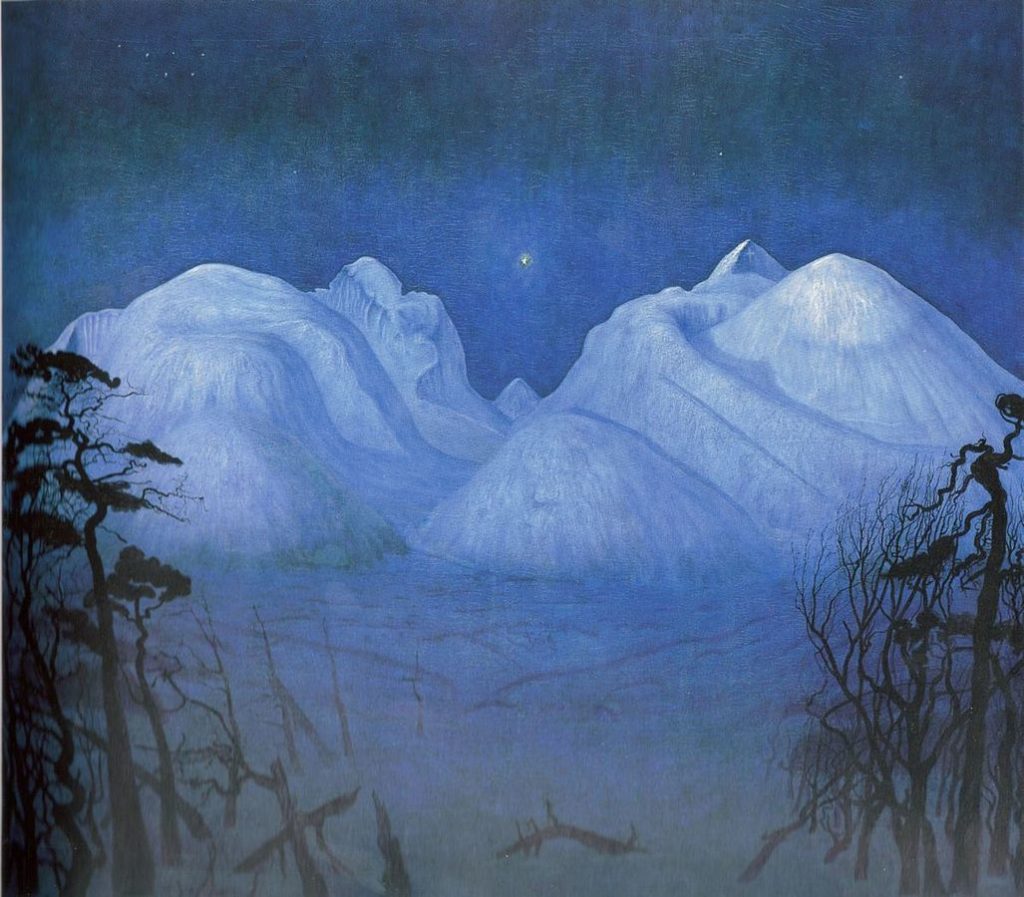
Harald Sohlberg, Winter Nights in the Mountains, 1914

Like Edvard Munch, Sohlberg disassociated himself from discussion about where he belonged in the history of art by strongly denying the influence of other contemporary artists. He rather relegated the origins of his artistic awakening to his own psyche and created his own intense stories based on mythologies of the Norwegian land. Consequently, the Norwegian painter created his own exceptional universe.

Norwegian Painter’s Exceptional Universe
Harald Sohlberg, From Røros

Harald Sohlberg is considered one of the leading exponents of neo romanticism in Norway, which broadly speaking covers the period from about 1890 to 1905. His paintings are mysterious and though provoking with rich colors that appeal to our intuitions and emotions. The artist explores hidden connections between the outer perceptible world and the inner essence of the human condition, revealing its relevance beyond Norway’s borders.

Many important works of Harald Sohlberg is now on exhibition at Trondheim Kunstmuseum. The exhibition lasts until 9 February 2020.

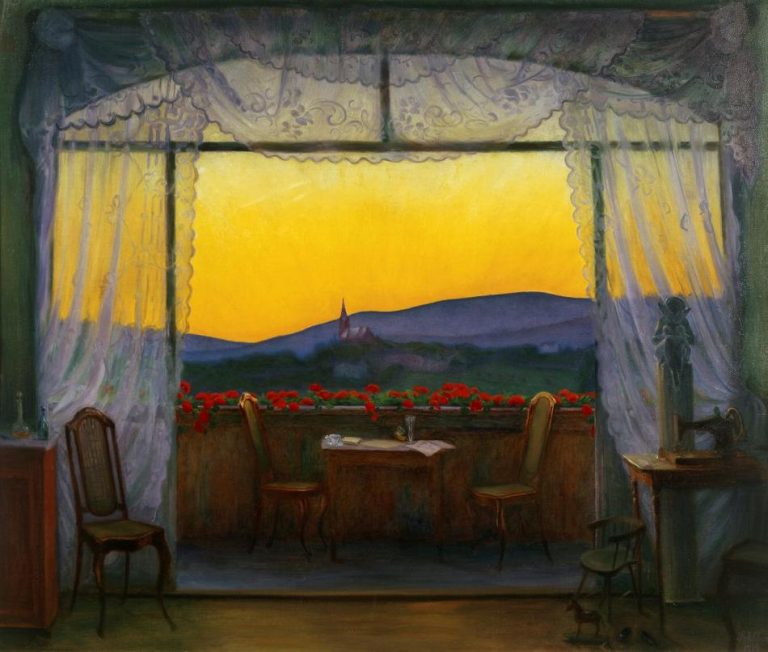
Feature image (on top): Harald Sohlberg, From a Home, 1919

Norwegian Painter’s Exceptional Universe, written by Tor Kjolberg


The Top Packing Suggestions for a Trip to Norway

0

Do you have a trip to Norway around the corner? Leaving in a couple days and your suitcase is still untouched? If you’re a bit stumped on what to pack because all the information online points to different weather trends, don’t worry! Learn about the top packing suggestions for a trip to Norway.

Read on for the top packing suggestions for your upcoming trip to this stunning Scandinavian country.

The Top Packing Suggestions for a Trip to Norway
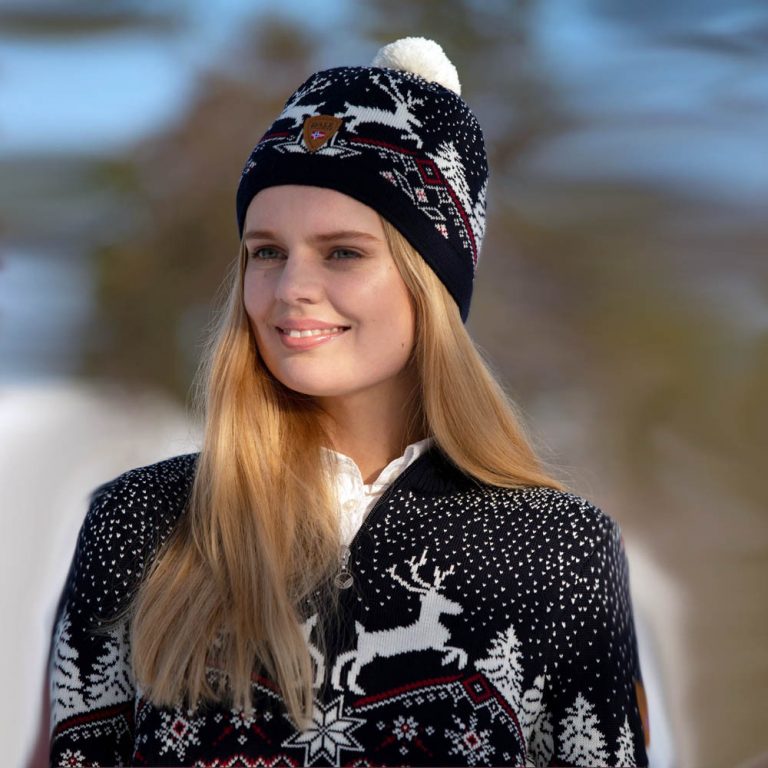
Bring your wool sweather
  1. Pack for all seasons

You might be going in the height of summer, but you should be packing for any eventuality. The one constant with the weather in Norway is that it’s always changing. Be prepared for a hot sunny day to quickly turn freezing with a biting wind and drizzle. The best option is to pack a lot of layers so you can adjust frequently during the day, from a hot, sweaty hike to the cold breeze on the summit.

  1. Dress like the locals

Wool is a common material used in Norwegian clothing and you should consider packing some wool clothing as well. As per Joan Denver, a travel blogger at Australian Help and Paper Fellows, “wool allows you to be prepared for all seasons, because it keeps you warm in colder weather but it also absorbs sweat really well when you get active. Whether you’re on a travel day on the plane or hiking up a mountain, bring some wool layers to always be comfortable.”

Related: Hitting the Walking Trails in Scandinavia

The Top Packing Suggestions for a Trip to Norway
The best option is to pack a lot of layers so you can adjust frequently during the day
  1. Use a layering system

As previously mentioned, the best way to pack for Norway is to have a lot of layers so you can easily switch during the day. Your first layer against the skin should be a thin woollen t-shirt (or other wicking material). The second layer is the insulation layer, either a fleece jacket or a down jacket which can pack down small into your day pack or tie around your waist. The third and final layer is the shell, which protects you from the elements like wind and rain. This is necessary in Norway regardless of the time of year you’re visiting. Get a nice waterproof and breathable shell jacket, and get similar pants if you’ll be doing a lot of outdoors activities.

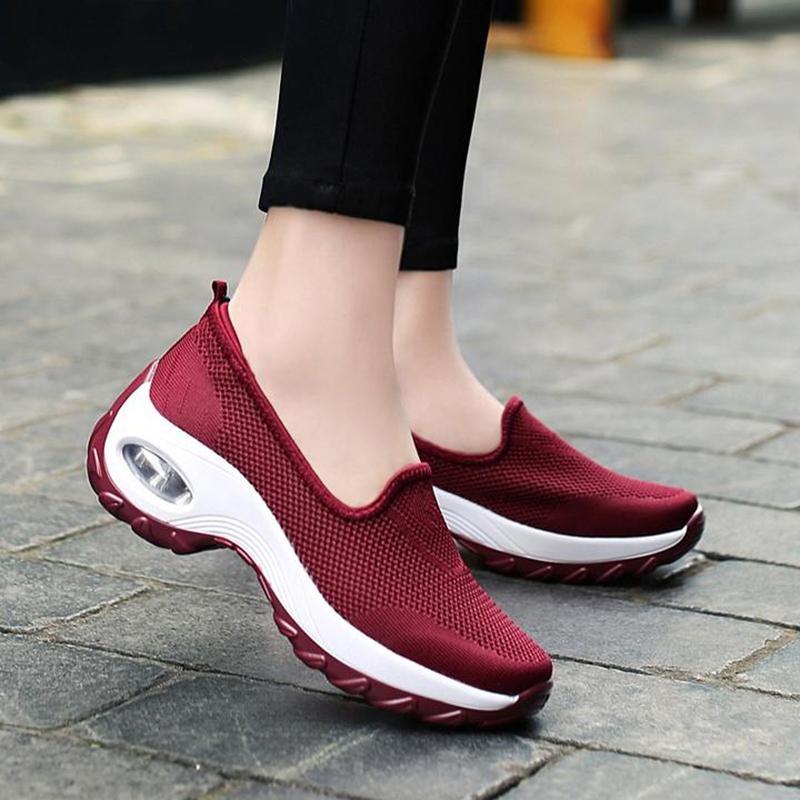
  1. Pack the right shoes

It’s hard to narrow down how many shoes to bring on a trip, and Norway is no different. You should have at least two shoes, if not three. Hiking boots that are waterproof or water resistant are a must if you’re planning on doing any kind of hiking. Then, you need to have sneakers that are comfortable yet fashionable for walking around cities. Finally, a third pair is fancier for going out to a nice dinner in the evening – you can eliminate this pair if you’re not planning on big nights out or your city shoes are acceptable.

Related: Active Life in Scandinavia

The Top Packing Suggestions for a Trip to Norway
Good shoes are essential
  1. Pack mittens and a scarf – even in summer

Even if you’re going to Norway in the middle of the summer and there’s nice weather forecasted for every day of your trip, you should still pack a hat, gloves, and a scarf. Dan Frasier, a lifestyle writer at Academized and State of Writing, explains that “whether you’re hiking by a fjord exposed to the wind of sitting at an outdoor café on a cold day (many cafes are outdoors even in cold weather), you need to be prepared. The last thing you want to do is feel cold to the bones every day of your vacation.”

Related: Let it Rain – Norwegian Rain

  1. Pack for comfort

At the end of the day, you want to pack more for comfort and practicality than for style. If you can combine both, that’s perfect, but if not, always put comfort first. Don’t worry about feeling like you’re too casual or “hiker-chic” – Norwegians won’t mind. You’ll get more strange looks if you show up in too trendy clothing that’s not weather appropriate. You also shouldn’t be surprised to see Norwegians out in shorts or skirts in 10-20 degrees Celsius (50-70 F). As soon as the weather gets a bit warmer and the sun comes out, everyone rejoices and pulls out their summer clothing.

Keep an eye on the weather channels, but don’t rely on them too much. Make sure you have clothing appropriate for all instances, and pack a day bag so you can quickly add and remove layers. Happy travels!

Feature image (on top): Christmas sweather from Dale of Norway.

The Top Packing Suggestions for a Trip to Norway, written for Daily Scandinavian by Ellie Coverdale.

The Top Packing Suggestions for a Trip to Norway
Ellie Coverdale

Ellie Coverdale, a writer for UK Writings and Essayroo, shares her thoughts about travel and lifestyles. She seeks out new adventures and experiences and shares them with her readers. Her goal is to inspire as many people as possible to live alternative lifestyles and leave their 9 to 5 jobs. She is also a teacher and writer for Boom Essays.

A Meal to Remember – in Stockholm

0

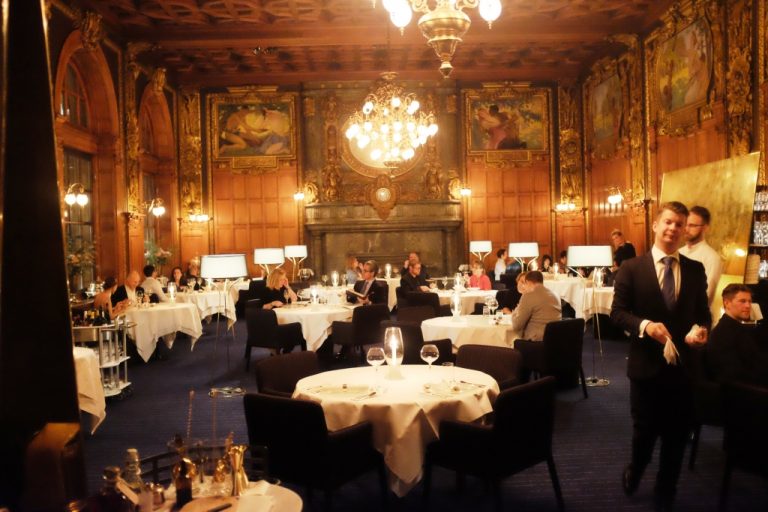
Operakällaren in Stockholm dates back to 1787 when the restaurant was situated in the cellar under Gustav III’s opera house. A decision was made in the late 19th century to demolish the opera house to build a new, better equipped one. The new Operakällaren was inaugurated 4 April 1895. Our visit to Operakällaren some weeks ago can best be described as exquisite with original dishes executed with elegance – a meal to remember – in Stockholm.

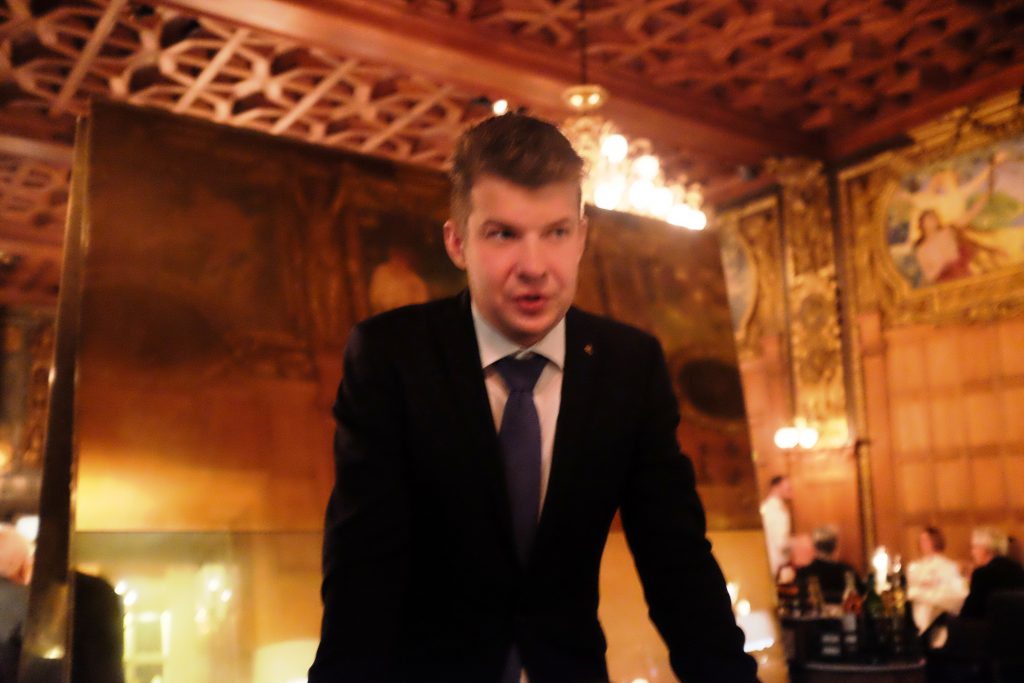
We were welcomed by restaurant manager Hugo Hall who recommended us to have a starter in a separate corner of the beautiful premises. He introduced us to head sommelier Johan Iller, who recommended us a champagne from Côte des Blancs developed by Marie Doyard in collaboration with Operakällaren. The cuvée was launched in September 2018. Marie Doyard is the granddaughter of the successful champagne-maker Maurice Doyard, who helped to found Champagne’s regulatory body, the Comité Interprofessionnel du Vin de Champagne.

Related: A Travel Journalist’s Contemplations on a Hotel Stay in Stockholm

A Meal to Remember – in Stockholm
Champagne and appetizers in a row
A Meal to Remember – in Stockholm
Head sommelier Johan Iller
A Meal to Remember – in Stockholm
Pata Negra cut in thin slices

Appetizers in a row
Our first encounter with the food was when one of the waitresses came to our table and cut a Pata Negra in thin slices. This buttery and delicious Iberico pork shoulder from Pata Negra pigs supplemented by the champagne was just a prelude to an evening of the most exquisite dinner I’ve experienced so far. And I must admit, I am a spoiled restaurant visitor.

Other waiters arrived regularly at our table to serve other small dishes, and the concoctions were a great way to warm up before we were accompanied to our table.

A Meal to Remember – in Stockholm
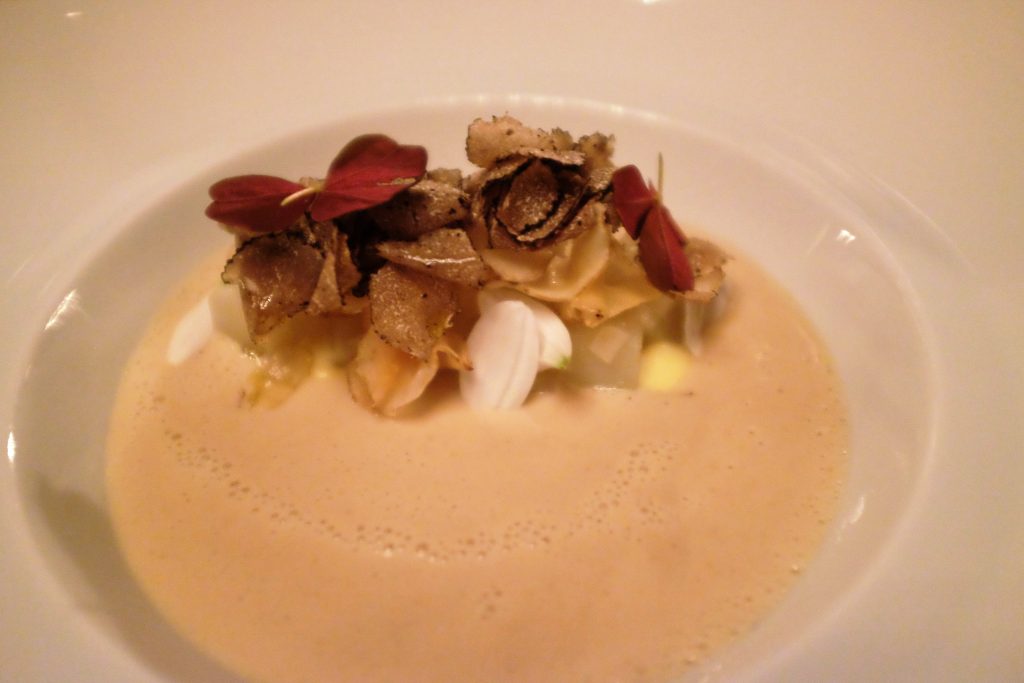
Roasted Jerusalem artichoke soup with “Svedjans” cheese cream
A Meal to Remember – in Stockholm
When it comes to the actual cooking of the food here at Operakällaren, they’re masters
A Meal to Remember – in Stockholm
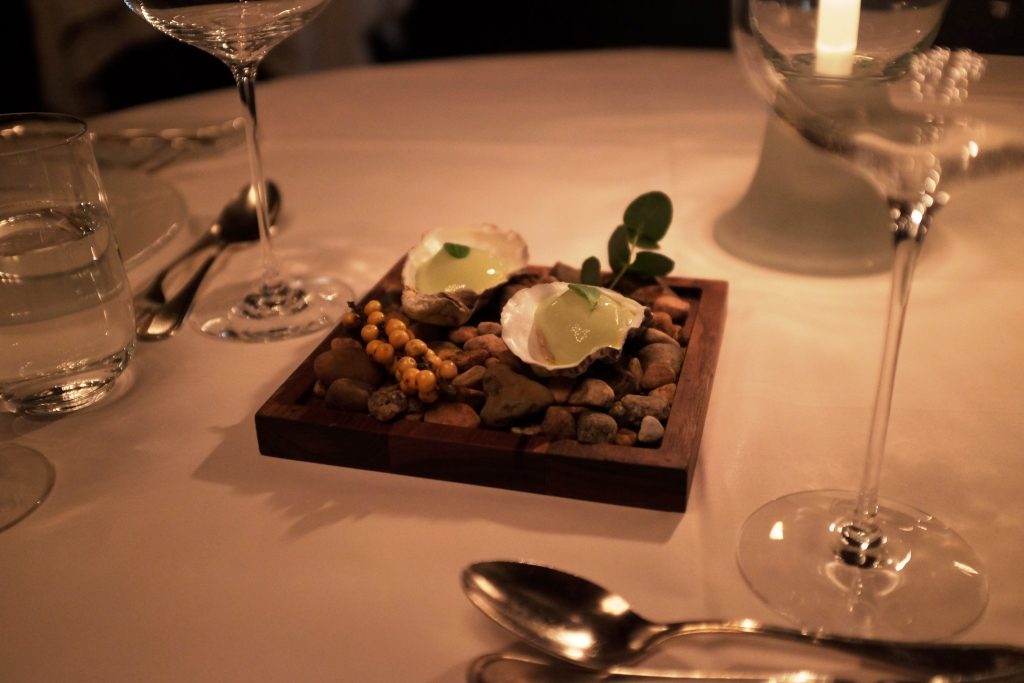
We were served a series of smallwonders

Elegance at the tables
One of the most impressive things in Operakällaren was the way the exquisite and original dishes were executed with elegance at the tables by waiters who clearly showed how much they loved their profession and their affection of what they served.

Related: 2000 Square Meter Restaurant in Stockholm

A Meal to Remember – in Stockholm
Preparing the main dish
A Meal to Remember – in Stockholm
In 1997 Operakällaren was honored with one star in prestigious Guide Michelin

When it comes to the actual cooking of the food here at Operakällaren, they’re masters. We were served a series of small wonders, everything made to perfection, both visually and with flavors promised in the menu description.

A Meal to Remember – in Stockholm
Our excellent entrées were roasted Jerusalem artichoke soup with “Svedjans” cheese cream baked Jerusalem artichoke and autumn truffle shared scallop from Frøya with cauliflower cream, pickled turnip and browned butter.

Our very memorable mouthfuls of main dishes were baked monkfish with Jerusalem artichoke, crispy pancetta, grilled salsify and spicy tomato sauce and baked pike perch from Angsö with corn cream, baked point cabbage and sabayon with sorrel.

Related: Where to Eat in Stockholm

I must admit I couldn’t pinpoint all of the flavors mentioned above, but after eating it, we felt not only was it the best example of a connoisseur dinner we’ve ever had, but something we’ll never forget.

A Meal to Remember – in Stockholm
From the confectionary


A Meal to Remember – in Stockholm
After surprises, entrés and main dish, we were content with petite four and coffee

After all the dishes and surprises, including excellent wines, we barely had any room for dessert, so we were content with petits fours and coffee.


Michelin-starred restaurant
Don’t let the essential presentation of the plates fool you as there is a lot more going on under the surface. Each plate truly allows the ingredients to speak for themselves. Pair this with an incredibly well-thought out menu with wines and you’re left with exquisite and original dishes that make for the most memorable feast.

A Meal to Remember – in Stockholm
Operakällaren’s wine celler also contains wines from late Princess Diana’s wine cellar.

I’m sure you’ve already worked out what I thought about Operakällaren, but if not and if I had to describe it in one word that would have to be – unforgettable.

A Meal to Remember – in Stockholm
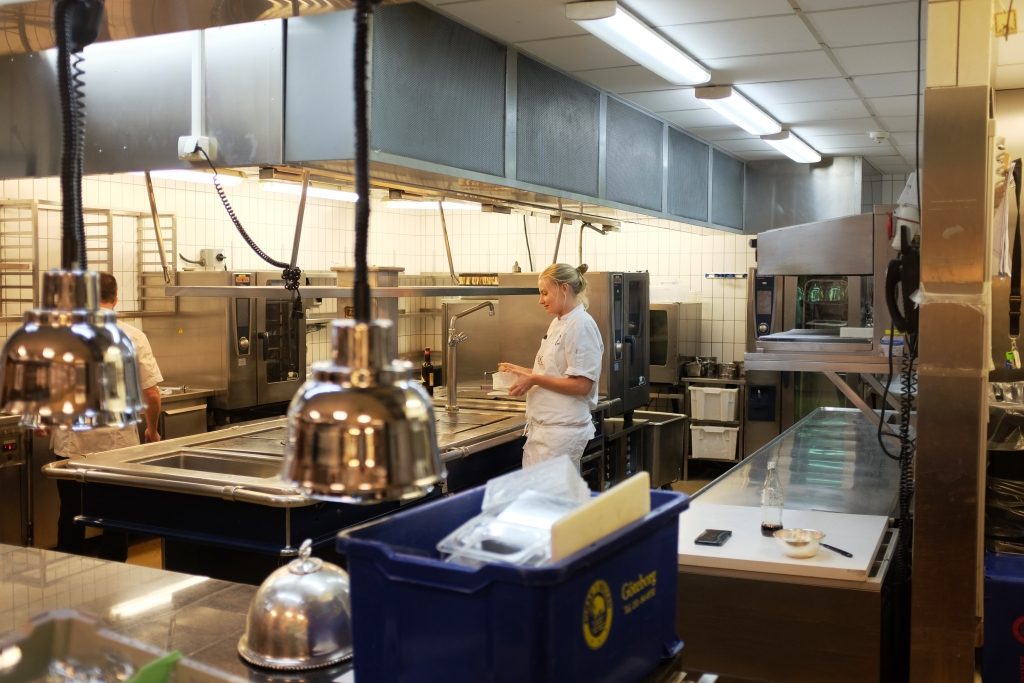
From t5he kitchen

In 1997 Operakällaren was honored with one star in prestigious Guide Michelin and five red ‘Couvert symbols’, crossed forks and spoons. I wonder why one star suffice.

Hint: In November, a new wine cellar bar opened its doors for lovers of fine wines. Some years ago, it was a key club for celebrities only.

All photos by Tor Kjolberg

A Meal to Remember – in Stockholm, written by Tor Kjolberg

Scandinavia Ranked One of the Safest Areas in the World

In a new index of 150 countries’ friendliness towards gay, lesbian and trance travelers performed by the LGBTQ+ Danger Index, Sweden is ranked no. 1 followed by Canada and Norway. Denmark ranks no. 14. So, Scandinavia Ranked One of the Safest Areas in the World for gay people.

The LGBT+ Danger index ranks the 150 most visited countries on eight different factors that may impact gay, lesbian and trans travelers, including legalizing same-sex marriage, worker protection and whether, based on Gallup poll findings, it is a good place to live.

Scandinavia Ranked One of the Safest Areas in the World
Same-sex relationships are illegal in 38 of the countries on the list

Related: Gender-neutral Swedish Preschools Produce More Successful Children

Gallup on gay issues
Gallup first polled on gay issues in USA in 1977. Since then, Gallup has gone on to ask dozens of questions about LGBT people and their rights and polling about LGBT acceptance internationally since 2005.

While some of the factors in the LGBTQ+ Danger Index do not directly impact travelers, the research reveals such factors are a decent overall indication of the attitudes within a culture. The authors of the research is an American couple, Asher and Lyric Fergusson, who also has a blog about safe traveling.

Scandinavia Ranked One of the Safest Areas in the World
The authors of the research is an American couple, Asher and Lyric Fergusson

Scandinavia Ranked One of the Safest Areas in the World
Sweden has a long history of LGBT rights. Sexual activity between those of the same gender was legalized as long ago as 1944. Sweden was the first country to allow transgender persons to change their legal gender after reassignment surgery.

Related: Leaders in Gender Enlightment

Norway has a law prohibiting discrimination based on gender identity and expression since 2013, and is one of the few countries in the world to explicitly protect intersex people from discrimination. Discrimination on the basis of sexual orientation, gender identity or gender expression shall be prohibited.

The rights of lesbians, gays, bisexuals, and transgender persons in Denmark are some of the most extensive in the world. Same-sex sexual activity was legalized in 1933, and since 1977, the age of consent has been 15, regardless of sexual orientation or gender.

Related: World’s First “Men-Free” Festival Held in Sweden

Scandinavia Ranked One of the Safest Areas in the World
LGBT global acceptance map

Same-sex relationships
Same-sex relationships are illegal in 38 of the countries on the list and punishable by death in five (Nigeria, Qatar, Yemen, Saudi Arabia and Iran). Some of the countries where it is illegal to be gay are also popular tourist destinations such as Jamaica, where in a 2013 survey of 71 LGBT people conducted by Human Rights Watch, more than half said they had been victims of homophobic violence.

The index notes: “These countries where homosexuality is illegal are also often severe human rights violators, usually penalizing male/male sexuality and/or trans women most harshly.”

Countries at the bottom of the index include Nigeria, Qatar, Yemen and Saudi Arabia.

Scandinavia Ranked One of the Safest Areas in the World, compiled by Tor Kjolberg

Norwegian Actor on Interpreting a Mass Murderer

The Norwegian mass murderer Anders Breivik killed 77 people across Oslo on 22 July, 2011. Norwegian actor Anders Danielsen Lie accepted the task of interpreting him in the film ‘22 July’. Read the Norwegian actor’s thoughts on interpreting the mass murderer.

Anders Danielsen Lie has admitted it took him a few weeks to agree on the part after he had been asked to interpret and play the role of Anders Breivik, who during the terrorist attack of 2011 on Utøya outside Oslo opened fire on hundreds of children and killing 69 people, as a misguided right-wing protest of immigration and left-wing politics.

Norwegian Actor on Interpreting a Mass Murderer
Anders Danielsen Lie interpreting Anders Breivik

Related: Utøya Memorial Pavilion, Norway

About the Actor
Anders Danielsen Lie (born 1979) is an actor, musician and medical doctor. He made his film debut when he was 11 years old in the title role of Herman (1990). He is best known for his leading roles in the multi-award winning ‘Reprise’ (2006) and Oslo, 31 August (2011) by Danish-Norwegian director Joachim Trier.

In 2011 Danielsen Lie released a concept album with music written, produced and performed by himself, ‘This is autism’.

Danielsen Lie has proven to be one of Norway’s best actors currently working, but he’s still relative unknown outside Scandinavia. It was a huge responsibility to accept the role of the mass murderer, and Danielsen Lie says he would never have done it if he wasn’t absolute certain he could create a character that was believable.

Related: A Literary Masterpiece About the 22nd July Massacre in Norway

Huge research job
Danielsen Lie knows there are a lot of emotions involved in making a film like this and as a professional actor he wanted everything to be accurate and as close to the truth as possible. It also involved a huge research job and he reflected on how it could affect him, since it’s pretty human to think that a person who has committed such an awful crime cannot be normal, cannot be a human being.

Norwegian Actor on Interpreting a Mass Murderer
For Anders Danielsen Lie It was a huge responsibility to accept the role of the mass murderer

Researching Breivik, watching interrogation footage, Danielsen Lie was struck by how “frighteningly normal” he was in most situations. There is almost 200 hours of interrogation footage. Danielsen Lie hasn’t watched all of it but a lot, and that has been the most important source of research for building the character.  Breivik is currently in prison in Norway for his heinous crimes. Even though he has certain pathological personality traits, most of the time, he’s completely casual and ordinary.

Related: Norwegian Massacre

Danielsen Lie never spoke to Breivik directly
Danielsen Lie never spoke to Breivik directly, but says he’s spoken to people who have spent much time with him. He once tried to schedule a meeting with him in prison, but Breivik declined without giving a reason. He has also spoken to his lawyer.

“It is actually quite disturbing to watch a person, when you know what he has done, and he is so ordinary and normal. It is very disturbing,” Danielsen Lie said in an interview.

On practicing medicine
Anders Danielsen Lie is still practicing medicine. He says it is important to him to practice regularly. His world is not only about the film industry. He needs to have a foot in reality and do something else. “That way I am connecting with the real world,” he says.

Norwegian Actor on Interpreting a Mass Murderer
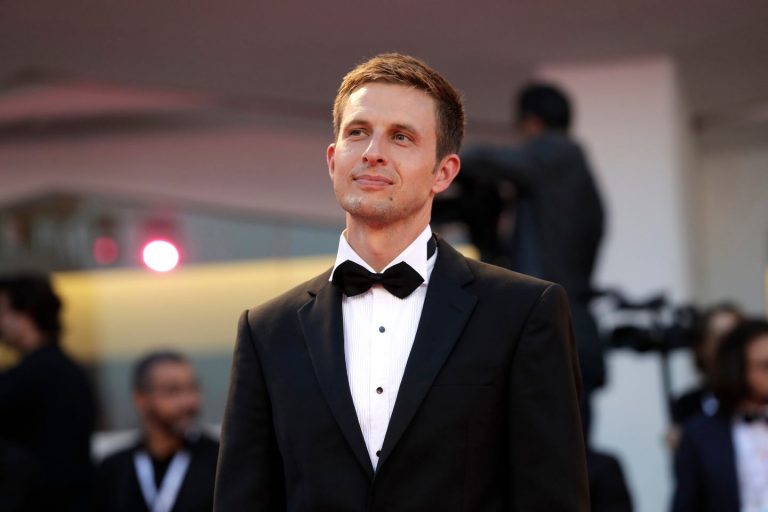
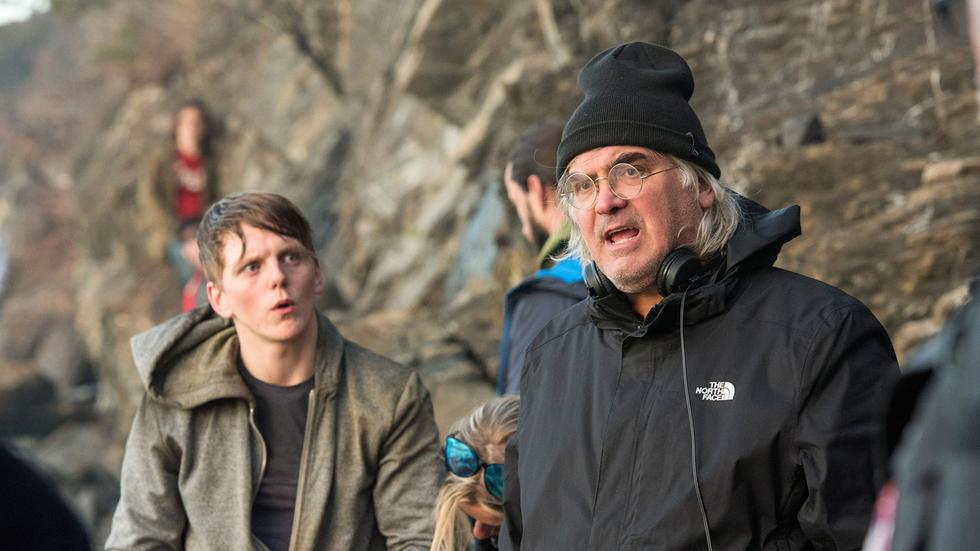
The film was written, directed and produced by Paul Greengrass (right)

About the film
‘22 July’ is a 2018 Norwegian-American crime drama film about the 2011 Norway attacks and their aftermath, based on the book One of Us: The Story of a Massacre in Norway — and Its Aftermath by Åsne Seierstad. The film was written, directed and produced by Paul Greengrass and features a Norwegian cast and crew. The film had its world premiere on September 5, 2018 in the main competition section of the 75th Venice International Film Festival.

Norwegian Actor on Interpreting a Mass Murderer, written by Tor Kjolberg

The Danish Twin Islands Lolland-Falster

The two islands Lolland and Falster, commonly just called Lolland-Falster are only separated by a narrow strait, Gulborgsund. A new ferry link, the Fehmarn Belt Fixed Link, is due to open in 2021 and will connect Rødby in Lolland with Puttsgarden in Germany. The Danish twin islands Lolland-Falster are worth a visit.

The Farø bridges connect Zealand to Falster and the ferry routes to Germany. The main town on the island Falster is Nykøbing, noted for the Czarens Hus (Tsar’s House), where Peter the Great stayed in 1716, which now houses the Falsters Mint Museum of local history.

The Danish Twin Islands Lolland-Falster
The Farø bridges connect Zealand to Falster and the ferry routes to Germany.

Related: The Eleven Prettiest Towns in Denmark

Fuglsang Museum of Art
From Maribo, just off the Nykøbing-Nysted road (Route 297) you’ll find the Fuglsang Kunstmuseum (Fuglsang Museum of art). The paintings displayed there, echoes some of the landscapes in the area, originally collected by brewer Carl Jacobsen from 1887 onwards.

The Danish Twin Islands Lolland-Falster
Fuglsang Museum of Art

Medieval Center in Nykøbing
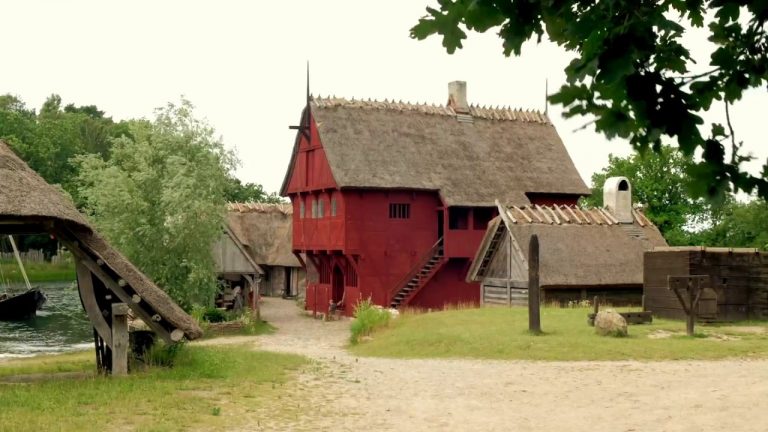
In Nykøbing you can time-travel to the days of damsels and knights at the recreated early 15th-century Medieval Center, a village populated by numerous costumed craftspeople at work.

The Danish Twin Islands Lolland-Falster
From Medieval Center, Nykøbing

Related: Bed & Bike in Denmark

Beach holidays
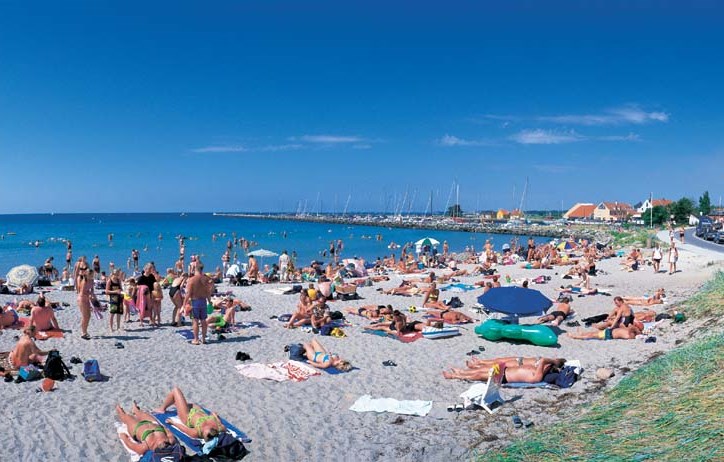
The area around Marielyst to the southeast, has miles of white sand dunes where families take beach holidays. A choice of bridges links Falster to Lolland.

The Danish Twin Islands Lolland-Falster
Lolland-Falster beaches

The 12th-century castle Aalholm Slot is closed to visitors, but you can visit the Automobile Museum in its grounds.

Related: Fun-loving Denmark

From Aalholm, the road north runs past lakes to Knuthenborg safari park.

In the far west, the Tärs to Spodsberg crossing connects the island with Langeland and Funen.

Feature image (on top): From Medieval Center, Nykøbing

The Danish Twin Islands Lolland-Falster, compiled by Tor Kjolberg