Hundreds of species of wild birds migrate every year to northern Scandinavia from Africa and southern Europe. Every year in March, you can watch migrating birds far overhead and wonder how they find their way, and how they get the strength to travel thousands of kilometers twice every year. Read more about Scandinavian wildfowl.
The fascination with this is beautifully described in Selma Lagerlöf’s famous story The Wonderful Adventures of Nils Holgerson, which recounts a boy’s journey with the wild goose to the very northern part of Norrland in Sweden.
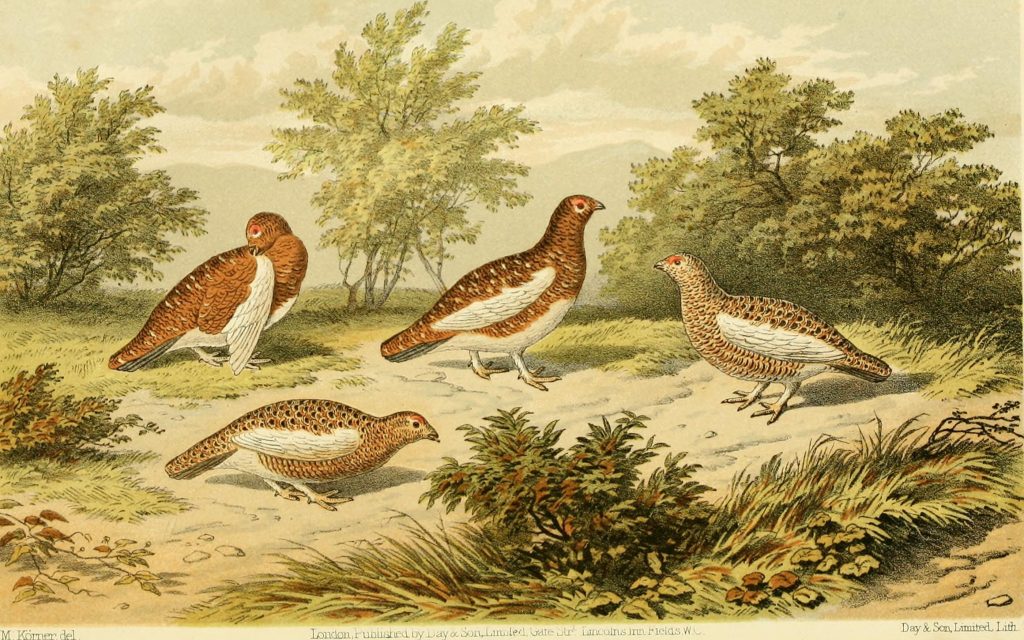
Many species are shot and eaten, mostly ducks and geese, but some are protected and can be eaten only locally. These are numerous different ducks and geese, just marketed as wild duck, and if you want a specific duck you must know the hunter. Eider and coot are plentiful available. In the mountains and on the moors, there are grouse, black grouse and ptarmigans, and in the south mostly pheasants; the last, which were originally imported for hunting from Asia, are bred intensively to offer shooting possibilities for trigger-happy city dwellers. Partridges are becoming rare, and so are the delicious snipe.
Some sea birds, such as puffins, are hunted locally when the bird population permits, but are not sold commercially.
Eider ducks
The common eider duck is a beautiful sight, the male having strikingly beautiful black and white plumage. As with all ducks, the female has mottled brown plumage so it can remain undetected on the nest.
The eider is the source of luxurious eiderdown, collected in the wild after the ducklings have left the nest, it’s an exciting thing to find, and one nest is enough to stuff a pillow. The nests, filled with regurgitated dish and bird shit, look unappetizing but are in fact easy to clean. The tiny down feathers, which the female eider plucks from her breast and stick together even in the strongest gale, so you can bash the whole nest against the rocks, and every piece of dirt will blow away, leaving only unbelievably soft and warm down.
The game birds and wildfowl of Sweden and Norway. Image: Wikipedia Commons
Buying and storing With wildfowl you must be happy with what you can get. Young birds have bendable beaks and tender feet – a young duck’s webbed feet can easily be torn with your fingers, which is impossible with old bird’s leathery feet. It would take up far too much space here to give you advise on hanging, plucking and cleaning wildfowl. Your hunter friend or butcher can tell you how.
Culinary uses Wildfowl are generally lean birds and can be cooked like chicken, domesticated duck or goose, though the leaner flesh must be compensated for in terms of fat, and cooked in a sauce to prevent it from drying out. Many wild birds have a huge breast and almost no other meat, and this can be cut off and grilled or fried as you would a duck breast.
All wildfowl are prepared in much the same manner throughout Scandinavia. All dish- and molluse-eating birds need a 24-hour soak in buttermilk to take away any fishy taste; after this they can be prepared like other wildfowl. The fishy taste is in the bone and tissue and seldom in the meat itself. The older the bird is, the fishier it becomes. Wildfowl that do not eat fish will not need the soak.
If you want a specific duck you must know the hunter
When dealing with coots, there is not much meat apart from the breast, so you can simply cut off the breast meat and fry it like a steak, or braise it as you would other wildfowl, except for a shorter time as there is no bone.
Pheasants must be cut up as they are very lean, and the breast will need only a short time to cook, whereas the thighs will need a long time to be tender. The thighs have numerous thin, needle-like bones, so take care when eating them, or simply take them out with tweezers before serving.
Ducks do not need to be cut up, as the thighs and breasts both become tender in a very short while.
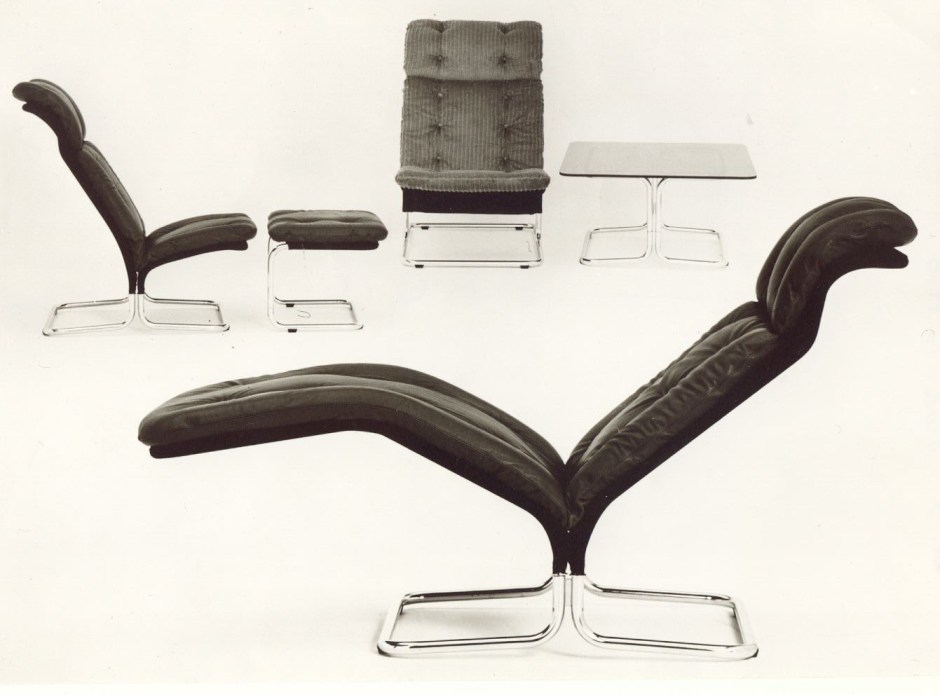
In these coronavirus times, people all over the world are sitting at home in their living room – perhaps even in an iconic Norwegian Siesta chair made by the Norwegian designer and architect Ingmar Relling (1920-2002).Read more about the iconic Norwegian Siesta chair.
Ingmar Relling is known as one of Norway’s most internationally recognized designers who created a series of functional furniture designs during his career. He took apprenticeship at a tender age of 16 at Vestlandske Møbelfabrik. His brother Adolf Relling, who was also a trained furniture designer, insisted that he enrolled at the Norwegian Academy of Craft and Art Industry in Oslo.
In 1965, Ingmar and his brother Knut designed the Siesta chair
Before starting his own studio in his home municipality Sykkylven in 1950, he started his career at Rastad & Relling design studio (1947).
420 Chair and the Nordic Chair
In the 1950s, Relling produced his 420 Chair for Vestlandske Møbelfabrik and in 1954 he desined his Nordic Chair, composed of two separate parts, a seat and a back. The chair could be folded and stored while not in use. Simplicity, minimalism, elegance and uncompromising quality are key concepts in all of Relling’s designs.
The Iconic Norwegian Siesta Chair
Nearly a decade later, in 1965, Ingmar and his brother Knut designed the Siesta chair. The Siesta has been produced in over 800,000 units and is still in production. United States President Jimmy Carter purchased sixteen Siesta Chairs to furnish the White House during his term. Over the years, the simple construction and design has remained the same, but the materiality, the thickness of the cushion and general detailing have changed with the trends.
The Siesta Chair can be found in permanent collections around the world, like the Victoria & Albert Museum in London, the National Gallery of Victoria in Melbourne, Die Neue Sammlung in Munich, the Cooper-Hewitt in New York, and the National Museum Oslo.
In 1992, the Siesta was awarded the Classic Award for Design Excellence by the Norwegian Design Council.
The Siesta has been produced in over 800,000 units
A legendary contemporary furniture designer Today, Ingmar is a legend in the world of contemporary furniture designers and is known for his designs characterized by minimalism, simplicity, elegance, and, more importantly, high quality.
Another gem by Ingmar Relling is the Tema chair from 1973 that borrowed a big leaf from the Siesta and was engineered from flat steel and a thick leather skin seat.
The furniture museum The furniture museum, Møbelmuseet, formerly Norsk Møbelfaglig Senter (NMFS) in Sykkylven is a museum and a documentation center for the furniture industry of Norway. Among others, the museum contains a permanent exhibition showing the development of the furniture industry, and now celebrates Ingmar Relling’s 100th anniversary.
The Iconic Norwegian Siesta Chair, written by Tor Kjolberg
We can’t imagine our lives without social media. And naturally, we want our social media accounts to look better than those of our friends. And that’s not a bad thing! Striving to take perfect pictures for Instagram, we develop our creativity, photographing, editing, and other skills. Read about the 11 Most Instagrammable Places in Stockholm.
Today, we will talk about the best places to take photos in Stockholm. Look through our top 11 list and find a perfect spot for your next photoshoot.
The most Instagrammable place in Stockholm is Stortorget
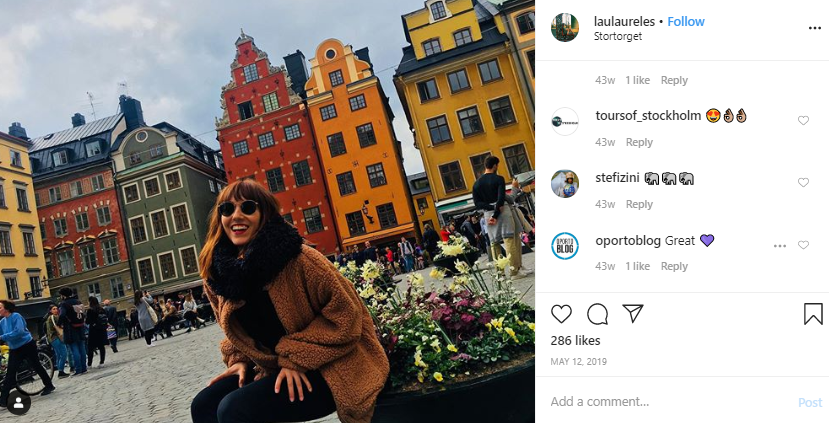
Stortorget
The most Instagrammable place in Stockholm is Stortorget, a public square in the old town. The square is famous for its colorful buildings that, according to historical records, were built no later than 1479.
Stortorget is a perfect place for walks and photoshoots. Whether you’re visiting Stockholm for the first time or have been to the city many times, we highly suggest you come to the square in the morning and take a few vibrant pictures for Instagram.
Stockholms stadsbibliotek is the biggest public city library created by famous Swedish architect Gunnar Asplund
Stockholms stadsbibliotek Stockholms stadsbibliotek is the biggest public city library created by famous Swedish architect Gunnar Asplund. Stadsbibliotek has been listed as one of the world’s most beautiful libraries for its stunning panorama of books spanning the cylindrical walls.
Today, you can come to the library not only to read a book but also to take pictures for Instagram. This place is open for the public, so you can visit it even if you don’t have the library card.
Riddarholmen is a small islet in central Stockholm
The Riddarholmen Church If you like to take photos next to historical buildings, here is another great Instagrammable spot for you.
Riddarholmen is a small islet in central Stockholm. It’s famous for its church used as Sweden’s royal burial church for a few centuries.
The church and islet itself look really beautiful and authentic in photos. So if you run a travel blog on Instagram, this place is a must-visit for you.
Grand hotel has an exclusive interior design that hasn’t lost its classic period charm
Grand Hôtel Stockholm Are you looking for a fancy Instagrammable place? Visit Grand Hôtel Stockholm. The hotel has an exclusive interior design that hasn’t lost its classic period charm.
“Do you want to convince your Instagram followers that you live a luxury life? Stay at Grand Hôtel Stockholm and take a few pictures in the main hall. Golden walls and red carpet always look fabulous in photos, so it will be easy for you to amaze your followers,” says Amanda Benson, fashion blogger and writer for Studyker.
Jumbo Stay Hotel Would you like to stay at one of the most Instagrammable hotels in Scandinavia? Jumbo Stay Hotel is the right choice for you.
Jumbo Stay Hotel is set in not in a building, but a decommissioned Boeing 747 jumbo jet. It has 33 standard rooms and a more expensive and luxurious “cockpit suite” located on the upper deck. Photos taken in these rooms go viral online, so the chances you have seen them on Instagram many times.
Jumbo Stay Hotel is located very close to Arlanda Airport. So if you have an early flight the next day, it will be comfortable for you to accommodate here.
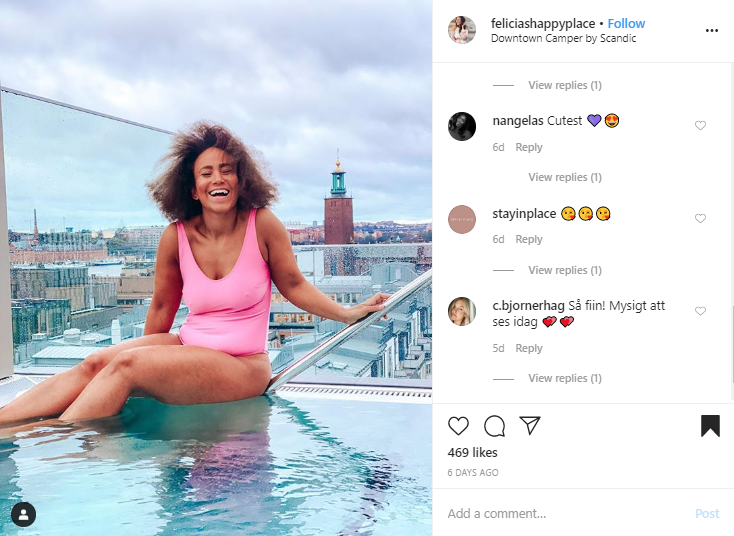
Downtown Camper by Scandic Do you want to make your Instagram followers jealous? Take a picture at a rooftop pool at Downtown Camper by Scandic. There are not that many rooftop pools in Scandinavia, so this place is rather unique.
If you don’t want to swim in the pool, get to the roof to shoot the Stockholm city skyline. From this spot, you will get awesome pictures.
The Stockholm metro is known as one of the most beautiful subways in the world
Odenplan Pendeltågsstation The Stockholm metro is known as one of the most beautiful subways in the world and for a good reason. Most of the metro stations look like masterpieces of modern art and architecture.
Odenplan Pendeltågsstation is one of those stations that look beautiful not only in life but also in photos. Both tourists and locals visit this place to take unordinary pictures for social media. Thanks to neon lights, this station is a suitable spot for photo shootings.
Snösätra Graffiti Wall of Fame is another Instagrammable place in Stockholm
Snösätra Graffiti Wall of Fame Snösätra Graffiti Wall of Fame is another Instagrammable place in Stockholm. Each painted wall can be used as a background for portrait photos. There are dozens of graffiti over here, so you can take a bunch of great photos in one visit.
Gavin Pereira, a professional photographer and content creator for Subjecto and WriteScout, shares tips on how to photograph graffiti: “Come closer to the wall, but make sure that your body doesn’t overlap the essential elements of the graffiti. Then ask photographer (your friend or random passer) to stand directly in front of you and take a few shots from your eye level.”
If you are fond of maritime museums, go visit the Vasa Museum
The Vasa Museum If you are fond of maritime museums, go visit the Vasa Museum. There is a vasa, Swedish warship built between 1626 and 1628, in the museum, and you can take photos in front of it. The good news is that you are 18 years old or younger you can enter the museum for free.
In the Royal Palace of Stockholm, you can take pictures in chic rooms
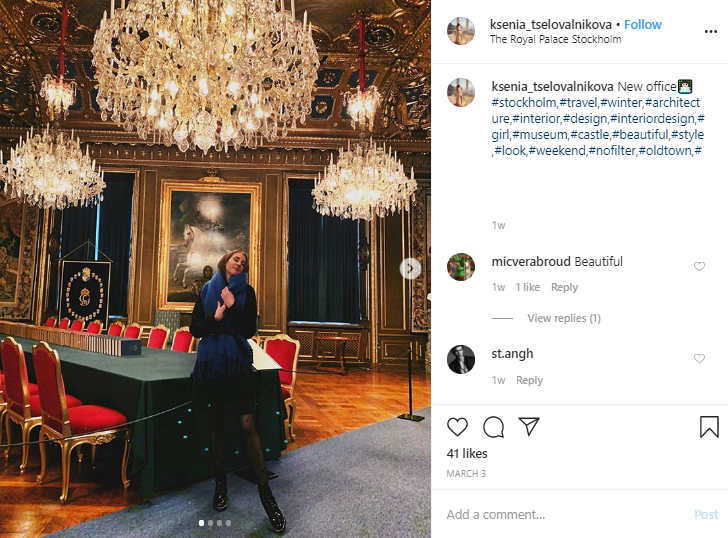
The Royal Palace And here is another Instagrammable spot for those who love museums, baroque style, and luxury interior designs. In the Royal Palace of Stockholm, you can take pictures in chic rooms decorated with red velvet wallpapers, golden ceilings, and enormous crystal chandeliers.
Just keep in mind that only small bags are permitted at visitor attractions. You will not be able to visit the palace if you bring a bag or case with wheels.
Monteliusvägen is a good place for a family photoshoot in Stockholm
Monteliusvägen
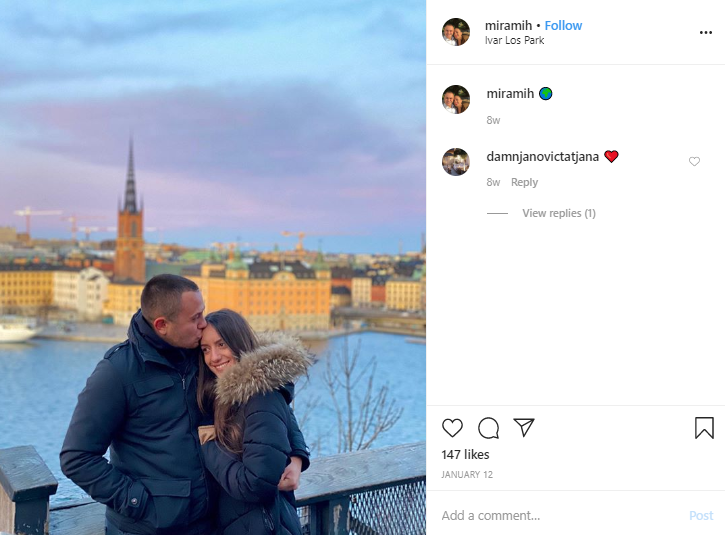
Monteliusvägen is a good place for a family photoshoot in Stockholm. If you have kids, you can take photos of them exploring cute old-timey houses and wooden farm animals in the playground.
Monteliusvägen also provides a great panoramic view of the city. So if you want to photograph a city skyline, this park is a must-visit for you.
Editor’s note: Although Instagram refers to this place as Ivar Los Park, one of our readers, Hanna Karlsson from Sweden, has brought to our notice that the place is in fact Monteliusvägen, located on Skinnarsberget. Thank you, Hanna!
The 11 Most Instagrammable Places in Stockholm – Wrapping up
Stockholm is a magnificent city with a rich history. So wherever you go, you will see great Instagrammable places. Whether you choose to walk in the old city or to visit a museum, you will find great spots to take stunning pictures.
Marques Coleman
The 11 Most Instagrammable Places in Stockholm , is written for Daily Scandinavian by Marques Coleman. Marques works as a writer and content creator for EssayAssistant and TopEssayWriting. He is passionate about traveling, photography, and social media marketing.
You are probably reading a lot of news related to China right now. We are moving into an uncertain, near future that is scary for many. I am now one of many who practices home office, and I have more time on my hands than what I would have otherwise, also generally fewer distractions (if one looks away from the bigger picture being painted in the global media) due to distanced socialization. Read the fascinating stories from a young Norwegian’s stay in China.
Recently, I received some tips from a friend in Shanghai, who just finished two months of home quarantine. He spent this time on self-reflection, reading books, and learned how to cook better. During these times, it might be wise to look backwards and forwards, to learn from yourself, about yourself, about others and about the larger world.
Sunshine on Mt. Taishan
Personally, I now have time to reflect about the past and the future, but especially I have been thinking about my past and the many experiences I’ve had and I am incredibly grateful for them. There are many to share, but I would like to start with some stories from China, long before the Corona chaos started.
Sharing all of my experiences and stories from China could fill a book. I will therefore share three stories, not necessarily the three most important or the most exciting stories, but simply the first stories that came to me when I wrote this. I want to tell you about a holy Buddhist mountain, how I met my best friend in China, and a story about myself, a Ukrainian man and a potato.
A Chinese man wanted a picture during my hike up Taishan
Growing up in an adventurous family
My China adventure started at a young age. I grew up in an adventurous family, who frequently took me and my older brother to travel in Norway, Europe and the United States during our childhood whenever our parents had the opportunity. My grandfather was a sailor, and on my mom’s side of the family several family members worked with building railroads. In other words, they lived a vagabond lifestyle on the road or at sea. That is why I have been told that my inner traveler is “in my blood”.
When I first wanted to leave the nest on my own initiative, I went on an exchange during high school as soon as I had the opportunity to. I ended up in New Zealand, where I stayed with an indigenous Maori family. This was an exciting experience in itself, but perhaps most importantly – it made me long for new experiences. I thought as soon as I get an opportunity to do something like this again, I will grab it.
My 4th day in China, on my way up Mt. Taishan. On the gate it says “门天中” – meaning “In the middle of heaven’s gate”
I was pretty tired of school by the end of high school. The plan was to take a year off, work for 6 months, earn some money, and then travel to Asia. I wanted to experience something new and foreign, and was inspired by ancient the Chinese philosophy, Taoism, learning to live in harmony with your surroundings.
Starting a bachelor’s program in Chinese
In my favor, the University of Bergen started a bachelor’s program in Chinese the same year I graduated from high school. My plan suddenly changed a bit: “What if I apply for the bachelor’s program in Chinese language and culture, so I can go on an exchange through university?” My train of thought was, yes, I was tired of school, but Mandarin, was something completely new. Why not give it a try?
I entered the undergraduate program and was quickly intrigued by the Chinese written language. A completely different structure, the use of symbolism to express oneself, and a different way to think and see the world. This added to my China curiosity, so as soon as I could, I applied for another exchange year abroad. This time not staying with a host family, but by myself.
Arriving in Shanghai
On August 22, 2014, I left for Shanghai with butterflies in my stomach. A new life as a 19- year old, alone, in a city with 25 million people in a completely foreign culture. With my very limited language skills, I managed to explain to the taxi driver at the airport where I was going. The first address we arrived at was wrong (thanks to my accent), but we found my hotel on the second try around. I will never forget the hour-long drive into the city on a freeway with 6 lanes in each direction. High-rise on high-rise on high-rise under construction, until we ducked down to the street level entering a myriad of life.
To have some time to explore Shanghai and its surroundings, I went to Shanghai two weeks prior to the start of my studies. I did not research much before getting there, so after I landed in China, I started to look for nearby attractions. My eyes fell on a sacred Buddhist mountain a few hours north of Shanghai, the Taishan mountain in Shandong Province. Partly due to my fascination with Taoism, partly due to the mountaineer in me, I decided after two days in China to go climb this mountain.
Language barriers
One of the first things that struck me in Shandong was that I was suddenly the only foreigner. There were no longer English-speakers around or English menus. At the hotel I paid 30 bucks for an overnight stay, to later realize that they made a bargain. There was nothing wrong with the hotel, but I had not yet learned the art of bargaining when they showed me the price on a calculator. As a gullible Norwegian, I accepted the price.
When I went out for dinner, I blindly pointed out on a menu at a local restaurant and ended up with a dry salad, not exactly ideal before going on a hike. Later, I realized the waiter meant, “are you sure it is sufficient,” while I thought they would take advantage of me as the hotel did.
Immortal Bridge, Mountain Taishan
On the way up the mountain, I was stared at up and down, not in a nasty way, but out of sheer curiosity. Then it helped that I knew a little Chinese – enough to say my name, where I came from and what I was doing. I was met with a fascination just as great as I had about the culture I was indulged in; all of a sudden, parents wanted to take pictures of me with their kids, I got thumbs up and wishes for good luck for my future.
A night outdoors on top of the mountain
The plan was to spend a night at the top of the mountain to watch the sunrise, a Buddhist tradition. At the top, I rented a hotel room in a Chinese mountain lodge. After checking in, I went out to explore the majestic mountain top. As I wandered around, I met a young Chinese man, Zhao, who also carried a large backpack and a sleeping bag. I knew a little Chinese, he knew a little English. It was clear that he was happy to befriend a Westerner, turned out I was the first he had talked to personally.
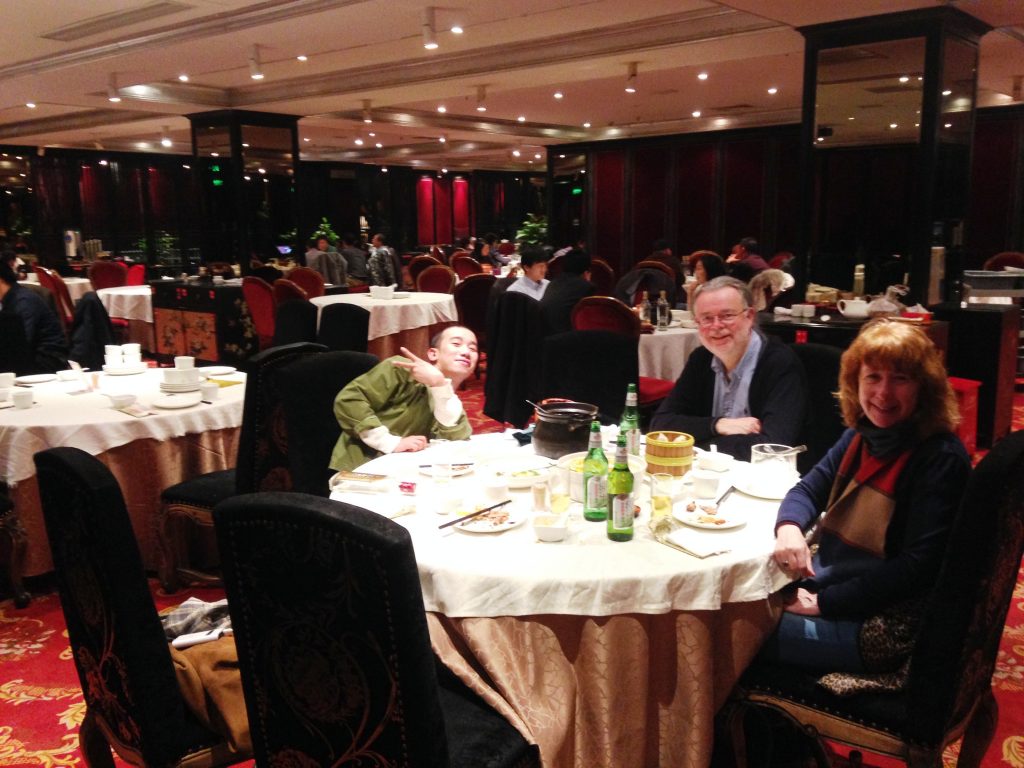
Zhao planned to spend the night outdoors, watching the stars and the sunrise. It didn’t take long to persuade me, even though I didn’t have a sleeping bag. With the help of Zhao, I rented my room to another Chinese couple who needed accommodation. Then we decided to spend the money I regained from the hotel room on a good dinner. Finally, I could share a table with a Chinese friend, before I knew it, we had six dishes on the table, among other things, fried scorpion.
Me eating scorpions
It was a cold night, but one I will never forget. It was not only me and Zhao who slept outside. It was not a sea of people, but enough to call it a community, a community that was equally excited to watch the stars, and the beautiful sunrise.
Socializing in rastaurants About a month later, I had settled down in Shanghai and lived in a collective with two other Norwegian exchange students from the University in Bergen. The night we had signed a lease for our new apartment, we went out to celebrate. After a few beers, it was time for some supper. Late at night in a Turkish restaurant, we sat next to another table with four Asians, and one standing next to it, a little drunk, who tried to make a scene. He scolded the table next to us, who was just trying to enjoy their meal. Finally, he was shown out by the staff. “What was that all about?” we asked the neighboring table. “Just someone who had a little too much to drink and looked for trouble,” they replied. Suddenly we were in a conversation with the neighboring table.
I pulled up my cellphone to show a picture of Bergen when someone at the table said “Hey, I know that sticker” and pointed to a sticker I had on the front of my cellphone. “Ghostly International, one of my favorite record labels,” he said. What a coincidence, it was also one of the record companies I like best! We started talking about music, one of my biggest passions, and quickly realized that we had a lot in common. Chen, nicknamed “C.C”, ran a cafe in a loft in Shanghai, “The Attic”. He gave me his business card, “Check it out!” he said. Well, of course I’ll do that, I thought, a little drunk.
C. C. and his dog Haru
C.C and The Attic
Some days went by, a few weeks went by, I was so distracted by the new school, new friends, a new language, a new city, so C.C. and “The Attic” were somehow forgotten. A few months later, one beautiful spring day, I was on a bar crawl with a friend from Brazil. We walked around the streets of Shanghai and jumped from bar to bar. At one point, we saw something that looked like a party on a roof terrace on the 6th floor in a low high rise, for Chinese standards. It looked lively, we thought, should we check it out?
We walked over to the building, where there was a restaurant on the ground floor, and some other dining places and offices on higher floors. There were no signs for the 6th floor. Let us check it out regardless, we thought. We went into what was known as Shanghai’s smallest elevator, just enough space for three people shoulder to shoulder, and took it up to the 6th floor. A lively gathering of people from all over the world met us on the little roof terrace we had seen from the street. We were not greeted with staring eyes, indicating “who are you and what are you doing here?” rather “welcome up!”
On the other side of the roof terrace was a small door that went into an attic with sloping ceilings. I walked in the door and who was sitting in the corner serving coffee and drinks, none other than C.C.! Instantly I went over to him, “So you finally came through huh!” he said to me. “Yes, I only wish I had come sooner!” I answered. In the Attic there were white painted walls, homemade furniture, art objects, vinyls, used clothes, a sofa corner and a small bar corner. I immediately felt a form of belonging. A place you could be yourself, meeting exciting, creative people from all over the world.
It wasn’t long before I became a regular at The Attic. C.C., ten years older than me, took me under his wings, and introduced me to a vast network of exciting people, taught me Chinese language and culture, how to DJ and some barista skills. He became a mentor, an older brother, a close friend. C.C. even took my parents on a trip when they visited me in China, while I was busy writing my bachelor thesis. He took me to his hometown and introduced me to his family. We still communicate regularly, 6 years later. I wait for him to have the opportunity to come to visit me here in Norway.
Me with Ms. Lin’s dumplings, while she is being camera shy in the background
A Potato story
Fast forward a few more months. My Norwegian roommates had moved out, and I was living with a young Ukrainian man and a Chinese girl. Me and Artiem, was his name, were going to cook dinner after a workout. The nearest supermarket was a little out of the way, we had to go into a mall and up to the second floor, to get to a giant market called Carrefour (French version of Wallmart).
On our way home, three minutes from the apartment, we discovered that we had forgotten to buy potatoes, an essential ingredient for what we were about to make. We were close to one of our favorite restaurants, where we ate about twice a week. It was run by Chinese Muslims, who served food from the Xinjiang region, located in the north-west of the country. They knew us well since we were regulars. “Should we ask if we can buy some potatoes from them,” we thought.
We walked into the restaurant and asked with broken accents if we could buy some potatoes. “Buy potatoes, from us?” asked the waitresses as they scratched their hair. “Wait a minute,” they told us. Okay, we thought, they will probably ask the boss. Two minutes later, they returned with a bag full of potatoes, and a freshly cooked potato for each of us. What a great service, we thought, then asked how much. “No no no, no payment,” they insisted. After a little back and forth, we took the potatoes and said, “thank you very much, we will come and eat here tomorrow!”
During the three-minute walk home we peeled and ate our freshly cooked potatoes. We passed a retired Chinese couple, who stared at us with big, curious eyes. They wondered what we were eating, whether it was actually boiled potatoes. “Yes,” we replied, “we got them from the restaurant on the corner over there”. Suddenly we were talking to this couple, who lived in a block in front of us, turned out we were neighbors.
Giving private lessons in English
We told them that we were exchange students who were in Shanghai to learn Chinese. They had a grandson who learned English and wondered if we would help him with his English lessons, then they could help us learn Chinese. “Of course!” we answered. The following Sunday, we turned up outside Mr. and Mrs. Lin’s apartment.
When they opened the door, they greeted us with big smiles and it smelled of home cooked food. Mrs. Lin was making 48 dumplings and asked if we would like to help prepare them, after a cup of tea in the living room. In the living room, I got caught up with Mr. Lin, who eagerly told me about his personal war stories. With my limited language skills, I tried as best I could to keep up, but I was struggling, something Mrs. Lin quickly picked up. “End your old stories,” she said, “they don’t understand anything! Come into the kitchen instead and I’ll teach you how to make dumplings. ”
This developed into a long-lasting friendship, we were frequently invited Sunday guests with the Lin couple. We helped the grandson, Wang, with his English homework, which he initially thought was a bit scary, but eventually became less and less scary. In return, we got to practice our Chinese, and often got some amazing good food served too.
Stories of humanity
These are stories of humanity. In times like this, with increasing protectionism and localism, with borders being closed, it is easy to resort to xenophobia. It is important to remember that we are all of the same kind, have the same needs and feelings. The generation of the Lin couple has gone through war, misery, hunger and need. It is a challenge for our generation to undergo restrictions to our freedom for the first time, but it is also important to think of all the good we have that we must not take for granted.
Take care of your mental health, show love to those around you, have a routine, a reason to get up in the morning, and be creative. Use this crisis to train your body and soul, both of which can be done at home. Though you may have to give yourself an extra push in the back to take action, maybe now is the time to slow down, evaluate what truly matters and continue on with open hearts.
Charlie Mandelid
Stories From a Young Norwegian’s Stay in China, is written by Charlie Mandelid for Daily Scandinavian. Charlie is an enthusiastic traveler with a special interest in China. He studied at Fudan University and Jiaotong University and ended his stay in China with an engagement with the Norwegian Foreign Ministry in Guangzhou. With a master’s degree in International Studies and Diplomacy, Charlie enjoys topics like international politics, sustainability, the Arctic and the Sino-Norwegian relationship.
Charlie Mandelid has a wide range of understanding and contacts to help enterprises understand how to successfully work with Chinese businesses. His source of information comes from his direct experience living in China for 3 years and his wide knowledge of commerce and regulations in China.
By the age of 25, Charlie has lived on five different continents, contributing to his global mind and spirit. He is also a musician with a passion for culture, languages, and food.
Norwegian photographer Arne Normann left his wife, children and newborn lambs in 1946 to travel all over Norway in a 1946 Chevrolet van with darkroom and bed in an assignment to make the best postcards from Norway. Between 1946 and 1990 he took approximately 300,000 pictures of Norwegian scenes.
In earlier times, you would not have traveled if you had not sent a postcard to family or friends back home. And many of the postcards that were posted in the last century had photographs taken by father and son Carl and Arne Normann, among Norway’s most prolific postcard photographers of all time.
Milkmaid’s Sunday
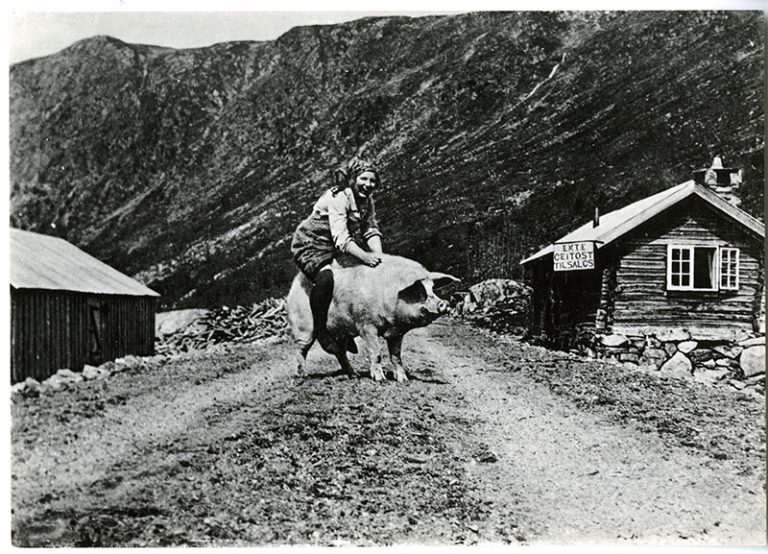
Despite texting and emailing, travelers still send postcards. Through the years, three Norwegian postcards have become venerable favorites. In sales, the all-time star is Seterjentens søndag (Milkmaid’s Sunday – feature image on top), featuring a black-and-white photo taken in 1932. More than two million have been sold. The photographer is said to be Fredric Hanche, but the publisher was Normanns Kunstforlag, founded by Carl Normann in 1906. (feature image on top).
Arne Normann, From Otta, Gudbrandsdalen
Normann’s art publishing company was for many years one of the largest companies in sales and postcard production in Norway together with Aune and Mittet. The company was sold to Fjellanger Widerøe in the 80s and is today owned by Swedish Pictura AB.
Best of Norway in Glorious Pictures
The book, Best of Norway in Glorious Pictures, is supplemented by text written by Inge Stikholmen filled with informative facts about the country. Majestic fjords, waterfalls, glaciers, green valleys, renowned ski slopes, charming coastal towns, and a culture-laden city capital are only an introductory indication of what Norway has to offer.
Arne Normann, From Jevnaker
“The postcards made by father and son Normann are of the very best and most important ones made, also photographically,” says art historian and author Ivar Ulvestad.
Father and son Normann
Carl Normann was 16 years old when his mother, stepfather and siblings emigrated to the United States in the early 1900s. Carl did not want to go and stayed in Norway. On bicycle he traveled all around the country and took pictures with his Ernemann glass plate camera.
Arne Normann, From Geiranger
The Best of Postcards from Norway
In 1035, an extensive archive of images that he had taken over more than 30 years burned, and Carl and his son Arne had to go on tour again with their Linhof cameras. In the years following the war, Arne Normann had around 250 travel days a year.
Arne Normann, Norwegian national costumes
On July 30, 1990, Arne Normann was a passenger in a Cessna plane over Lillehammer. Arne Normann, 78, perished together with the pilot and another photographer.
The variety of plant life on Bornholm is astounding. The northern part of the island is extremely rocky and by radiating heat picked up from the sun, the rocks keep the surface warm enough for figs, grapes, mulberry, trees and other plants from Southern Europe to grow well. Read more about the wonderful plant rich island in Denmark.
Sweet cherry trees blossom in June and give a colorful show. Red orchids are common on the banks, in the river valleys and thousands of woodland flowers, especially blue, yellow and white anemones, cover large areas. About 25 percent of Bornholm is woodland.
Almindingen In the center of the island is Almindingen, Denmark’s third largest forest. However, Paradisbakkerne is wilder in vegetation than Almindigen and is best enjoyed on foot. Small farms are scattered all over the island.
Skt. Nikolai Church
Rønne The largest town on Bornholm with 14,000 inhabitants is Rønne. Its harbor is one of the largest provincial ports in Denmark. Some parts of the town have been well preserved, especially in the area just east of Skt. Nikolai Kirke. The beautiful Kastellet is on the east side of town. Today it is a military museum, Forsvarsmuseet.
Bornholm, by Danish painter Oluf Høst. Photo: Store norske leksikon
Bornholm has inspired many Danish painters, as well as having produced a few of its own. Oluf Høst is the best known. Bornholm Museum and its collection of paintings and exhibits from prehistory onwards, relating to the island’s past is worth visiting. It also includes a charming model of the Bornholm railway.
Hammershus is notable for its sandstone baptismal front depicting the life of Christ in 11 relief carvings
Åkirkeby The main town in the southern part of Bornholm is Åkirkeby with a population of 2,100. It is the only one of the larger towns situated inland. It was an ecclesiastical center, and its church Åkirke, was built around 1150 as a chapterhouse in the Archbishopric of Lund. The large tower was extended around 1200, and at the same time it was fortified with walls even heavier than those of Hammershus. It is notable for its sandstone baptismal front depicting the life of Christ in 11 relief carvings: the figures are explained in runic script, and end with the signature of the stonecutter, “Sighraf, master”.
Åkirkeby’s other attraction is NaturBornholm, a superb interactive visitor center that explains the island’s history, wildlife and geology. The building was designed by Hemming Larsen, architect of Copenhagen’s Opera House.
Denmark’s easternmost town is Svaneke
Svaneke Denmark’s easternmost town is Svaneke which prospered with the success of the shipping captains. The largest buildings were originally merchants’ homes. Today it’s the prettiest town on Bornholm, famous for an abundance of artists’ workshops and its lively craft market from Wednesdays to Sundays in summer.
North of the town is an old Dutch mill, and nearby an untraditional water tower, built by the architect Jørn Utzon in 1951.
Gudhjem (God’s home) is another very picturesque place
Gudhjem Cycling downhill is forbidden in Gudhjem (God’s home), another very picturesque place, built on steep slopes down to the water. Windmills around the town once provided electricity.
Bornholm’s most famous artist is celebrated at the Oluf Høst Museum, housed in the painter’s former studio.
There is an open-air agricultural museum, Landbrugsmuseet Melstedgård, just southeast of Gudhjem at Melstedt, complete with horses, pigs and poultry.
Northwest of Gudhjem, the excellent Bornholms kunstmuseum, perches on a craggy outcrop above the sea and houses a worthwhile collection of artwork from the Bornholm School, ranging from the 1800s to the present.
Grønbechs Gård (Bornholm’s Center of Arts and Crafts), an old merchant’s house in Hasle, showcases the work of the island’s artists and designers, with changing wood, ceramics, jewelry, glass and textile exhibitions.
Feature image (on top): From Bornholm, copyright PXhere
The Wonderful Plant Rich Island in Denmark, compiled and written by Tor Kjolberg
“A specialist in versatility” perfectly sums up the long and totable career of the multi-talented Danish architect and designer Louis Weisdorf (born in 1932). Read this profile of the Danish designer and architect – a specialist in versatility.
In 1954, aged 22, Louis Weisdorf was one of the youngest ever graduates of Copenhagen Royal Academy of Fine Arts. He went to work for Poul Henningsen, the creator of the iconic PH5 pendant, and assimilated ideas that would influence his own philosophy. A couple of years after graduation, he was a couple of years into a 10-year assignment at the city’s amusement park, Tivoli Gardens. At 31, he made the drawings for Konkylie, the first of his light designs.
Inspired by Poul Henningsen
“I was very inspired by Poul Henningsen. My lamps were mostly designed with his principle not to have the light shine directly in your eyes, but indirect. So, the light is covered,” says Weisdorf.
Weinsdorf has worked with everything from graphic, interior- and industrial design, to recreational areas as most fields within the building trade, so he was well prepared when the time came to present his own light designs.
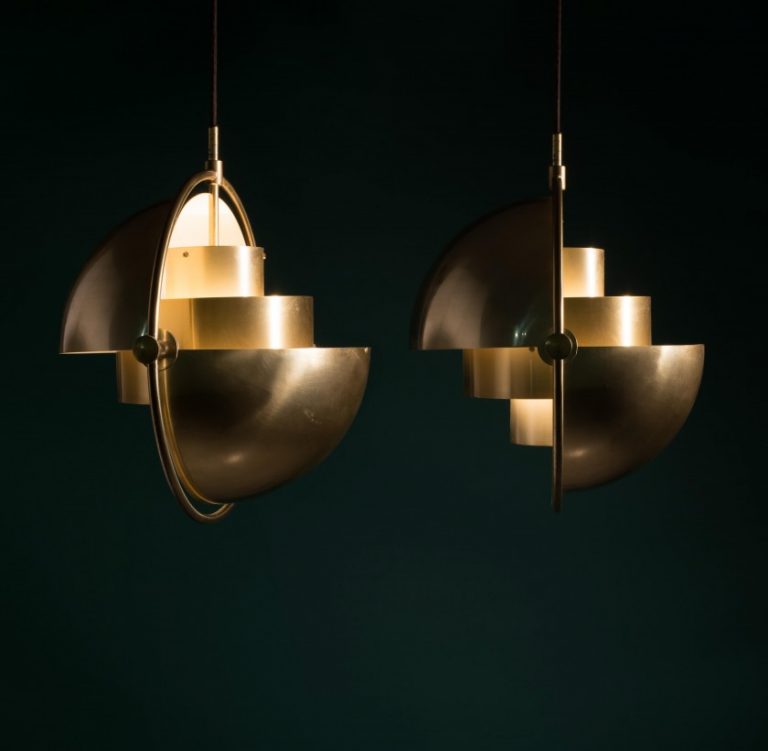
The original Konkylie (Conch) Hanging Light for Tivoli. Gardens was made of 12 identical flat loops of brass. Here’s a modernized version.
The Konkylie (Conch) Hanging Light for Tivoli Gardens was made of 12 identical flat loops of brass assembled each on its own tier to form a hollow globe resembling a conch shell. It was shiny on the outside and yellow and orange on the inside. The lamps were hung around the park and emitted a spectacular light. A few still hang there.
“I was very inspired by Poul Henningsen.” said Poul Weisdorf
Repeating elements
“I was drawn to designing lamps built from repeating elements, looking for a solution where you could combine the vertical suspension with uniform slats. The result was the Konkylie,” Weinsdorf explains.
After Konkylie was produced, a claim was made that Weisdorf had borrowed its design from the Moon Pendant by Verner Panton, for whom Weisdorf also had worked. Weisdorf sought judgment from his old mentor, Henningsen, who delivered a Solomonic verdict. “I do not think that either of them is a lamp,” he pronounced. “I would rather call them ladies’ hats. And as ladies’ hats, they are quite different.”
Worked closely with many designers
In the late 1960’s, Weisdorf set up his own design studio in Copenhagen and worked closely with many designers including Verner Panton, Poul Henningsen and Le Klint. Then came the Facet, consisting of 18 identical metallic elements, each a long punched and bent piece that fits into the next one, and that into the next, until a cylinder is formed. Light emerges through small gaps between the pieces, revealing the interior colors.
Weisdorf’s favorite lamp is his Turbo Pendant (1967)
Weisdorf’s favorite lamp is his Turbo Pendant (1967), consisting of 12 uniform aluminum lamellae spiral-twisted to form a flower-like sphere. The Turbo was partly inspired by Japanese rice-paper lanterns.
However, Weisdorf is best known for the Multi-Lite (1972), which departs from his other designs. It maintains a dynamic quality, but rather than deriving it from a fixed design element, it features two adjustable shells that allow users to change its profile at will.
The Ekko (1968) is another of Louis Weisdorf’s designs based on repeating – or echoing – elements, though in this case the angular metallic sections take two forms, the two end pieces differing from the three central ones.
Ekko, by Louis Weisdorf
Danish designer and architect – a specialist in versatility
Weisdorf designed lamps for about 15 years in a diverse 60-plus-year architecture career that has included the design of homes, schools and two amusement parks. Today, Weisdorf lamps are collectors’ items and can be bought on auctions. And in specialty shops.
Danish Designer and Architect – A Specialist in Versatility, written by Tor Kjolberg
It’s official — coming in just behind Italy, Swedish people are the second most tattooed in the world. An incredible 47% of Swedes have at least one tattoo. In fact, the average number of tattoos is four. Read more about Sweden: The Second Most Tattooed Country In The World.
In Stockholm, there is an enormous tattoo culture — it has even been called the tattoo city of the world. There are more than 50 tattoo studios in the city where you can get inked with some incredibly reputable designers and guest artists from all over the world, making tattooing an undeniable component of Swedish culture.
In Stockholm, there is an enormous tattoo culture. Photo: Lucas Lenzi/Unsplash
Why do so many people have tattoos? Stockholm is a unique and creative city where people really want to express themselves. Through body artm they are not only showing their individuality, but also celebrating the things that make life special. The oldest form of body decoration has certainly never gone out of fashion — there is even evidence that the Swedish vikings from 900 years B.C. had ink. They had tattoos from the necks down to the tips of their fingers, particularly in dark green colours, and images of trees and knotwork were extremely common.
Tattoo studios in Stockholm In modern-day Stockholm, there is an incredible choice of tattoo studios to choose from. Salong Betong is often frequented by well-known celebrities and musicians. They specialise in black and grey work and are particularly good for portraits. Last time the Guns ‘n’ Roses ex-guitarist Slash was in town, he headed to Catapult Tattoo for some ink. Moreover, two of the artists at the studio, Emilia and Fabbe, took part in the television show “Master Ink.”
There are more than 50 tattoo studios in Stockholm. Photo: Tattoo View, Stockholm
Stockholm Ink Bash Every year in August, there is a three-day tattoo convention that attracts some of the best artists and designers in the business. This year is the 24th year for Stockholm Ink Bash. This tattoo-extravaganza showcases 15 different categories in competition from “Best of New School” to “Best of Neo Traditional”. It gives professionals in the industry a great platform for showcasing their work. It also gives the customer the opportunity to get inked by some of the iconic names in tattooing. If you are addicted to the buzz of the needle, it is a great event with some first-class entertainment.
Stockholm is a unique and creative city where people really want to express themselves. Photo: Stockholm Ink Tattoo Studio
Sweden: The Second Most Tattooed Country In The World
Tattoos are deeply ingrained in the culture of Stockholm. You can walk down the street and be inspired by all of those full sleeves that you will see strutting around town, and perhaps you’ll even feel the need to take part and get inked yourself!
Karoline Gore
Sweden: The Second Most Tattooed Country In The World is written for Daily Scandinavian by Karoline Gore. Karoline is a freelance writer from Stoke on Trent in the UK who left the corporate grind when she started a family and has never looked back. She enjoys contributing to a range of online publications on the topics that are important to her.
Sweden is the last country in the world where business is as usual. How long can the country avoid a catastrophe? Global attention has been drawn to Sweden with their approach while Denmark and Norway have imposed extensive restrictions. Read more about the Coronavirus an Sweden with its business as usual approach.
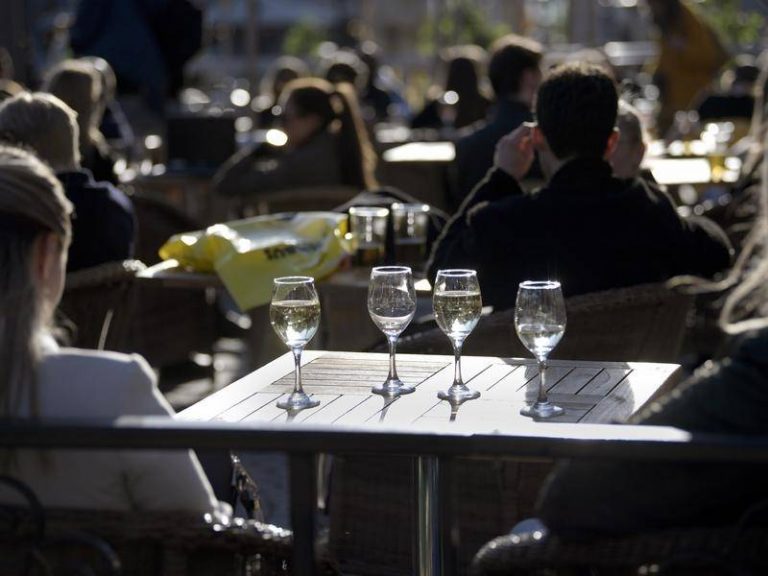
In Stockholm, young people have been gathering everywhere in the city and enjoying bubbles from pavement seating and families have been tucking into ice creams in the popular squares. From this week on, however, gatherings for more than 50 people are banned.
Traffic on the Øresund Bridge, linking the Swedish city of Malmö and Copenhagen, has also fallen considerably. Denmark is under coronavirus lockdown and has strict border controls. The Swedish side, however, remains open. But not many are making that journey now.
. Prime minister Stefan Löfven has urged Swedes to behave “as adults”
Also, neighboring Norway has placed extensive restrictions on its borders while Sweden took a decidedly different path. However, things are noticeable quieter on the roads in Sweden now. Passenger numbers on Stockholm’s public transport is said to have fallen by 50% and polls suggest almost half of Stockholmers are remote working.
Nevertheless, last weekend, couples strolled arm in arm in the spring sunshine in Malmö and the cafes did a brisk trade. Inhabitants enjoyed picnics and barbeques and playgrounds were rammed, no one wearing a mask.
Sweden has only shut its high schools and colleges and kept its preschools and grade schools open, while Denmark and Norway have told all students to stay home.
Business owners, however, understand their responsibility, and the state-funded company Stockholm Business Region that supports the capital’s global business community estimates that the number of people working from home rises to at least 90% in the city’s largest companies.
Shocking images from hospitals in Italy and Spain seem slowly to have slayed public fears, but the government’s strategy seems to be self-responsibility. Public health authorities and politicians are still hoping to slow down the spread of the virus without the need for draconian measures. Prime minister Stefan Löfven has urged Swedes to behave “as adults” and not to spread “panic or rumors”.
Yesterday, Norway, population 5.3 million, had 1308 coronavirus cases and 32 deaths; Denmark, population 5.6 million, reported 2,577 cases and 77 deaths; Sweden, with 10.12 million people, recorded more than 4,028 cases and 146 deaths.
Last week, a petition signed by more than 2,000 doctors, scientists, and professors – including the chairman of the Nobel Foundation, ProfCarl-Henrik Heldin – called on the government to introduce more stringent containment measures. “We’re not testing enough, we’re not tracking, we’re not isolating enough – we have let the virus loose,” said Prof Cecilia Söderberg-Nauclér, a virus immunology researcher at the Karolinska Institute. “They are leading us to catastrophe.”
In Sweden, there have been more guidelines than strict rules, with a focus on staying home if you’re sick or elderly, washing your hands, and avoiding any non-essential travel, as well as working from home. Stoicism has been a way of life, and the average Swede believes in the authorities’ decisions.
“The problem with a lockdown like it’s been done in Denmark and Norway is you tire the system out,” said Anders Tegnell, Sweden’s chief epidemiologist, who is leading the government’s handling of the crisis and advocating a strategy of mitigation. “You can’t keep a lockdown going for months – it’s impossible,” he concluded.
“Doesn’t Sweden take the corona crisis seriously?” asked the Danish newspaper Politiken in a headline recently.
Demography may also be a relevant factor in Sweden’s approach. In contrast to the multi-generational homes in Mediterranean countries, more than half of Swedish households are made up of one person, which cuts the risk of the virus spreading within families. However, that is also the case in Denmark and Norway.
Anders Tegnell says Sweden has the crisis under control
While there is a constant reappraisal of the situation, Tegnell says Sweden has the crisis under control. “Sweden’s approach appeals to the public’s self-restraint and sense of responsibility. That’s the way we work in Sweden,” he explains.
“The business community here really thinks that the Swedish government and the Swedish approach is more sensible than in many other countries,” says Andreas Hatzigeorgiou, CEO at the Stockholm Chamber of Commerce.
The dilemma is summed up by Orla Vigsö, a professor of crisis communications at Gothenburg University: “People are starting to ask: are others stupid and paranoid? Or is Sweden doing it wrong?”
Coronavirus in Sweden: Business as Usual, written by Tor Kjolberg
Freelance writers have the freedom to go anywhere in the world. The beauty of this occupation is that you aren’t tied down to one place. You can go anywhere you like, do your job, and enjoy your freedom. Traveling can be very beneficial for freelance writers since working from home can be monotonous. That’s why you need to get yourself out there and choose a beautiful place for your work environment. Read more about the top Scandinavian destinations for freelance writers.
If you are looking for your next destination, Scandinavia can be the perfect pick. Whether you prefer big cities or natural landscapes it offers it all. Let’s take a look at some of the best destinations for freelance writers in Scandinavia.
Lysekil: The sea has a relaxing effect on almost everyone. Photo: Anna Zcanowicz/Unsplash
Lysekil, Sweden If you are looking for a quiet place to relax and listen to the sound of waves, you can find that in Lysekil. This little picturesque fishing town is like a destination from your dreams.
It has a rich history since it dates back to the 16th century. In your free time, walk around the charming neighborhood in the old town and admire the beautiful architecture.
The sea has a relaxing effect on almost everyone so take your laptop, sit by the coast, and let your imagination run wild.
Gotland has the most sunlight during the year in all Sweden. Photo: Visit Sweden
Visby, Sweden Seclude yourself on Gotland island and find your peace in Visby. Visby is actually the only city on this island. It can serve as a starting point from where you can explore the island.
Some of you may be worried about Sweden’s reputation that it is gloomy and lack the sunlight. In that case, head to Visby. Gotland has the most sunlight during the year in all Sweden so it is perfect for sun-seekers.
“I was surprised by how much this island has to offer. Whenever I wasn’t busy with writing I was roaming around the island. Believe it or not but there are around 100 medieval churches and numerous prehistoric sites. How cool is that?” shared Estelle Liotard, a writer at TrustMyPaper.
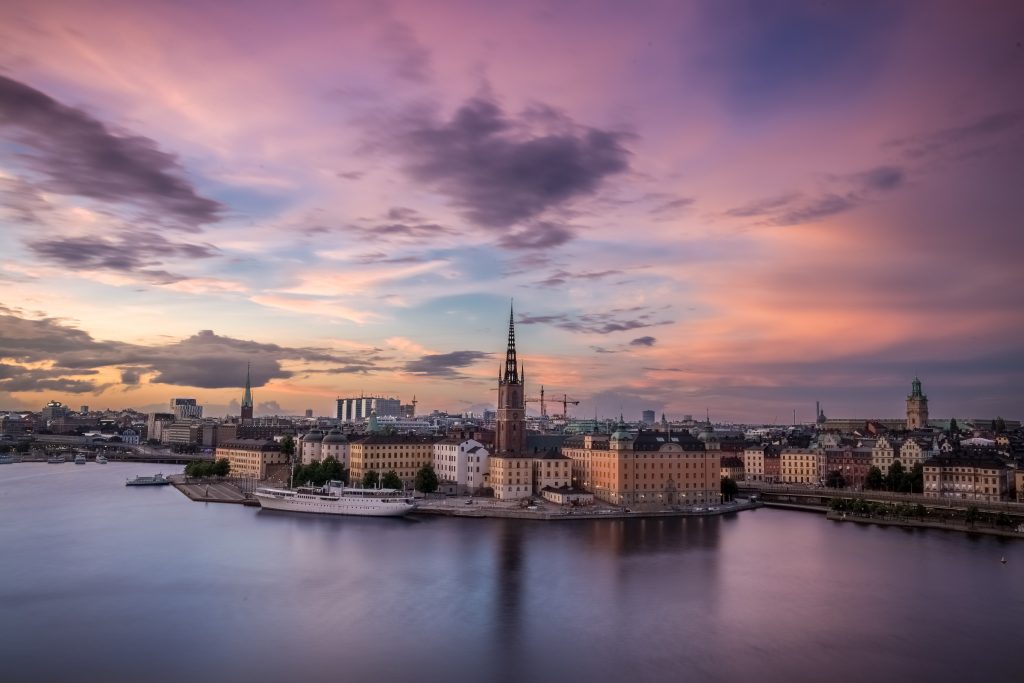
Stockholm is one of the most developed cities and the largest city in Scandinavia. Photo: Raphael Andres/Unsplash
Stockholm, Sweden We simply can’t talk about Sweden and not mention Stockholm. Stockholm is one of the most developed cities and the largest city in Scandinavia. The city is known for its technological advances, sustainability, and rich cultural heritage.
Many cafes are adapted to the needs of freelancers. Here are the most popular choices among the local freelancers:
Kaffeverket
Il Caffè
Coffice
Gast
Café Pascal
Stockholm can offer you all the amenities of the typical capital but it also has natural landscapes, clean air, running and bike trails and so much more. One is certain, you will never be bored in this city. Whether you like activities that keep your body moving, drinking coffee, eating good food or visiting museums, Stockholm has it all.
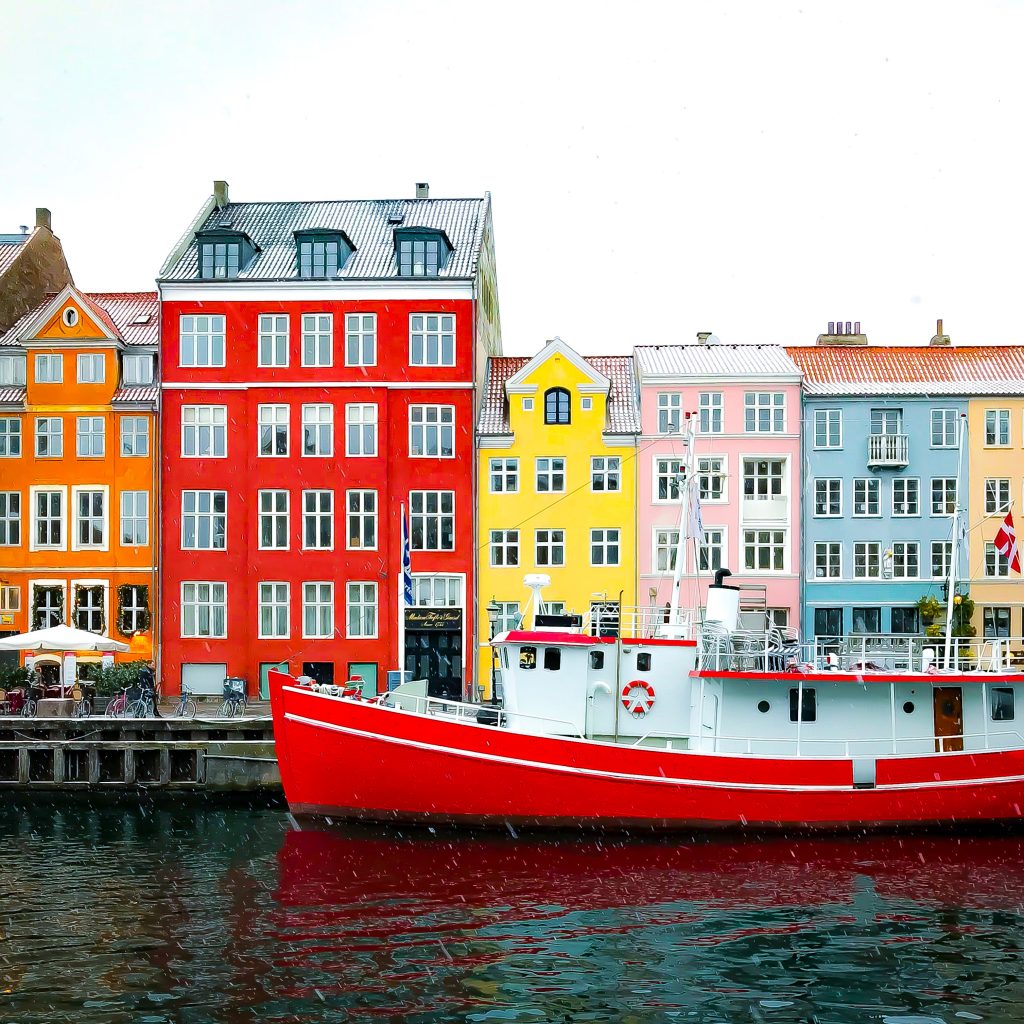
The capital of Denmark sits on the coastal islands of Zealand and Amager. Photo: Maksym Potapenko/Unsplash
Copenhagen, Denmark While we’re talking about the big cities, Copenhagen must be mentioned. Copenhagen is the capital of Denmark and it sits on the coastal islands of Zealand and Amager.
Melanie Sovann, a writer at GrabMyEssay explained why Copenhagen is her favorite travel destination, “Copenhagen has to offer some great coworking spaces. Even if you travel alone, you can be surrounded by people who are in the freelancer community. I actually met some great friends there.”
Check out these coworking spots if you do end up in Copenhagen:
Greencubator
KPH Projects
The Camp
Founders House
Republikken
Besides finding your workplace, you must find a way to make the most of your free time. What you must visit when in Copenhagen are Tivoli Gardens, The Little Mermaid landmark. Nyhavn harbor, Den Blå Planet National Aquarium, King’s Garden, and City Hall Square.
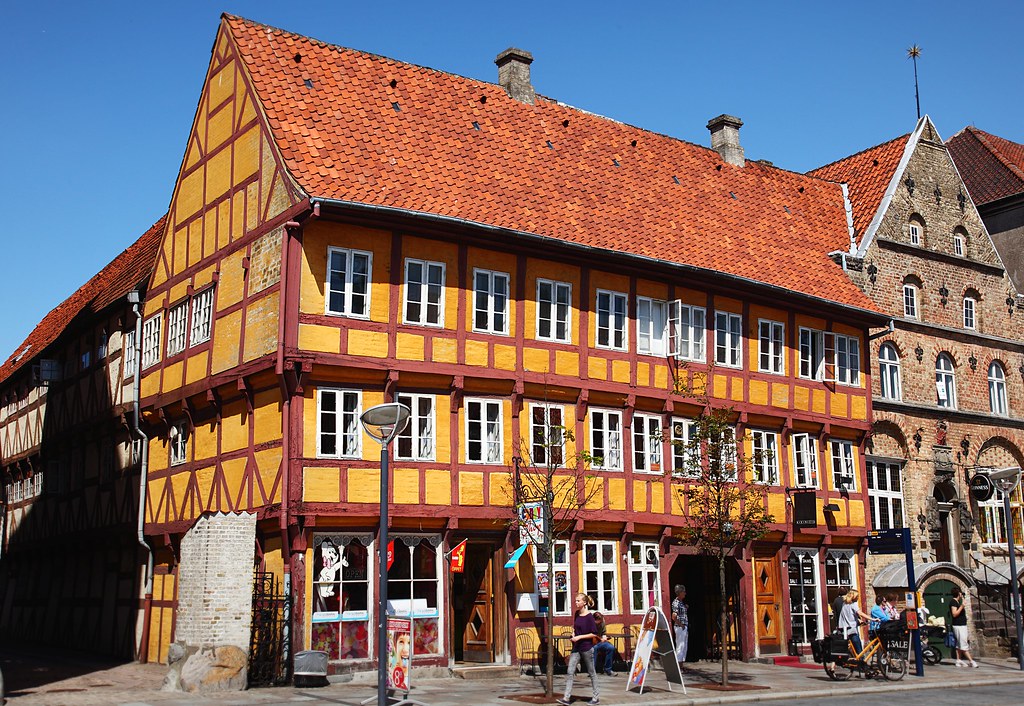
This ancient Danish city Aalborg is a cultural and industrial center. Photo: Flicr
Aalborg, Denmark This ancient Danish city is a cultural and industrial center. Maybe you’ve heard about Aalborg Carnival, the largest festival in Scandinavia that takes place in Aalborg.
Maybe your inspiration for writing is powered by art and music. If that’s the case then you’ll love Aalborg. It is known for opera, theatre, and symphony.
Absorb the incredible sight of half-timbered mansions. It will make you feel as if you have traveled back in time. You can come across some impressive old buildings such as:
Aalborghus Castle, a former royal residence from the 16th century
Budolfi Church (built on the ruins of an old Viking church) from the 14th century
Jens Bang’s 17th century Dutch Renaissance home
Mayor Jørgen Olufsen’s half-timbered and sandstone house from the 17th century
The historic sites can easily motivate you to take your writing skills to the next level and maybe even try to write a book. If you need some help with the writing process you can turn to writing services such as Studicus, WowGrade, SupremeDissertations, and BestEssayEducation. You can even turn the pictures you have taken into a book cover. Editing and design tools like Canva and PickMonkey can help you with that.
Bergen is the best pick for all of you who are aiming for a town-like destination. Photo: Visit Bergen
Bergen, Norway You can’t help but fall in love with this colorful city. Replace your routine-based life with an adventurous city like Bergen.
When you hear that it has around 280,000 inhabitants you may think that it is too small. However, its great position with water on one side and mountains on the other explains why so many people are attracted to this place.
Bergen is the best pick for all of you who are aiming for a town-like destination. Just enjoy the simple life and completely surrender to your writing business.
Dorian Martin, a senior writer at IsAccurate business translation service shared how he got mesmerized with Bergen, “When I decided to use the advantage of freelancing and live a few months abroad, I chose Bergen on a whim. It turned out to be the perfect place. Whenever I can, I go back to this city, just me and my laptop.”
Top Scandinavian Destinations for Freelance Writers – Some Final Thoughts Changing your place of work that is your home for a new location can be a motivating journey. As you can tell, Scandinavia has so much to offer and you won’t be disappointed by any of these places.
Even writers who feel like they are in a rut and need to get their creative juices flowing can make that happen by visiting a new destination. These incredible cities and sights that surround them can bring out the best in anyone.
Helene Cue
Top Scandinavian Destinations for Freelance Writers, written for Daily Scandinavian by Helene Cue. Helene is a passionate writer and editor who explores a broad spectrum of topics that revolve around marketing and tech. She currently works as an in-house writer and a content marketing specialist. Her pieces are always captivating and informative.
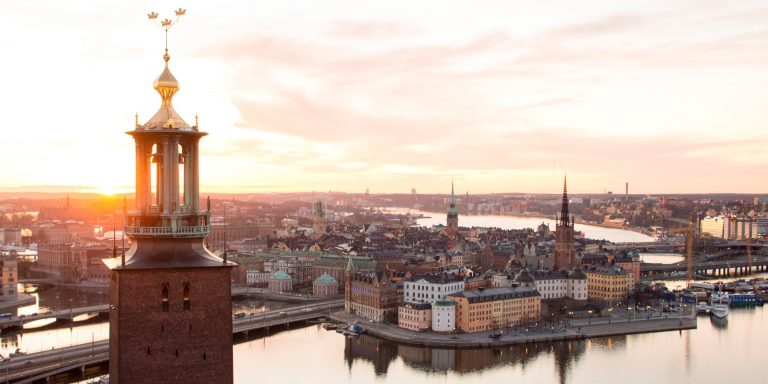
Feature image (on top): Stockholm. Photo: LinkedIn