
Danish Designer and Architect – A Specialist in Versatility

“A specialist in versatility” perfectly sums up the long and totable career of the multi-talented Danish architect and designer Louis Weisdorf (born in 1932). Read this profile of the Danish designer and architect – a specialist in versatility.

In 1954, aged 22, Louis Weisdorf was one of the youngest ever graduates of Copenhagen Royal Academy of Fine Arts. He went to work for Poul Henningsen, the creator of the iconic PH5 pendant, and assimilated ideas that would influence his own philosophy. A couple of years after graduation, he was a couple of years into a 10-year assignment at the city’s amusement park, Tivoli Gardens. At 31, he made the drawings for Konkylie, the first of his light designs.

Danish Designer and Architect – A Specialist in Versatility
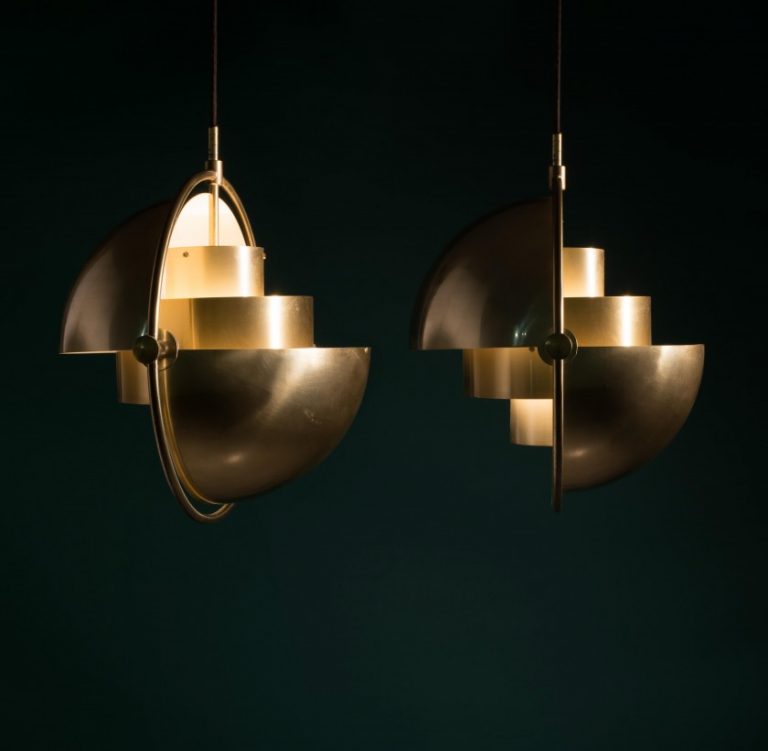
Multi light pendant by Louis Weisdorf

Related: Best in Scandinavian Design

Inspired by Poul Henningsen
“I was very inspired by Poul Henningsen. My lamps were mostly designed with his principle not to have the light shine directly in your eyes, but indirect. So, the light is covered,” says Weisdorf.

Weinsdorf has worked with everything from graphic, interior- and industrial design, to recreational areas as most fields within the building trade, so he was well prepared when the time came to present his own light designs.

Danish Designer and Architect – A Specialist in Versatility
The original Konkylie (Conch) Hanging Light for Tivoli. Gardens was made of 12 identical flat loops of brass. Here’s a modernized version.

The Konkylie (Conch) Hanging Light for Tivoli Gardens was made of 12 identical flat loops of brass assembled each on its own tier to form a hollow globe resembling a conch shell. It was shiny on the outside and yellow and orange on the inside. The lamps were hung around the park and emitted a spectacular light. A few still hang there.

Related: Portrait of a Norwegian Designer

Danish Designer and Architect – A Specialist in Versatility
“I was very inspired by Poul Henningsen.” said Poul Weisdorf

Repeating elements
“I was drawn to designing lamps built from repeating elements, looking for a solution where you could combine the vertical suspension with uniform slats. The result was the Konkylie,” Weinsdorf explains.

After Konkylie was produced, a claim was made that Weisdorf had borrowed its design from the Moon Pendant by Verner Panton, for whom Weisdorf also had worked. Weisdorf sought judgment from his old mentor, Henningsen, who delivered a Solomonic verdict. “I do not think that either of them is a lamp,” he pronounced. “I would rather call them ladies’ hats. And as ladies’ hats, they are quite different.”

Related: Norwegian Designer Makes Traditionally Knitted Reading Lamps

Worked closely with many designers
In the late 1960’s, Weisdorf set up his own design studio in Copenhagen and worked closely with many designers including Verner Panton, Poul Henningsen and Le Klint. Then came the Facet, consisting of 18 identical metallic elements, each a long punched and bent piece that fits into the next one, and that into the next, until a cylinder is formed. Light emerges through small gaps between the pieces, revealing the interior colors.

Danish Designer and Architect – A Specialist in Versatility
Weisdorf’s favorite lamp is his Turbo Pendant (1967)

Weisdorf’s favorite lamp is his Turbo Pendant (1967), consisting of 12 uniform aluminum lamellae spiral-twisted to form a flower-like sphere. The Turbo was partly inspired by Japanese rice-paper lanterns.

However, Weisdorf is best known for the Multi-Lite (1972), which departs from his other designs. It maintains a dynamic quality, but rather than deriving it from a fixed design element, it features two adjustable shells that allow users to change its profile at will.

The Ekko (1968) is another of Louis Weisdorf’s designs based on repeating – or echoing – elements, though in this case the angular metallic sections take two forms, the two end pieces differing from the three central ones.

Danish Designer and Architect – A Specialist in Versatility
Ekko, by Louis Weisdorf

Danish designer and architect – a specialist in versatility
Weisdorf designed lamps for about 15 years in a diverse 60-plus-year architecture career that has included the design of homes, schools and two amusement parks. Today, Weisdorf lamps are collectors’ items and can be bought on auctions. And in specialty shops.

Danish Designer and Architect – A Specialist in Versatility, written by Tor Kjolberg

Sweden: The Second Most Tattooed Country In The World

0

It’s official — coming in just behind Italy, Swedish people are the second most tattooed in the world. An incredible 47% of Swedes have at least one tattoo. In fact, the average number of tattoos is four. Read more about Sweden: The Second Most Tattooed Country In The World.

In Stockholm, there is an enormous tattoo culture — it has even been called the tattoo city of the world. There are more than 50 tattoo studios in the city where you can get inked with some incredibly reputable designers and guest artists from all over the world, making tattooing an undeniable component of Swedish culture.

Sweden: The Second Most Tattooed Country In The World
In Stockholm, there is an enormous tattoo culture. Photo: Lucas Lenzi/Unsplash

Related: Mr McTattoo

Why do so many people have tattoos?
Stockholm is a unique and creative city where people really want to express themselves. Through body artm they are not only showing their individuality, but also celebrating the things that make life special. The oldest form of body decoration has certainly never gone out of fashion — there is even evidence that the Swedish vikings from 900 years B.C. had ink. They had tattoos from the necks down to the tips of their fingers, particularly in dark green colours, and images of trees and knotwork were extremely common.

Tattoo studios in Stockholm
In modern-day Stockholm, there is an incredible choice of tattoo studios to choose from. Salong Betong is often frequented by well-known celebrities and musicians. They specialise in black and grey work and are particularly good for portraits. Last time the Guns ‘n’ Roses ex-guitarist Slash was in town, he headed to Catapult Tattoo for some ink. Moreover, two of the artists at the studio, Emilia and Fabbe, took part in the television show “Master Ink.”

Sweden: The Second Most Tattooed Country In The World
There are more than 50 tattoo studios in Stockholm. Photo: Tattoo View, Stockholm

You might also like to read: The Sophisticated Swedes

Stockholm Ink Bash
Every year in August, there is a three-day tattoo convention that attracts some of the best artists and designers in the business. This year is the 24th year for Stockholm Ink Bash. This tattoo-extravaganza showcases 15 different categories in competition from “Best of New School” to “Best of Neo Traditional”. It gives professionals in the industry a great platform for showcasing their work. It also gives the customer the opportunity to get inked by some of the iconic names in tattooing. If you are addicted to the buzz of the needle, it is a great event with some first-class entertainment.

Sweden: The Second Most Tattooed Country In The World
Stockholm is a unique and creative city where people really want to express themselves. Photo: Stockholm Ink Tattoo Studio

You may also like to read: Heavy Retro in Stockholm

Sweden: The Second Most Tattooed Country In The World
Tattoos are deeply ingrained in the culture of Stockholm. You can walk down the street and be inspired by all of those full sleeves that you will see strutting around town, and perhaps you’ll even feel the need to take part and get inked yourself!

Sweden: The Second Most Tattooed Country In The World
Karoline Gore

Sweden: The Second Most Tattooed Country In The World is written for Daily Scandinavian by Karoline Gore. Karoline is a freelance writer from Stoke on Trent in the UK who left the corporate grind when she started a family and has never looked back. She enjoys contributing to a range of online publications on the topics that are important to her.

Coronavirus in Sweden: Business as Usual

0

Sweden is the last country in the world where business is as usual. How long can the country avoid a catastrophe? Global attention has been drawn to Sweden with their approach while Denmark and Norway have imposed extensive restrictions. Read more about the Coronavirus an Sweden with its business as usual approach.

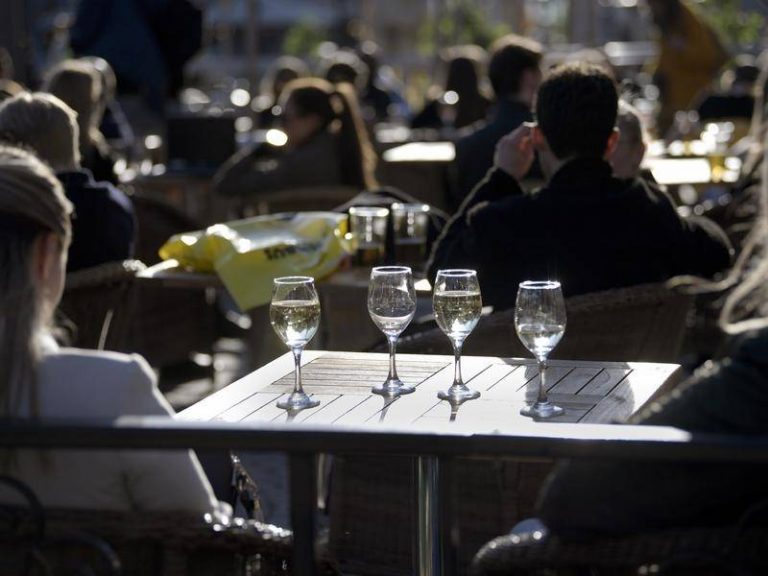
In Stockholm, young people have been gathering everywhere in the city and enjoying bubbles from pavement seating and families have been tucking into ice creams in the popular squares. From this week on, however, gatherings for more than 50 people are banned.

Traffic on the Øresund Bridge, linking the Swedish city of Malmö and Copenhagen, has also fallen considerably. Denmark is under coronavirus lockdown and has strict border controls. The Swedish side, however, remains open. But not many are making that journey now.

Coronavirus in Sweden: Business as Usual
. Prime minister Stefan Löfven has urged Swedes to behave “as adults”

Related: Coronavirus: What It Means For Your Visit To Scandinavia Ore Elsewhere

Also, neighboring Norway has placed extensive restrictions on its borders while Sweden took a decidedly different path. However, things are noticeable quieter on the roads in Sweden now. Passenger numbers on Stockholm’s public transport is said to have fallen by 50% and polls suggest almost half of Stockholmers are remote working.

Nevertheless, last weekend, couples strolled arm in arm in the spring sunshine in Malmö and the cafes did a brisk trade. Inhabitants enjoyed picnics and barbeques and playgrounds were rammed, no one wearing a mask.

Sweden has only shut its high schools and colleges and kept its preschools and grade schools open, while Denmark and Norway have told all students to stay home.

Business owners, however, understand their responsibility, and the state-funded company Stockholm Business Region that supports the capital’s global business community estimates that the number of people working from home rises to at least 90% in the city’s largest companies.

Coronavirus in Sweden: Business as Usual
Quiet Sunday in Stockholm

Related: Ikea Donates Millions To Ebola Fight

Shocking images from hospitals in Italy and Spain seem slowly to have slayed public fears, but the government’s strategy seems to be self-responsibility. Public health authorities and politicians are still hoping to slow down the spread of the virus without the need for draconian measures. Prime minister Stefan Löfven has urged Swedes to behave “as adults” and not to spread “panic or rumors”.

Yesterday, Norway, population 5.3 million, had 1308 coronavirus cases and 32 deaths; Denmark, population 5.6 million, reported 2,577 cases and 77 deaths; Sweden, with 10.12 million people, recorded more than 4,028 cases and 146 deaths.

Last week, a petition signed by more than 2,000 doctors, scientists, and professors – including the chairman of the Nobel Foundation, Prof Carl-Henrik Heldin – called on the government to introduce more stringent containment measures. “We’re not testing enough, we’re not tracking, we’re not isolating enough – we have let the virus loose,” said Prof Cecilia Söderberg-Nauclér, a virus immunology researcher at the Karolinska Institute. “They are leading us to catastrophe.”

In Sweden, there have been more guidelines than strict rules, with a focus on staying home if you’re sick or elderly, washing your hands, and avoiding any non-essential travel, as well as working from home. Stoicism has been a way of life, and the average Swede believes in the authorities’ decisions.

“The problem with a lockdown like it’s been done in Denmark and Norway is you tire the system out,” said Anders Tegnell, Sweden’s chief epidemiologist, who is leading the government’s handling of the crisis and advocating a strategy of mitigation. “You can’t keep a lockdown going for months – it’s impossible,” he concluded.

“Doesn’t Sweden take the corona crisis seriously?” asked the Danish newspaper Politiken in a headline recently.

Demography may also be a relevant factor in Sweden’s approach. In contrast to the multi-generational homes in Mediterranean countries, more than half of Swedish households are made up of one person, which cuts the risk of the virus spreading within families. However, that is also the case in Denmark and Norway.

Coronavirus in Sweden: Business as Usual
Anders Tegnell says Sweden has the crisis under control

While there is a constant reappraisal of the situation, Tegnell says Sweden has the crisis under control. “Sweden’s approach appeals to the public’s self-restraint and sense of responsibility. That’s the way we work in Sweden,” he explains.

“The business community here really thinks that the Swedish government and the Swedish approach is more sensible than in many other countries,” says Andreas Hatzigeorgiou, CEO at the Stockholm Chamber of Commerce.

The dilemma is summed up by Orla Vigsö, a professor of crisis communications at Gothenburg University: “People are starting to ask: are others stupid and paranoid? Or is Sweden doing it wrong?”

Coronavirus in Sweden: Business as Usual, written by Tor Kjolberg
Top Scandinavian Destinations for Freelance Writers

Freelance writers have the freedom to go anywhere in the world. The beauty of this occupation is that you aren’t tied down to one place. You can go anywhere you like, do your job, and enjoy your freedom. Traveling can be very beneficial for freelance writers since working from home can be monotonous. That’s why you need to get yourself out there and choose a beautiful place for your work environment. Read more about the top Scandinavian destinations for freelance writers.  

If you are looking for your next destination, Scandinavia can be the perfect pick. Whether you prefer big cities or natural landscapes it offers it all. Let’s take a look at some of the best destinations for freelance writers in Scandinavia.

Top Scandinavian Destinations for Freelance Writers
Lysekil: The sea has a relaxing effect on almost everyone. Photo: Anna Zcanowicz/Unsplash

Lysekil, Sweden
If you are looking for a quiet place to relax and listen to the sound of waves, you can find that in Lysekil. This little picturesque fishing town is like a destination from your dreams.

It has a rich history since it dates back to the 16th century. In your free time, walk around the charming neighborhood in the old town and admire the beautiful architecture.

The sea has a relaxing effect on almost everyone so take your laptop, sit by the coast, and let your imagination run wild.

Top Scandinavian Destinations for Freelance Writers
Gotland has the most sunlight during the year in all Sweden. Photo: Visit Sweden

Visby, Sweden
Seclude yourself on Gotland island and find your peace in Visby. Visby is actually the only city on this island. It can serve as a starting point from where you can explore the island.

Some of you may be worried about Sweden’s reputation that it is gloomy and lack the sunlight. In that case, head to Visby. Gotland has the most sunlight during the year in all Sweden so it is perfect for sun-seekers.

“I was surprised by how much this island has to offer. Whenever I wasn’t busy with writing I was roaming around the island. Believe it or not but there are around 100 medieval churches and numerous prehistoric sites. How cool is that?” shared Estelle Liotard, a writer at TrustMyPaper.

Top Scandinavian Destinations for Freelance Writers
Stockholm is one of the most developed cities and the largest city in Scandinavia. Photo: Raphael Andres/Unsplash

Stockholm, Sweden
We simply can’t talk about Sweden and not mention Stockholm. Stockholm is one of the most developed cities and the largest city in Scandinavia. The city is known for its technological advances, sustainability, and rich cultural heritage.

Many cafes are adapted to the needs of freelancers. Here are the most popular choices among the local freelancers:

Kaffeverket
Il Caffè
Coffice
Gast
Café Pascal

Stockholm can offer you all the amenities of the typical capital but it also has natural landscapes, clean air, running and bike trails and so much more. One is certain, you will never be bored in this city. Whether you like activities that keep your body moving, drinking coffee, eating good food or visiting museums, Stockholm has it all.

Top Scandinavian Destinations for Freelance Writers
The capital of Denmark sits on the coastal islands of Zealand and Amager. Photo: Maksym Potapenko/Unsplash

Copenhagen, Denmark
While we’re talking about the big cities, Copenhagen must be mentioned. Copenhagen is the capital of Denmark and it sits on the coastal islands of Zealand and Amager.

Melanie Sovann, a writer at GrabMyEssay explained why Copenhagen is her favorite travel destination, “Copenhagen has to offer some great coworking spaces. Even if you travel alone, you can be surrounded by people who are in the freelancer community. I actually met some great friends there.”

Check out these coworking spots if you do end up in Copenhagen:

Greencubator
KPH Projects
The Camp
Founders House
Republikken

Besides finding your workplace, you must find a way to make the most of your free time. What you must visit when in Copenhagen are Tivoli Gardens, The Little Mermaid landmark. Nyhavn harbor, Den Blå Planet National Aquarium, King’s Garden, and City Hall Square.

Top Scandinavian Destinations for Freelance Writers
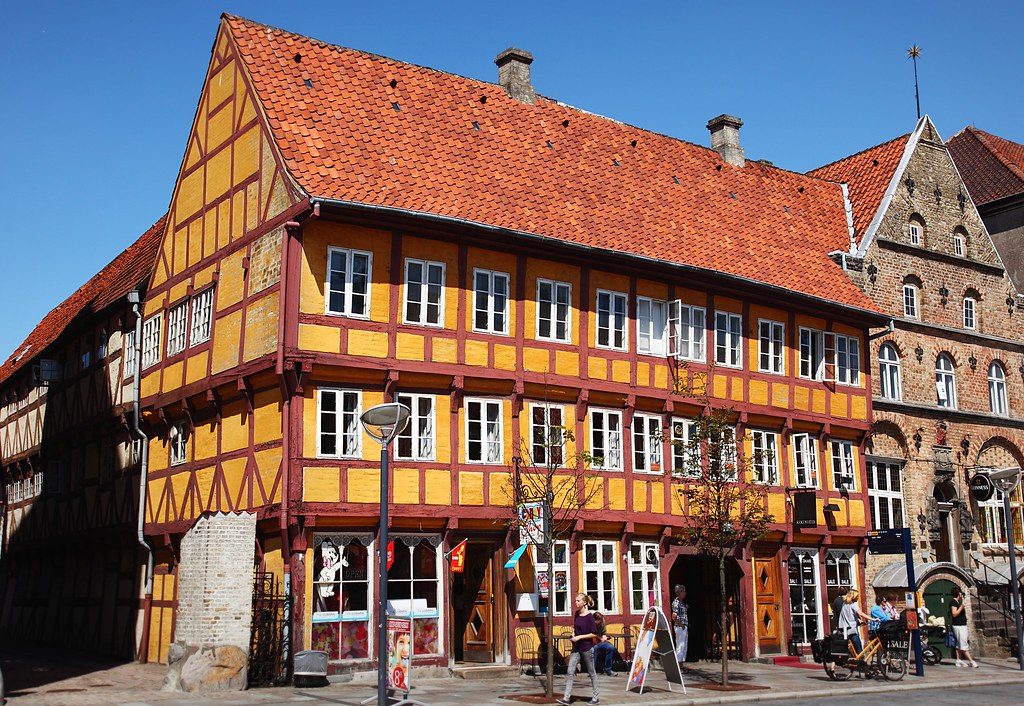
This ancient Danish city Aalborg is a cultural and industrial center. Photo: Flicr

Aalborg, Denmark
This ancient Danish city is a cultural and industrial center. Maybe you’ve heard about Aalborg Carnival, the largest festival in Scandinavia that takes place in Aalborg.

Maybe your inspiration for writing is powered by art and music. If that’s the case then you’ll love Aalborg. It is known for opera, theatre, and symphony.

Absorb the incredible sight of half-timbered mansions. It will make you feel as if you have traveled back in time. You can come across some impressive old buildings such as:

Aalborghus Castle, a former royal residence from the 16th century
Budolfi Church (built on the ruins of an old Viking church) from the 14th century
Jens Bang’s 17th century Dutch Renaissance home
Mayor Jørgen Olufsen’s half-timbered and sandstone house from the 17th century

The historic sites can easily motivate you to take your writing skills to the next level and maybe even try to write a book. If you need some help with the writing process you can turn to writing services such as Studicus, WowGrade, SupremeDissertations, and BestEssayEducation. You can even turn the pictures you have taken into a book cover. Editing and design tools like Canva and PickMonkey can help you with that.

Top Scandinavian Destinations for Freelance Writers
Bergen is the best pick for all of you who are aiming for a town-like destination. Photo: Visit Bergen

Bergen, Norway
You can’t help but fall in love with this colorful city. Replace your routine-based life with an adventurous city like Bergen.

When you hear that it has around 280,000 inhabitants you may think that it is too small. However, its great position with water on one side and mountains on the other explains why so many people are attracted to this place.

Bergen is the best pick for all of you who are aiming for a town-like destination. Just enjoy the simple life and completely surrender to your writing business.

Dorian Martin, a senior writer at IsAccurate business translation service shared how he got mesmerized with Bergen, “When I decided to use the advantage of freelancing and live a few months abroad, I chose Bergen on a whim. It turned out to be the perfect place. Whenever I can, I go back to this city, just me and my laptop.”

Top Scandinavian Destinations for Freelance Writers – Some Final Thoughts
Changing your place of work that is your home for a new location can be a motivating journey. As you can tell, Scandinavia has so much to offer and you won’t be disappointed by any of these places.

Even writers who feel like they are in a rut and need to get their creative juices flowing can make that happen by visiting a new destination. These incredible cities and sights that surround them can bring out the best in anyone.

Top Scandinavian Destinations for Freelance Writers
Helene Cue

Top Scandinavian Destinations for Freelance Writers, written for Daily Scandinavian by Helene Cue. Helene is a passionate writer and editor who explores a broad spectrum of topics that revolve around marketing and tech. She currently works as an in-house writer and a content marketing specialist. Her pieces are always captivating and informative.

Feature image (on top): Stockholm. Photo: LinkedIn

Award-Winning Danish Jazz Saxophonist

Danish saxophonist and composer Benjamin Koppel (b. 1974) is one of the most award-winning musicians of his generation, known for his versatility and virtuosity. Read more about the award-winning Danish jazz saxophonist.

In spite of his young age, he’s considered one of Denmarks most talented and sought after saxophonists, both at home and abroad. “Music is a form of communication, and to me it is very important to play both for and with the audience,” says Koppel.

Koppel’s musical background is deeply rooted in his family. He is the grandson of the famous Danish classic composer Herman D. Koppel, and son of musician and composer Anders Koppel, who had great success worldwide with the band Savage Rose. So, the music genre of the family spreads out from classical to jazz and pop and Benjamin Koppel masters all the genres with the outmost perfection.

Award-Winning Danish Jazz Saxophonist
Benjamin Koppel is considered one of Denmarks most talented and sought after saxophonists, both at home and abroad

Related: Scandinavia – the Best Jazz Region in the World?

Summer Jazz
Koppel formed his first band when he was 15 years old and has released nearly 40 CDs as a soloist, composed over 200 pieces of music and appeared on more than 100 CD productions. He has been a visiting professor at universities in the United States and China, and since 2009, he and his company Cowbell Music has been organizing the Valby Summer Jazz (now Summer jazz), a part of the Copenhagen Jazz Festival. This festival takes place just outside the center of Copenhagen in the small suburb of Valby.

Whether you are a complete jazz beginner or a more experienced listener, Summer Jazz has something for everyone.

Related: Nordic Balm

World-class pianist and composer Kenny Werner has also played a major role in the creation of the festival. Every year he and Koppel have worked together on assembling different talented musicians in interesting and new formations. This year is no exception, with great domestic and international names like Benny Werner, Randy Brecker, Benjamin Koppel, Miroslav Vitous, Julian Lage, Brian Blade and The Fellowship Band, Marie Carmen Koppel, Johnathan Blake, Scott Colley, DJ Noize, Shaka Loveless, Pede B, Karen Mukupa, Al Agami and Ataf Khawaja. The festivals runs from 6th through 15th July.

Award-Winning Danish Jazz Saxophonist
since 2009, Koppel and his company Cowbell Music has been organizing the Valby Summer Jazz

Award-Winning Danish Jazz Saxophonist
“I am lucky enough to have played with a wide range of fantastic musicians from all over the world,” says Koppel. “This festival has given me the opportunity to invite some of them to Denmark to play. In collaboration with Kenny, I have assembled special orchestras with musicians who have never played together before. This gives the audience an experience they cannot find anywhere else. It’s very much a once-in-a-life-time experience,” he explains.

Related: The Standard Copenhagen

The variety of Koppel’s musical collaborations is wide, and has established him as a sought-after musician internationally. As a soloist and bandleader, he has performed/recorded with Phil Woods, Kenny Werner, Jim Hall, Joe Lovano, Scott Colley, Daniel Humair, Palle Danielsson, Alex Riel, Miroslav Vitous, Anders Koppel, Inger Dam Jensen, Michala Petri, Adam Nussbaum, Randy Brecker, Chano Dominguez, Charlie Mariano, Portinho, David Sanchez, Sheryl Crow, and others.

Award-Winning Danish Jazz Saxophonist
“I am lucky enough to have played with a wide range of fantastic musicians from all over the world,” says Koppel. Photo Flickr

Unique musical experiences
Today, his company Cowbell Music has developed into a music and event bureau producing concert and unique musical experiences in cooperation with different Danish and international enterprises and cultural institutions. As a musician, Koppel appears both with international jazz stars, Danish pop acts and symphony orchestras in Europe, USA and China.

Koppel has published the book “Out of Music” (Gyldendal).

Award-Winning Danish Jazz Saxophonist, written by Tor Kjolberg

Will Norway Be The First Market For Electric Commercial Flights?

A new plane has already been used for demonstration purposes, but the aim is obvious: Norway pushes to electrify all domestic flights by 2040. Will Norway Be The First Market For Electric Commercial Flights?

State-owned Norwegian airport operator Avinor has been collaborating with partners in the aviation industry on a development and innovation project for electric aircraft, and the first commercial routes are expected before 2030.

Will Norway Be The First Market For Electric Commercial Flights?
Road, rail or boat travel often take a lot longer than a short flight

Related: Climate-Smart Airports in Sweden

A new report
Last month, a report from Avinor and the country’s Civil Aviation Authority stated that electric planes could be a boon to reducing greenhouse gas emissions and tackling climate change. So far, however, there are no airliner-size electric-powered aircraft being built yet, so that’s a major barrier.

Nevertheless, the project is backed by the Norwegian Ministry of Transport and Communications, and ZERO, Widerøe and SAS are also supporting the project designed to bring Norway’s first electric aircraft to the country.

Will Norway Be The First Market For Electric Commercial Flights?
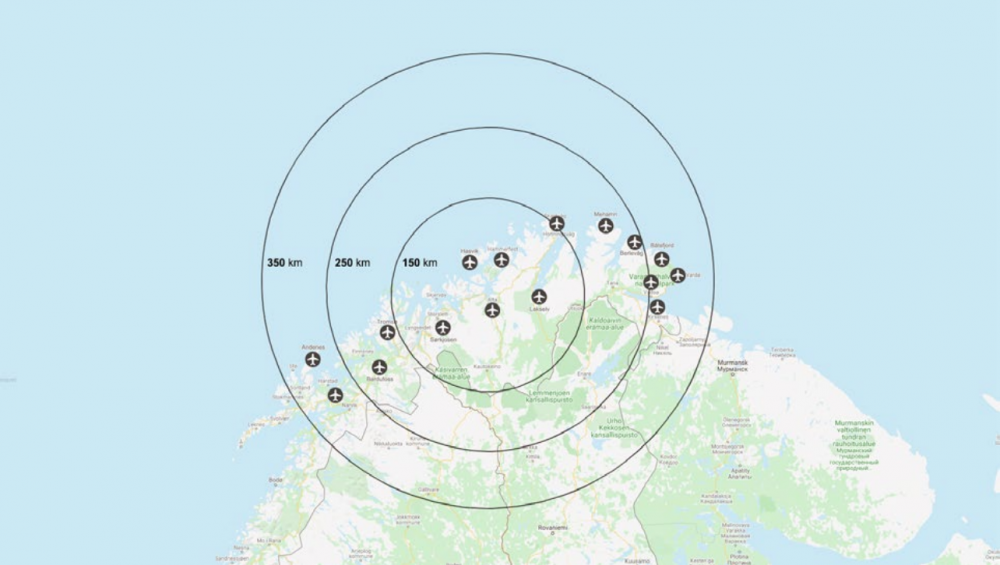
. In the Northern most section of the country, there are 16 airports within 217 miles (350 km) of Alta, a central airport hub

Related: Scandinavian Mountains Airport – Without Air Traffic Control Tower

A multitude of small, short-haul airports
Norway is a large country which has a multitude of small, short-haul airports. In the Northern most section of the country, there are 16 airports within 217 miles (350 km) of Alta, a central airport hub. There are popular regular trips between these airports, as flights are far quicker and far more direct compared to driving.

“Electric aircraft are set to significantly improve the environmental consequences of the aviation industry. It could also be cheaper to fly as operating costs for several aircraft models will be considerably lowered, which will have an impact on ticket prices”, explained Dag Falk-Petersen, CEO of Avinor.

Will Norway Be The First Market For Electric Commercial Flights?
Avinor has decided to start a program to electrify the flights in Norway

Related: Sustainable Shipping in Norway

10 hour by car – 80 minutes by air
For example, driving from Andenes to Alta would take more than 10 hours, and involve a lot of difficult and convoluted driving. On the other hand, a flight takes about 90 minutes.

The board of directors from Avinor visited Airbus in Toulouse about five years ago and were told that the company had been doing a lot of work in this area already. That is the reason Avinor decided to start a program to electrify the flights in Norway.

Will Norway Be The First Market For Electric Commercial Flights?
And Norway is a good place for such experiments. Much of the country’s terrain is mountainous and there are many offshore islands, which means there are a lot of short-haul flights (Avinor runs no fewer than 46 airports in Norway). Road, rail or boat travel often take a lot longer than a short flight, especially during the winter when snow and ice can block roads and tracks.

Will Norway Be The First Market For Electric Commercial Flights? Written by Tor Kjolberg

How to Deal with Language Barriers while Traveling to Scandinavia

Scandinavia is such a beautiful region that can offer you unique travel experience. You have probably read about its culture and fun tourist activities. The pictures of its incredible nature and impeccable architecture must have intrigued you and evoke the desire to see it in person. The only thing that can be holding you back is the language. Here you can read how to deal with language barriers while traveling to Scandinavia.

No matter whether you are traveling to Denmark, Norway, or Sweden, the language can seem very difficult to learn. If you are questioning your decision to travel to Scandinavia because of the language barrier, your dilemma will now be solved. Here are a few handy tips on how to conquer the language barrier on your trip to Scandinavia.


How to Deal with Language Barriers while Traveling to Scandinavia
Everyone can learn the basics

Learn a Few Basic Phrases
Everyone can learn the basics. Phrases such as “Hello”, “Bye”, “Where is the bathroom”, “Where can I find a restaurant”, “Can you help me”, and similar can be sufficient for travelers.

Knowing the basics will help you gather the most important information. Even if you don’t have the talent for learning languages, you can cope with these few sentences.

Related: Scandinavian Translation Service Gets Your Message Across – In Any Major Language

To ensure that you won’t forget them in the time of need, write them down. However, write the phrase how you would pronounce it, not how it is written in the native language. Since you don’t know how to read their spelling, it won’t mean anything.

Have these phrases on your phone because that’s the one thing that you’ll probably always have by your side. Whenever you need it, just pull out the phone and you’ll be all set.

How to Deal with Language Barriers while Traveling to Scandinavia
Don’t be ashamed to use visual cues in order to explain what you want to express

Use Visual Cues
People communicated way before language was formed. If they could do it in the past, why can’t we?

Don’t be ashamed to use visual cues in order to explain what you want to express. Everyone can understand hand gestures and pointers.

Related: Language of the Vikings

Of course, you won’t be able to completely explain what you want but it can get you some answers. For example, if you are looking for a bus station just point at the bus on the road or show the local a picture of a bus station.

What is most important is that you are resourceful and innovative. It can be useful if you have a paper map with you and ask the host to mark your place of stay. Just in case if you get lost at some point you can show the locals where you are staying and they can direct you there.

How to Deal with Language Barriers while Traveling to Scandinavia
No matter whether you are traveling to Denmark, Norway, or Sweden, the language can seem very difficult to learn.

Carry a Pen and Paper
If you don’t know how to explain with gestures and you don’t know the language, there is another solution – sketch it. The idea may seem silly at first, but once you realize how helpful it can be you won’t question this method.

Have a piece of paper and a pen by your side at all times. When a situation occurs in which you can’t explain to the locals what you need, use the pen and paper to draw it.

“I learned this trick from a backpacker I met a few years ago. He told me that a pen and paper got him out of confusing situations many times. Since then I follow this advice religiously,” shares Amanda Willis, a translator at TheWordPoint and passionate traveler.

Related: How to Schedule Learning Swedish

The pen and paper can have another useful purpose. Give them to the local so they can sketch out the road which you need to take when you ask for direction.

If you are good at Pictionary, you will be great at this. This may not be your first choice for expressing yourself, but the more options you have for coping with language barriers the better.

How to Deal with Language Barriers while Traveling to Scandinavia
Prepaid sim cards will give you access to the internet

Buy a Prepaid Sim Card
Those who are staying there for a longer period of time should consider buying a prepaid sim card. This can make your life so much easier.

Prepaid sim cards will give you access to the internet and consequently, you’ll have all the info in the palm of your hand.

Sim cards in Scandinavia are a pretty good deal and it will definitely be a money well-spent. Look at it as an investment in a better travel experience.

Look for a Telenor, Telia, or 3 shop stores. They are mostly situated in the city center. Ask the receptionist or your apartment host where you can buy a prepaid sim card and get that done the very first day.

How to Deal with Language Barriers while Traveling to Scandinavia
The most popular voice translation option is Google Translate

Use Voice Translation
Once you get your internet activated, it is time for you to meet your new best friend – voice translation.

While you are still at home download a voice translating app. Here are a few options:

Translate Voice

Speak and Translate

ITranslate

All you need to do is to speak in your phone what you want to ask or say and the app will automatically translate the sentence in the target language.

However, the most popular voice translation option is Google Translate. Those who don’t like to deal with apps can just go with the well-known Google feature. Type in what you want to say, translate to the target language, and play the translation to the local. Or, simply make the voice input and get it translated.

How to Deal with Language Barriers while Traveling to Scandinavia
Dictionaries can serve as a back-up

Carry a Pocket Dictionary
It is time to go old school. Before cell phones completely altered our lives, people would rely on dictionaries as their language helpers.

Just in case if you use all the battery on taking amazing shots, buy a dictionary. Pocket dictionaries are especially great for traveling. They don’t take too much space and they won’t make your bag heavy.

Dictionaries can serve as a back-up. As great as technology is, it can sometimes fail us. That is why dictionaries can serve as a safety net for communication purposes.

Find travel dictionaries in your local bookstore or buy them on Amazon. The prices are very affordable so it won’t hurt your budget. Check out the following examples:

Swedish-English dictionary

Norwegian-English dictionary

Danish-English dictionary

How to Deal with Language Barriers while Traveling to Scandinavia – Conclusion
As you can tell, there are several resourceful ways that will help you conquer the language barrier. Remember that you shouldn’t focus on the language, you should focus on wonderful experiences and amazing people you will meet along the way.

How to Deal with Language Barriers while Traveling to Scandinavia
Erica Sunjaro

How to Deal with Language Barriers while Traveling to Scandinavia is written for Daily Scandinavian by Erica Sunjaro. Erica Sunarjo graduated from South Texas College majoring in Marketing and Creative Writing. Her career is channeled towards several skills. She works as a professional writer, translator, and editor. Currently, Erica is a copywriter at BestWritersOnline. She writes thought-provoking articles for publications in a variety of media and actively participates in many translating projects.

The Never-Ending Story of a Norwegian Furniture Designer

0

“It all started in 2011 with a dinner at my house where the table was so small that I had to put the serving trays on top of each other,” says Norwegian designer Bjørn van den Berg, who has a master’s in product design from OsloMet University. Read the never-ending story of the Norwegian furniture designer.

After customizing his own shoes, belts and jackets, he became a local success and created his first commercial label in 2012. His inspiration comes from the desire to recreate everyday situations and emotions in his objects. In 2015 he designed his Plateau tray series, which are overlapping each other in different levels of height creating a connection between the elements presented.

The Never-Ending Story of a Norwegian Furniture Designer
Areal floor lamp, by Bjørn van den Berg

Related: A Norwegian Design Pioneer

Featured in international magazines
Bjørn’s works have been featured in many international magazines, like Harper’s, Bazaar, Treats Magazine, Beau Monde and many others. His creative output has continued to impress. In 2016, New York Times named him one of their designers to watch and in 2017, his Aeral Lamp designed together with Falke Svatun won a Wallpaper Magazine design award.

Then his work started to feature in several Dutch national television productions and shows, such as the Voice, Holland’s Next Top Model as well as in several international music videos. During the London Design Festival 2017, he collaborated in the show “Punctuating Space” in which he conveyed concepts and evoke emotion in spaces via tactility, form, color and light.

THIS ARTICLE IS UNDER REVISION

Related: Prominent and Successful Norwegian Designer Duo

Never-ending search for new challenges
Bjørn van den Berg is also part of Klubben, a Norwegian design collective. The group brings together emerging Norwegian furniture designers as well as those in the neighboring fields of textiles and accessories, to promote their work internationally.

Related: Unique Wallpaper Designed by Norwegian Designer

The Never-Ending Story of a Norwegian Furniture Designer

The never-ending story of the Norwegian product designer goes on….

The Never-Ending Story of a Norwegian Furniture Designer, will be updated soon.

Sophisticated Elegance to a Public Facility in Norway

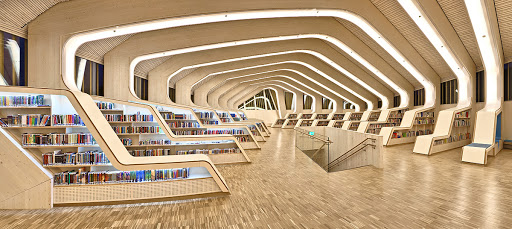
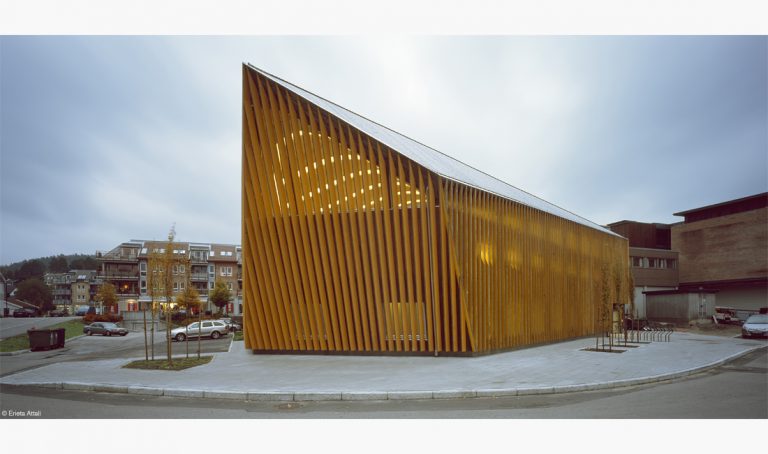
The library in Vennesla, north of Kristiansand in Norway, comprises a library, a café, meeting places and administrative areas and links an existing community house and learning center together. Helen & Hard Architects has supported the idea of an inviting public space. All main public functions have been gathered into one generous space allowing the structure combined with furniture and multiple spatial interfaces to be visible in the interior and from the exterior. The result is a sophisticated elegance to a public facility in Norway.

An integrated passage brings the city life into and through the building. Furthermore, the new building is open and easily accessible from the main city square, knitting together the existing urban fabric. This was achieved by a large glass facade and urban loggia providing a protected outdoor seating area.

A Sophisticated Elegance to a Public Facility in Norway
The new building is open and easily accessible from the main city square

Related: The Unique Energy Design Hotel in Norway

Expressive ribs
The expressive ribs combine structure, technical infrastructure, and functionality into one architectonic element that creates a dynamic aesthetic identity for the project to meet the client’s original intent to mark the city’s cultural center.

The whole library consists of 27 ribs made of prefabricated glue-laminated timber elements and CNC cut plywood boards. These ribs inform the geometry of the roof, as well as the undulating orientation of the generous open space, with personal study zones nestled along the perimeter. The offset construction of the ribs allows the curves to function as spatial interfaces with inset lighting elements to provide a soft glow to the interiors and acoustic absorbents which contain the air conditioning ducts.

Related: Exporting Norwegian Architecture  

A Sophisticated Elegance to a Public Facility in Norway
The whole library consists of 27 ribs made of prefabricated glue-laminated timber elements and CNC cut plywood boards

Adapting two adjacent buildings
“In this project, we developed a rib concept to create useable hybrid structures that combine a timber construction with all technical devices and the interior,” explains the architects.

The gradually shifting shapes of the ribs are generated through adapting to the two adjacent buildings and also through spatial quality and functional demands for the different compartments of the library. Each end façade has been shaped according to the specific requirements of the site. At the main entrance, the rib forms the loggia which spans the width of the entire square.

Sophisticated Elegance to a Public Facility in Norway
The rib spans the entire width of the building and then slowly condense to create more intimate rooms.  While the building’s roof is formed by the geometry of the curves, the massing along traces the natural lines of the site and responds to the main street by folding down towards it.

A Sophisticated Elegance to a Public Facility in Norway
The rib spans the entire width of the building and then slowly condense to create more intimate rooms

Related: Magnificent International Interest around New Norwegian Tourist Attraction

Typical of Helen & Hard’s work, a main intention has also been to reduce the energy need for all three buildings through the infill concept and the use of high standard energy saving solutions in all new parts. The library is a “low-energy” building, defined as class “A” in the Norwegian energy-use definition system.

The library opened in 2012.


About Helen & Hard
Helen & Hard was founded in 1996 in Stavanger on the west coast of Norway by Norwegian architect Siv Helene Stangeland and Austrian architect Reinhard Kropf. Today, the company has a youthful staff of 26 people drawn from 10 countries, with offices both in Stavanger and Oslo.

The last 10 years Helen & Hard has specialized in using timber as construction material and has developed a close collaboration with the ingenieur Hermann Blumer in Creation Holz. Inventing building systems in timber together with site specific spatial conceptions, which mutually inform each other has resulted in novel spatial designs such as, the Pulpit Rock Mountain Lodge, the Navet Museum and the Vennesla Library.

Sophisticated Elegance to a Public Facility in Norway, edited by Tor Kjoberg based on text description provided by the architects
6 Reasons Why Swedish School Education is Better

0

The main thing about school education in Sweden is to identify and develop each child’s talents and abilities, and to teach students how to set and achieve goals. While working with children, the teacher takes on the role of an assistant rather than a strict teacher with a pointer. Essay writing service EssayShark conducted a study on the advantages of the Swedish education system. Find out more about the 6 reasons why Swedish school education is better.

Personalized Approach and Respect from the Cradle
Formally, the educational process starts literally at the nursery: the vast majority of Swedish children start kindergarten already at the age of 1.5-2 years. Pre-school education is an essential part of the Swedish educational system and is available to all, regardless of the income level. Swedish pre-school education emphasizes the importance of the game in a child’s development. Gender-based education is becoming increasingly popular, with the primary goal of giving children equal opportunities in life, regardless of gender. Every child at the age of 6 is guaranteed a place in the preparatory class, where children are introduced to the first steps of general education.

6 Reasons Why Swedish School Education is Better
Everything about a child’s performance or behavior at school is discussed individually with the child and his/her parents

A child’s personality and dignity are untouchable, and children in Sweden have the same right to be respected and treated equally as adults.

Related: Best Colleges With Scandinavian Studies Degrees

Therefore, despite the fact that most classes at school are in group form, the teacher will never praise some and scold others in public. Everything about a child’s performance or behavior at school is discussed individually with the child and his/her parents. All teachers working in schools, both subject teachers and those working outside the classroom with children, have specialized pedagogical training and are required to be certified. By the way, several top essay writers from essayservice also work in these schools and help not only children but also students from the USA.

No Marks Until the Sixth Grade
Until the sixth grade, students in Swedish schools are not given any marks at all, so as not to interfere with individual development and not to cause a sense of competition and stress. Over the last hundred years, Sweden has tried out many knowledge assessment systems. In 2011, Swedish schools moved from a three-point scale to a six-point scale. Pupils can be given the following grades: A (Exemplary), B (Excellent), C (Good), D (Adequate), E (Acceptable), and F (Fail, not passed).

The student assessment and evaluation system is an eternal subject of heated debate among both politicians and school staff. The Swedes believe that any scoring system is always imperfect and unfair. Therefore, new approaches to the assessment of pupils are regularly discussed in the Riksdag and municipal authorities.

6 Reasons Why Swedish School Education is Better
Until the sixth grade, students in Swedish schools are not given any marks at all, so as not to interfere with individual development and not to cause a sense of competition and stress

Related: Gender-neutral Swedish Preschools Produce More Successful Children

Education as a Game
From first grade to third, the school curriculum is based on mathematics, Swedish, housekeeping, social studies, and natural sciences. Lessons are mostly in the form of a game. Already at the age of 7-10, children are actively involved in social science lessons to discuss what is happening in the world, for example, after watching the children’s news program together. This show is called Lilla Aktuellt and is broadcast daily on Swedish television. It introduces the youngest viewers to the main events of Sweden and the world simply and clearly.

From the third grade, students start learning English. They are not yet bothered with grammar and cramming. They learn simple songs, how to count, and are introduced to some words and expressions in a game form. Physical education is also present in the schedule, but more in the form of mobile games and trips to nature if the weather allows. Housekeeping classes are one of the most favorite. Boys and girls together learn to sew and knit, make toys and uncomplicated household appliances with their own hands, as well as cook and bake with simple recipes.

6 Reasons Why Swedish School Education is Better
Lessons are mostly in the form of a game

Related: 12 Scandinavian Universities Rank Among the 300 Best in the World

From secondary school onwards, the workload and the knowledge and skills requirements of schoolchildren are increasing considerably. There are more homework and opportunities for independent choice of subjects. For example, from sixth grade, you can choose a second language besides English. The most popular languages are German, French, and Spanish.

Psychological Comfort is a Priority
The psychological well-being of children is a priority for Swedish schools. Each school has a supervisor whom children can approach to talk about, for example, their academic performance problems, difficulties with their family or their peers. In addition, teachers regularly have individual conversations with each child, during which they try to find out how comfortable the child feels in class, among classmates, whether he or she has time to learn the material, whether the school or parents need additional help.

At the beginning and the end of each school year, pupils are assessed. It takes place individually, in the form of a conversation with the child and his parents. The aim is to help the child to identify problem areas in his or her studies and to understand what needs to be worked on in the future. The teacher acts only as a moderator, asks leading questions, helps the child to formulate a thought, but does not impose his opinion.

6 Reasons Why Swedish School Education is Better
The psychological well-being of children is a priority for Swedish schools

Prove The Answer If You Know It
When solving problems, for example, in Mathematics, Physics, or Chemistry, the Swedish school pays special attention to how the student thinks and analyzes the problem. In other words, it is essential not only to give the right answer but also to show how you come to a solution.

Education for Everyone
Pupils who find it difficult to read and/or write are entitled to additional individual assistance from teachers. For some children, it can be challenging to focus on what the teacher says. Statistically, almost every class has a child diagnosed with ADHD (Attention Deficit Hyperactivity Disorder). These children need special support to learn to concentrate and not be distracted. An individual learning plan is developed for them so that they can catch up with their peers and open up to the full.

6 Reasons Why Swedish School Education is Better is written for Daily Scandinavian by the EssayShark team.