Pop artist Kai Gundelach or just “Gundelach” has drawn praise from both media and streaming platforms. Gundelach’x cool falsetto and Nordic-noir analog-electronic production quickly went from being an underground favorite to one of the big cross overs in Norway. His is often cited as one of Norway’s most interesting pop artists.
Also called the Norwegian master of melancholy, Gundelach premiered his latest video, made in collaboration with Oslo singer ARY, earlier this year. Before becoming a solo artist, Kai Gundelach worked as a DJ, having kept his music to himself for several years while playing the clubs of Oslo. It’s a good thing he decided to air them as they deserved to be heard.
One of Norway’s Most Interesting Pop Artists
Gundelach released his first single, Alone in the Night, in 2015 and the hype has been rising around him ever since. His self-titled debut EP was released in 2016. His single Spiders changed everything. Pharrell Williams played the track on his radio show and the Norwegian was also praised in the UK by BBC Radio 1’s Phil Taggart.
Gundelach released his first single, Alone in the Night, in 2015 and the hype has been rising around him ever since
International recognition has also lead to him playing all over Europe and receiving heavy radio play in Germany and the UK. Recently, he signed a deal with American label Terrible Records – joining the likes of Blood Orange, Public Access TV and Solange – and breaking out onto the global stage is now a very real possibility for him.
The Universe of Gundelach
Dark and introverted but with danceable rhythms that evoke the neon lights of the dance floor, his songs mix analog synths and soulful R&B vocals with minimalistic, dark electro-pop. The universe of Gundelach is Nordic cool, bleak and cold but full of sexy sounds that touch your soul.
One of Norway’s Most Interesting Pop Artists, written by Tor Kjolberg
Last weekend the world’s first major ‘men-free’ festival was held in Gothenburg, Sweden in response to sexual offences reported at music events in the country last year.
The idea of a ‘for women only’ festival was thought up by Swedish comedian Emma Knyckare after sexual offences at Sweden’s biggest music festival Bravalla 2017. It claims to be the world’s first festival exclusively for women, trans and non-binary people.
Screenshot from the Statement Festuval in Gothenburg.
Cis-men and cis-women
As well as barring cis men from entry, the new festival only included performances by women, transgender and non-binary artists. Even catering and security personnel were women only.
Cisgender is the opposite of transgender. The term cis-man or cis-woman applies to an individual whose gender matches their assigned sex at birth, whereas a trans or non-binary person is someone whose gender or gender-identity differs.
Comedian Emma Knyckare thought up the idea of a man-free festival
“We simply want that women, non-binaries and transgender to be able to visit an awesome festival and feel safe at the same time,” said Emma Knyckare and adds, “I had no idea how much work was involved in organizing a music festival, now I know.”
World’s first ‘men-free’ festival held in Sweden
When questioned on how organizers were going to stop men getting in, Mis Knyckare said, “No-one will be questioned at the entrance, but the festival has hired a specialized security company to develop a specialized ‘access system’.”
To finance the festival, Knyckare and her team first collected donations via a Kickstarter crowdfunding campaign, raising half a million Swedish krona. As many as 300,000 people gave money, which laid the foundations for the festival and a further budget was provided by means of sponsors.
‘Statement’ claims to be the world’s first festival exclusively for women, trans and non-binary people
Music and comedy
The event featured musical performances from former Eurovision Song Contest winner Loreen, Frida Hyvönen, Joy, Beatrice Eli, Maxida Märak and Tami T. Comedians also played at the festival, including Nour El Refai, Petrina Solange, and Josefin Johansson.
The organizers have a long-term goal of allowing cis men to attend the event.
World’s First ‘Men-Free’ Festival Held in Sweden, written by Tor Kjolberg
Rosemaling is the decorative folk painting of Norway and its history began in the low-land areas of Eastern Norway about 1750 inspired by upper-class artistic styles when Baroque, Regency and Rococo were introduced to Norway’s rural cultures. At first Norway’s painters followed these European styles closely.
If you came across this article as a student preparing a research paper, consider delegating the task to https://essayhub.com/ essay writing help professionals. Yet, in case a brief overview will suffice, keep reading this article!
At the beginning of the century, Norway had a population of a mere 500,000 – with only 40,000 people living in what was defined as urban areas. It was a society based on the age-old ways of agriculture, fishing and hunting – and people lived on farms or in cottages scattered across the long-stretched landscape.
So while writing your research, try to take into account all listed features. The art writers from EssayWriterCheap emphasize that cultural differences are the main factors to count on as well as historical background.
American Rogaland rosemaling
The story of Norwegian rosemaling
Compared to the art of woodcarving and textile art, rosemaling is a much younger art form, at least on a larger scale, and it may come as a surprise that the history of rose painting and its place in Norwegian folk art is not as old as one might think. Painter and author, Nils Ellingsgard, has chronicled the journey of the art form.
The painters who rosemaled for their livelihood were trained within a “guild” and they traveled from county to county painting churches and/or the homes of the wealthy for a commission of either money or merely room and board. Thus, rosemaling was carried over the mountains and toward Norway’s western coast.
How did Rosemaling come to America? Norwegian rosemaling continued its westward migration all the way to America. Emigration was heavy from some of the areas where rosemaling was well established. Travelers packed beautifully rosemaled trunks to make their journey across the Atlantic. Well-known as well as lesser known painters traveled to the New World.
Per Lysne, a Norwegian immigrant from Stoughton, Wisconsin rekindled an interest in Scandinavian folk art when his “Smørgaasbord” plates were sold in Chicago’s Marshall Fields department store in the late 1930’s. European folk art was rediscovered through home decorating magazine articles in the 1930’s and 1940’s.
A traditional form of art
Some of the artists in Norway often worked as farmers during the summer, subsidizing their living in the winter months painting rooms and furniture for more successful farmers.
The art displays many stylized flowers and scroll forms, combining blended colors and fine outlines on a plain background color. Traditional paint colors were derived from local raw materials, for example, rust red came from red iron oxide in the ground. Brushes were made of hairs from a squirrel’s tail or a cow’s ear.
Compared to the art of woodcarving and textile art, rosemaling is a much younger art form
Once farther away from the influence of the guilds, these artists tried new ideas and motifs. Soon strong regional styles developed. The Norwegian authority on the art of decorative painting – or rosemaling Nils Ellingsgard has through his gem of a book, Norsk rosemaling, given us a better understanding of this world of artistic beauty.
As time passed the Telemark and Hallingdal valleys became known for their fine rosemaling.Upon their exposure to rosemaling, rural folk would often imitate this folk art. Not having been taught in an urban guild, the amateur became spontaneous and expressive in his work on smaller objects such as drinking vessels and boxes.
BNeer bowl from late 1700s. Artist Sondre Peerson Busterud from Telemark
The future of rosemaling
Rosemaling went out of style in about 1860-1870. Whether the traditions will continue to bloom is difficult to predict, but the many surviving objects will stay on and give joy to future generations for centuries to come. Objects that are symbols of our common history – and the many people who created them.
The Story of Norwegian Rosemaling, written by Tor Kjolberg
Amalienhaven is a modern park donated to the capital of Denmark by the A. F. Møller shipping company in 1983. Walking along the promenade in Copenhagen to the north you will find the dazzling fountain Gefion Fountain (Gefionspringvandet), dedicated to the Nordic goddess Gefion.
At the start of Langeline is the symbol of Copenhagen, The Little Mermaid (Dern lille havfrue). This bronze statue of the character from Hans Christian Andersen fairy tale was created by Edvard Eriksen in 1913. Quite bizarrely, she was taken to Shanghai, China, in 2010 to sit in lonely state in the Danish pavilion at the World Expo; but that was just a guest visit.
Southern Frihavn in Copenhagen
Along the Promenade in Copenhagen
The quay of Langeline follows, and Europe’s busiest cruise-ship pier is to the north of this at Frihaven (Free Harbor).
One of the most architecturally interesting of the newer buildings in this area is Paustians Hus, designed by Jørn Utzon, who also desiuned the Sydney Opera House. Paustian is one of Copenhagen’s finest furniture stores; the building also houses a good restaurant.
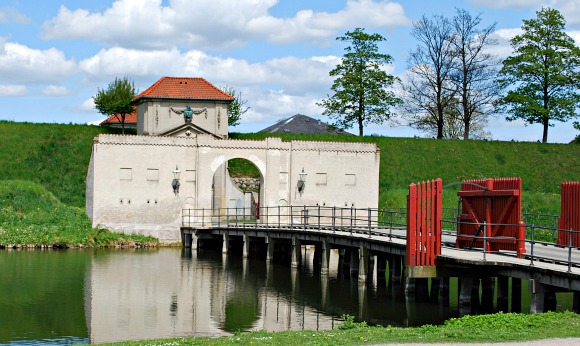
Back to the city center Return to the city center via Kastellet (The Citadel), a fortification that has kept its old ramparts intact. Part of the area is still military property.
Churchillparken, a tiny park just south of Kastellet, provides a home for the Museum of the Danish Resistance (Frihedsmuseet), which commemorates the Danish resistance fighters of World War II. Apart from acts of sabotage against Nazi occupants, the underground group managed to get 7,000 of Denmark’s 8,000 Jews out of the country.
Along the Promenade in Copenhagen, written by Tor Kjolberg
Early risers or visitors arriving Copenhagen in the morning have plenty of cafés and restaurants to choose from located in several places across the Danish capital. Our team has tested some of them, and here are some recommendations for your breakfast in Copenhagen.
A hearty breakfast should get your day started, and an early breakfast or brunch are never far away in Copenhagen.
Cafe Bang & Jensen
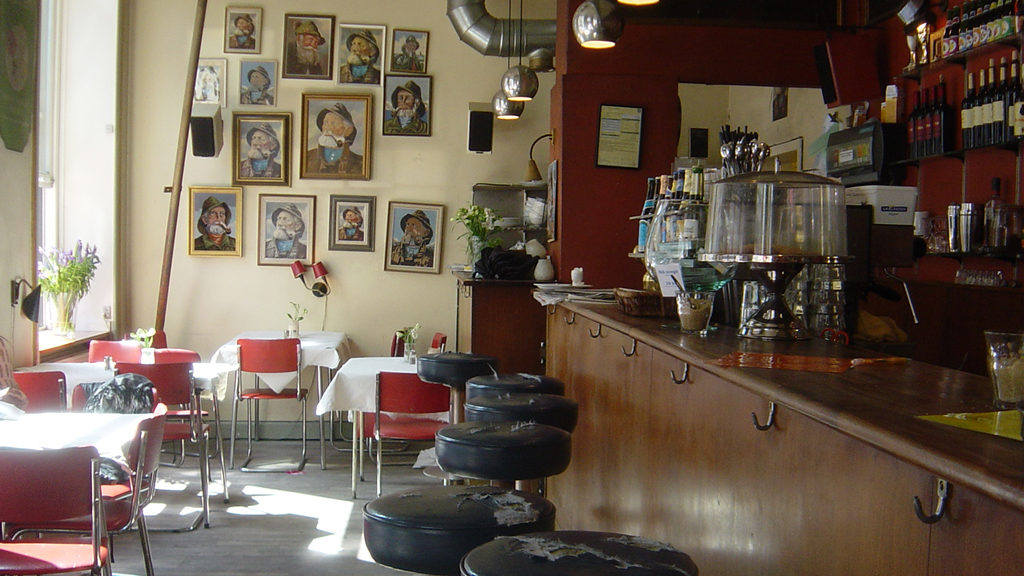
Café Bang & Jensen Located in the posh end of Istedgade, this former pharmacy houses a delightful café that is very popular with the Vesterbro locals. The atmosphere is cozy and relaxed and you will feel instantly at home among quaint lamps and odd unmatched chairs.
Between 08:00 and 10:00 you can tuck into a delicious breakfast buffet. After 10:00 you can make individual brunch orders: hard- or soft-boiled eggs, organic coffee or green teas.
Cafe Europa 1989
Located in the very heart of Copenhagen, on Amagertorv, Café Europa has been inspired gtom the very best of various Eiropean café cultures; the traditional French cafe, the cake houses found in Vienna and Budapest, the Italian coffee menus and, of course, the culinary inspiration from the Spanish tapas and the Greek yogurts.
Jesper Gørtz at Lille Bakery
Lille Bakery This little café and bakery, opened spring 2018, is located inside an industrial building at Refshaleøen a little outside Christianshavn, a popular district of Copenhagen. Lille Bakery is run by a former chef at NOMA, Jesper Gørtz, which is definitely reflected in the quality and taste of the bread and food served there.
Order their bread with cheese and ham and whipped butter. The huge slices of bread leave you with the perfect option of getting more dishes to taste as a supplement.
Mad & Kaffe, Fredriksberg You’ll find Mad & Kaffe at three locations in Copenhagen, all of them located in beautiful surroundings. The cafes are decorated to suit the spirit of the local area.
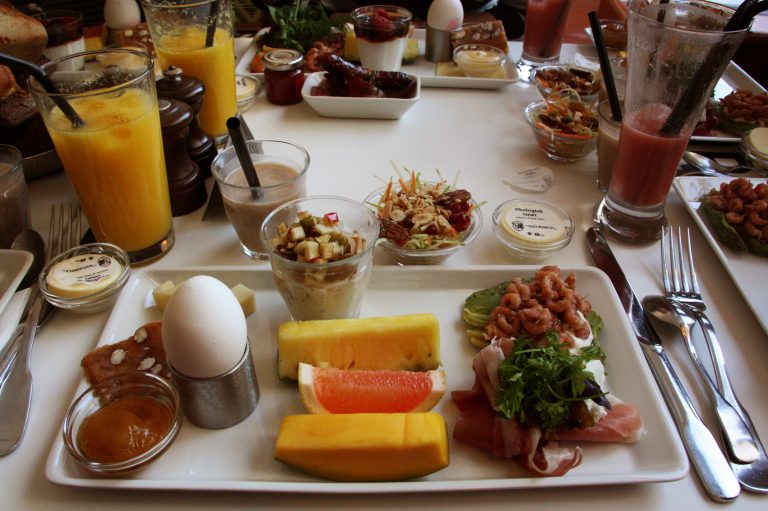
There is a breakfast card where you can put together your very own breakfast board, choosing from 18 different components. Everything on the menu is made from scratch with fresh and good (seasonal) ingredients.
Mad & Kaffe Vesterbro
Mad & Kaffe, Vesterbro
When Mad & Kaffe opened in 2015 it took Copenhagen by storm. Ever since, the café has shining its light on Vesterbro.
Of you’re a brunch lover, this place should absolutely be on your bucket list. Located in one of Vesterbro’s hotspot locations, you can combine your own tasty breakfast plate by ticking the list of various breakfast possibilities. Mad & Kaffe also offer lunch and bigger meals.
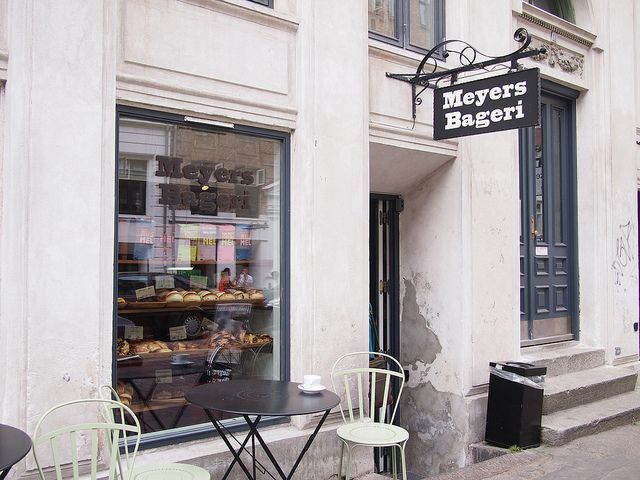
Meyers Bageri, Jægersborggade This small bakery, where you can buy organic bread, freshly ground flour and cakes opens early in the morning and is often crowded. Not surprisingly since there’s only room for five people.
The Danish chef and entrepreneur, Claus Meyer, along with a baker and a confectioner runs this little delicious bakery. Especially the cinnamon rolls “kanelsnurrer” made with Valrhona chocolate is worth waiting for.
Omegn & Venner
Omegn & Venner in Torvehallerne
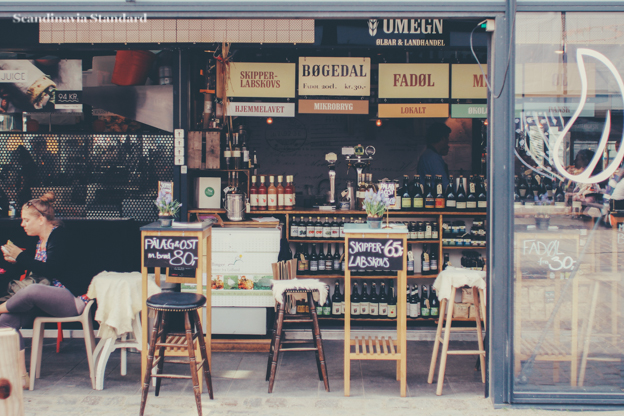
Omegn buys their products from farmers outside Copenhagen and sell them in their outside stall in Torvehallerne. The selection of products depend on the season, but you will always find a great variety of vegetables and fruits.
Omegn has an indoor stall in Torvehallerne and here you can enjoy some delicious local products such as hams, sausages and cheese, and make sure to try one of their beers along with it. Opens every day, except Sundays (11am) at 10 am.
Winterspring
Winterspring
Opened in March 2018, this is a newcomer in Copenhagen. Owner and manager Karina Schmitt Lund has specialized in making incredibly quality ice creams and sorbets, using ingredients and exceptional Nordic design, for which they have gained great acclaim and won international awards.
Not really a breakfast café, but a delicious ice cream before exploring the city is not a bad idea.
Wulff & Konstali
Wulff & Konstali
In this bakery located on Amager, Copenhagen South, you can mix your own brunch or breakfast from a menu. You can choose between 21 different choices with everything from freshly baked bread and pastries, eggs, bacon, waffles, chia porridge, yoghurt and granola, avocado and much, much more.
Wulff & Konstali has made delicious brunches since 2008.
Breakfast in Copenhagen
We all know that breakfast is the most important meal of the day and when you travel and have a full day of exploring Copenhagen in front of you, then breakfast becomes even more important. We therefore hope this little guide is helpful when you’re going to decide where to start your day in the Danish capital.
If you want to gladden your senses, take them to Aalborg in Denmark. To the architecture of Alvar Aalto, to intimate icons, glorious glass and celebratory ceramics. Experience the spirit of Aalborg.
Some people are ambivalent about the North Jutland Museum of Art. It was designed by Finland’s great designer-architect Alvar Aalto and has such an unusual form that it quickly becomes a matter of whether the architecture detracts from the art, or allows the light to come in and enhance it.
Museum of Modern Art in Aalborg. Architect: Alvar Aalto
The spirit of Aalborg
But regardless of what you think about the museum itself, it is a great place to entertain the senses. Here you will find exciting specialist exhibitions, a sculpture park and amphitheatre concerts, films, lectures and much, much more. And if there should be no special activities while you are visiting, you can experience a permanent exhibition of Danish and international art from 1900 to the present day, which is just as exciting as the architecture.
Artbreak Hotel is not a hotel at all, but a workshop gallery
Sensuous expression
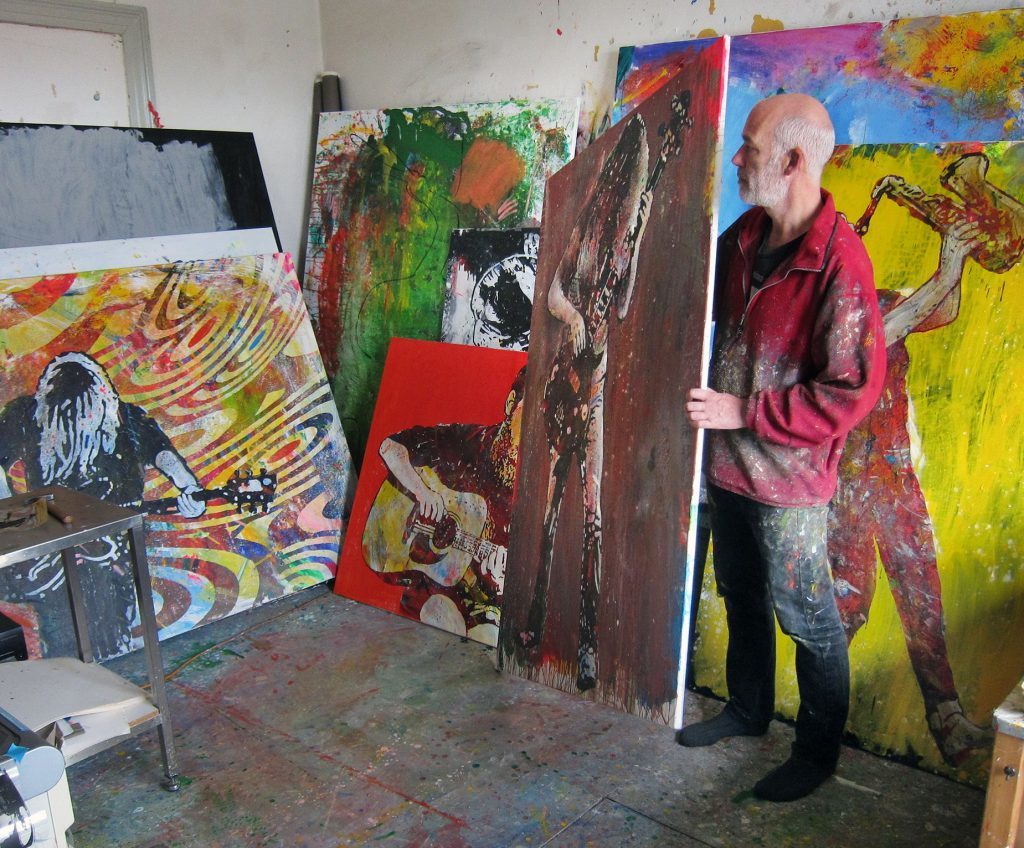
Having left the museum, you can stroll down into the center of town, where you can visit Artbreak Hotel, which is not a hotel at all, but a workshop gallery. This is where artist Nils Sloth have set himself the task of challenging himself and his visitors. His expression is lively to put it mildly, and riotously colorful. In his pictures the senses are met by an almost overwhelming richness of expression.
Nils Sloth in his Artbreak Hotel
You have to stand back from his pictures to really take in the explosion of visual impressions. Figurative and abstract elements in all the colors of the artist’s palette, and using a variety of techniques all packet into the same picture, Nils works offer the eye a journey of exploration, and the possibility of getting lost in a veritable riot of sensuality.
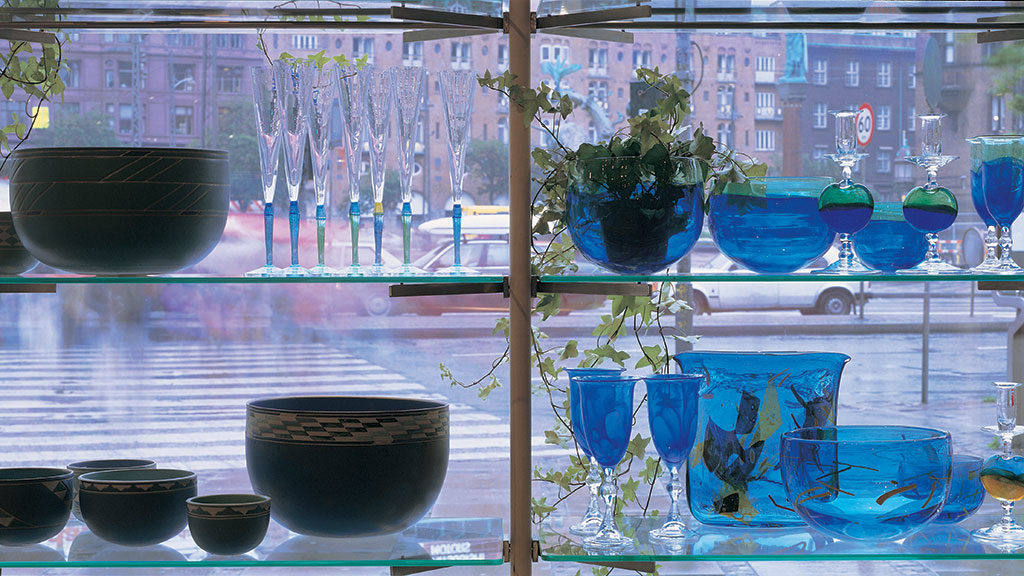
Clear shapes His daughter became a glass-blower? Certainly not! But Lene Højlund did just that. And when she came home with a schnapps glass that she had made for her father, his opposition melted as quickly as the glass fragments she feeds into her Glaspusteriet in central Aalborg. She has been there for most of the 31 years she has been blowing glass. Mostly clear glass. Because she thinks it is important to play with and challenge the transparency of the material.
Lene Højlund in her Glaspusteriet
“It is its very transparency which is special about glass. You mustn’t spoil that. But my pieces are also intended to brighten one’s existence. Not only through the use of color, but also through humor,” she says.
At Lene’s place you will find pieces which make fine gifts both from and to 6-7 years-old. You will find that special wedding present, too. But Lene’s specialty is perhaps the gift that can be supplemented for years to come. She makes a lot of pieces which go together in series, like candlesticks, dishes, bowls, vases and serving trays. And in Lene’s glassware the light is allowed to shine through the glass and play with the colors.
From Gallery Lisbeth L in Aalborg
Unique glass beads
Lisbeth Larsen is a jewelry designer, who designs and makes unique glass beads by hand, using them in her jewellery designs together with other natural materials. No two beads are alike, and you can therefore always be sure to find an original and unique piece of jewellery at the gallery
In Nibe, just outside of Aalborg, you will find. In her Galleri Lisbeth L, she creates beautiful jewelry inspired by the colors of nature and current fashion trends.
To create the unique, and often very colorful jewelry, Lisbeth Larsen uses a special technique where glass rods are heated so they can be shaped around a steel mandrel. She then adds colors, thus forming different patterns.
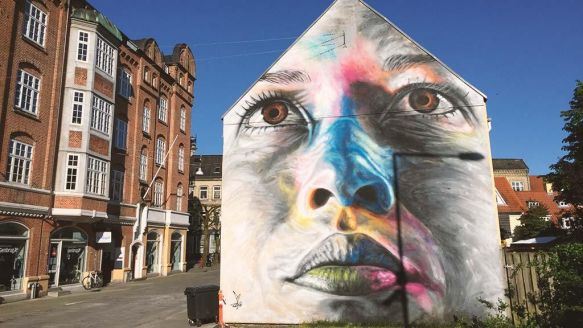
Street art in Aalborg
Aalborg is perhaps best known to many for its nightlife. But the town is no less exciting by day, when it offers an abundance of culture, colors, shapes and sensuousness.
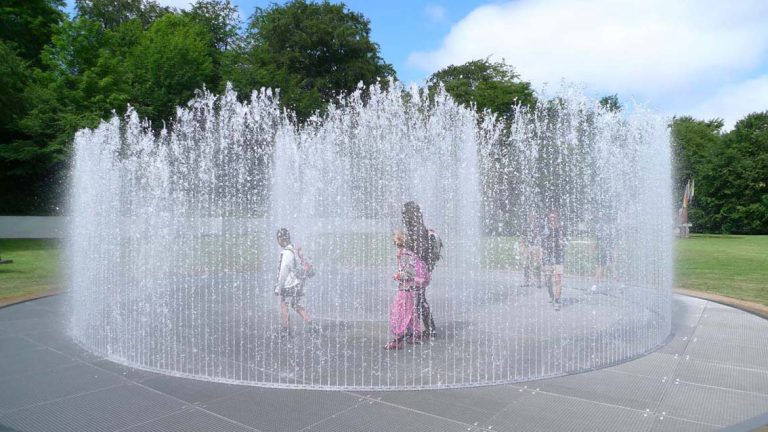
Feature image (on top): Water pavilion in Aalborg by Jeppe Hein
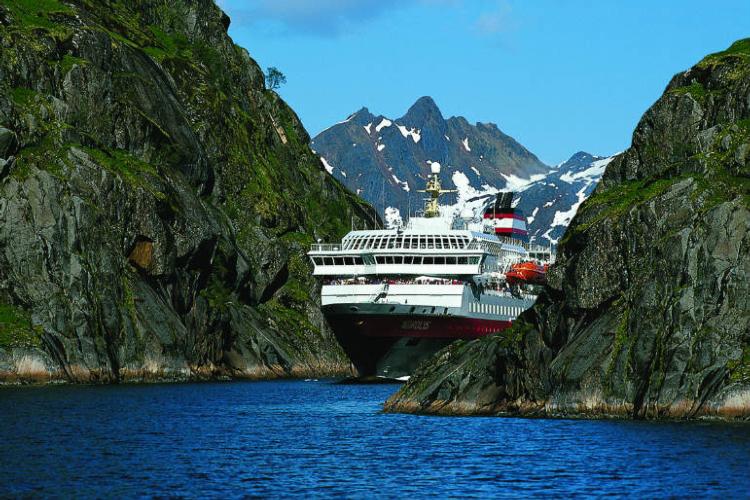
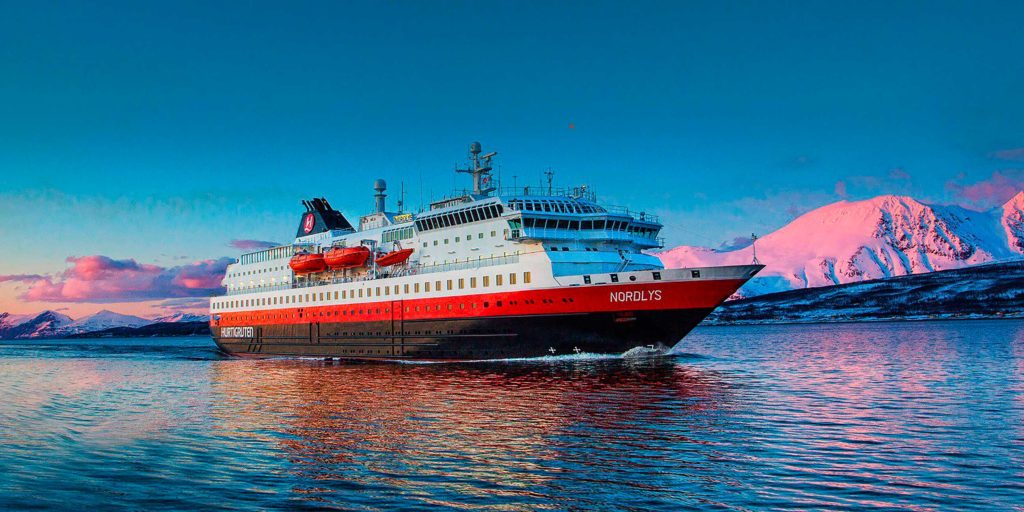
Large cruise ships ply the 2,000-km (1,250-mi) voyage between Bergen and Kirkenes in Norway, but for sheer intimacy it’s difficult to beat the more informal service offered by the ‘postal’ ships that serve outlying coastal communities. Cruising coastal Norway with a ‘postal’ ship is the ultimate way to have a taste of Norway.
This odyssey takes you around Norway’s breathtakingly beautiful fjord coastline, stopping over thirty times and showing you a side of Norway inaccessible by any other means of transport.
This odyssey takes you around Norway’s breathtakingly beautiful fjord coastline, stopping over thirty times
The journey begins in Bergen
The journey begins in Bergen, a harbor town founded by the Vikings almost a millennium ago, when it quickly became a vital hub, handling trade between Northern Europe and the British Isles. As you leave the port, the splendid 14th-century gabled buildings of the seafront slowly dwindle to nothing and your eyes are drawn to the wonderfully rugged coastline.
Hurtigruten MS Nordlys
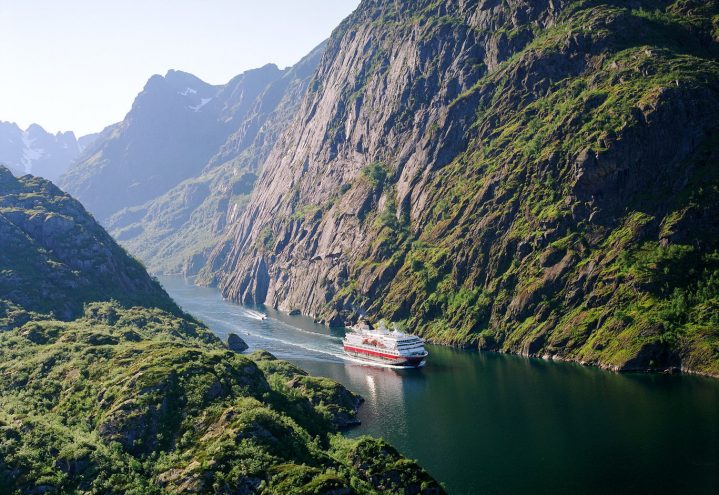
Along the way you will see glorious fjords, precipitous mountains and quaint fishing villages before crossing the Arctic Circle. Here, as you approach the North Cape, you will experience the midnight sun in summer. Winter offers chance to see the Northern Lights – the ultimate light show.
The voyage is showing you a side of Norway inaccessible by any other means of transport
Cruising coastal Norway with a ‘postal’ ship
For much of the journey all eyes are fixed on the starboard side, where snow-capped mountains and fjords abound. This is until the vessel meanders between the Lofoten islands whose stark, craggy beauty hits you from both sides.
Passing the Arctic Circle
The trip gives you a true appreciation of this beautiful country and how most of its population clings to the coast. When you cross the Arctic Circle, the population becomes more thinly spread and the scenery ever more dramatic. The awe-inspiring Laksefjorden and Tanafjorden lie ahead, before the vessel reaches its final destination, the sheltered port of Kirkenes.
All photos: Hurtigruten
Cruising Costal Norway with a ‘Postal’ Ship, written by Tor Kjolberg
Since the beginning of her illustrious career, Swedish Liselott Watkins as dedicated herself to documenting “all the shades of women” in various media and different art forms. But it all began as a 25-year venture as a fashion illustrator. The Swedish illustrator has been documenting women all ger career.
Watkins is a catalyst for the female spirit and lives in the spirit of solidarity of women worldwide. She has immortalized figures of defiance, melancholy, assurance and vulnerability in glossy magazines like the New York Times, Vanity Fair, Harper’s Bazaar and Vogue.
Liselott Watkins is a catalyst for the female spirit and lives in the spirit of solidarity of women worldwide
Swedish illustrator documenting women
Her portraits are as unexpected as her most important material and instrument, and her defiant, backward-leaning women have lived on beyond most collections and trends. Her dreamed ip stylish, hard-edged characters convey both a steely confidence and the kind of nonchalance young girls always seem to be after.
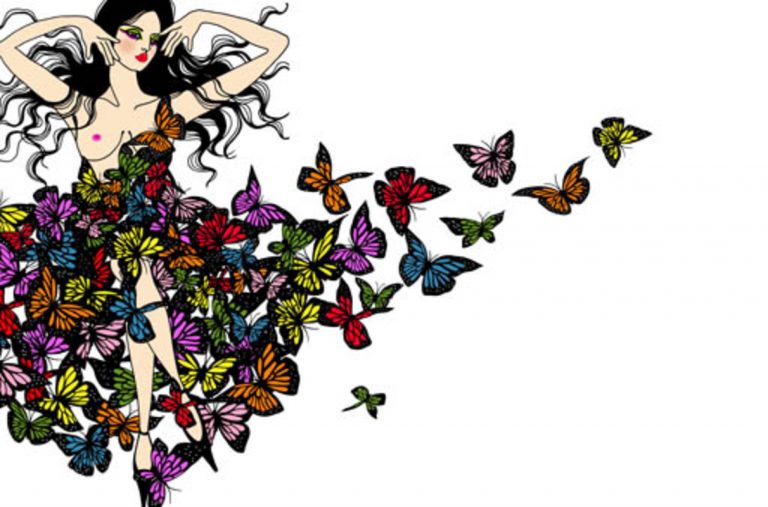
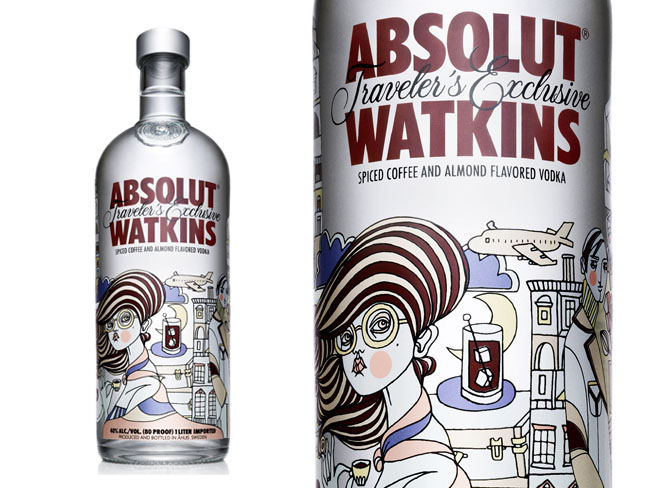
Afrochick by Liselott WatkinsAbsolut Watkins
From pen and ink she tells the stories of the supposed frivolity of fashion, colored with a with that can conjure living, breathing persons. For the past years she has even been dreaming up a world outside the lines, creating an army of earthenware women by hijacking antique ceramics and using her hallmark clipped collages.
Watkins’ defiant, backward-leaning women have lived on beyond most collections and trends
The power of women as individuals
Living and working anywhere else but her homeland throughout her career, Watkins has been negotiating the power of women as individuals whose fortitude flourishes in numbers—separate souls enriched by a sense of supportive community. It’s a notion that entered her consciousness through steady exposure to culture shock.
A fashion illistration by Liselott Watkins
Liselott Watkins grew up in the countryside about two hours outside Stockholm. When she turned 17 she moved to Texas and went to art school. “From there, I went to New York, where I lived for a while; for a long time, I felt that particular sort of New York loneliness that seemed to be helped by drawing these girls. In a way, I tried to channel their sureness. It was like therapy,” she says.
A Liselott Watkins illustration for Glutton for LifeA Liselott Watkins illustration for Prada
Now she lives in Rome with her husband and two children. “This is such a female-driven society,” she says wrestling with the gender imbalance of her adopted country. “The Swedish me asks, ‘Why are these women everywhere, doing everything? Where are the men?’ But then, the whole matriarchy—helping each other, perhaps because you don’t think men are going to be there—it’s so beautiful in a way, because it’s so supportive.”
Swedish Illustrator Documenting Women, written by Tor Kjolberg
Norwegian actress Amrita Acharia of Nepalese-Ukrainian origins was born in Oslo and is best known for her roles in Game of Thrones, the ITV series The Good Karma Hospital and the Norwegian film I am Yours which landed her a nomination for Best Actress at the Norwegian Amanda Awards. Now the Norwegian actress is fully occupied by the medical drama Good Karma Hospital.
Amrita was born in 1990 to Nepalese Dr. Acharya and a Ukrainian mother, and moved to England with her parents when she was six years old and they later relocated to Norway. Thanks to her international upbringing, she speaks Nepali, Ukrainian, Russian, English, and Norwegian.
Amrita was born in 1990 to Nepalese Dr. Acharya and a Ukrainian mother, and moved to England with her parents when she was six years old
Promotion visit to Johannesburg
The brunette beauty has recently been working in Johannesburg to promote the second season of the show, in which she acts as Dr. Ruby Walker. “As an actor, it’s about making sure that you give your editors and directors options or take the direction you are given, and that you don’t just stick to one way of doing things during takes. Similarly you need to find a way to replicate takes and be able to find that moment again. This is where your personal process needs to be something that you can hold on to,” she said when visiting acting students in Johannesburg.
The feel-good series is based on creator and writer Dan Sefton’s experiences as a doctor in South Africa.
Norwegian actress in medical drama
However, the show is filmed in Sri Lanka and for the first season a crew from Cape Town worked on the production. The series follows a group of hard-working doctors in an under-funded hospital in tropical South India. Junior doctor Ruby hopes to distract herself from heartbreak and find a job in India. The show has been renewed for a third season which will start filming later this year.
The brunette beauty has recently been working in Johannesburg to promote the second season of the show
What makes the show so universally appealing is probably that it has a unique backdrop of India. While the show has some similarities with other shows such as Grey’s Anatomy, the difference is that it is nuanced with the social economical structure in India and everything else that comes with that society.
The Norwegian film ‘I am Yours’ landed her a nomination for Best Actress at the Norwegian Amanda Awards
Busy with philanthropic work
As well as being a talented actress, Amrita is also busy with philanthropic work. She’s previously taken part in the London Marathon raising money for a school back in Nepal that was affected by the 2015 earthquake.
Norwegian Actress In Medical Drama, written by Tor Kjolberg
Bartender Eguene Shashin from the first underground cocktail bar Korobok in Moscow paid a visit to Himkok in Oslo last week-end. Himkok is considered one of the twenty best bars in the world (latest rating). The Moscow Underground Bar Met World Acclaimed Bar Himkok in Oslo 24 – 27 August.
Both bars have definitely lived up to their expectations. In a way they are doing for cocktails what the two capitals’ Michelin starred restaurants have done for cooking. Eugene Shasin is considered Russia’s best barman according to Diageo Reserve World Class.
Eugene Shasin is considered Russia’s best barman according to Diageo Reserve World Class
Moscow Underground Bar Meets World Acclaimed Bar in Oslo
In addition to world famous traditional cocktails, Shasin served signature cocktails where guests could witness only 30 percent of the working process. The other 70 percent were hidden and a well- kept secret, the same way he does it at home in his Moscow bar. Kokobok cocktail bar is a part of the famed White Rabbit Family.
Acclaimed Himkok in Oslo Since opening in 2015, Himkok has developed and matured: From being on the Top 50 list, today the place has found its true identity as a Norwegian cocktail joint and climbed to position no. 20. Not Nordic – Norwegian, as co-owner and general manager Yunus Yildiz is quick to point out. Its Flavors of Norway menu is a celebration of the Norwegian craft and a tribute to the ingredients, producers and farmers of this country. Cocktails based around unique Norwegian flavors include cloudberries, seaweed, birch and even the caramelized milk cheese known as ‘brunost’.
World’s best bars
With a bar among the best in the world, Oslo joins a short and exclusive list; the only other cities with bars in the top 20 are London (6), New York (4), Singapore (2), Paris (2), Athens, Shanghai, Tokyo, Mexico City and Miami. At the top of the list is American Bar in London.
Moscow Underground Bar Meets World Acclaimed Bar in Oslo, written by Tor Kjolberg