The Lyse Road in Norway was constructed as a service route for a hydro-electricity station, but that bland description reveals nothing of the experience the road has to offer.
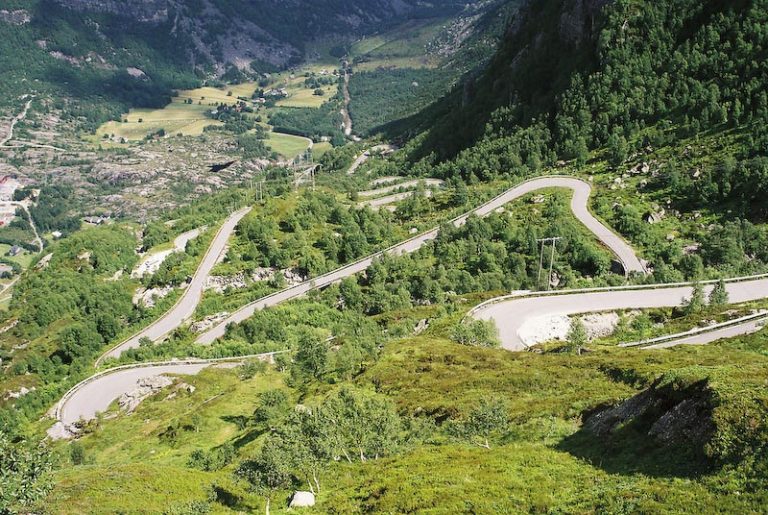
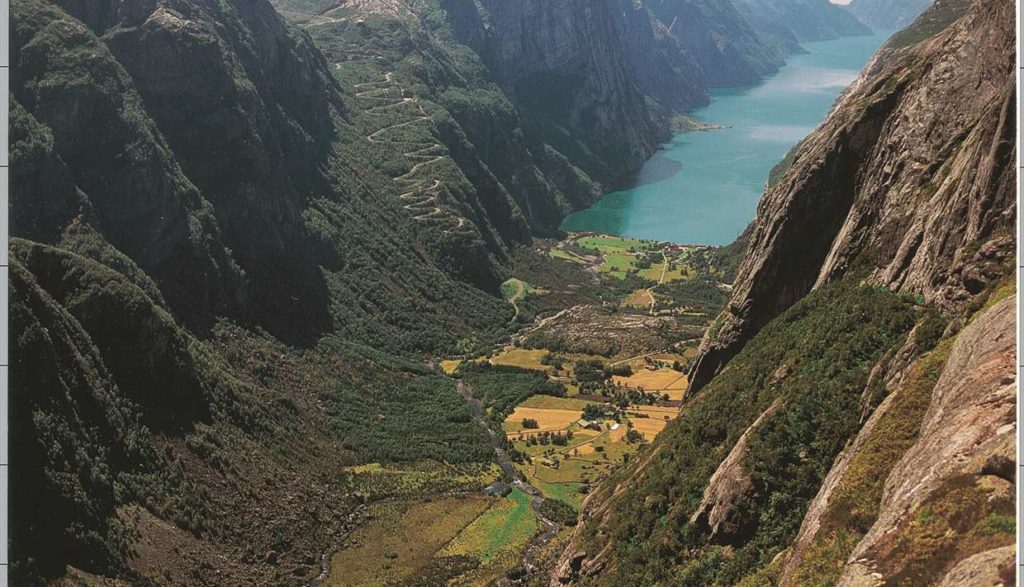
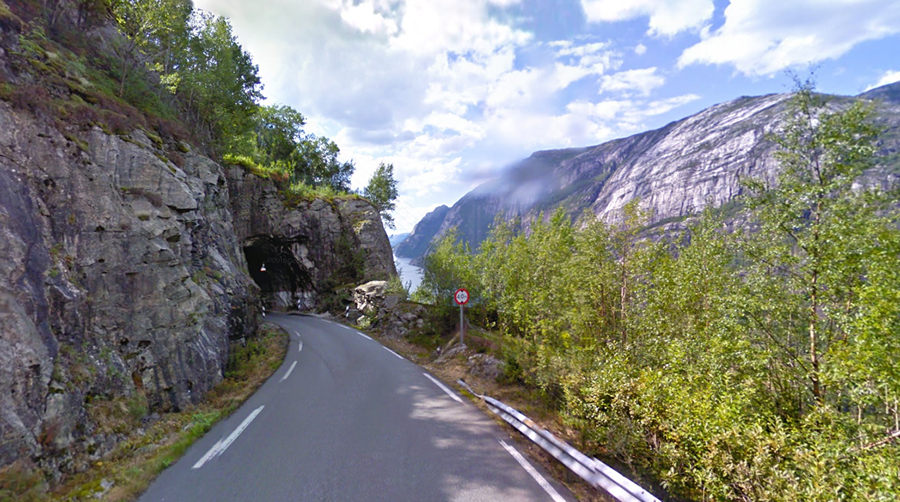
The Lyse Road in Norway twists and sweeps, clinging precariously to the side of a mountain that rises out of one of Norway’s most beautiful fjords, making it the ultimate challenge to your driving skills and rush like no other.
Lyseborn, Norway
The Lyse Road in Norway Built in the 1980s, the 44-km (27-mil) long Lyse Road stands as the critical test for those who have a zest for driving on mountain roads. All along the magnificent mountains on one side and the shimmering darkness of Lysefjord on the other, this really is like a scene from a car advertisement.
Viewed from above it would seem as if someone had thrown a giant sidewinder onto the edge of a mountain. With 27 hairpin bends, the Lyse is the ultimate brake-tester. The views are always amazing, if at times a little disorienting, and the relative shallowness of parts of the fjord produces the most wonderful light.
Stop and enjoy the views
There are a few places where you can stop and it is advised to do so, if only for the sake of the driver, who should be concentrating in the road that he/she will have a little chance to enjoy the stunning scenery.
Consideration for other users of the road must be a priority on this often single-lane highway, but this is a top rate scuttle if you get a clear run. The drive takes one to two hours. The road is closed in winter, roughly between November and April.
The Lyse Road in Norway twists and sweeps, clinging precariously to the side of a mountain that rises out of one of Norway’s most beautiful fjords
Highlights
The hike to Pulpit Rock, with its views high above the fjord is one of the highlights. Another is the view of the road from Øygardsstølen. Don’t miss the Tjordal hydroelectric power station, the reason for the road’s existence or the charming little town of Lysebotn.
Pulpit Rock is one of the highligts on the Lyse Road.
Speed limits are rigorously enforced in Norway, so if you are tempted to speed, don’t. This road demands the utmost respect and fines can be as steep as the road itself.
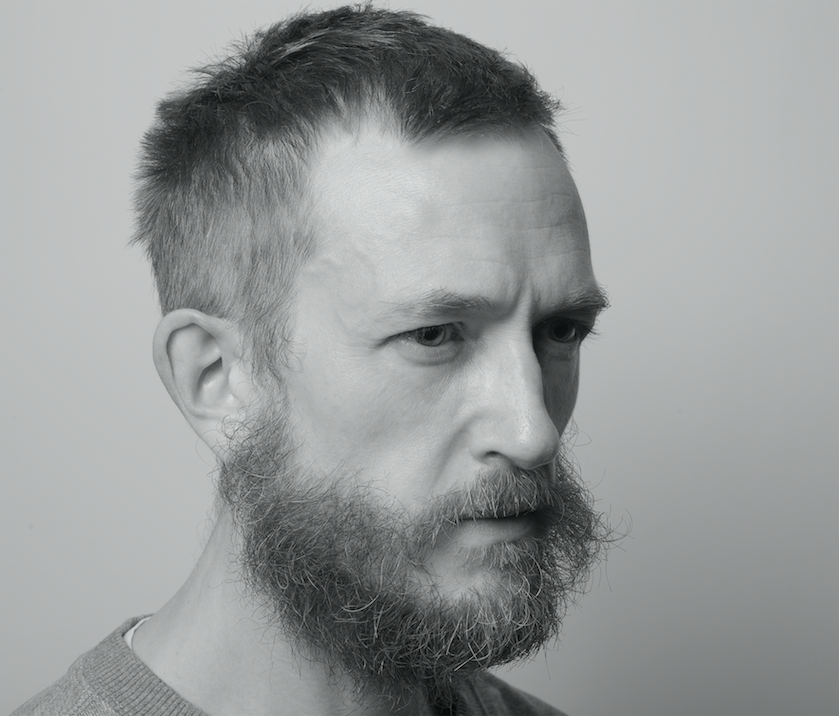
Multi-artist Kim Hiorthøy has left his mark on the creative Norway in more fields than you’d ever imagine – he is a graphic designer, a cinematographer as well as a musician. Hiorthøy is the youngest artist ever to receive the Klassikerpris (Visuelt’s Lifetime Acheievement Award).Visuelt is Grafill’s annual design festival. The Weird Beats of Multi-talented Norwegian Artist Kim Hiorthøy can be experienced in multiple creative fields.
Hiorthøy began making music while attending the Trondheim Academy of Fine Art; he worked in the academy’s sound studio until he left school and purchased his own equipment. After various “collaborations and accidents”, his music was eventually introduced to Joakim Haugland of the Smalltown Supersound record label. Haugland asked Hiorthøy to work with the label, and in 2001 Hiorthøy released his debut album, “Hei”.
Hiorthøy began making music while attending the Trondheim Academy of Fine Art
In his music, Kim Hiorthøy mixes everything from folk, free-jazz, lo-fi electronics, and acid house to instrumental hip-hop and field recordings. His album Dogs (2014)is a beautiful, minimal departure and consists mostly of piano and ambient noise, with occasional interjections of electronic beats and synths.
The Weird Beats of Multi-talented Norwegian Artist Kim Hiorthøy Hiorthøy’s musical style is difficult to classify. The Smalltown Supersound website offers the following description: “On his records Kim Hiorthøy combines weird beats, lo-fi/leftfield electronics, field recordings, electro-acoustic sounds and samples, resulting in a sound all his own.”
On the album Dogs, Hiorthøy has stripped everything down to a minimum, and gone to the core of his characteristic sound. The album consists of mostly just piano and ambiance, with some beats, and on some tracks the occational synth. Dogs is his purest and most beautiful album.
Hiorthoy himself cites Jan Johansson as an inspiration but says that for him the music on this album is still anchored in early hip hop, sample-based music (though there are no samples on Dogs).
Hiorthøy is represented by Oslo-based art gallery Standard
The graphic design of Kim Hiorthøy
While exploring music at the Trondheim Academy of Fine Art, Hiorthøy simultaneously began his work in graphic design. He started to publish fanzines and design record sleeves for local bands, and as time passed, he began to work more seriously in a variety of creative mediums. Hiorthøy is the definition of the multi creative, his CV is proof of someone who’s never settled and always strived to create something new.
Kim Hiorthøy, author and film director
In 2002 he debuted as an author with Du kan ikke svikte din beste venn og bli god til å synge samtidig (You cannot let your best friend down and become good at singing simultaneously) . Hiorthøy is represented by Oslo-based art gallery Standard and he has worked as a film photographer on multiple films by filmmaker Margareth Olin. One of his latest work was his directorial debut with the feature film The Rules for Everything (2017).
As time passed, Hiorthøy began to work more seriously in a variety of creative mediums
Kim Hiorthøy
Hiorthøy was born and raised in Trondheim, Norway, and studied at the Trondheim Academy of Fine Art (1991–96) as well as the Royal Danish Academy of Fine Arts in Copenhagen (1999–2000). During his tenure at the Trondheim Academy of Fine Art, Hiorthøy spent a year abroad in 1994 to attend the School of Visual Arts in New York. There he worked extensively with Cinematographer Mott Hupfel. Currently, he lives and works in Berlin, Germany. A fictionalized version of Hiorthøy is a character in an Erlend Loe novel.
The Weird Beats of Multi-talented Norwegian Artist Kim Hiorthøy, written by Tor Kjolberg
More than 130 miles above the Arctic Circle in Sweden, at Riksgränsen (on the border of Sweden and Norway) the skiing is never over until the midnight sun finally droops below the horizon. Skiing all summer long is indeed possible in Scandinavia.
Putting on your skis in Northern Sweden in June, July and August more than makes up for the unchallenging slopes and the disorientating 24-hour daylight. You are afforded plenty of time to enjoy a slice of winter and satisfy your summer wanderlust.
Cross-country skiing at the Riksgränsen, the border between Norway and Sweden
Taking into the slopes
The Ice Hotel, a small ski resort 94 miles away, has now melted and won’t reopen until late autumn, but the residents of Riksgränsen are still pushing their boots into their ski bindings, picking up their poles and taking to the slopes.
Riksgransen shot to fame in the mid 90s when Ingemar Backman launched his infamous method there, but its remoteness and lack of park facilities have ensured that over recent years, it has been largely overlooked in favour of central European glaciers.
You are afforded plenty of time to enjoy a slice of winter and satisfy your summer wanderlust at Riksgränsen between Norway and Sweden
Skiing All Summer Longin Scandinavia
“It’s become a bit of a legendary place for the Swedes,” explains Torkel Karoliussen, a champion Norwegian Telemark skier who has visited Riksgransen more than a dozen times. “The season doesn’t really start until March, and it’s best in May, and you can ski under the midnight sun in June.”
Little has changed in the surrounding countryside over the centuries. The region is still highly populated by the Sami community, an indigenous people whose main income derives from reindeer farming: it’s thought they own 100,000 reindeer in the area. It is also rich in mountain wildlife, with foxes, brown bear, lynx and hunting wolverine stalking the mountains.
The region is still highly populated by the Sami community, an indigenous people whose main income derives from reindeer farming
More information
A good Web site for train information and reservations from Sweden is Snälltoget Bus transfer details on the Swedish side: www.ltnbd.se. For trains from Norway: NSB.
Skiing All Summer Long in Scandinavia, compiled by Tor Kjolberg
Not only is India the world’s largest democracy and a vast, beautiful and exciting country. It also has 330 million middle-class citizens with a huge buying power. That is a little less than half of the total European population, so India will be a major player in international issues in the years to come. Add to that that the Indian economy is estimated to be the third largest in the world by 2020. Indian middle-class citizens want to explore the world and Indian tourists are now looking to Scandinavia.
Mohit Batra, India Representative, Scandinavian Tourist Board confirmes that Indian tourist arrival in Scandinavia is expected to reach 50,000. “A tremendous growth in the number of Indians travelling to Denmark, Norway, and Sweden. The visa application to the Scandinavian countries is likely to be upward of 60,000 and on an average three-room nights spent in Denmark, five in Norway and three-four in Sweden.
K V Singh is co-owner of Hotel Mahal Khandela in Jaipur and CEO of Indian Heritage and Culture Tours
We have asked K V Singh, co-owner of Hotel Mahal Khandela in Jaipur and CEO of India Heritage and Culture Tours, what Indian visitors to Scandinavia would appreciate the most.
Why is Scandinavia so exciting for people in India, Mr. Singh?
“Indians in the age group of 25-45 want to go on cruises, they love adventure and sight-seeing, not to forget the honeymooners,” says K V Singh. “Those with children will love to take them to places where kids can have fun, Disneyland-style!” he adds.
That’s a great answer to a Scandinavian. Let’s start with cruises and explorations.
Cruising Norwegian fjords
Cruises
Visitors to Oslo, the capital of Norway should indeed enjoy at least one or two day-cruises on the Oslo fjord. Saturdays and Sundays during the Summer months, Ruter (a common management company for public transport in Oslo) offers three daily sailings, 10.05 pm, 01.05 am and 4.35 am from the Town Hall Pier in Oslo.
The 16-hour sailings between the Danish capital Copenhagen and Oslo, operated by DFDS Seaways, leave at 5 pm and arrive at 9:30 am the next day. So, you can spend seven hours in Norway’s capital and then return to Copenhagen, or take this cruise from Oslo and do Copenhagen as a day trip – or just go one-way in either direction.
Cruising through the Swedish heartland is another beautiful experience not to be missed. This four-day cruise among 100,000 of Sweden’s lake district is a highlight for boat lovers and those who fancy the chance to see Sweden at the romantic pace of times gone by.
Stockholm, the capital of Sweden
Sightseeing
The many choices of sightseeing in Scandinavia are too many to be mentioned here, but to give you a hint, Scandinavian places in a nutshell might be a teaser to what may be expected when visiting Scandinavia.
Tivoli Gardens, Copenhagen
Amusement parks For those traveling with children, Scandinavia is simply a paradise. Family fun is important for Scandinavians, and here we present our bucket list:
Scandinavians are more and more concerned about vegetarian food.
Veggie Mania in Scandinavia
“A large number of Indians are vegetarian and look for Indian restaurants. Visits to museums to my mind are not their top priorities! Beef is of course taboo,” says K V Singh.
There are hundreds of Indian restaurants spread throughout Scandinavia, not to mention vegetarian eateries, so Indian visitors should feel very much at home here. Just let’s give you a few examples:
“Children addicted to fast food and colas. Most Indian men enjoy beer.”
Try the real beer of the Vikings, mjød
Fast food and beer
Fast food are also found all over Scandinavia, so children should not at all suffer. And men should indeed visit some of the many mini breweries popping up all over Scandinavia. Scandinavian beer is world famous – Nordic men are beer lovers too!
How do we best treat our Indian visitors, Mr. Singh?
“Married Indian women are not the sporting kind and would like to avoid extreme sports or activities. Indian women are fond of shopping. Indians are boisterous and sometime rowdy but make friends easily. A few words of Hindi such as Namaste and they will eat out of your hands.”
Well, let us end this short overview with a few hints on shopping in Scandinavia:
Be aware that the above information is just some samples of what Scandinavia has to offer. Daily Scandinavian offers daily new updates and our new website INNOvision will soon be up and running. In addition, Indiaheritageandculturetours is your one stop information source for personalized tours and experiences throughout India and neighboring countries.
Indian Tourists are Looking to Scandinavia is a coproduction of K V Singh and Tor Kjolberg
Celebrated Danish Teddy Kristiansen was already in childhood inspired to be one of the world’s greatest illustrators. When he came across an article about a comic book artist, he made his career choice. He studied for half a year at Ulrik Hoff’s School of Drawing and Painting, but otherwise he is self-taught. The Danish comic book illustrator has cooperated with celebrated artists.
He made his debut in 1986, with a comic in the magazine Kulørte Sider (Pulp Pages). His first album was ‘Superman og Fredsbomben’ (‘Superman and the Peace Bomb’), the first official ‘Superman’ story produced entirely outside the USA, in 1990.
The Danish Comic Book Illustrator is telling rich stories
Then he started to read other types of literature that was a little more challenging and started to think that he should do a comic book telling a rich story like when you are reading a novel, and that’s exactly what he has been doing.
In 1992 he produced in collaboration with Peter Snejbjerg an 18-page painted story for Tarzan: Love, Lies and the Lost City. Collaborating with celebrated writers like Steven T. Seagle, James Robinson and Neil Gaiman, Teddy consistently produced books that are both beautiful and thought-provoking. He went on to paint the Eisner Award-winning Superman graphic novel, It’s a Bird (2004), a poignant, personal tale masterfully rendered in the artist’s watercolors.
Award-winning books Teddy Kristiansen was nominated for the American Eisner Award (The Oscar of the comic book world) for his book Red Diary, which was an English translation of his originally Danish graphic novel, that was published by Image Comics as a flip-novel in 2012.
Though Kristiansen’s style is often characterized by angular, elongated characters, he possesses an amazingly broad range, perhaps best illustrated in his work for Sandman Midnight Theatre.
For the Danish market, Kristiansen has produced graphic novels, such as ‘Olafur Kjartanson’s Journals of the Secret Scriptures’ (2010) and ‘Heisenberg Revisted’ (2011) with writer Oscar K.
The Eisner Award
The Will Eisner Comic Industry Awards, commonly shortened to the Eisner Awards, are prizes given for creative achievement in American. They are named in honor of the pioneering writer and artist Will Eisner, who was a regular participant in the award ceremony until his death in 2005. The Eisner Awards include the Comic Industry’s Hall of Fame.
The Danish Comic Book Illustrator, written by Tor Kjolberg
Norway’s national brown cheese (brunost) harks back to its days as a poor country, with a focus on preserving fish and meats in salt, lots of potatoes and simple sauces.Brunost is primarily produced and consumed in Norway. It is regarded as one of the country’s most iconic foodstuffs, and is considered an important part of Norwegian gastronomical and cultural identity and heritage. But what is Norwegian brown cheese?
Norwegian brown cheese got international attention in 2013 when a consignment of 27 tons was spread in a road tunnel beyond the county of Nordland and caught fire. Kjell Bjorn Vinje of the public roads’ administration said: “I didn’t know that brown cheese burns so well.”
Brown cheese on crisp bread
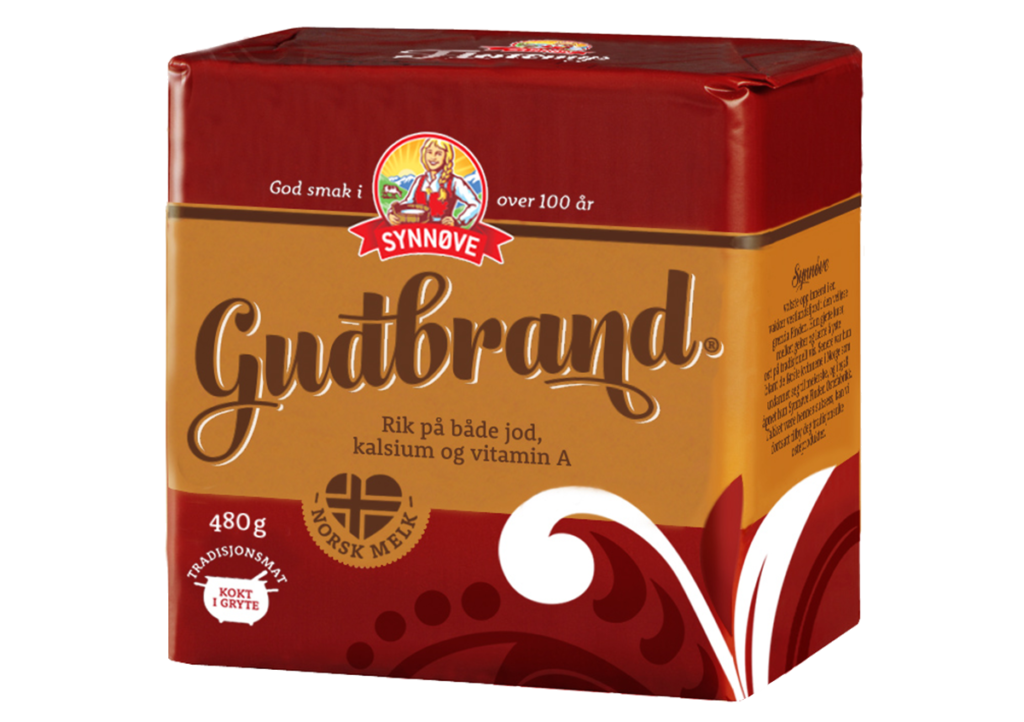
However, one of Norway’s best loved culinary treats is also one of its simplest. It is often used to just refer to the Gudbrandsdalsost (Gudbrandsdal Cheese), which is the most popular variety. The cheese is tan-colored with a distinctive caramel flavor.
Brown sauce is also used as an ingredient in cooking, particularly in sauces for game meat.
But what is Norwegian brown cheese and how is it eaten?
The creation of the modern, firm, fatty brunost is commonly attributed to the milkmaid Anne Hov from the rural valley of Gudbrandsdalen. In the second half of the 1800s, Gudbrandsdalen was suffering economically due to falling profits from grain and butter sales.
While working at the Valseter mountain farm near Gålå in 1863, Anne Hov (sometimes named Anne Haav) came up with the idea of adding cream to the whey when boiling, and to boil it down in an iron pot until the fluid content was reduced to less than 80 percent, creating a firmer, fattier, more cheese-like product. She originally called it feitost (“fat cheese”). The name later changed into fløtemysost (“cream whey cheese”). The product immediately caught on, and was soon commonly produced and consumed in the area. This variety is currently the second most popular type in Norway. (Wikipedia)
The brown cheese is tan-colored with a distinctive caramel flavor.
Larger-scale production
When Hov married and moved to Rusthågå farm in Nord-Fron, she started larger-scale production and invented a variety where she added goat’s milk to the mix for a more pronounced taste. The local trader Ole Kongsli liked it so much he thought there might be a market for the product in the capital, Oslo. The cheese is set into small blocks most commonly of around 500 grams, wrapped and can be eaten and enjoyed immediately.
The creation of the modern, firm, fatty brunost is commonly attributed to the milkmaid Anne Hov from the rural valley of Gudbrandsdalen
In 1933, aged 87, Hov received the King’s Medal of Merit (Kongens fortjenstmedalje) for her contributions to Norwegian cuisine and economy. In modern times, most brown cheese is mainly produced by the national dairy TINE, although many regional variations exist. Every Norwegian seems to have a favorite. TINE market a total of 13 varieties while the second-largest is Norwegian dairy company Synnøve Finden, market two varieties of brunost. There are also a number of smaller, artisanal producers, mainly in Norway and in the US.
Serving brunost
The texture is firm, but slightly softer than Gouda cheese, for example, and lends itself well to cutting and shaping. It does not crumble like hard cheeses. It’s fair to say brunost hasn’t a huge fanbase outside Norway and it can be a challenge to non-Norwegians.
The most common way to serve brunost is by using the unique cheese slicer, invented by the Norwegian carpenter Thor Bjørklund in 1925. This item is an integral part of any Norwegian kitchen. You slice off a slither from the block and can eat it atop toast, on a crispbread topped with strawberry jam, or even with waffles. It is also used as an ingredient in cooking, particularly in sauces for game meat.
Waffles and brown cheese
Like any intensely flavored ingredient in a cook’s larder, brown cheese is endlessly versatile. A typical Norwegian dish is finnbiff or venison stew: brown cheese is the secret ingredient that adds both depth of flavour and richness to the sauce.
Usage and taste
Brown cheese is very common in the traditional Norwegian matpakke (literally “food pack”), which is a common Norwegian lunch—sandwiches are packed in a lunch box in the morning, and carried to work for consumption in the 30 minute lunch break commonly afforded to Norwegian workers. One advantage of brunost for this purpose is that although its texture changes if not refrigerated, its taste does not.
The taste is a difficult to describe, you just have to try it. An attempt to describe the taste might be as a deeply savory dulce de leche. The sweetness comes from overcooking whey until a Maillard reaction kicks in and the milk sugars caramelize. Brown cheese doesn’t go through any maturation process, and it keeps in the fridge for a few months.
What is Norwegian Brown Cheese? Written by Tor Kjolberg
Planning a visit to northern Sweden? Then modern and airy Bistro Norrland is definitely worth a try.
Sitting in the modern harbor in Luleå, it is right on the waterfront. Head Chef Brian Landry is in charge of the creative work in the kitchen and visitors can try the bistro’s exciting menu that combines local produce and traditional Scandinavian dishes with a contemporary twist. The delicious dishes at Bistro Norrland, Sweden combine passion, rustic finesse and modern culinary innovation to excellent effect.
Bistro Norrland, Sweden combine passion, rustic finesse and modern culinary innovation to excellent effect
Bistro Norrland, Sweden
Service is friendly and precise, and under the command of the house sommelier guests will receive recommendations on which drink will compliment your meal perfectly. Sit at the illuminated bar with a local beer or cocktail, such as White Lady, made from gin, citron and Cointreau, or a Rum Daisy, made from light rum, lime juice and pomegranate. The bar also offers more casual seating if you’re dining alone.
Enjoy traditional Scandinavian dishes with a contemporary twist
Don’t miss out on Kalixlöjrom, local olden roe, with a glass of bubbly, or the reindeer off the grill, as well as sweet treats to finish off your meal.
For the Norwegian high-end shoemaker Faust, architecture studio Snøhetta has created a complete visual identity and the brand’s very first signature store in Norway’s capital, Oslo. Meet a Norwegian high-end shoemaker with high-end interior
Architecture studio Snøhetta created not just the interiors of the store in Oslo’s modern, buzzy Barcode Project, but also the entire brand identity including web design and business cards, right down to a customized typeface that’s based on 17th-century manuscripts for the signage and business cards.
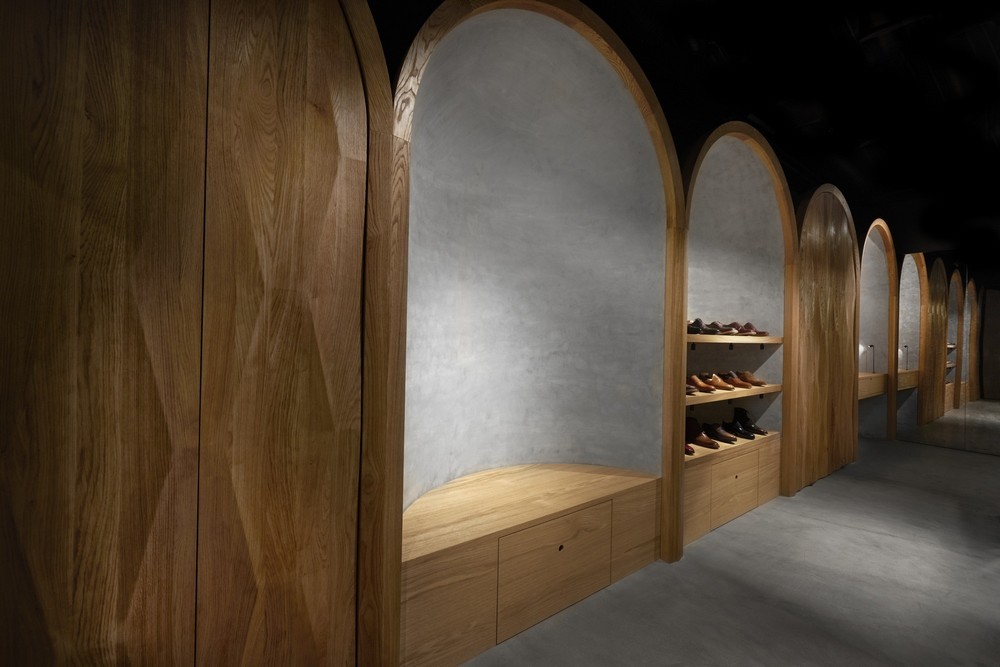
Architecture studio Snøhetta created not just the interiors of the store in Oslo’s modern, buzzy Barcode Project, but also the entire brand identity
Norwegian High-end Shoemaker with High-end Interior Faust founder Alvaro Miranda comes from a family of shoemakers. His aim is to continue the for centuries practically unchanged art of shoemaking, and create a personalized experience and a customized result by using a contemporary approach. His store offers both tailor-made shoes as well as handcrafted ready-made shoes.
The showstopper
The showstopper, though, is the interior. Snøhetta has created a space that is positively Gothic in its moody romanticism and sly homage to Goethe, and customers are invited to be part of shoemaking, from the measuring of the feet to the final sculpting and sewing.
Snøhetta has created a space that is positively Gothic in its moody romanticism and sly homage to Goethe
The art of shoemaking has remained practically unchanged for centuries, and Faust aims to continue the cordwainer’s tradition with a contemporary approach while honoring their time-tested methods. The artisanship is central in the design concept, striving to create a personalized experience and a customized result.
Almost religious architecture
The entire length of one wall is lined with five vaulted concrete niches interspersed with perfectly milled and oiled oak doors. The latter slide open to reveal shoe boxes and, literally, the tools of the trade – the instruments and leather swatches that transform feet patterns into lasts and, ultimately, finished shoes. The niches refer to a historic, almost religious architectural language, giving homage to the quality driven trade of shoemaking.
Online insight
Drawing the link back to today’s digital world, the Faust experience starts online. Snøhetta designed and developed in its entirety a simple yet elegant website that allows the customer to gain a greater insight into the process of shoemaking. Applying the custom typeface and selected colors also digitally gives Faust a holistic and consistent feel throughout its identity and brand.
“Now I take you into my keeping, a welcome, and silent guest.”
FaustNorwegian High-end Shoemaker with High-end Interior, written by Tor Kjolberg
Swedavia, a Swedish world leader in developing climate-smart airports, has won international recognition for its investment in bio aviation fuel. Last year, a delegation with representatives from organizations such as Singapore Airlines, the Civil Aviation Authority of Singapore and Changi Airport visited Sweden’s largest airport operator to learn more about the company’s work to reduce airport climate impact. So far there are five climate-smart airports in Sweden.
Swedavia has demonstrated how they are making the aviation industry more sustainable and reducing carbon footprint from flying at five Swedish airports, Stockholm Arlanda Airport, Gothenborg Landvetter Airport, Bromma Stockholm Airport, Visby Airport and Luleå Airport.
Visby airport, Sweden
The most climate-smart in the world
Visby Airport is now entirely fossil fuel free. Following years of focused work, which includes electrification of its vehicles, a switch in fuels and implementation of efficiency measures, the airport has now secured its position as one of the most climate-smart in the world.
The fuel is produced by World Energy in Los Angeles and supplied by SkyNRG and Shell through the Fly Green Fund. Since 2016, Swedavia gas bought bio aviation fuel each year corresponding to the fuel consumed by its employees on some 10,000 annual flights for business purposes. Bio aviation fuel is indeed key to the long-term sustainability of air travel, and Swedavia’s vision is for Swedish domestic air travel to be fossil-free by as early as 2030.
Gothenborg airport, Sweden
The Fly Green Fund is a Nordic initiative founded by SkyNRG, NISA and Karlstad Airport, that enables organizations and individuals to reduce their carbon emissions by flying on sustainable aviation fuel.
Climate-Smart Airports in Sweden
Swedavia’s investment in bio aviation fuel has been recognized internationally. Swedavia is reducing carbon emissions for all their business flights through the Fly Green Fund. With their support Swedavia is not only making their own air travel more sustainable but through their partnership in the Fly Green Fund, they are also supporting the development of local sustainable aviation fuel production.
The Fly Green Fund is a Nordic initiative founded by SkyNRG, NISA and Karlstad Airport
Aviation’s battle against climate change
Aviation’s battle against climate change is a two-pronged affair. On one hand you have aircraft emissions, contributing between 2 and 6 per cent of the world’s greenhouse gas pollution, depending who you speak to.
Swedavia has demonstrated how they are making the aviation industry more sustainable and reducing carbon footprint from flying at five Swedish airports last year
Then there is the impact of airports themselves, huge builds requiring massive amounts of energy all year round and occupied by fleets of fuel-hungry vehicles. The latter prong at least is one that Sweden’s Visby Airport can happily say it is doing the best it can to overcome.
Transport of the future
“Air travel needs to be part of the transport of the future and it must be sustainable. In the short term, biofuel is the solution that can provide the most benefit for the climate so investments in this are absolutely essential. With our forests as raw materials, we also have good opportunities for large-scale domestic production of biofuel. There is potential here for a new Swedish industrial sector and a showcase for the country,” said Jonas Abrahamsson, president and CEO of Swedavia in a press release.
All images: Swedavia
Climate-Smart Airports in Sweden, written by Tor Kjolberg
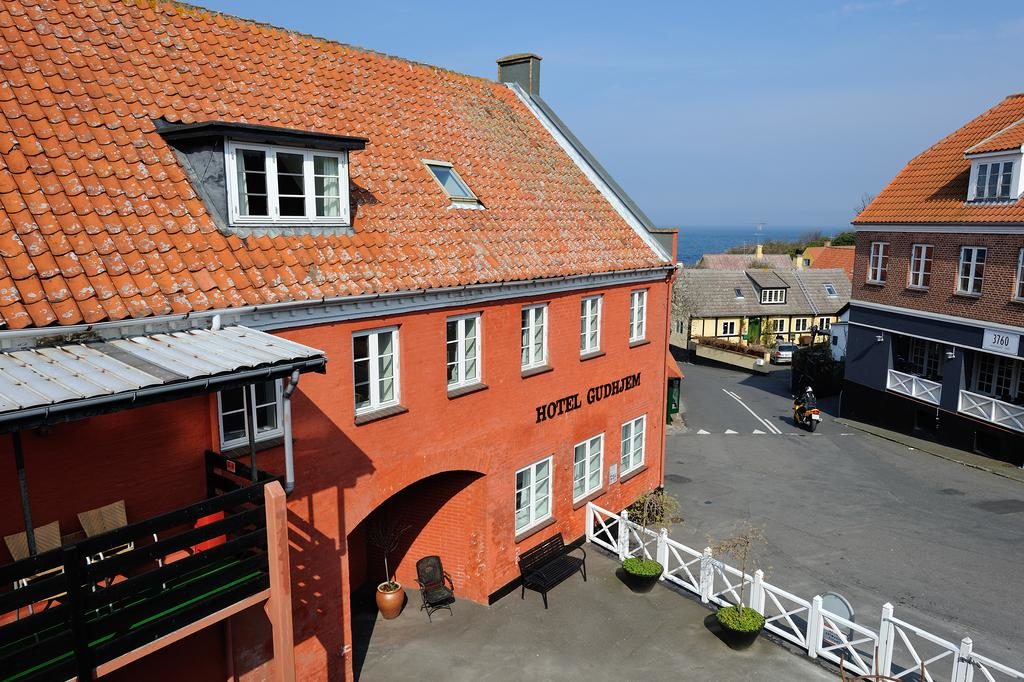
Gudhjem, meaning «God’s home», is a small fishing village on the coast of Bornholm, Denmark’s only rocky island in the Baltic. Find out how to enjoy the Sun over Danish Gudhjem.
Gudhjem has long been famous for its lovely small smokehouses and its amazing smoked herrings. You buy them directly from the huge, sooty chimneys, where the golden fish hang side by side in their thousands. They are a real delicacy, and well worth a detour if you are in Scandinavia.
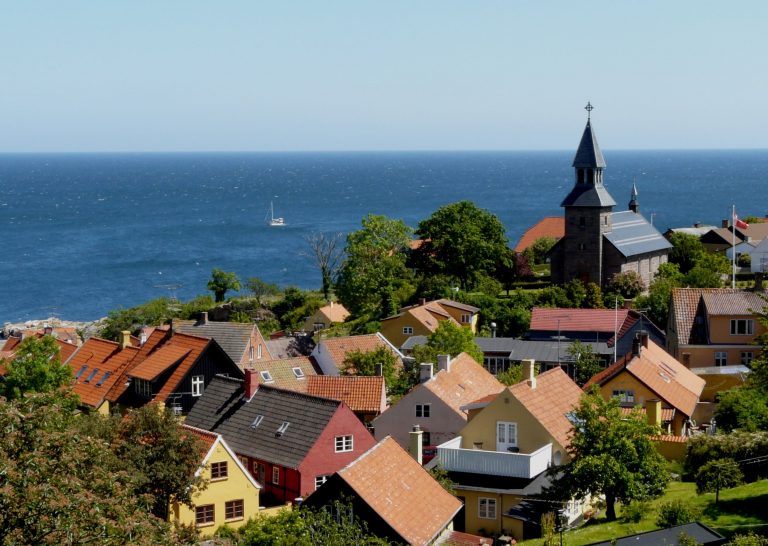
Gudhjem is Denmark’s only town upon a hill – built from the cliffs at sea level and up alongside the 48 m high hill Bokul
Assemble a sandwich on rye bread, with a whole peeled smoked herring (or a large piece of smoked mackerel), a few red onion rings, a couple of sliced radishes, lots of finely cut chives, and on top, as a rising sun, a raw egg yolk. And there you have it – the “Sun Over Gudhjem”.
Add coarse sea salt, black pepper, a cold beer and a sea view to the Baltic, and you will not find anything more authentically Nordic than this.
Sun Over Danish Gudhjem Gudhjem is Denmark’s only town upon a hill – built from the cliffs at sea level and up alongside the 48 m high hill Bokul. Try to climb on top of the Bokul – you’ll be rewarded with a breathtaking view from above: A view over the town, the red roofs, the harbor and the sea. Continue by crossing the road and walk into the exciting forest to the “secret” lake Gråmyr – with its red-white waterlilies. Here you have an almost healing silence and during late summer you can pick blueberries.
Holkadalen and the coffee castle in Gudhjem From up above the town you can almost dive into the beautiful Holkadal (Holka valley) with its high trees, where the locals met and celebrated in the old days. Follow the gravel road to the large building called Kaffeslottet (Coffee castle), which overlooks the city. Or you could follow the valley down to Gudhjem and discover the town, its small and crocked roads with the cliffs, beautiful nature and well-kept houses.
Salenebugten, Helligdomsklipperne, Art Museum There is a very unique nature along the coast, on both sides of Gudhjem. If you follow the coastal path along the Salenebugten (Salene bay) you have a beautiful view into Northern Bornholm – and even over to Sweden when the air is clear and the visibility high. Continue to the Helligdomsklipperne (Sanctuary cliffs) and Bornholms Kunstmuseum (Bornholms Art Museum). On the way back, you could take the boat M/S Thor, that sails back and forth between the Sanctuary Cliffs and Gudhjem.